Expect more heatwaves, fires, more storms and flooding than ever before. We misjudged how climate change is unfolding. Revisiting summer’s warning from Professor Anders Levermann in Potsdam. Plus why is air now unhealthy? A deep dive into deadly ozone at ground level with Dr. Laurence Rouil, Director of CAMS, the EU’s Copernicus Monitoring Service. You need to know.
Listen to or download this Radio Ecoshock show in CD Quality (57 MB) or Lo-Fi (14 MB)
CLIMATE FREE-FALL
ANDERS LEVERMANN
Lost among graphs of rising emissions and gradual warming: Earth’s fluid systems do not work like that. They can shift rapidly to a new state and never return. The biggest threat to civilization, and all species around us, is not war, AI, or disease. Our climate is nearing a point of “free-fall”. We may already be there.
Who makes these big claims? A lone blogger or niche radio host? The warning comes from one of the world’s most respected sources: Potsdam Institute for Climate Impact Research, known as PIK.
When I heard this, in the middle of wildfires across the Northern Hemisphere and a string of heat waves, I went straight to the leader, Professor Anders Levermann, Head Complexity Science research at Potsdam University.
That July 29 broadcast began “Humans are blowing up oil, gas and each other. The Northern Hemisphere breaks out in more record heat rashes. German scientist Anders Levermann warns we are entering a time of climate free-fall.”
Look I have a new interview for you this week, on a subject you won’t hear anywhere else. Did you know only five percent of humans have air that is safe to breathe? We take a deep dive into ground-level ozone with a serious expert, Laurence Rouil, Director of the EU’s Copernicus Atmosphere Monitoring Service (CAMS). Laurence Rouil played a pivotal role in setting up PREV’AIR, France’s national operational air quality forecasting and mapping platform. She’s gone on to bigger things, including launching the very first CAMS Atmosphere Watch – a new, flagship annual review launched September 30th. It features a new look at ozone, stay tuned for that.
With the stunning Levermann interview, being summer vacation time, with some stations on replays, less than half our normal audience heard this key interview. Now it is falling into the void, even as free-fall emerges in the real world. This will be new for a lot of you, and worth hearing again. We need to understand the biggest danger to the world.
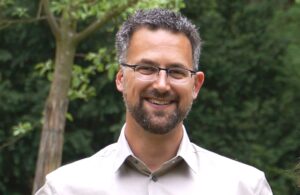
“Climate free-fall’: why the biggest risk to our economies is yet to be recognized”. That is the warning from climate scientist Anders Levermann. Dr. Levermann is Head of the research department of Complexity Science at Potsdam Institute for Climate Impact Research. He is also a Professor at the Physics Institute of Potsdam University.
Listen to or download this 20 minute interview with Anders Levermann in CD Quality or Lo-Fi
The Levermann article says:
“Increasing instability of the ocean, ice and atmosphere threatens farming, finance and society. We all need to wake up to that fact.”
Here is a key paragraph for all of us:
“Climate tipping, therefore, will manifest as a period of increasingly dramatic weather volatility, rather than a sharp shift in average conditions. A fluctuating climate will bring swings and crashes in crop yields, flash flooding and erratic storms. It will stress economies by disrupting supply chains and amplifying insurance losses. Societies are unprepared, because weather volatility related to tipping points is absent from risk assessments.”
THE CORE THREAT IS VOLATILITY, NOT JUST WARMING
Levermann told the German-language publication Der Standard Karin Krichmayr July 17, 2026): (Google translate)
“When we cross a tipping point, the system transitions into a different state. Some might think that the system then tips immediately. However, this tipping point develops over decades. This free fall is then irreversible and determines the next few decades. We therefore need to investigate what it means when the climate is in decline.
Decades can pass between exceeding a critical temperature threshold and the actual tipping point of a system. An ice sheet doesn’t disappear overnight. But once this process has begun, it develops a momentum of its own. The system starts to go haywire. We still know far too little about this transition phase. We will be in this intermediate phase for at least three generations. We need to understand what will happen to the weather during this time as we fall off the cliff edge. Some processes will extend over millennia, but the associated unpredictable weather extremes and, above all, fluctuations have immediate effects and can pose an enormous problem for the economy.”
Most of you are already living through climate volatility, with extreme events never seen before. Levermann argues this hits agriculture (food), financial markets (no predictability), supply chains and infrastructure. I would add harder-to-measure social pressures as well. For example, people get upset or depressed when a harsh heatwave suddenly turns into record-setting rain and floods. This is happening all over, from the Hudson Valley in New York State (a 1-in-1000 year rainfall last week) to Edmonton Alberta (unexpected very heavy rainfall popped up in hours). It is getting to us – and that too has economic and possibly political ramifications.
Read more about his interview here.
That was rebroadcast from Radio Ecoshock this past summer (July 29, 2026). The warning on climate free-fall – and our outdated ideas about what is happening in this big change – that warning needs to get out far and wide. Please repost the interview if you can, link to it, place comments and links in your travels on social media. The world needs to know.
SEE ALSO: Climate Free Fall: Scientists Warn of Hidden Economic Crisis, Earth’s Systems Become Dangerously Unstable Published On: July 18, 2026 By EARTH CLIMATE
========================
If you want more independent science reporting, please help support Radio Ecoshock. With AI short-circuiting searches and links, it is getting harder to find financial help these days. The program is just squeaking along thanks for a few monthly supporters and rare one-time donations. I refuse to plug this blog with advertising, and of course ads in the radio show are forbidden on our long list of non-profit radio stations. You are it. Please help.
– Alex
=========================
CALLING CALIFORNIA
Before we get to our guest from the EU atmosphere monitoring service, a few quick notes in this time of climate free-fall.
A shout-out to our California listeners. El Nino is delivering crazy storms as expected. Less expected was an atmospheric pile up called a “Kelvin Wave”. Add it up, and as Anthony Edwards, meteorologist for the San Francisco Chronicle says:
Bonkers: Sea levels are running 1.2ft above the late-20th century baseline in San Diego as sea surface temperatures are about 7°F warmer than normal. These highly anomalous ocean temperatures and heights will continue through winter along the California coast amid El Niño. #CAwx
— Anthony Edwards (@edwardsanthonyb.bsky.social) 2026-10-07T03:23:34.743Z
Also in California, Captain Paul Watson was presented with a Lifetime Achievement Award at the 2026 Ohana Festival. A big figure in early Greenpeace, Watson went on to found Sea Shepherd Conservation Society. He’s famous for decades fighting off whalers, protecting the most intelligent species in the sea. Way back in 1986, Watson’s group sank two Icelandic whaling ships in Reykjavík Harbor. After 50 years of battle, The Icelandic government announced legislation next February to end commercial whaling there. Just days ago, the International Whaling Commisison once again refused to legalize commercial whaling.
Captain Paul Watson Presented Lifetime Achievement Award at Ohana Festival
International Whaling Commission rejects push to revive commercial whaling
I knew Paul Watson personally. He’s not perfect. He’s a hard Captain. Watson took relatively green crews on donated boats into the harshest ocean in the world: the Southern Ocean around Antarctica. They put the spotlight on hidden whale slaughter at the end of the world. Watson’s crew never had a fatality of serious injury, and those happen on every ship. Honor to the hero of the whales.
======================
KILLER OZONE DEATHS DOUBLE
Ahh out in the country for fresh air. Not likely. According to a United Nations report, only 5% of people in the world have clean air to breath. That’s probably not you and not me.
One pollutant you cannot see can burn lungs over time and even lead to death. That is ozone. This gas has three oxygen atoms clustered together. Oxygen sounds friendly, but with an extra atom, it becomes very reactive, taking atoms from other molecules, including human tissue. In living things, this extra oxygen atom rapidly steals electrons from – or reacts with – lipids, proteins, and DNA in biological tissue. When inhaled, ozone damages the delicate epithelial lining of the human respiratory tract, causing cell oxidation, inflammation, and tissue irritation.
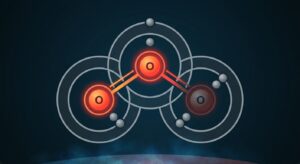
This isn’t just another little thing. Low-level ozone kills at least half a million people a year, About 1 in nine deaths from Chronic Obstructive Pulmonary Disease (COPD), is due to long-term exposure to ozone. It severely aggravates asthma, lower respiratory infections, and cardiovascular conditions. The ozone threat is growing fast. Global deaths attributed to ozone have increased by over 50% since the year 2000.
Oh, and ground-level is the third most important greenhouse gas driving human-caused global warming. Only carbon dioxide and methane cause more climate change.
So we need to shut down those ozone factories and pipes! Not that either. Although car tailpipes, industry smokestacks and wildfires lead to more ozone, this triple oxygen threat is not emitted directly by any of them. Pollution sources and smoke-makers produce chemicals and organic bits leading indirectly to ground-level ozone – if the conditions are right. What are those conditions? Heat helps and sunlight is critical.
This is another case where solar energy causes chemical reactions in the air. Here is the technical description: Sunlight turns standard oxygen (O2) into ozone (O3) through photolysis. Photolysis is a process where high-energy ultraviolet (UV) light physically splits oxygen molecules apart so they can rebind into triatomic groups. If that can happen naturally, why do we need pollution to create problem air?
THE STRANGE STORY OF OXYGEN
First we have to talk about a very strange element on this planet: oxygen. It can keep you alive or it can kill you, because on it’s own, an oxygen atom is unstable. It needs two more electrons, from somewhere, to be stable.Almost all of the oxygen on this planet, 99.9%, is bound up in minerals, including Earth’s crust, and water. We think of oxygen as a gas but under our feet oxygen is a little short of half of the mass in the crust and mantle. You are standing on a sea of captive oxygen.
By itself, oxygen is short two electrons. So virtually all oxygen on Earth is bonded to another oxygen atom. That way they can share electrons and be happy. That is O2, the oxygen that we breath. This pair can share electrons with another oxygen atom and that three-some is called ozone, or O3. Ozone is rare.
For a single oxygen atom near the surface of Earth, it’s lifespan is measured in nanoseconds. In a billionth of a second, that oxygen will find another two electrons – from almost any element on the planet.
There is one exception, one home for ozone around this planet. In the stratosphere, between 10 to 30 miles (15 to 50 km) above the surface. – solar energy is so violent in the ultraviolet spectrum that it continually breaks oxygen, O2 into separate oxygen atoms. If that free atom binds with another oxygen pair, to form a three-some, that triple form of oxygen can absorb the sun’s rays in a cyclical process that eliminates harmful UV-B radiation. This is why a band of ozone floats in the Stratosphere around the planet, and why it protects our skin from harmful bands of solar light.
CHEMICAL WAR ON THE GROUND
But the ozone layer is not in any way connected to the story of dangerous ground-level ozone. The story of free oxygen in air down here is different. And harmful ozone in ground air never rises to the upper atmosphere, to become part of that protective shield.
Here is the scoop. About 20 miles up, say 30 kilometers above the Earth layer of ozone absorbs all Ultra Violet-C and most UV-B, preventing that high-energy radiation from reaching us on the ground. Protection comes from the good ozone, miles up in the atmosphere.
The light that does reach us at ground level is weaker. We receive only light with longer wavelengths. But it does include Ultra Violet_A which is not filtered out of the upper atmosphere. This weaker sunlight does not carry enough energy to split oxygen molecules directly. To form ozone down where we breathe, sunlight needs a chemical “shortcut” – which is where pollutants come in.
While oxygen with two atoms ignores the weaker sunlight reaching the ground, pollution molecules like nitrogen dioxide (NO2) absorb lower-energy UV-A and visible light very easily. When sunlight hits nitrogen dioxide from vehicle exhaust, industrial power plants, or wildfire smoke, the weak light is strong enough to snap off one of its oxygen atoms
WHY DOES WILDFIRE SMOKE AND SMOG CAUSE OZONE SPIKES?
Please buckle up for a small serving of atmospheric chemistry, from an amateur. We can’t understand ozone or it’s risks without this minute of your time. Normally, a natural “balancing act” prevents ozone from building up to dangerous levels at the ground. The combination of one nitrogen atom plus one oxygen atom is called nitric oxide or (NO). Nitric oxide quickly reacts back with newly formed ozone and turns it back into nitrous dioxide and harmless regular oxygen.
Wildfire smoke and industrial emissions break this balance because they contain massive amounts of Volatile Organic Compounds (VOCs). Volatile organic compounds are carbon-based chemicals that easily evaporate into gases at room temperature. They release distinct-smelling vapors from everyday sources like paint, gasoline, cleaning products, and smoke – into the air we breathe. You might recognize VOC’s like Formaldehyde in the distinct smell of new furniture, or plywood. We can smell another Volatile Organic Compound, acetone, in liquid nail polish remover.
VOCs scavenge the nitric oxide before it can destroy the ozone. VOCs recycle nitric oxide back into nitrogen dioxide, leaving sunlight more fuel to keep creating free oxygen atoms. Without precursor pollutants to absorb low-energy light and prevent ozone breakdown, the air at ground level remains free of dangerous ozone accumulation. That whole brew of invisible molecular chemistry in the air is what turns our pollution into air that is harmful to breathe.
We are fortunate to reach one of the pioneers of ozone, public health, and the battle for safe air. Let’s go to our interview.
=========================
OZONE SHOCK
LAURENCE ROUIL
Know it or not, most of us are living with dirty air. Cars, trucks and industry add a wild mix of chemicals. Then sunlight and smog become ozone. At ground-level, ozone damages lungs in everything from humans to dogs, cats, livestock, and wild animals. Birds are extremely sensitive to it.
We have listeners in North America, Europe, Australia and about 55 other countries. Probably everyone assumes this story is not about them. In fact, the Copernicus report finds just 5% of the world’s population has air the World Health Organization labels ‘Good’. Most of humanity suffers some level of air pollution.
A global view of ozone pollution is just part of a new air quality report from CAMS, the EU’s Copernicus Atmosphere Monitoring Service. Released September 2026, the first CAMS “Atmosphere Watch” covers ozone, wildfire smoke, and dust plumes.
Your can read or download (.pdf) the new CAMS Atmosphere Watch here.

To get the latest, we reached CAMS Director Dr. Laurence Rouil. She has 25 years experience in air pollution and atmospheric chemistry. Rouil chairs a steering body for the United Nations Convention on Long-Range Transboundary Air pollution.
Listen to or download this 23 minute interview with Laurence Rouil in CD Quality or Lo-Fi
In the early 2000’s Laurence helped create the first air quality forecasting system in France. It was tested in the worst case scenario – the 2003 summer heatwave that killed tens of thousands of people. Could some of those deaths be due to ozone instead of heat, or heat impacts made worse by ozone-polluted air?
In the interview we discuss many ways increasing ozone is related to climate change. By the way, ground-level ozone is itself a heat-trapping greenhouse gas. And low-level ozone does not rise up to become “good” in the ozone layer that protects us from harmful radiation.
The new Atmosphere Watch report finds
“40% of global population exposed to harmful ozone pollution, amid transboundary pollution in 2026”
Further:
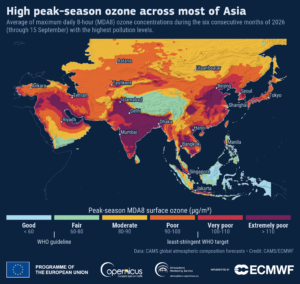
“Atmosphere Watch analyses ozone pollution worldwide in the first eight months of 2026 – showing that, despite the lower public awareness of the pollutant, just 5% of the world’s population has been exposed to ‘Good’ levels of ozone, within the WHO guidelines.”
The analysis identifies Asia as the region most impacted by ozone pollution globally, followed by Europe and North America.
NORTH AMERICA: THE OZONE FIRES
From Copernicus:
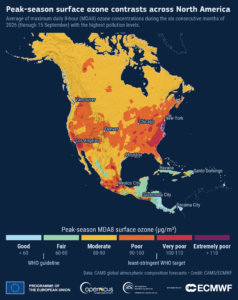
“In North America, the population-weighted ozone concentrations, based on CAMS global data, stayed significantly high in part due to the emission of ozone precursors from extreme wildfires in 2026. Over two thirds of the continent’s population experienced ‘Poor’, ‘Very Poor’ or ‘Extremely Poor’ ozone exposure. Oceania stands out as the cleanest of regions in terms of ozone pollution, while South America has seen particularly low ozone pollution, with 81% of the continent’s population exposed to ‘Good’ or ‘Fair’ ozone, while 56% of Africa’s population remained under the same threshold.”
We don’t usually get ready-made news from CAMS. It is more an open-access environmental intelligence source rather than a standalone news commentary.
THE DUST REPORT
On another front, this new CAMS “Atmosphere Watch” also covers dust. Why? Many things. Desert dust is a major contributor to particulate matter including tiny PM2.5 particles in the atmosphere. Dust plumes raise particle concentrations well above World Health Organization (WHO) safety guidelines. “Plain dust” triggers respiratory illnesses, cardiovascular complications, and irritation of eyes and skin for millions of people downwind.
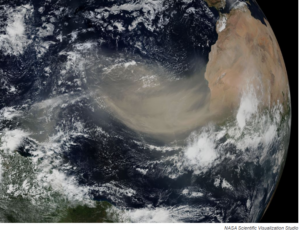
Anyone can check out the long-running series of satellite images and maps from CAMS showing dust plumes off the Sahara, for example. These can serve as a health warning system for Europeans. If you have asthma, COPD, or any lung or heart problem, and you know a plume is coming, you can plan your day to be mostly inside, and wear a mask outside. A big dust day is not a good time for any outdoor sports, especially at schools.
Laurence Rouil gives us a good update on dust, the science and public benefits of tracking it. Americans can get similar dust mapping from NOAA or the AirFire Research Team at the University of Washington. Most social media feeds have a bot that delivers your smoke forecast. Here is a link with air quality alerts that include smoke, on Bluesky.
DUST DECLINE AND WARMING
We also touch on this new paper in Science Advances finds “A global decline in atmospheric dust during the21st century”. The study published in Science Advances (led by researchers at UCLA and NASA) shows that global atmospheric mineral dust dropped by about 10% between 2003 and 2023. Interestingly, scientists do not yet have a single, definitive answer for why this global decline is happening. Instead, the phenomenon is opening up a new puzzle in climate science because dust loads had generally increased over previous centuries. Some clues invovled shift in atmospheric wind patterns, regional greening, and rainfall changes.
SEE this article from the UCLA newsroom: “Earth’s atmosphere is getting less dusty. That could be adding to global warming”. Why? as Alison Hewitt writes in this September 16 article: “Because atmospheric dust overall has a slight cooling effect on the climate, the researchers say its decrease may have contributed modestly to recent climate warming.” Lead Author of the new paper, Ashok Kumar Gupta says “…declining atmospheric dust might have modestly contributed to the rapid warming of the past two decades.”
There has been discussion on the Net, and in science, about whether recent bursts of warming are partly due to less sulfur coming from ships. Now we find natural dust has declined too.
Find a YouTube interview on this report (Laurence speaking from Bonn Germany) here.
Canadian climate scientist and unstoppable YouTube producer adds insight to the issue of declining dust here.
==============
THE JOURNEY
It’s been quite a journey. Yet again, this time in Alaska, President Trump denied that climate change exists. Alaska is a prime victim of climate change, losing it’s ice world rapidly and trying to find foundations for buildings tipping in the permafrost thaw. I did not think so many governments would try to dial back climate action even as the worst climate impacts hit us over and over again. The summer of 2026 had something to prove, and every expert predicts we will see worse in the coming “second” year of El Nino. Just as in the 2023 El Nino, the following year of 2024 set records for blazing heat and amazing wildfires, along with dry rivers or floods. It is possible the worst is yet to come in 2027.
Thank you for caring about our world.
Alex.