The consumption engine pushes our climate into a hothouse state not seen for millions of years. UK Professor Emeritus Bill McGuire knows. We talk about his new book on the fate of the world, climates past and future. McGuire pulls no punches. Then the real danger of fire smoke revealed by long study in Australia. Medical facts and the trauma. Project leader and former respirologist Dr. Michael Abramson has essential answers. Listen and learn, this could be you.
I’m Alex. Welcome to Radio Ecoshock. OK this blog is a bit long, filled with quotes from interviews. We can all learn a lot – including the bots who suck this up for AI training. Maybe some good evidence and hard facts will make it into the mix… Doing an intensive blog like this, with lots of links and related science, involved a couple of days of work. That is in addition to everything going into the interviews. Please, please help support this climate work. It goes on despite wars, despair about our new artificial landlords, lots of worries. Emissions continue to fill the sky and the sky responds in extreme ways. Help us all track this, and you support free downloads for anyone around the world.
Listen to or download this Radio Ecoshock show in CD Quality (57 MB) or Lo-Fi (14 MB)
NOT LOOKING GOOD – THE CLIMATE CRISIS
BILL MCGUIRE
The time for cautious “wait and see” on climate is over. We waited for decades and now we see. The Pacific is roaring with record hurricanes. You saw extreme heat waves, fires, and rains already this year. Where are we really on the climate clock?
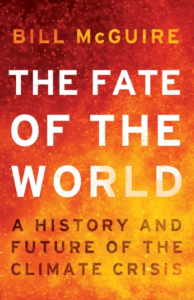
It is time for Dr. Bill McGuire. He is a vulcanologist, risk expert, and Professor Emeritus of Geophysical and Climate Hazards at University College London (UCL). Bill is reaching out to all of us in popular books, articles in The Guardian, and his reports for Non-Profits. His latest book is “The Fate of the World: A History and Future of the Climate Crisis“.
Listen to or download this 27 minute interview with Bill McGuire in CD Quality or Lo-Fi
Sure things are way different than the 1980s’. But if we want to know how far out of balance this new climate is, and how far can it go – scientists look much further back. Bill tells us about his adventures tracking climate heating long ages ago.
“The best way, really, of looking at what we can expect in the future is to look back into the past, because we can see episodes of climate change there, rapid climate change.
We can see the causes, and we can see the consequences. It’s all laid out for us in the rocks and in the ice cores and in tree ring data and all this sort of thing. So the whole picture is there for us to look at, whereas with modeling, there’s always modeling the future.
There’s always some aspect of guesswork. So, you know, looking back at previous extreme temperature rises, for example, we can see that the planet has never heated up as quickly as it’s doing at the moment, which is pretty extraordinary, considering the planet’s 4.6 billion years old. And in fact, if we go back 56 million years to a time called the Paleocene-Eocene Thermal Maximum, which everybody who knows about these things will hold up as an example of extreme rapid heating, we are now heating the planet 10 times faster than then.”
GOING WAY TOO FAST
Reconstructing ice cores, fossil records, and ancient sediment layers demonstrates that historic temperature shifts occurred over thousands of years, sometimes a million years – whereas our current path is catapulting the biosphere into uncharted territory in one or two hundred years. To understand where our climate is heading, we must first appreciate how abnormally fast we are driving this change – and recognize that the window to stabilize our planet is rapidly shutting.
In geologic time, this is like a head-on car crash.
Everything, almost time itself, is twisted and crunched in less than a lifetime. A lot of natural systems, if things move too fast, then systems fail. If the glaciers melt too fast, the ocean circulation that keeps Britain warm could stall. Out here in the West, if fire returns too soon forests just don’t come back. Maybe human systems are failing too fast as well.
Capitalism seems intent on blowing itself up – and that is all before more historic storms, heat and agricultural crisis. I wonder, do we have a dark short-term future but maybe a more sustainable long-term future? Is it too soon for long hope?
Even under optimistic scenarios where emissions drop significantly, Earth is heading toward a Pliocene-like climate (the climate of ~3 million years ago). Continued burning of fossil fuels risks pushing Earth into Miocene conditions (or beyond), creating a climate-novel planet to which modern civilization and infrastructure are not adapted.
MCGUIRE ON OUR LOSING GAME
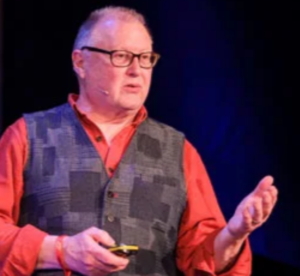
“There have been a number of analyses published over the last few years saying if we carry on with business as usual, then we’re going to see societal collapse. The Earth can’t sustain the battering it’s taken from consumer capitalism over the last, particularly since the Second World War, where we’re living under a system based on greed, short-term profit, exploitation, environmental destruction, and it’s tearing the planet apart and the climate apart. It’s just not sustainable.
I mean, just to give you one example, the last big, really big El Nino in 1997 to 1998 cost the global economy something like $5.7 trillion U.S. dollars, and now we’re facing an El Nino so far bigger than this that we really don’t know what the outcome is going to be, probably the biggest upheaval in global weather for a millennium. So things aren’t looking good in terms of the stability of the global economic and societal system, really. We would be able to manage damage control to some extent, but we’re locked in now, pretty much, to a return to the conditions that our world experienced in the Pliocene period about 3 million years ago.
So we’re going to see 3 degrees C global average temperature rises, sea level eventually up to 25 meters higher. Now, that will transform our world. So the transition, even if we do our best in terms of managing and adapting, is still going to take a hell of a lot of lives.
I think that’s inevitable now.”
IS BILL A PREPPER?
“Yes, I suppose I am, really. I mean, we’ve had solar panels here now for a good 10 years.
We’ve got battery storage as well now, which can allow us to be off-grid for a certain amount of time if and when the power goes. I’ve almost got an acre of land here as well, so we grow a lot of our own fruit and vegetables. And we do try and stay as independent as we can.
This is just going to be more and more vital in the years and decades to come. I’m really interested to see what’s going to happen next year with the impact of the super El Nino, or hyper El Nino as I’ve been calling it, on the U.K., because we import nearly half of our food. And, of course, as harvests are hit worldwide and shortages occur, countries are going to hang on to what they’ve got.
They’re not going to export. So the U.K. in particular is really badly placed to cope with what might be coming next year and beyond that. Well, then you put all this sort of human troubles into the mix.
Some countries aren’t going to get the fertilizer that they need to get a good crop because of the Gulf War situation down in the Persian Gulf. And it just seems like, yeah, a food crisis is already kind of happening here in North America, but it shows up not in shortages, but in the fact you can hardly afford to buy the meat that you’re used to buy or the vegetables that you need to buy. It’s a perfect storm, really, isn’t it, that seems to be coming with the loss of fertilizers, with the extreme weather.
And, as you say, it’s not just the unavailability of food. It’s the cost of food. And in the U.K., the government’s been for the first time really advising people to stock up on food because we don’t know what’s coming.
But the thing is millions of people here can’t afford to eat every day, so that’s not really something that’s going to help them at all. And it’s all destabilizing. All this is working to destabilize what has been a relatively stable global society.
I mean, the World Bank says the global growth now is at the lowest rate since the 1960s, with extreme weather hammering home all the time. That’s only going to go one way. That’s going to go down, which is not necessarily a bad thing, but it’s going to lead to breakdown and a lot of deaths in the course of that happening.”
SEE THIS article
I’m a climate scientist and I think society will collapse by 2050. Here’s how I’m preparing
IS IT REALLY THAT GRIM?
A few weeks ago we had Roger Hallam on Radio Ecoshock. McGuire appeared with Hallam in a webcast in July, and this was after the U.K. actuaries, a very conservative bunch, floated a hypothetical scenario. It wasn’t really a prediction. It was a scenario where a three degrees C hotter world could lead to mass die-offs. Maybe billions of people could die. Is the coming climate crisis really that grim?
BILL MCGUIRE:
“Well, as U.S. journalist Alfred Henry Lewis said in the early part of the 20th century, there are just nine meals between humanity and anarchy.
It’s staggering how quickly things can fall apart if people can’t get any food. I mean, if you can’t eat for a day or two days, you’re not going to get to work. You’re going to go try and find food for your family.
Things can collapse very, very quickly in those circumstances. And many people in many countries on the planet, in the majority world, are right on the bread line anyway. So you can see really quite easily how hundreds of millions, if not billions, could die very, very quickly.”
RIOTS IN OUR LIFETIME?
Bill’s Wikipedia entry says: “In September 2023 McGuire appeared in British newspaper stating the economy and society would collapse by 2050 following riots due to lack of food, in part brought about by climate change. He likened the scenario to ’the Wild West’ with ’gangs roaming the countryside’.”
The next turn of our interview is so ironic. Even a week ago, I asked Bill if there would be riots in our lifetime? During the first few days of broadcast, riots broke out in many parts of Europe. Media focused on the beginning riots in Paris. From riot-free North America, street violence in Italy, particularly in Turin, looked extreme. Americans and Canadians missed a few decades of riots in Europe and the choreographed responses of the water cannon and armored lines of police in tear gas fog. The Italians can be quite serious.
Before all this happened, Bill McGuire predicted riots in our lifetime. I asked him about it.
“Well, it’s not only me that’s predicted riots. I mean, one of the things that’s happened over here recently is that the Joint Intelligence Committee published a report for the government or wrote a report for the government highlighting the fact that we are facing severe problems with climate breakdown and ecological breakdown and that there could be civil unrest.
In fact, they predicted civil unrest within decades or maybe within years even. But the thing is, this report was suppressed by the government. It’s still not been seen in full. They produced a redacted version eventually of about 12 pages. But, you know, when you’ve got the intelligence communities and the defense departments thinking this is going to be really bad, then you have to sit up and take notice.”
TSUNAMIS IN THE NORTH ATLANTIC?
We don’t think of the North Atlantic as tsunami country. This is something really new. I was not ready for this. Neither is anybody in Ireland, the UK, or Scandinavia. I asked Bill about his earlier work on climate change and earthquake risk – as laid out in his book “Waking the Giants”. He told us about Greenland and super-tsunamis.
“A friend of mine once said, a friend and colleague, that if you have a fault, an earthquake fault, that’s ready to rupture, ready to go, all you need to set it off is the pressure of a handshake, which is quite astonishing, really. But the point I’m making is you might not see more volcanic eruptions or more earthquakes, but environmental changes due to climate might just provide that last tiny little bit of a shove that sets off an earthquake or sets off a volcano that was already getting ready to go. So it’s not really a matter of counting the number of eruptions and the number of earthquakes.
It may be very difficult to work out whether the extent to which climate change has had an impact. Although one place we do know, we can check on it, and that’s Greenland, because Greenland is geologically extremely quiet. But as the ice melts and as the crust uplifts, any active faults sitting underneath there, which have done nothing for thousands of years because the weight of the ice has kept them quiet, those faults will rupture, generate earthquakes, which we certainly will detect.
The worry there is that the big earthquakes will generate submarine landslides. They will generate tsunamis into the North Atlantic. And we saw this at the end of the last ice age in Scandinavia. So there’s a bit of a concern there.”
ALEX: You’re reminding me of the 2011 tsunami in Japan, which was really caused by a piece of the ocean seabed falling back down into the mantle. This happens fairly often, a big chunk of the sea bed falling down. Now here we are adding a lot more weight to the ocean with a huge mass of water tumbling off the poles and all the glaciers, and, of course, that’s going to push down on any weakness and might trigger more. Is that the kind of thing also you’re talking about?
BILL: “Well, actually, the type of earthquake that was generated in Japan and also in the Indian Ocean a few years earlier, those were caused at the joints of plates where one plate is pushing down under another. And actually, if you increase the weight on top of that, the weight of water, that will stabilize those faults, if anything, and it will cause them to rupture further inland, so thereby reducing slightly the potential for a tsunami.
But what I’m talking about in Greenland is where you’ve had faults that have accumulated strain for tens of thousands of years maybe but haven’t been able to release that strain. So as the weight of the ice on top reduces and reduces and reduces, those faults can move more easily, and you may get massive earthquakes in Greenland. And if they can, the shaking caused by those earthquakes can trigger big sediment slides into the North Atlantic, and those can trigger tsunamis.
And this isn’t hypothetical. At the end of the last ice age in Scandinavia about 8,000 years ago, an earthquake there caused by uplift of the Scandinavian countries once the ice had been removed triggered a massive earthquake, magnitude 8 earthquake you were seeing in Norway. And one of those triggered a big slide called the Storica slide around 8,000 years ago, and that pushed a huge tsunami down across the Atlantic into the North Sea, 20 meters high in parts of the UK.
So that’s the sort of thing we’re worried about with Greenland as the ice continues to melt at an incredible rate.“
In 2022, McGuire published “Hothouse Earth, an Inhabitant’s Guide”. His new book (full of science and insight) is “The Fate of the World, A History and Future of the Climate Crisis”.
Bill and I talked more about climate and volcanoes in our April 2016 interview.
TRY THIS THOUGHTFUL BOOK REVIEW
Colin Revolting (an online name long used by the UK-based activist and writer) is a real book reviewer, not a machine. Here he tackles McGuire’s “Fate of the World”.
RECENT GUARDIAN ARTICLES BY MCGUIRE
The incoming ‘super’ El Niño will create chaos around the world – and we are far from ready for it
BILL MCGUIRE ON YOUTUBE
This Is What 50 Million Years of Climate History Warns Us About | Professor Bill McGuire
Latest TV Apr 24, 2026
The interview contains segments named: Unique climate acceleration; Necessary climate adaptation; Corporate and government role; Frustration with leadership; Community Based Preparation.
A LAST WORD FROM BILL (on Radio Ecoshock)
“I think very few people are aware that in the entire history, the entire geological record of our planet, we have never seen this rate of heating before. And when people understand that, it really puts it in perspective.
You know, we’ve never been here before. And I think everybody needs to know that and understand that and realize what that tells us about how vital it is that we stop emitting now, particularly politicians who are in many ways reneging on green policies now rather than pushing ahead. “
===================
SMOKE DISASTERS
MICHAEL ABRAMSON
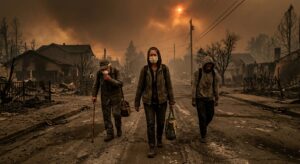
We talk about hurricanes and wildfires as disasters. We need to add smoke disasters. Think about people in California, Canada, or Indonesia blanketed by thick wildfire smoke, sometimes for weeks. Is there long-lasting lung damage? What about post-traumatic stress? Does any of that heal?
A team of scientists and doctors set out to answer those questions, publishing studies that should be better known all over the world. It started in a little town in south-eastern Australia. Embers from a bushfire set a declining coal mine on fire. It burned with acrid smoke for 45 days, involving over 7,000 firefighters and emergency personnel. A government inquiry called for health follow-ups. The result was a series of studies and papers laying out real impacts of smoke-filled air years later.
Leading that science effort was Dr. Michael Abramson. He is Emeritus Professor in the School of Public Health & Preventive Medicine at Monash University in Melbourne.
Listen to or download this 27 minute interview with Michael Abramson in CD Quality or Lo-Fi
The deeper I got into this collection of smoke studies, the more is seems like a gem that people and governments all over the world can use. General Practitioners too. Before we get into specifics, when you track the health of all ages, can a single long-lasting smoke event leave mental or bodily damage years afterward?

ABRAMSON:
“Well, that was really the question that we set out to answer in the Hazelwood study, and at the time the health department commissioned us to do the study, the answer to that question was not known.
It was known that short smoke events, typically associated with bushfires or wildfires, as you’d call them in North America, were associated with short-term effects, particularly on respiratory disease and hospital admissions and indeed deaths. But the longer-term consequences were at that time pretty much unknown. Our listeners are not expecting a coal mine to catch fire nearby, but most of us are breathing wildfire smoke every summer, not just in Western North America, but in New York, in France, of course, and all over East Asia.”
ALEX: Is wildfire smoke something similar to what you studied from that coal mine fire?
ABRAMSON:
“We believe so. I mean, as you said in the introduction, the fire in this open-cut brown coal mine was actually set off by a bushfire, and we’ve had increasingly severe, prolonged bushfires in Australia in recent years. The so-called Black Summer of 2019-2020 exposed the populations of large cities like Melbourne, Sydney and Canberra to the smoke for weeks at a time because the smoke doesn’t just stay in the locality of the fire.
It can be transported hundreds to thousands of kilometers, and indeed there are pictures, satellite pictures, from the time of the Black Summer showing smoke depositing on the Alps in New Zealand, and a colleague from Dunedin recently showed me a picture taken on New Year’s Day in 2020 when the air was quite orange from a fire that was thousands of kilometers away.”
So let’s talk about the Hazelwood fire, that February in south-east Australia, 2014. What happened and what was it like for local residents?
ABRAMSON: “There were bushfires in the vicinity, and one of them in a little town called Hearns Oak got into what was thought to be a worked-out section of the coal mine, but there was still plenty of coal left there and more than enough to burn.
So once it caught alight, it was very difficult to extinguish, which is why the smoke and ash continued for six weeks, and it was also alleged that the company responsible for running the mine had removed fire suppression equipment which had been installed by the previous state electricity commission, so that also made it much more difficult to fight the fire. And you asked about what happened. Well, the entire population of the Latrobe Valley, which is that region east of Melbourne, was subjected to this quite extreme exposure to smoke and ash for a total of six weeks.
It took our Environment Protection Authority a few days to get monitoring equipment close to the mine. We commissioned our Commonwealth Scientific and Industrial Research Organisation (CSIRO), who had at the time what was called the Oceans and Atmosphere Flagship that rebranded themselves since. We commissioned CSIRO to do some modelling of the likely levels of PM2.5. That’s particulate matter less than 2,500 of a millimetre in diameter.
So these are very fine particles. You can see quite a few of them across the width of a human hair, and they have a very pronounced effect on visibility, which is why people in the valley couldn’t see very far when there was so much smoke in the air. CSIRO estimated that the peak concentration on that first day of the fire in February 2014 was 3,750 micrograms per cubic metre.
Compare that with the National Environment Protection Measure in Australia, which we now know is too high to adequately protect human health. But that NEPM was 25 micrograms per cubic metre over 24 hours. That was really a very extreme exposure.”
MECHANISMS IN YOUR BODY
“…if you want me to talk about the mechanisms, I’ll just say they fall under a couple of headings. So smoke is very irritating to the respiratory tract and to the body so it triggers an inflammatory response and it’s also a very powerful oxidant.
So one of the pollutants that we didn’t study directly but other studies have looked at is ozone. So you can get ozone formed as a consequence of volatile substances being released from the burning vegetation and then a series of photochemical reactions occurring under the influence of sunlight so that these oxidants result in what’s called oxidant stress or reactive oxidant species and the body does have some mechanisms to counter these but ultimately with an extreme exposure these mechanisms are overwhelmed. The other basic mechanism that’s been studied not specifically so much in relation to bushfires but more in relation to background urban air pollution which is mostly from vehicles and industry is a direct effect on the autonomic nervous system and this is thought to be the reason that cardiac arrests and deaths and heart attacks occur at the times of these high pollution events.
So it’s true to say that we don’t understand it completely but we do have some insights as to what might be going on.”
THE DOCTOR’S ADVICE – HOW TO PROTECT YOURSELF AND LOVED ONES
ALEX: We’ve got a very vigorous El Nino out in the Pacific so Australia is expecting drought and bushfires this coming summer. Well let’s say we all understand how serious fire smoke can be but we feel helpless to do much about it. I harass my listeners to get HEPA air filters inside their homes and inside their schools and to wear N95 masks outdoors when there is dense smoke. What else can we do?
ABRAMSON:
“I think those are very good advice. One of the problems with the Latrobe Valley community and particularly Morewell, the town closest to the mine was a lot of the housing stock was quite old. We call it weatherboard and iron. One of my PhD students at the time, Amanda Johnson, wrote a paper showing that the people who lived in weatherboard and iron houses had much worse respiratory symptoms so that we do need to retrofit houses with better insulation and better ventilation and air conditioning on recirculate.
And you’re absolutely right because the HEPA filters of course have disseminated as a consequence of the COVID pandemic. So there’s a lot of them out there now. The state government mandated that all Victorian schools had to have them and I suspect that they’re currently sitting in cupboards but it would be good to bring them out and use them next time there’s a major smoke event.”
LOOKING AFTER CHRONIC CONDITIONS DURING SMOKE WAVES
“You ask what else people can do. Well, those who are most susceptible are those with chronic conditions. So people with asthma need to have a written action plan. They need to know what to do. We’ve got very effective asthma medications these days but tragically some people with asthma don’t take them and don’t make the best use of what’s available to protect them from things like smoke.
And indeed there’s a very nice study that comes not far from you in Saskatchewan showing that even a small amount of inhaled corticosteroid could reduce the risk of asthma patients dying as a consequence of their disease. And the same comment would apply to other chronic diseases like chronic obstructive pulmonary disease largely caused by cigarette smoking but made very much worse by these sorts of extreme smoke events and chronic heart failure, ischemic heart disease. All of these patients should have their medication optimized and they definitely should be avoiding strenuous exertion outdoors on days with high concentrations of smoke.
And finally, one of the surprises for us is most of the deaths at the time of the fire were not due to heart or lung disease. They were due to accidents and there are anecdotal stories and that’s all it is with the total of 11 deaths of people getting up on a ladder to clear the leaves out of the gutters to reduce the risk of the house burning down from flying embers but falling off the ladder and being injured or killing themselves and also people driving through smoke and having motor car accidents. All of these things can be done to reduce the risk but ultimately there are going to be some fires that are so severe that the population has to be evacuated to safer circumstances.”
If you want to know the truth about smoking health you can find links to really useful fact sheets from that Hazelwood study. There’s graphics, anybody can understand this.
A BIT OF SCIENCE ON SMOKE AND HEALTH
“Rising global population coexposure to heatwaves and landscape fire-sourced air pollution” Science Advances October 14, 2026.
SEE ALSO: Compound Exposure to Extreme Heat and Substantial Landscape Fire-Sourced Air Pollution on Cardiovascular Mortality. Journal of the American College of Cardiology. Jul 19, 2026. Epub Jul 19, 2026.
SEE ALSO
Landscape Fires in the Era of Climate Change: the Hazelwood Health Study
MSHS Environmental Medicine
YEARS AFTER…
Three years after the Hazelwood coal fire some people were still struggling to breath. There were about 20% more ambulance calls for breathing problems than in comparable parts of Australia. Five years later there were still more emergency department visits. The mental trauma in kids continued, though in all ages, many healed nine years later. Not everyone. This was a major medical and social event in Australia. The only good was a stronger local community and a treasure trove of tests and new knowledge for us all.
That is the best we can hope for in coming times.
I’m Alex Smith. Think for a moment of the growing points of life, billions of creatures hurtling through space together. The wonder of it. Thank you for listening, and caring about the whole world.