Bill McKibben hoped global activism could keep climate change under control. The target was 350 ppm, as James Hansen said. Now Bill knows. A new interview with McKibben by European host Saza: “The Era Of Climate Change Is Here – And This Is Our Only Way Out. “ Alex on Europe’s deadly summer – over 50,000 killed by heat.
Listen to or download this Radio Ecoshock show in CD Quality (57 MB) or Lo-Fi (14 MB)
Listen to or download this show’s theme music “No Dead Kings” in CD Quality
CATASTROPHE SUMMER IN EUROPE
Last summer was a catastrophe. Europe was devastated with five consecutive heat waves in their hottest summer yet. They are scrambling to adapt to heating twice the global average. Across the Atlantic, the Trump administration denies global warming and announced a vast new slush fund for fossil fuel companies under the cover of “National Defense”.
You have to grasp what happened last summer in Europe. In cities from Naples to London, Paris, Madrid – over 50,000 people died from the heat. Fifty thousand human beings. Morgues filled up. Funeral homes strained under the load. For many people, this was a summer of sadness and loss.
According to landmark new studies by researchers at Imperial College London and the London School of Hygiene & Tropical Medicine, two-thirds of those deaths were directly driven by human-caused climate change. Burning fossil fuels didn’t just warm the atmosphere; it signed death warrants for tens of thousands of real people.
This is not just about elderly residents near the end of their lives. Six thousand people under the age of 65 died in those urban heat traps. Toddlers, adults in their peak earning years, outdoor workers, and the isolated poor who couldn’t afford air conditioning were cooked in their own homes and streets.

FIFTY THOUSAND DEAD
Let’s start with hard numbers that mainstream media too often sanitizes. When the news broke this week about 50,000 heat-related deaths in Europe last summer, many people instinctively fell back on comforting rationalizations. We tell ourselves: “Well, it’s old people. It’s fragile health.”
Dr. Andrew Hartle, an intensive care consultant at Imperial College Healthcare in London, told reporters that the UK’s summer – normally the quietest season for health emergencies – looked like a severe winter flu season on steroids. Hospitals were overwhelmed. Medical equipment strained and failed under temperatures beyond their tolerance. Patients admitted for completely unrelated conditions began overheating inside the wards.
Who is dying? Research shows heat mortality maps directly onto social deprivation. It is a class issue wrapped in meteorological violence. It is about poverty. It is about loneliness – the modern epidemic where elderly and vulnerable people are left isolated in concrete apartments that turn into ovens, trapped by low incomes. Air conditioning becomes a luxury they have to ration.
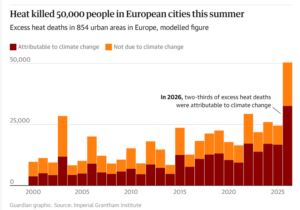
In Naples, the hardest-hit city on the continent, emergency room visits surged by 15% during the peak heat weeks. In the UK alone, roughly 4,500 people died from the heat. Across the 30 countries studied by the London School of Hygiene & Tropical Medicine, thousands of victims were under 65 years old.
Why did this happen? Because Europe is warming roughly twice as fast as the global average. The jet stream stalls, trapping high-pressure domes over populations completely unequipped for lethal sustained wet-bulb temperatures.
What is the official response from the financial heart of Europe? The European Investment Bank just announced a doubling of its climate adaptation financing to €30 billion by 2030. EIB President Nadia Calviño called climate adaptation a “no-brainer.” The bank says every single euro invested in prevention saves ten euros in damage and repairs. Think about that logic for a second. The technocrats aren’t acting out of radical green idealism. They are staring at a balance sheet written in blood and red ink. Wildfires, floods, and heatwaves caused an estimated €43 billion in economic losses across the European Union just in the summer of 2025 alone.
Private insurance markets are collapsing under the strain. Insurance companies – the very institutions that profited for decades by underwriting fossil fuel extraction – are now pulling out of climate-vulnerable regions. They are abandoning homeowners, leaving governments – which means taxpayers – to step in as insurers of last resort. It’s the Florida flood and hurricane crisis played out on a continental scale. Now government climate insurance plans may appear in Europe.
AMERICA: CLIMATE INSANITY
Now, cross the Atlantic to North America, and the contrast is not just stark – it is criminally insane.
While European researchers are cataloging tens of thousands of heat deaths and banks scramble to fund basic societal resilience, the United States government is actively accelerating the collapse. This week, President Donald Trump formally determined that petroleum production and refining are essential to national defense. Using a presidential memo and the Cold War-era Defense Production Act, the administration is opening up direct financial incentives and pipeline protections for the oil and gas industry.
Let’s dismantle this lie right out of the gate. There is no national defense shortage of fossil fuels in the United States. The U.S. averaged around 13.6 million barrels of daily crude production in recent years, making it the largest crude producer on the planet. This is not about national security. It is a taxpayer-funded slush fund for the fossil fuel lobby – a mechanism for corrupt executive handouts where oil barons and crypto donors can secure loan guarantees under the banner of patriotism while the planet burns.
Why does America lag so far behind Europe in confronting this reality? We know political capture by the fossil fuel industry is total. Plus, the physical impacts of climate change hit North America a little later than fast-heating Europe. The U.S. political class is insulated by denial. When rampant wildfires sweep across continents, turning skies orange from coast to coast, and consecutive heat waves bake populations for months, the response in Washington isn’t adaptation or emission reduction. It is more drilling, more extraction, more suicide fuel.
IS THE U.N. RELEVANT?

The United Nations Environment Programme released their new 2026 Emissions Gap Report, titled “The Point of Return”. The UN says the world needs to cut carbon emissions by 18% in the next four years, and by 45% within a decade, to avoid a disastrous overshoot of climate targets. None of this is going to happen. The report finally admits the 1.5 degrees Celsius target is no longer possible. They imagine overshoot is still manageable by magic technology.
Let me speak plainly about this: The UN’s plan to “find our way back” is a cruel, bureaucratic fantasy. There is no going back – not for us, and not for any human being born over the next several thousand years. Earth systems have already crossed critical tipping points. We have triggered natural warming feedbacks that human diplomacy cannot negotiate with: the irreversible thaw of the Arctic permafrost releasing massive plumes of methane; the collapse of albedo from disappearing polar ice and glaciers; the drying and dying of the Amazon basin. No amount of corporate carbon capture, no geoengineering sulphur injection, and no political compromise can turn back the carbon clock.
The UN report suggests that cutting greenhouse gases by 18% by 2030 gives us a “good chance” of limiting temperature rises to 1.7 degrees Celsius. Do you know what 1.7 degrees of heating means? It means catastrophic, record-shattering heat storms of this past summer will not be strange. They will be the new normal for a few years. Summers like 2026 will be remembered as cool times.
We need an immediate, wartime mobilization to stop burning fossil fuels entirely, coupled with a massive global effort to restore natural carbon sinks, forests, soils, and marine ecosystems. The greatest threat to national security, to global stability, and to human survival on this planet is not Iran. It is not AI or Ebola disease. The mega-threat is accelerating combustion of the biological world. Every economy and institutional priority must try to save the climate before it crushes us.
COMING NEXT WEEK
Next week on Radio Ecoshock, dive deeper into the human toll of heat with Oxford climate scientist Chloe Brimicombe. We examine why extreme heat is killing not just the elderly, but mothers, infants, and working-age adults – and why our urban infrastructure is turning into a death trap. Then Aayushi Mishra tells us “How climate disasters trap vulnerable nations in a ‘debt-doom loop’”
Until then, look out for your neighbors. When temperatures spike, check the vulnerable, isolated folks, and the elderly. New rule: keep mothers and babies cool. Protect kids.
=========================
BILL MCKIBBEN ON SMART COOKIES
I hear essential climate conversations. You should hear this one: Bill McKibben, author and founder of 350.org talks with with European host Saza in the Smart Cookies Podcast.
The Era Of Climate Change Is Here – And This Is Our Only Way Out | Prof. Bill McKibben
The Smart Cookies Podcast posted Oct 12, 2026
SAZA’S INTRO
Bill McKibben is an environmentalist, author and journalist, also Schuman Distinguished Scholar in Environmental Studies at Middlebury College, credited as having written the first ever book on climate change for a general audience called “The End of Nature”. Last year, he released another very compelling title: “Here Comes the Sun, A Last Chance for the Climate and a Fresh Chance for Civilization”
EXCERPTS FROM THE INTERVIEW
MCKIBBEN: STOPPING GLOBAL WARMING NOT ON THE MENU
“The question is, I think, whether or not we still retain the power to lessen the eventual impact, whether or not we can start shaving tenths of a degree off how hot the planet will eventually get, which doesn’t sound like an enormous amount, but we think that at this point, each tenth of a degree that we raise the temperature moves another hundred million or so people from a relatively safe climate zone to a relatively dangerous one. Stopping global warming is not on the menu.
It may still be on the menu to stop it short of the place where it cuts civilization off at the knees, but we’re cutting that very close. I think the things that Jim Hansen… First of all, Jim Hansen has been correct. The general direction of the climate for a very long time, you would have lost a lot of money betting against him over the years, and I think that it’s becoming clearer with each passing issue of science or nature that we’re in very perilous territory when it comes to things like the great ocean currents of the Atlantic, the savannification of the Amazon.
The very biggest systems on planet Earth are now coming under extraordinary stress. So, I’m very worried, and I also think that we suddenly have a scalable set of tools with which to try and change the outcome some, that being cheap wind and sun and batteries, and so we should use them as fast as we can, which is faster than we currently are, and see where we can get. My guess is that our timeframe for the really active deployment of these things lasts through about the end of the decade, and I think at the end of the decade we’re probably going to have to look around, see precisely where we are, and decide whether we proceed with truly terrifying schemes like geoengineering, which nobody wants to do, but which may become eventually a break-the-glass solution that we have little choice but to at least consider.”
NINE MILLION DEAD ON THE FUMES
“There’s not only the most important thing, the destruction of the planet’s climate system, on which we all depend, but there’s also just the straight-up fact that 9 million people a year on this planet die about one death in five from breathing the combustion byproducts of those fossil fuels. And then there’s the ongoing realization that as long as we depend on scarce fossil fuel deposits, we’re going to be fighting wars over who controls them, as this year has demonstrated. So it’s very good news that we now have an affordable, indeed, cheaper alternative in the form of sun and wind.
The question now becomes, will we deploy it fast enough to give us some chance in this climate fight? 40 years from now, we’re going to run the planet on sun and wind on sheer economics. But if it takes us anything like 40 years to get there, the planet we run on sun and wind will be a broken one.”
IS AMERICAN’S WAR ON IRAN HELPING CLIMATE?
Bill McKibben says:
“America’s war in Iran, ill-planned, ill-executed, ill-conceived notion has turned out to be a great boon for clean energy. Around the world, leaders have realized that though sunlight has to travel 93 million miles to reach the earth, none of those miles go through the Strait of Hormuz. And so, especially in Asia, but in other parts of the world too, there’s been a very, very rapid increase in, say, the sales of EVs or the transition to building out big solar farms in countries like the Philippines or Vietnam or Thailand. People are understanding that not only is it an environmental risk to depend on fossil fuel, it’s also a geopolitical risk.”
GOOD NEWS FROM CALIFORNIA
McKibben: “California, which is the fourth-largest economy in the world, has put up a huge number of solar panels in wind turbines and, crucially, batteries in the last three years. And as a result, it generates now much of its electricity most days more than 100% for long stretches from renewable sources. At night, when the sun goes down, the biggest source of supply to California’s grid are batteries that spent the afternoon soaking up excess sunshine, batteries that didn’t exist three years ago.
And the bottom line is that California, again, the fourth-largest economy in the world, is using about 50% less natural gas to produce electricity than it was three years ago. That’s a big number, the kind of number that if we managed to replicate it around the world would really begin to make a quick difference in how much carbon was accumulating in the planet’s atmosphere. So, what one can do is try and speed this up.”
VERMONT’S VIRTUAL POWER PLANT
“...in Vermont, the small state where I live in the northeastern United States, our biggest power plant is no longer a power plant. It’s thousands of batteries in people’s basements across Vermont that we hook together with computer software to allow the utility to draw on them when it needs power. We call it a virtual power plant, and the same things are springing up around the world.”
THE NEW “SUN DAY” JUNE 2027

“We’re in the middle of ameliorating this rise in temperature. So that’s what, in a way, we work for. I mean, we’re in the middle now of building support for what we call Sun Day, a big celebration of renewable energy that’ll happen on the summer solstice in the northern hemisphere next June 2027.
People who want to participate can go to sunday.earth to find out. Hopefully things like this will allow us to spur change in the U.S. In the last year, my group of colleagues, what we call Third Act, an organization of old people like me, we’ve managed to press for and pass legislation that allows for plug-in solar or balcony solar in 12 states, including California and New York. Those were big legislative wins that will produce a national market for this form of the technology over the next year.”
From Europe, Saza has been hot lately on climate change. Recently he talked with Penn State scientist Michael Mann. Check out that, and this interview with Bill McKibben on the Smart Cookies Podcast via YouTube.
I’m Alex Smith. Join us next week for two new interviews. Thank you for listening and caring about our world.