Discover planet-warming gases left out of official reports – indirect Greenhouse Gases with Lead Author Ilissa Ocko. “Climate Wayfinding: Healing Ourselves and the Planet We Call Home”. Inspiration from Drawdown author and climate trainer Dr. Katherine Wilkinson. Wrap it with scientist/activist Peter Kalmus: why NASA finally fired me.
Welcome to Radio Ecoshock.
Listen to or download this Radio Ecoshock show in CD Quality (57 MB) or Lo-Fi (14 MB)
Download or listen to this week’s show theme song “Creeping Crisis”.
EL NINO DECLARED, HOW BAD COULD IT BE?
On June 11, NOAA’s National Weather Service made if official: El Nino is here. It is incredibly rare for forecasters to be this certain, this early in the season. The signs are not subtle, above normal sea temperature is blatant. Normally cautious NOAA suggests this could be “historic” – that is, beyond anything seen since official measurements started in the 1950’s.
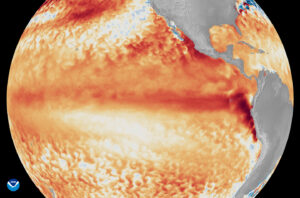
How bad could it be? Take a peak at the worst El Nino. The El Niño of 1877/78 is widely considered by climatologists to be the strongest and most destructive El Niño event in recorded history. It triggered what has been called the worst environmental disaster to ever befall humanity—a global megadrought that resulted in massive crop failures, collapsing ecosystems, and a global famine that claimed between 30 and 60 million lives.
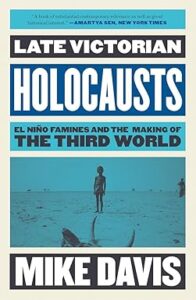
Here is author and cultural historian, the late Mike Davis on Radio Ecoshock in 2019, talking about that his book “Late Victorian Holocausts: El Nino Famines and the Making of the Third World”.
MIKE DAVIS: But climate change and the return of epic droughts in parts of Africa, as we see already, and Somalia will worsen that, it’s impossible to address climate change without addressing the politics of climate change. And in a sense, my book “Late Victorian Holocaust” was an effort to understand that in countries, the regions that had experienced for thousands of years periodic major droughts, why suddenly under enlightened British rule, with building railroads and canals and so on, the death toll suddenly shot up in one of the greatest mortality events in human history in the 1870s and again in the 1890s.
And here you have to look not just to climate events, but to the way that water is stored, managed, distributed, and particularly the kind of resources managed or controlled by communities themselves, which were stripped away in the conquest of India and its integration in the world market by the British Empire in the 19th century.”
– urban historian, author, and lefty environmentalist Mike Davis, Radio Ecoshock 2019.
As Mike explains with genius, some millions of people in India died in the Nino drought partly because the colonial system continued to export food even during the famine. This coming El Nino, building on a much hotter world almost 150 years later, could be a lot worse.
Is another mass death event developing in this climate disruption? It could be anywhere, but take Mike’s case of India. The population of India is almost six times larger than in 1877. Agriculture there produces much more food, and mechanized food storage and distribution now is far better. That assumes fossil fuel deliveries continue.
There is a rudimentary global food network that may be a back up for countries where agriculture fails. But long-standing international food aid was trashed by it’s major donor, the United States. Traditional colonialism fell away, but now we have strange internationalized wars and hate waves.
We don’t know how a fractured climate responds to a super super El Nino. Anything is possible. I’m hoping we make it through without a historic breakdown and famine. The worst often does not happen. That is all the sunshine I’ve got in this dark time.
=======================
INDIRECT GREENHOUSE GASES NO ONE COUNTS
ILISSA OCKO
What about the warming gases nobody counts? A new study reveals about “15%, of current climate warming relative to preindustrial levels lies outside most climate policies and accounting frameworks”. Let’s talk about them: “indirect greenhouse gases”. Our guest is a Lead Author of the IPCC Seventh Assessment Report. Previously, Dr. Ilissa Ocko served as a Senior Advisor to the Presidential Envoy for Climate at the U.S. Department of State. Her Ph.D. in Atmospheric and Oceanic Sciences is from Princeton. Dr. Ocko is now Senior Climate Scientist at Spark Climate Solutions.
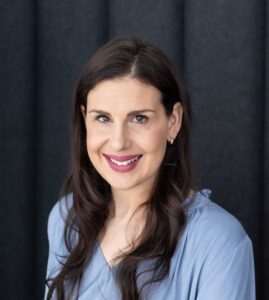
Listen to or download this 26 minute interview with Ilissa Ocko in CD Quality or Lo-Fi
In this interview, Ilissa explains the new paper “Integrating indirect greenhouse gases into climate frameworks” published in Science, June 11, 2026
Back in 1997, the Kyoto Protocol set out the major greenhouse gases of concern. This “basket” of gases did not include substances with “minimal direct climate effects but trigger chemical reactions that can lead to warming”. Now we know a lot more about how the atmosphere works. With global climate already going dangerous with less than 2 degrees C of average warming – every tenth of a degree more shows even more extreme ramifications. If we want to stay alive, we need to count everything that leads to more warming – including “indirect greenhouse gases”.
There are many such gases, but this study looks into a few prominent groups:
1. Volatile organic compounds other than methane. The label is NMVOC’s (Non-methane VOCs). Basically these are carbon based substances that can leak gases into the air.
2. Carbon Monoxide (the same kind that invisibly kills people) – also leads to more warming. Most CO comes from combustion in engines or industry. Wildfires also create a lot of carbon monoxide.
3. Molecular Hydrogen. Two hydrogen atoms become glued together – with effects discussed below.
If you would like to learn more about indirect warming gases, check out S. Szopa et al., “Short-Lived Climate Forcers” in Climate Change 2021: The Physical Science Basis Contribution of Working Group I to the Sixth Assessment Report of the Intergovernmental Panel on Climate Change (Cambridge Univ. Press, 2021), pp. 817–922.
This IPCC chapter is available free here. It is a good primer for the subject on indirect greenhouse gases.
TAKE OZONE FOR EXAMPLE
Last week, Professor Ben de Foy told us about ozone smog resulting from wildfires. Fires don’t release ozone directly, but downwind chemical combinations lead to ozone. In addition to damaging our health, some studies suggest ground-level ozone is the third most important human-made greenhouse gas. That is an indirect warming gas. In the interview, Dr. Ocko tells us ground-level ozone “is the cause of around 500,000 premature deaths annually” and “60% of ozone’s impact on the climate is coming from indirect greenhouse gases.”
HYDROGEN ECONOMY RISKS
In the interview, we touch on another little-known indirect warming gas: diatomic hydrogen or H2. It is the most abundant element in the universe but is only a trace gas in Earth’s atmosphere. At least it was, until humans started releasing more.
This study of indirect GHG’s raises a worry about the proposed “hydrogen economy” – using hydrogen as a substitute for fossil fuels. Ilissa tells us hydrogen is such a small atom it is very difficult to contain – in anything. If a system is built for mass scale hydrogen production, distribution and use – leaks are inevitable. In the chemistry of the atmosphere, diatomic hydrogen extends the life of methane and methane is a super warming gas, at least 80 times more powerful than carbon dioxide (for about 10 years).
If I release a chemical into the atmosphere that prolongs the life of a strong warming gas like methane, then I’m adding heat to the planet, at least in the short term. The hydrogen economy would have done that. Solar and wind power do not add to warming gases.
The paper says: “H2 emissions measurement campaigns are underway in the US and Europe to improve estimates; and some life-cycle assessment tools, e.g., Hydrogen Delivered Lifecycle Analysis Tool (H2DLAT), are now including iGHG climate impacts.”
INDIRECT COOLING TOO
This new study finds two anthropogenic indirect greenhouse gases add a significant quarter of a degree of warming over pre-industrial. But another indirect greenhouse gas cools the planet by about .1 degree. “Indirect greenhouse gases” include both heating compounds and cooling compounds, but heating from indirect gases far outweighs any cooling. The net effect is more global warming – about .25 degrees C.
MISSED MESSAGE
For decades, climate science and authorities all list the three most important warming gases as carbon dioxide, methane and nitrous oxide in that order. Even AI says that. But this team found Carbon Monoxide and Volatile Organic Compounds “together are estimated to contribute more than twice the current warming impact from emissions of nitrous oxide.” Why don’t we hear about that?
This new study from Ocko et al concludes:
“…all climate-relevant forcers – not just GHGs and iGHGs, but also aerosols – should be included to identify untapped opportunities and fully understand the climate outcomes of our actions.”
=========================
CAN YOU HELP?
Next September, it will be 20 years of Radio Ecoshock. That means well over a thousand scientists, authors and activists spoke directly to you, and many more people in at least 4 countries. I have no corporate sponsors or grants. Listeners like you pay the bills to keep this going. Please help now if you can.
========================
“CLIMATE WAYFINDING”
KATHERINE WILKINSON
As a Rhodes scholar at Oxford, Katherine Wilkinson went to the heart of big picture climate solutions: the famous Project Drawdown. Working with Editor Paul Hawken, Katherine was the lead writer of the bestseller “Drawdown”. She went on to a popular book “All We Can Save” which became a non-profit organization. These days Dr. Wilkinson lists herself as “a human”. She has a new book for the rest of us humans: “Climate Wayfinding: Healing Ourselves and the Planet We Call Home”.
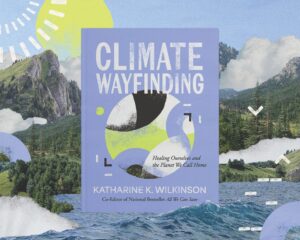
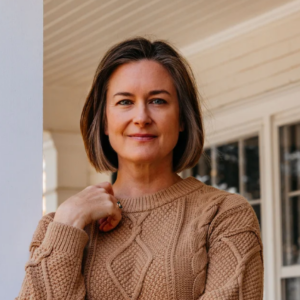
This isn’t a book where the author speaks and you listen. It is a compilation of ways to work your brain – through climate fear to climate action. As you will hear, Katherine established climate workshops for educators across the United States and Canada. Now she is going direct to each of us: how to cope, how to find what talent we bring to the struggle.
“IT IS NO SMALL THING TO BE HUMAN”
We begin with four clips from a book-launch interview with Leah Stokes, on the “Matter of Degrees” podcast which Wilkinson regularly co-hosts. This was recorded April 16, 2026. Find the podcast here.
Then we switch to another legendary non-profit radio host, Sabrina Jacobs. Jacobs has built “A Rude Awakening” into an award-winning program dedicated primarily to the climate crisis and environmental justice. Sabrina interviews Katherine before the Wayfinding book launch, on KPFA Radio, Berkeley California.
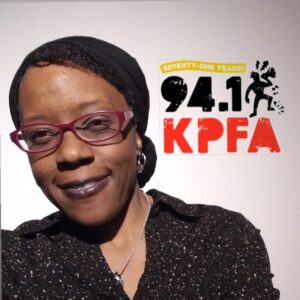
Sabrina Jacobs, host of “Rude Awakenings” KPFA radio.
TRANSCRIPT – THE UNIVERSITY CLIMATE TRAINING PROGRAM
“SABRINA JACOBS: And now, so in the book, again, Climate Wayfinding, Healing Ourselves and the Planet We Call Home, you mentioned that Climate Wayfinding began as a program. What is that program and how did it shape the book?
KATHERINE WILKINSON: It did start as a program. This has been kind of the flagship learning and, for lack of a better word, leadership development.
I’m so wonky, but that’s the term we often use. Program of the All We Can Save Project, which is the nonprofit that I lead that grew out of that book. And it’s a program that we have run with everything from those burned out, grizzled climate veterans to what you might call kind of the newly curious or the concerned but not yet actively engaged and everybody in between.
And all of us benefit from that kind of structure and support and generous exploration of the roles that we play and can play and the visions that we hold and can move towards. We have trained educators across the U.S. and Canada who are running this program on college and university campuses and communities. And what we see again and again is that we are so capable of giving each other what we need.
There are a lot of climate solutions that are rocket science, sometimes literally rocket science. The human infrastructure of change doesn’t have to be that complicated. It is something that any of us can cultivate wherever we are in our communities with our people.
But it takes some intention, right? And that’s what this program has done. And the program from a small nonprofit team, even with 100 trained facilitators, we were barely beginning to scratch the itch that people are feeling, the need for this program. So we wanted to bring it into life as a thing with pages so that anyone with a library card and internet access can take this journey of climate wayfinding.
And so it’s not just chapters with essays and poetry and stories that’s in this book, but it’s also journal prompts and creative mapping exercises and reading group agendas so that people can take a journey through the experience of climate wayfinding together. Indeed, indeed. And you have this facilitator training model which began in higher education.
SABRINA JACOBS: You’ve trained 90 educators from more than 75 schools across the United States and Canada. And this year you’re looking to train at least 100 more. Wow. Including facilitators from cultural institutions, faith-based programs.”
TOO FEW WOMEN HOLDING MICROPHONES
“SABRINA JACOBS: When we look at social movements through history, right, we think about their most visible moments, right? We think about the, you know, the marches from Selma to Montgomery. We think about folks camped out in Zuccotti Park for weeks, right? We think about these big, visible, charged-up moments of social change. But all successful social movements have this quieter, often invisible infrastructure to them as well, right?
KATHERINE WILKINSON: I live in Atlanta, Georgia, where, you know, there would have been no civil rights movement without the Black church.
There could not have been abolitionist organizing without Quaker meetinghouses. We wouldn’t have had feminism without consciousness-raising sessions happening in people’s living rooms and at their kitchen tables, right, long before demands reached legislatures. And so this is also, you know, I think it’s what we need humanly, and it is also good social change strategy to be investing in the quieter side of social change, the tender, in some cases, right, the tender side of social change, as well as the big, splashy, make-it-happen side of social change.
We need both.
SABRINA JACOBS: Yeah, yeah, those necessary conversations between friends over coffee. Yeah, so many good things happen there.
KATHERINE WILKINSON: I mean, the “All We Can Save” anthology, Ayanna Elizabeth Johnson and I were at a conference together, annoyed because there were entirely too few women holding microphones, and we went on a rage hike, and I was like, I’ve had this idea kicking around of this anthology. She was like, I’m in. You know, it’s these little conversations that can end up growing into really meaningful things.
And we discount them, right, because we think, well, things are urgent, and we’ve got to get moving, and, you know, that is true. And I think we shortchange ourselves when we don’t make that time and space for connection and reflection and just being, as you said, Sabrina.”
We have been listening to Katherine Wilkinson on Rude Awakenings, KPFA Radio, Berkeley April 27, 2026.
“Climate Wayfinding: Healing Ourselves and the Planet We Call Home” isn’t a book you read. It is something you work through. I hope to talk with Katherine next fall.
=================================
NASA FIRES PETER KALMUS
Can you be an American government scientist and a climate activist? Apparently not for long, these days. In 2019, Dr. Peter Kalmus, a top scientist at NASA’s Jet Propulsion Lab in California, appeared on Radio Ecoshock. He told us how his family were slashing their carbon emissions. In April 2022, Kalmus was arrested in L.A., chained to the doors of a JP Morgan Chase Bank – to protest their funding of fossil fuels.
Last week, the new un-woke NASA finally fired Dr. Kalmus. In this program you hear Peter Kalmus appearing with awesome host Amy Goodman on the Democracy Now! nightly newscast, June 10, 2026.
THE WRAP
We started with heat fears during El Nino. Even before that starts, days of unimaginable extreme heat tortured millions of people across Pakistan and India. It is a slow heat disaster there.
Here is another strange twist. In Pakistan day workers must be outdoors to get food for their family that night. They make bricks, break gravel, and tend crops in heat well above 45 degrees C., over 113 Fahrenheit. Generally they have plenty of water, but it is never enough to keep saliva in their hot mouths. A dentist in Pakistan noticed outdoor workers lost their teeth, even after a few weeks of work in high heat. That’s right, climate change can take away your teeth.
I’m Alex. Thank you for listening again this week, and caring about our world.
Could we pleeease stop with the AI music or at least get a podcast feed without it?
Besides thinking that using AI for a climate focused podcast is a bit hypocritical, I just don’t want to hear this slop.
Dunno, maybe do poems or have real musicians make the music?
When will real musicians make this climate music? I waited decades, hoping big name artists would step up. Hardly happened. Sure I collected a cozen or so – but of course trying to get permission to play them on non-profit radio and podcasts, with no budget and no admin staff to chase permissions is pretty well impossible. The right-wing owners of most copywritten songs are just dying to bury any NGO with law suits. Nobody has money for lawyers. So what are you saying: no music for climate radio? Please send me a list of the great songs about towns burning down due to fossil fuels, songs about methane and codfish at the Poles. Or point me to talented volunteer musicians ready to work for nothing. Really good radio-ready stuff.
Hypocritical? Man, just being alive in any Western country is total hypocracy. We are driving around hoping for a climate solution. Everything, from food to towels depends on fossil fuel production and delivery.
Other listeners have said they like the songs a lot, but AI makes them nervous. Makes me nervous. I pass those concerns on in my several shows on AI and the server crash culture (it will crash/is crashing).
In the end, these songs, and writing them, expressing the musician side of me (once made a living at it), makes me happier in a sad time. They help me keep going. I hope you stick with the voices of science despite the annoyance.
Alex
The other thing about calling these tunes “AI slop”: actually there is a human-written poem in them. This is not the thoughts (or word patterns) of a machine. These are slices from my own life, brain, and times.
For about ten years I wrote music using computer synthesizers. My machine could interpret notes (MIDI) into horns, Sitar, or whatever. It does not seem like a big leap to let a machine provide music for my lyrics.
By making these songs free, under a Creative Commons license, my hope is they will be used by activists, presenters and educators to introduce or accompany communications about the climate emergency. It is like driving a gas car to a climate protest. You hope the results outweigh the damage.