So hot in Europe! June wildfires on Greenland. Antarctica above freezing even in the dark of winter. Hear new science of why and what next. Maybe the Gulf Stream/AMOC doesn’t stop. What does that mean for extreme climate change in Europe? Dr. Alice Carter-Champion from Royal Holloway finds the surprising deep past story with news for today. When permafrost thaws, natural systems could release more greenhouse gases than humans. From Institut Pierre Simon Laplace in France, Dr. Philippe Ciais returns with worrying new science: even more heat coming.
Listen to or download this Radio Ecoshock show in CD Quality (57 MB) or Lo-Fi (14 MB)
ANOTHER HEAT WAVE FOR EUROPE
Yet another punishing heat wave stuck Europe this week. France closed hundreds of schools and canceled public events, as Paris soared above 40 degrees C – over 104 Fahrenheit – for the first time in June. France recorded it’s hottest day ever! The UK was broiling. Heat turned into extreme weather in Germany. Spain reached 45 degrees C., 113, with dust pollution from the Sahara in the South.
A new report from Allianz Trade warns such extreme heat drags the European economy, with productivity falling as much as 7% in some EU countries. Climate changes costs the economy big-time.
BOTH POLES MELTING NOW
Both Poles are melting. In the dark winter of Antarctica, now when it should be cold like outer space, we have a weird winter heatwave. In some places, temperatures are 36 degrees Fahrenheit above normal for June – that’s is 20 C hotter.
The Antarctic Peninsula recorded daily highs above freezing during the coldest, darkest stretch of the season. Glaciers on King George Island are thawing and they shouldn’t be. Even Antarctica can’t freeze these days.
Meanwhile U.S. representatives tried to erase the words “climate change” at a big Antarctic meeting. They call is “specific” environment changes. “France … expressed it had strong concern about the gradual disappearance of references to climate change in the work of the Committee [for Environmental Protection].”
At the other end of the world, Greenland is warmer than ever, plus a recent heat wave. Ice loss in Greenland is massive, up to 17 faster than normal at times. After it’s warmest January on record, Greenland is now dealing with wildfires.
According to Karl Brix Zinglersen, head of the Department of Environment and Minerals, there are no traces of vegetation fires in Greenland before 2008.
This is new. Now Greenland has wildfires.
AMERICA BURNING
In the U.S. there is a battle of extremes. One heat wave follows another, with ugly storms, tornados, hail the works in between. Brilliant Emily Atkin reports America is set up for fire like a tinderbox. In her Substack newsletter “Heated”, Emily finds government reporting…
“Already this year, 33,349 fires have already burned more than 2.6 million acres, a little over 4,000 square miles. That’s about 63 percent higher than the 10-year average for this point in the year.”
The Federal Government declared a National Preparedness Level 3, not usually seen in June.
Down in the South, it’s been killer heat in from Texas to Florida. In Tropical Storm Arthur and it’s aftermath Louisiana broke it’s all-time record for 24-hour rainfall. It was 22 inches – 55 centimeters – in 24 hours, but this one went over two feet of rain, basically in a day and night. It was dangerously hot in South Texas, like upt o 120 degrees – 49 C.
Florida meteorologist Jeff Berardelli says it’s not just unbearable hot there now. It is way hotter than it used to be. He checked records and says …
There’s been a huge increase in extreme heat across Florida! Look closely: In the blue 1950s #Florida averaged 20-30 days a year with a heat index of 100°+. Now in the red that number has 2X, 3X or even 4X due to hotter and more humid weather. It’s not coincidence, it’s climate change!
— Jeff Berardelli (@weatherprof.bsky.social) 2026-06-19T12:42:31.514Z
Decades ago, I lived a year near Tampa, without A/C. Don’t try that now. According to Berardelli’s graph: In the1950’s Tampa had 20 days with heat index of 100 degrees F.. Now it’s 80 days. Miami had 15 days over 100 heat index in the ’50’s, now it’s 5 times more: 70 days of unbearable weather. It is cooking in Florida right now. No wonder wildfires and extreme precipitation are on the rise there. It is not just sea level there.
Don’t get me started about unbelievable long-lasting heat around Iran, where the troubles continue. That war has a backdrop where stepping on anything outside burns your feet. The flight decks of aircraft carriers can be 140°F or 60°C. Don’t touch anything metal outside without welder’s gloves!
So this planet is extremely hot in all the wrong places. This before El Nino adds the burst of Pacific Ocean heat. Don’t look away from climate news. The is going to be one Hell of a summer in the Northern Hemisphere.
I’m Alex. I’m focused and determined. This is Radio Ecoshock. Let’s get to our scientist guests.
====================
A WARNING FROM THE PAST
ALICE CARTER-CHAMPION
Scientists in Europe warns us about a big change in the ocean. The impacts would be beyond our experience. The warming North Atlantic current could shift, leaving a patch of awful cold in a rapidly warming world. Could it happen? It already did – and we just learned more about that abrupt climate transition long ago. The results are shocking, not what you expect.

Dr. Alice Carter-Champion was part of the team publishing June 11 in Nature Communications. At Royal Holloway, University of London, Alice is a researcher into the deep past of the ocean. She is a time detective collecting clues from the bottom of lakes and the sea. We reached her at a workshop in Bulgaria.
Listen to or download this 25 minute interview with Alice Carter-Champion in CD Quality or Lo-Fi
Global ice sheets reached their greatest extent between 26,500 and 19,000 years ago. This new study begins as the Holocene was approaching, around 13,000 years ago. Everything seemed heading for the warmer time we call the Holocene. But around 12,900 years ago there was an abrupt, severe cooling in the Northern Hemisphere lasting about 1200 years. The British Isles began to feel more glacial again during this excursion called “The Younger Dryas.”
There is a lot of talk about severe cold period covering Northern Europe – just as the rest of the world overheats. The movie “The Day After Tomorrow” showed massive cold invading in just weeks. Scotland and New York froze over before governments could react. In real life this ocean change develops more slowly, but could swing toward a new state in decades. Major European scientists like Stephen Rahmstorf are warning the public about a growing possibility this warming ocean current could fail. Part of the global heat exchange system, this is the Atlantic Meridional Overturning Circulation or AMOC. The Gulf Stream is part of that.
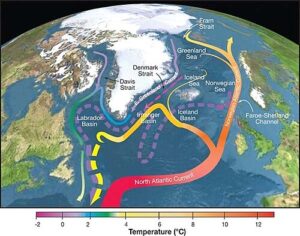
Alice and her colleagues studied high-resolution paleoceanographic sediment cores to track the movement of ocean currents more than 10,000 years ago. Here we come to an astounding surprise. Contrary to what we thought, the big Gulf Stream did not stop during the Younger Dryas. It moved further North and more important, slid below cooler Arctic meltwaters. Benign heating of the North Atlantic, stopped arriving in Iceland, Scandinavia and northern Europe.
According to hard data collected from the ocean floor, the time lag between undersea changes and the great cooling was between 30 and 80 years. That makes it possible the Gulf Stream, or AMOC, could have already begun to change, but we might not know it until 50 years later.
THE COLD BLOB
The year 2015 was the hottest on record to that point. A map of ocean temperatures shows a lot of bright red warming patches. But there was a strange blue “cold blob” hovering in the Atlantic below Greenland. This year that ocean cooling spread as far West as Canada’s Labrador Sea. Could this be part of the puzzle of the Gulf Stream change?
SEE; Research Letter Open Access “Multidecadal Atlantic “Warming Hole” Heat Content Variations Are Caused by Ocean Heat Transport, Not by Surface Fluxes” Stefan Rahmstorf et al May 28, 2026
AND “The Atlantic Cold Blob: A Warning Signal from the Ocean – How a Mysterious Cooling Patch South of Greenland Is Reshaping Our Understanding of Climate Change” by Dr. Isuru Senarath
INSIDE OCEAN SCIENCE
On June 14, the UK’s Guardian newspaper three top ocean scientists reported programs that monitor the strength of the North Atlantic currents are at risk of being defunded, especially in the United States. The European OpenEye initiative sounds promising but doesn’t become functional until 2035. Are we going blind to this existential danger for the UK and Northern Europe?
We have been discussing the new paper “Co-ordinated shifts in deep-water formation and Gulf Stream migration during abrupt climate changes.” This is Open access Published: 11 June 2026 in Nature Communications.
SEE ALSO: “Amoc collapse could change Europe’s climate 10x faster than expected. We aren’t ready” – Penny Holliday, Femke de Jong and Sjoerd Groeskamp June 14, 2026
====================
PERMAFROST FLIPS SINK TO SOURCE – SOONER
PHILIPPE CIAIS
About 15% of all the land in the Northern Hemisphere is frozen year round. But in the distant past that was covered with green life. All that old carbon is stored in the deep freeze, waiting for warmer days to release it . When permafrost thaws, natural systems could release more greenhouse gases than humans. There is nothing we can do to stop it. Is this mechanism already at work? We have new science with more answers.
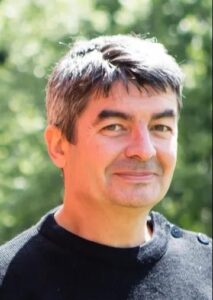
Dr. Philippe Ciais is Associate Director of the Laboratory of Sciences of Climate and Environment at the Institut Pierre Simon Laplace, a top-level research institute west of Versailles. Dr. Ciais is a physicist specializing in the global carbon cycle and climate change.
WORLD’S MOST CITED CLIMATE SCIENTIST ON RADIO ECOSHOCK
According to a global ranking by Carbon Brief, the overall most cited climate scientist in the world is: our guest Professor Philippe Ciais of the Laboratory for Climate and Environmental Sciences in Paris. In the top spot, Ciais currently has over 69,000 total academic citations for his work on the global carbon cycle. He’s also been named the world’s Number 1 environmental scientist. This is a scientist with foundational work on climate change who still makes time for our listeners.
Prof Philippe Ciais Named World’s No.1 Environmental Scientist
Listen to or download this 27 minute interview with Philippe Ciais in CD Quality or Lo-Fi
A SINK COLLAPSE DURING EL NINO?
Before we get to the permafrost, here we go into a strong El Nino year expected to drive more record heat later this year and into next. Philippe and I talked in 2024 about a study suggesting natural recapture of CO2 by land plants “collapsed” during record heat. Should we expect another bump in climate change during El Nino – simply because over-heated plants can’t capture as much of our carbon pollution?
Philippe tells us:
“We do expect that El Niño comes with a weakening or collapse of the absorption of carbon dioxide by the vegetation in the tropics, and we believe that the same thing may happen in a few months because El Niño, which is forecasted by the global weather and climate systems, seems to be a very strong one. And the stronger is the El Niño, the drier is the climate over the rainforest and tropical continents, and we do expect indeed a very bad year again for carbon dioxide uptake by the vegetation and the soil.”
PERMAFROST – SINK OR SOURCE?
The real inspiration for this interview is harsh news: after thousands of years collecting and storing greenhouse carbon, more than a third of the vast boreal Arctic is now emitting more than it stores. This includes the boreal forest across Alaska, Canada, Scandinavia and Russia – plus the treeless Tundra and all those wetlands. It is all warming four times faster than the global average. Wildfires make emissions even worse.
The North has shifted. More and more, those emissions are amplifying our fossil burning civilization. Eventually, those “natural” sources, pushed by our changes to the atmosphere, will overtake human forcing. Then any changes we make could be too late.
So we need to know when that switch happens. As always, new science find the permafrost pendulum will come earlier than expected. The new paper, published June 12th is “Net release of CO2 from thawing permafrost soil carbon predicted to occur earlier in this century”. Philippe Ciais is co-author.
A number of papers in the last couple of years warned the Arctic “sink” grabbing carbon from the air is become a source instead. In January 2025, scientists from the Woodwell Climate Research Center found more than one-third of Arctic-boreal region is now a source of more carbon into the air.
After millennia as carbon dioxide sink, more than one-third of Arctic-boreal region is now a source
DEEP CARBON COMES OUT
Here is a key insight from the interview. Ciais says:
“So all the conventional climate models that have an imperfect description of permafrost carbon predicted that the continuous growth of plant was basically beating or offsetting the small release of frozen carbon by thawing. We found something different because for the first time we accounted for a lot of frozen carbon which is deep. We’re talking about carbon which is buried deeper than one or even three meters.
And when we account for this old deep carbon, we found that it’s quite vulnerable to warming and it could release more CO2 than previously thought. And this is the reason why instead of behaving like a continuous carbon sink in the future, according to our model predictions, we see that the sink will continue until the middle of the century and might reverse to a source because of the very strong effect of the CO2 which is released by the deep carbon that was previously frozen.”
WILDFIRE WILD CARD
On Radio Ecoshock, we cover increasing super wildfires – especially in the far north, like Canada’s record-smashing burn in 2024. A 2025 study led by University of Alberta scientists found burned permafrost peatlands release carbon for years after wildfires. So it’s a complex picture where extreme northern heat pushes wildfires that expose more permafrost land.
In the interview I cite this Canadian science Research Letter (Open Access) “Large Carbon Losses From Burned Permafrost Peatlands During Post-Fire Succession” Christopher Schulze et al (October 7, 2025).
PERMA-FUTURE?
Let’s fast-forward to 2070, just 44 years away, well within the time of many living now. I ask Dr. Ciais: Given what we know so far, what do you think will be happening with the permafrost and atmosphere then?
“Well, it seems that the warming in the Arctic is inexorable. It’s currently three to four times faster than the global warming. We are not heading into a strong reduction of carbon dioxide emissions, although we may hope that this will change in the future. So right now, with the stated policies and the lack of mitigation effort, we are probably going to have global warming of like, I would say, 2.5, perhaps 3 degrees [C] if we don’t do anything. That’s global.
And for the Arctic, it means an Arctic warming of 7, sometimes 8 degrees in some regions. So, you know, it’s just physics. If you expose the frozen soil to temperature above zero during the long part of the year, a lot of the permafrost will be gone, and the carbon will be available for microbes to be decomposed.
We still have a lot of uncertainty because we don’t know if this carbon is fully tasty for the microbes. We think it is tasty, but we don’t have too much measurement to confirm that. And also part of this soil carbon might not go to the atmosphere. It might go as dissolved carbon to the rivers and to the ocean. And this lateral export of carbon from permafrost soil is something which is still missing in our model. So we have a lot to do to understand all the possible pathways that determine the fate of previously frozen carbon.”
So the bottom line is: we have to drastically slash our greenhouse gas emissions – because natural systems like permafrost are responding to warming by adding more warming.
SEE ALSO THIS METHANE GROWTH PAPER BY CIAIS IN FEB
Why methane surged in the atmosphere during the early 2020s P. Ciais et al. Science Feb. 5, 2026
PREVIOUS PHILIPPE CIAIS ON RADIO ECOSHOCK
The Plan To Wreck The Atmosphere
Posted on November 22, 2023
And in September 25, 2024 on collapsing capture of CO2 by land plants
WILDFIRES AND CLIMATE CHANGE: PHILIPPE CIAIS
“Boreal fires, which typically account for 10% of global fire carbon dioxide emissions, contributed 23% in 2021, a new study reports.”
MOST RECENT ECOSHOCK SHOW ON PERMAFROST AND CLIMATE
Meltdown Sounds – The Permafrost Pulse
Posted on February 18, 2026, the newest permafrost science with Christina Schädel, Senior Research Scientist at the Woodwell Climate Research Center in Massachusetts.
THANKS FROM ALEX
Congratulations. Only inquiring minds make it this far. Thank you for embarking on this journey. I also thank the hardy group of listeners who donate $10 a month to keep this program going out free to people around the world every week. Without your support, this direct voice of the scientists would not happen.
More to come next week. These are busy times covering the greatest change humanity will ever know.
Alex.