What the oil industry won’t tell you: fossil fuel smog is killing almost 100,000 Americans a year. In the UK mortality estimates range from 29,000 to 43,000. From UCL and University of Birmingham, Dr. Karn Vohra on the real cost of gas and oil in the USA. Few of us could name the third biggest greenhouse gas. The ins-and-outs of ozone and global warming with Professor Bill Collins from University of Reading. Plus: the hot state of Pakistan with Adil Najam and a new climate song “Hot Nights”.
Listen to or download this Radio Ecoshock show in CD Quality (57 MB) or Lo-Fi (14 MB)
FOSSIL-BURNING POLLUTION KILLING US
Karn Vohra
Americans die younger than men and women in the UK or Scandinavia – like five to seven fewer years of life expectancy. There are many factors, but a big one is simple: living with lots of oil and gas pollution. From well sites all the way to our tailpipes and factories, fossil fuels rob years of life.
In the last few years the U.S. produced more gas and oil than Saudi Arabia, Russia and Canada combined. The new Administration wants to make even more. What price are Americans paying for fossil energy dominance?

These days, you can’t make such claims without a lot of proof. We have that now in a new Open Access paper called “The health burden and racial-ethnic disparities of air pollution from the major oil and gas lifecycle stages in the United States.” The Lead Author is Dr. Karn Vohra, a research fellow at University of Birmingham and University College London. He is a specialist in Environmental Health and Risk Management with several previous papers on oil and gas pollution.
Listen to or download this 22 minute interview with Karn Vohra in CD Quality or Lo-Fi
But tens of thousands of people in the United Kingdom are dying way too early because of fossil smog. The UK estimates come from this earlier 2022 paper “Impacts of emissions policies on future UK mortality burdens associated with air pollution” by Macintyre et al. It’s everywhere.
In 2021 Karn Vohra led a study finding one in five deaths around the world was caused by burning fossil fuels. That is about 8.7 million deaths globally in 2018, a staggering loss. A year later, Karn warned of premature mortality in fast-growing tropical cities. Vohra told the New York Times: ““Our analysis suggests we’re entering a new era of air pollution in these cities, with some experiencing rates of degradation in a year that other cities experience in a decade.”
Now he’s tackled fossil air pollution deaths and harms in the United States. Despite illness clusters around refineries and ports, the worst pollution by far comes from the “end-use” stage, like burning in power plants and cars.
The Science Advances press release summarizes findings of the new paper:
“A new model based on air pollution data from 2017, which represents all four phases of the oil and gas (O&G) lifecycle in the United States, suggests that 91,000 premature deaths and 10,350 preterm births are attributable to the industry. Additionally, the data show intense racial disparities, with Black populations facing higher mortality and preterm birth burdens from particulate matter exposure, along with substantial health impacts in Asian, Hispanic, and Native American populations. Previous air pollution research has tended to focus only on portions of the O&G lifecycle.
To address this knowledge gap, Karn Vohra and colleagues sought to quantify the full impact of all four stages of the O&G lifecycle:
upstream (exploration and extraction),
midstream (storage and transmission),
downstream (refining and processing), and
end-use (delivery and consumption).
The researchers created an emissions inventory that identified nine harmful compounds released at different O&G lifecycle stages, including fine particulate matter, nitrogen dioxide, benzene, and formaldehyde. They then combined this inventory with demographic datasets, ambient surface concentrations, a chemistry transport model, and health risk assessment models to quantify mortality, preterm births, and rates of asthma and cancer.”
IT’S ACTUALLY WORSE NOW
To get complete data, the study led by Vohra used 2017 as a baseline year. The tally of U.S. premature deaths and illness is shocking. But Vohra tells us the industry expanded by about 40% since then! Deaths and damages are correspondingly much worse that this study finds, despite our belief the air has been cleaned up. For example, some visible smog has been reduced in Los Angeles since the 1970s with regulations, but the air there is still lethal. And this is before we add in the new, even more toxic, wildfire smoke on top.
The authors also use figures from an Environmental Protection Agency database. Some of those numbers are industry reported, and outside studies find much higher levels. Again this sounds worse. We should say actual damages to Americans are higher than reported but unknown.
In previous times, we might expect governments would become concerned with this data and regulate every stage to reduce pollution. The current U.S. government, and other governments, are tossing out not just regulations, but even requirements to monitor or report pollution. Vohra agrees it is possible this paper could not be produced for 2025 or 2026, as data disappears. We will pretend tens of thousands are not dying early because nobody tracks it.
Alex says: The electric car (and truck) revolution were supposed to fix this. The current Administration is trying to kill that off too. We love to drive. Apparently millions of people are dying to do it.
I don’t often see studies with such detail in sources and methods. The authors must have anticipated criticism from the fossil fuel lobbies. Yet, despite publishing these mortality and harm data for years, Vohra says there has been no pressure or attacks.
ECO-JUSTICE?
Also under attack lately: the eco-justice movement. But this paper is explicit that African Americans, Latinos and Native populations suffer the greatest damages from fossil energy pollution. It is no secret that life expectancy near refineries is lower, and these are often placed in predominately non-white areas. If this is your campaign, read this paper to get hard facts backed up with hard numbers. Also check out this 2021 paper.
For example, other studies find White men in Louisiana live 4 to 6 years longer than Black men. The majority of Black men do not reach the age of seventy. Even taking into account poverty and diet, it looks like all those wells, refineries and oil shipping are taking a toll on Black residents around them.
I wonder: How many of these deaths are preventable? Did anyone calculate a spreadsheet of costs to cut pollution versus lives saved? For example, are the specific parts of this “lifecycle” that could be cleaned up at relatively low cost, saving a lot of lives, versus other steps that would seem impossibly expensive for just a few lives saved?
The study maps are easy to understand. People near high oil and gas production and refining are at a much higher risk of premature death or birth. If current governments and corporations refuse to do anything about the pollution – is the only option to move to a place with cleaner air?
CALIFORNIA AND TEXAS SUFFER MOST
From the study:
“Texas and California have the greatest burden for almost all pollutant-health outcome risks and O&G lifecycle stages. Only New York (7200) and Pennsylvania (6300) premature mortality totals for all stages from combined exposure to PM2.5, NO2, and MDA8 O3 surpass that for Texas (5800).”
==============================
OZONE IS THE NUMBER THREE WARMING GAS!
Bill Collins
Ozone is a big factor in global warming. A new study led by University of Reading found ozone could be the second largest contributor to future warming by 2050. Ironically, efforts to restore the protective ozone layer may add to the climate shift.

Let’s investigate with the Lead Author, William J. Collins, Professor of Climate Processes at University of Reading. He’s been working and publishing on this sticky problem for 20 years. In 2006 he co-authored the paper “Radiative forcing since preindustrial times due to ozone change in the troposphere and the lower stratosphere.” We’ve learned a lot in the twenty years since. In this interview, Bill talks about the new paper “Climate forcing due to future ozone changes: an intercomparison of metrics and methods” – published August 21, 2025 in EGU Atmospheric Chemistry and Physics.
Listen to or download this interview with Bill Collins in CD Quality or Lo-Fi
Ozone has two faces. In the upper atmosphere it helps prevent cancer by shielding ultraviolet rays from the Sun. Here on the ground, ozone is part of the smog that kills millions of people a year. So there is “good” ozone and “bad” ozone?
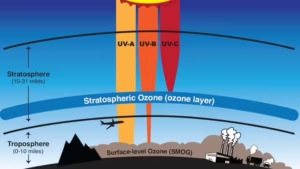
Let’s start high in the stratosphere. We know the ozone hole over Antarctica is dangerous. So governments banned Chlorofluorocarbons or CFC’s. We hope upper level ozone will recover. Unfortunately, as we hear in this interview, that ozone recovery will contribute to more warming. Ozone is itself a greenhouse gas reducing the amount of energy released from Earth to space.
Try this helpful article by University of Reading “Ozone will warm planet more than first thought, study finds”. The article says:
“While banning ozone-destroying gases such as CFCs has helped the ozone layer to recover, when combined with increased air pollution the impact of ozone could warm the planet 40% more than originally thought.
A new study led by the University of Reading found that from 2015 to 2050, ozone is expected to cause 0.27 watts per square meter (Wm-2) of extra warming. This figure—which measures how much extra energy gets trapped per square meter of Earth’s surface—would make ozone the second largest contributor to future warming by 2050, after carbon dioxide (1.75 Wm-2 of extra warming).”
==========================
PAKISTAN IN THE HOT SEAT
Perhaps some people hold a dark concept of climate conquest. They don’t reduce greenhouse gases, clean up deadly air, or get off fossil dependence. They/we think industrial tools ensure our survival, while other countries or races are damaged by ongoing climate disasters. We win and they lose. It is a sick logic where everyone and every species loses to a destabilized climate and moral decay.
Case in point: Pakistan.
Pakistan endured a string of spectacular climate-driven disasters. With over 1300 glaciers, they have the largest volume of glacial ice outside the Poles. But with smashing heat, glaciers fail – leaving outbursts of water and rocks to wash away everything and everyone downstream. In addition, significant parts of the country flood at the same time during abnormal extreme rain. That just happened. Lives and livelihoods are lost along with homes and business. There is no insurance and no aid to rebuild or replant. Some families never recover.
WHO CARES?
Who cares? Pakistan is a nuclear power. They just made a mutual defense pact with Saudi Arabia. The Saudis have long-range missiles but no nuclear weapons that anyone knows. Will Saudi Arabia fund their nuclear weapons development in Pakistan?
Keep in mind always, both countries are unbearably hot the whole time. Both Pakistan and Saudi Arabia have recorded temperatures as high as 53 degrees C or 128.8 Fahrenheit in the shade. The last few years have been brutally hot. How does that change what people do?
In 2015, the New York Times wrote: “Searing temperatures, which have been as high as 113 degrees Fahrenheit, or 45 degrees Celsius… a sense of panic and crisis persisted in [Karachi], the country’s financial and commercial capital as well as the capital of Sindh Province.” More than 1,300 people died in Karachi in that heat wave.
REALITY REPORTED FROM PAKISTAN
Adil Najam
In 2016 we got a report directly from Karachi. That key port city in Pakistan was already going through heat waves killing thousands. Those years seem cool compared to new record heat, going on and on, in Pakistan in 2023 and ever since. People are dying and flocking to hospitals. The majority of the population, Najam says, do not have any access to air-conditioning, and not even a fan or reliable electricity. Most people in Pakistan are defenseless – and they contribute a teaspoon of warming gases compared to our massive burning over the past century. They did not make global warming, but they try to survive on the front lines of extreme global heating. Get the real picture.
Listen to or download the full 22 minute interview with Dr. Adil Najam in CD Quality
This is from Radio Ecoshock in June 2016.
In July 2025 the New York Times reports:
“Since 1960, Karachi’s mean nighttime temperatures have risen by about 4.3 degrees Fahrenheit (2.4 degrees Celsius), while daytime highs have risen by about 2.9 degrees Fahrenheit, studies show. Globally, temperatures have risen by about 1.9 degrees Fahrenheit since 1900.”
The worst for Pakistan, maybe the worst anywhere, was the 2010 “super-flood”. Twenty million people were displaced as almost a third of the country went underwater. A third of Pakistan was underwater again in 2022’s “super flood”. It killed at least 1700 people and affected 33 million.
At least 700 people died in the summer of 2025 as weird extreme rains turned into flash floods and landslides. Whole villages were wiped out. In between drought lasting years have plagued other agricultural parts of the country. Compound events are increasing – like heat waves melting glaciers which then flood everything below.
GEOPOLITICS
Getting back to geopolitics amid disaster, Pakistan is supposed to be a US ally, chosen over India. Pakistan’s Army Chief was just in the Whitehouse and Pakistan got better tariff deals than India. This development affronted India. Indian Prime Minister Modi went to the Shanghai Cooperation Organisation (SCO) summit in Tianjin, China August 31 to September 1, 2025. Russia, North Korea, Iran were featured but dozens of countries attended. Saudi Arabia was there as a “Dialog Partner” not a signed-up member of SCO (yet). One aim is for China to create a world economic system outside Anglo-American dominance. As Al Jazeera put it “Xi, Putin and Modi pledge unity at summit to counter US-led global order.”
Pakistan has a population of around 250 million people. Millions of Pakistanis live in enclaves in other countries. We share this world in a hundred ways. Their fate and response are in a rising tide of challenge and distress in the real world.
Thanks for listening and caring.
NEW SONG “HOT NIGHTS”
We go out with a test. I can’t decide between two versions of a song covering hot nights, the global warming phenomenon increasing around the world. The lyrics are by Alex Smith and music by AI. First we get dirty delta blues – and then Suno creates an acapella version, something it was unable to do a year ago.
HOT NIGHTS (dirty delta)
HOT NIGHTS (Acapella)