Why are so many experts and bloggers predicting more cold outbreaks as the planet warms? Our UK scientist Edward Hanna explains. What happened the last time Earth’s atmosphere carried so much carbon dioxide? Welcome to the Mid-Pliocene Warm Period. With just 400 parts per million CO2 Earth went over 3 degrees C hotter. Sea levels were at least 27 feet higher. We get the inside scoop in new science led by New Zealand scientist Georgia Grant. High science and deep time this week on Radio Ecoshock.
Listen to or download this Radio Ecoshock show in CD Quality (57 MB) or Lo-Fi (14 MB)
WELCOME TO THE STRATOSPHERE
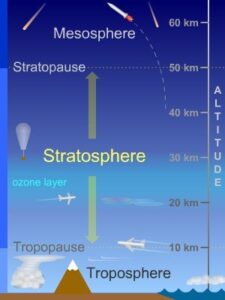
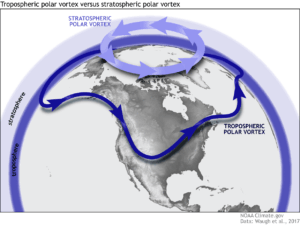
Humans did not know much about the stratosphere until the last century. We can’t see it. Sound doesn’t carry from there, or travel well in that thin air. Large three-dimensional waves of air move about in the Stratosphere, like ocean currents. Pushed by differences in temperature and pressure, the strongest stratospheric winds are around both Poles. These circular winds usually flow counter-clockwise in the Northern Hemisphere, and clockwise around the South Pole. Sometimes they collapse and flow the other direction in a Sudden Stratospheric Warming. Polar Vortex winds help keep the coldest air on Earth circulating around the Poles, and not further south into the mid-latitudes where the majority of humanity live. As we hear from our first guest Dr. Edward Hanna, that protection can break down.
CREATOR: gd-jpeg v1.0 (using IJG JPEG v62), quality = 100
Keep in mind, despite what TV forecasters say, the Stratospheric Polar Vortex is not the same as the Jet Stream, which is lower down in the Troposphere. The Stratosphere is less turbulent than the Troposphere, which is why big jets may fly up to 36,000 feet or more, above 11,000 meters.
Previously we thought all weather happens in the Troposphere, while the Stratosphere was relatively calm and stable. But the separation between the weather layer and the stratosphere is not complete. We know that certain energy events in the Troposphere can influence stratospheric winds. But our interest here is the other way around. How do variations in the Stratospheric Polar Vortex change our weather? Is this why large regions can be hit with a severe cold-air outbreak even as the world warms? We are seeing warmer and warmer winters. Each year competes for the warmest winter ever recorded. Then strangely, Arctic air events arrive in the south.
Take the atmospheric cold blob over Scandinavia and Northwestern Russia two years ago. It was the winter running October 2023 to January 2024. The rest of the planet was record hot, coming out of the phenomenally hot year of 2023. According to a 2024 study on this Russo-Scandinavian cold blob: “On 5 January 2024, the temperature dropped to -44.6°C in Vittangi, Sweden, and -44.3°C was recorded at Enontekiö Airport, Finland. Both readings were the lowest temperatures recorded in their respective countries in the twenty-first century.” That’s just a little shy of minus 50 degrees Fahrenheit, way below normal, dangerously cold – in a record hot world.
Skiers and ice-fishers loved it. But electricity prices hit an all-time high in Finland. Rail, roads and ferries shut down, along with some schools. The study authors noted, “people may be more vulnerable to severe cold because they occur less frequently nowadays”.
COLD THREAT TO WINTER WHEAT
Meteorologist and climate scientist Judah Cohen publishes studies of extreme weather while working for a private company. In an interview, I asked Judah “Who buys forecasts which include developments in the Stratospheric Polar Vortex?” Cohen gave the example of grain futures traders. If you could know winter wheat might be damaged by a cold-air outbreak, you might make money betting on that, or make trades that readjust global wheat pricing, based on availability from crop success or failure.
I took a look at winter wheat. About a third of humans depend on wheat as a staple crop. Eighty percent of all wheat is winter wheat. It is planted in the Fall to let it develop a root system and a few leaves ahead of Spring. In February 2025, Reuters reported Chicago wheat future prices hit a four month high as cold threatened winter wheat in both America and Russia.
On the Great Plains, a January 2025 cold-air outbreak brought temperatures as low as -40 degrees C, which is about the same as minus 40 degrees Fahrenheit. A previous dry fall made the wheat more fragile to cold. Drought and excursions of cold-air during breakdowns of the Polar Vortex combine to raise threats to crops. Soil with less moisture gets colder faster than moist soil.
The classic case of cold-air outbreak was the North American winter storm of February 13–17, 2021. The cold traveled south all the way to Texas and Northern Mexico. Texas experienced the largest blackout in the U.S. since the Northeast blackout of 2003. The cold outbreak killed about 700 people in the United States – most of them in Texas. Pipes burst, refineries shut down, power plants went off line. Infrastructure was not built for such cold and Texas chose an isolated power system that could not draw from neighboring states.
The event was preceded by a sudden stratospheric warming (SSW) event in January, which can disrupt the polar vortex and lead to these cold air outbreaks. But a study from the American Meteorological Society found stratospheric changes were not central to this particular cold wave. They found atmospheric variability and predictable La Niña teleconnections were principal causes of the deadly Texas cold snap of 2021..
Stay tuned for long-shot predictions favoring unusual cold and snow for North America and parts of Europe next winter. Are all the drivers lining up for a severe cold outbreak?
==================================
NASTY COLD SNAPS DURING WARMING
EDWARD HANNA
It is hard to believe but in the mid-latitudes where most of us live – winters are warming faster than summers. Except… severely cold air can suddenly break out of the Arctic. Due to changes in the upper atmosphere, a key study shows cold-air outbreaks become more likely as the planet warms.
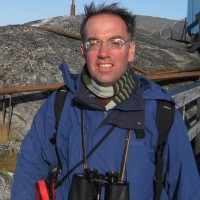
The Lead Author is Professor Edward Hanna from University of Lincoln UK. Dr. Hanna published more than one hundred and fifty peer-reviewed papers. He was a Contributing Author on the IPCC Fifth Assessment Report and a Fellow of the Royal Meteorological Society. Published December 10, 2024, the title for this winter weather warning is: “Influence of high-latitude blocking and the northern stratospheric polar vortex on cold-air outbreaks under Arctic amplification of global warming”.
Listen to or download this 26 minute interview with Edward Hanna in CD Quality of Lo-Fi
From October 2023 to January 2024, a nasty cold wave settled over Scandinavia and parts of Russia. While the rest of the world was record-warm, this “cold blob” made a half dozen countries colder than normal for months. One of the best season forecasters, Copernicus Climate Change Service did NOT predict this cold blob, even when the model was started in October 2023 when the cold air had already arrived.
“… the Arctic has warmed four times faster than the global mean annually based on observed data since 1980.
Despite this Arctic amplification, a surprising number of historic cold-air outbreaks have occurred in the United States and Eurasia in recent years, the frequency of which may even be increasing regionally during the period of [Arctic amplification].”
This paper from Hanna et al. includes a really helpful review and overview of the science. Just recently, July 11, a new paper appeared on “Cold-air outbreaks in the continental US: Connections with stratospheric variations”. Lead Author is Laurie Agel from the University of Massachusetts Lowell.
In the Severe Weather Europe blog, Andrej Flis finds three key factors are lined up to predict a serious cold-air outbreak next winter. Everybody from city operators to social agencies would like a prediction. Is it too soon – and if so, how far in advance can we know deadly cold is on the way?
======================
BACK TO THE FUTURE: THE WARMING BEFORE THIS
GEORGIA GRANT
Climate models warn a much hotter world is coming within a single lifetime. This calls for drastic changes to our fossil-fueled civilization. But are those predictions solid How does a “global mean average” actually show up in your country?

International scientists have been working to cross-check the future against times of past warming. Our guest Dr. Georgia Grant helped develop a new tool using carefully analyzed sediments. She is Senior Sedimentologist for GNS Science, now the new Public Research Organisation Earth Sciences New Zealand. Georgia is a deep-past explorer looking for echoes of the future.
Listen to or download this 27 minute interview with Georgia Grant in CD Quality of Lo-Fi
A major focus for scientists comparing the deep past to our future is the “mid-Pliocene warm period” – a relatively short period of about 300,000 years around 3 million years ago. The continents were in modern positions and carbon dioxide levels were about 400 parts per million. Some scientists call this time the mid-Piacenzian Warm Period.
So what happened to Polar ice in the last warming period? How hot was it on land?
Scientists have developed several techniques to estimate CO2 levels and temperature at that time. Some use fossil remains of indicator species. This study goes one step deeper, also looking at clues in sediments. For example, in a bay in New Zealand, Georgia Grant worked with samples taken from sediments keeping a record several million years long. It requires extremely careful sampling and patience to date layers.
In 2019 Georgia investigated sea level rise during the mid-Pliocene warming. In a 2023 paper published by the EGU, Grant’s team emphasized global warming is not going to affect the whole planet equally. I’ve seen a map of heat distribution during the Mid-Pliocene [in Robinson and Dowsett, 2008]. The biggest heat changes circle around the Poles, while the Tropics don’t change a lot. That is bad news for my country of Canada, and I guess for New Zealand too.
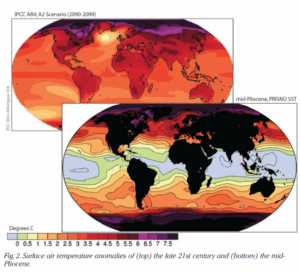
In her 2025 paper, Grant found sea level rise may have been over-estimated. While still shockingly different, as much as 45 meters – about 150 feet – from lows to the highs – sea level rise might have been less extreme than some science suggested.
Until about a million years ago, the timing of glaciers expanding and contracting was coincident with the 41,000 year cycle of the tilt of the Earth relative to it’s orbit. Then for the last million years, the classic ice ages we know, the timing shifted to the 100,000 year pattern of Earth’s orbit. I ask Georgia if we know why this great ice clock changed.
When funding for the Deep South Challenge was cut by the government in 2024, where does that leave the New Zealand Earth System Model? Seven years of work, creating the first Southern Hemisphere global climate model that I know about, are at risk. Key people have left. There is a scramble to keep this tool. As I discussed last week with Edward Doddridge, New Zealand has been cutting climate research funding.
For a number of years, going back to her 2019 model measuring grain size to estimate water depth, Georgia Grant has been searching for a Holy Grail: an independent record of what past warming was like, particularly changes in ocean heights and temperatures, as well as glaciation. Getting this right helps an essential check on predictions made by current climate models, particularly the sensitivity of big systems like ice and ocean currents. We can check models of the future by running them backward to see if they accurately reproduce the past. But what was the past? That is part of her work.
MORE BREAKING SCIENCE ON MIOCENE WARMING
“Speleothem evidence for Late Miocene extreme Arctic amplification – an analogue for near-future anthropogenic climate change” Stuart Umbo et al September 8, 2025. They found that Miocene warm period endured at least 18 degrees C of Arctic warming! This may be the time when crocodiles inhabited the remote far-north Ellesmere Island. Their bones, and other plant fossils, speak to an Arctic that could warm like the Tropics of today. I got this tip from Jan Umsonst.
=============
If you find this program and blog useful, please become a supporter! You could make a one-time donation, or offer a low cost monthly contribution. There is no other funding for Radio Ecoshock. Find out how here.
More science direct from the authors next week as we track a little planet heading for big changes.
Thanks to all readers and listeners!
Alex
Radio Ecoshock