Climate experts and meteorologists in Germany are freaking out. Global warming accelerated significantly. News from The German Meteorological Society, the German Physical Society, and Potsdam Professor Stefan Rahmstorf. I’ll break down the latest including a horrific 3 degrees C of global warming by 2050. Until now, the ocean absorbed about a third of carbon dioxide emissions. Latest science finds “Unexpected decline in the ocean carbon sink under record-high sea surface temperatures in 2023”. We talk with Lead Author Jens Daniel Müller in Zurich. Hot trouble this week on Radio Ecoshock.
I’m Alex Smith.
Listen to or download this Radio Ecoshock show in CD Quality (57 MB) or Lo-Fi (14 MB)
1. WARMING ACCELERATION
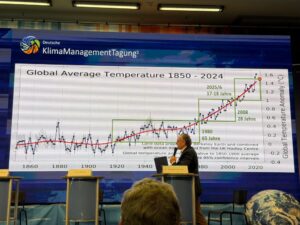
While American authorities call global warming “a hoax”, people in other countries are pressing every alarm button. Who are these “alarmists”? The German Meteorological Society (DMG) – the weather people – and the German Physical Society (DPG), the world oldest and largest society of physical scientists. On September 25, they released a warning report called “Global warming is accelerating – A call for decisive action”. They now see 3°C of global warming could be reached already by 2050, fifty years ahead of the former worst-case scenarios.
The report is so far just in German, but an English version is expected. I would not have known except for posts on BlueSky by Dutch amateur scientist Leon Simons. I am sometimes wary of Simons. He gets excited, has a mono-focus on aerosols and climate, and attacked well-established climate scientists he disagrees with. However, Simons is perceptive, on-the-hunt, and from his perch in the Netherlands serves as a good doorway into developments in Germany and the rest of Europe.
As Simons says, the auto-translation of the German report works well. Here are just a few quotes from the German report on acceleration, courtesy of Leon Simons and auto-translate:
‘Increasingly extreme weather conditions are making predictable agriculture difficult, and in some cases impossible.
There is a high risk that the limits of habitability will be exceeded in some regions of the world.
More translated quotes from German report “Global warming is accelerating – A call for decisive action”:
“Decisive collective action can prevent loss of control. We therefore call on all political actors in Germany to become aware of the real danger posed by progressive man-made global warming and the urgency of action.’
‘We therefore call on all political actors in Germany to discuss the withdrawal from low-lying coastal regions on the North and Baltic Seas.”
The BlueSky poster Climate News replies, quote:
“Good that they’re catching up. Eight months ago [we posted]:
“At 3C or more of heating by 2050, there could be more than 4 billion deaths, significant sociopolitical fragmentation worldwide, failure of states (with resulting rapid, enduring, and significant loss of capital), and extinction events.”
Climate News Continues: “Although estimate ranges vary, with China’s faster emissions reduction 3C may be breached 3-5 years later – e.g. 2052-56.
Warming has accelerated and now is at almost 0.4C per decade (and that is also increasing).
Our climate is currently already at 1.5C of warming, and by 2035-38 will be at 2C, 2044-47 at 2.5C and 2053-56 at 3.0 C.”
That was from Climate News, possibly located in Italy?
ACCELERATED WARMING IS A THREAT TO LIFE AND LIMB
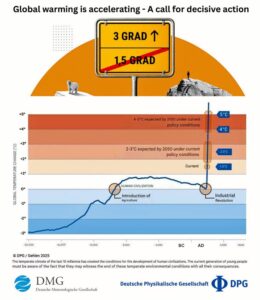
Lets get back to that report from the German Meteorological Society and Physical Society. Here are the opening paragraphs, translated from German by Google, under the title “Accelerated warming is a threat to life and limb”.
“Even the currently measurable temperature changes are having dramatic effects. Worldwide, in Europe, and Germany, extreme weather events are increasing and are increasingly occurring in regions where these events were previously completely unknown.
On the one hand, prolonged droughts, heat waves, and widespread forest and bush fires are becoming more frequent, while on the other hand, heavy rainfall events, often accompanied by severe flooding, are occurring. The resulting damage to private and public property is immense and threatens to increase further as global warming progresses.
The dangers to life and limb are also increasing sharply due to climate change. Young children, the elderly, and people with pre-existing medical conditions are particularly affected by extreme heat. In some regions of the world, it is already almost impossible to survive (or survive) under extreme weather conditions for long periods of time.
It is possible that before 2050, situations will arise for the first time in tropical regions where the combination of high humidity and extremely high temperatures makes outdoor survival impossible. Regional heatwaves with unusually high water temperatures, declining oxygen levels, and increased carbon dioxide concentrations are also becoming increasingly frequent in the oceans, with fatal consequences for marine life. Sea level rise is expected to accelerate significantly and threaten coastal regions worldwide in the coming decades.
Increasingly extreme weather conditions are making predictable agriculture difficult, and in some cases impossible, in large parts of the world. Water supplies are also becoming a constant challenge in many places due to melting glaciers. Furthermore, global biodiversity is declining dramatically. For hundreds of millions of people – currently primarily in the Global South – these developments pose a very high potential for impoverishment and famine. There is a high risk that the limits of habitability will be exceeded in some regions of the world. This would significantly increase the likelihood that people would be forced to leave these regions.”
End quote from the new report from associations of German meteorologists and physical scientists.
THE 15TH EXTREME WEATHER CONGRESS IN HAMBURG
Also September 24 and 25, we have the the 15th Extreme Weather Congress in Hamburg. There Frank Böttcher, Chairman of the German Meteorological Society told “Heute” the television news program on the German channel ZDF:
“We must now think and plan for a world in which we will already exceed the three-degree limit by 2050….The acceleration of global warming is so rapid that we are flying off the climate curve.”
Can anyone really plan for a world so hot just 25 years from now? Top German climate Professor Stefan Rahmstorf told ZDF TV Exceeding the three-degree mark by 2050 would be a “worst-case scenario” [which could make] “regulated adaptation practically impossible.”
The latest Extreme Weather Congress was livecast on YouTube. Find those links in my show blog for anyone understanding German. Can we get an English transcription? When can Google provide live translation into a hundred languages, like we are all at the United Nations? We all need to be there for this emergency news.
Separate from all this, climate researchers Stefan Rahmstorf and Grant Foster made their urgent pre-print available to us, before peer-review. Their new study is titled “Global Warming has Accelerated Significantly”.
The Abstract says, quote:
“Recent record-hot years have caused a discussion whether global warming has accelerated, but previous analysis found that acceleration has not yet reached a 95% confidence level given the natural temperature variability. Here we account for the influence of three main natural variability factors: El Niño, volcanism, and solar variation. The resulting adjusted data show that after 2015, global temperature rose significantly faster than in any previous 10-year period since 1945.”
Not convinced by the top-rated German climate scientists, meteorologists or physical scientists? Remember former NASA Goddard Director James Hansen published his own paper online in February of 2025 titled: “Global Warming Has Accelerated: Are the United Nations and the Public Well-Informed?”
Then there are hard data measurements showing Earth is returning less heat into space, called the Earth Energy Imbalance. More on that below. Plus check out this new paper on “The history of a + 3 °C future: Global and regional drivers of greenhouse gas emissions (1820–2050)”.
We don’t need prophecy or Artificial Intelligence to know now: This world will change in ways not yet imagined in just half a lifetime. But let’s get to our guest with the latest on carbon capture by the ocean, the lifeline we counted on so far.
========================
IS OCEAN CO2 CAPTURE FAILING?
JENS DANIEL MÜLLER
Humans have been saved from greenhouse doom by the vast ocean. About 25% of our carbon dioxide emissions dissolve into the sea. The oceans also absorb about 90% of the heat induced largely by anthropogenic greenhouse gas emissions (Canadell et al., 2021; Friedlingstein et al., 2022). But that could change as sea surface temperatures rise into marine heat waves.

Is that happening? Could it? Our guest is a leader in exploring just these questions. Jens Daniel Müller is a biogeochemist exploring how the ocean stores carbon. After getting his PhD, Muller worked with Nicolas Gruber, a pioneer of the field. Now Jens is a Research Fellow with the NGO Carbon to Sea in Washington D.C. He is also Coordinator of the first distributed modeling of ocean acidification.
Listen to or download this 23 minute interview with Jens Daniel Müller in CD Quality of Lo-Fi
Jens Muller’s mentor Nicolas Gruber led a 2019 study of the ocean sink for anthropogenic CO2 from 1994 to 2007. Up to that point, the rate of carbon uptake seemed steady despite climate change. Muller and colleagues checked again for a 2023 paper and found signs of weakening carbon uptake. His new paper, published September 2nd in Nature, found a troubling development for our climate future. Look for “Unexpected decline in the ocean carbon sink under record-high sea surface temperatures in 2023”.
This means less greenhouse gas produced by humans is taken back into the sea. As global emissions continue to rise to new records, more of it stays in the atmosphere. No wonder we see weather disasters, wildfires and extreme heat records – more very year.
The ocean contains carbon in three main chemical forms. That carbon can be released into the atmosphere, called “outgassing”. Going the other way, the atmosphere is overloaded with carbon added by humans. Some of that CO2 is captured by the sea. The key question here: how much more carbon is getting trapped in the sea compared to what oceans release? It has been a solid win for our atmosphere having the ocean as a sink for emissions. That is changing.
A SCARY MOMENT
There is a scary point in this team’s new paper. They say record sea surface temperatures in 2023 were technically hot enough to “cause the uptake of CO2 from the atmosphere to cease.”
That did not happen. As I understand it, less carbon dioxide than the maximum possible was released during extended marine heating – because more stagnant waters below failed to bring as many carbon-holding chemicals to the surface. Nobody can guarantee these non-thermal mechanisms that compensate for ocean heating will continue to operate.
Scientists are NOT saying the ocean has switched from being a sink to a source. That is a simplification you only find in alarming YouTube videos. But when the ocean captures less carbon as we warm, that is more serous than most of us can imagine.
Will the seas let us down? If the ocean system cannot take our greenhouse pollution, we are stuck with it – all of it. We have never experienced that and have no models to predict what that all-you-pollute-is-what-you-get could be like. This is an out-of-reality problem that could become real.
Get more on the “ailing” ocean carbon sink here (reliable science journalism at phy.org).
=====================================
PULL THE METHANE EMERGENCY BRAKE!
As you probably know, end of September was Climate Week in New York City. It was a super gathering of world experts, buzzing like bees about the emerging climate emergency.
The NGO Methane Action cornered some of the best to talk about methane. Can we control that super warming gas, which is responsible for almost a third of warming on this planet? Host Daphne Wysham called on the President of the Institute for Governance and Sustainable Development, Durwood Zaelke.
Sadly, the audio is unintelligible to humans. But Google AI got it all in a transcript. Here are Durwood Zaelke’s brief initial remarks:
“It’s very simple. It’s too hot. Yeah, we’re 1.5 degrees. The latest IPCC report says we’re headed to three degrees and we have too little time before the self amplifying feedbacks push us past a series of tipping points. There are five to 11 irreversible tipping points between 1.5 2 degrees. So 1.5 today, two tomorrow, three soon after. I mean, we are in a climate emergency.
So we need the strategies that are the fastest way to turn warming.
It should be obvious but we originally – those of us who worked on this for decades you know – thought that climate might be a long-term problem… you know we we figure this out in the future. But the moment is now that we need to bend the warming curve. So you look at the the strategies you look at the decarbonization side which is absolutely essential and we need to move to clean energy as fast as we possibly we can. But you discover that that is not the best way to turn down warming.
It’s a long-term marathon. That’s because it is politically difficult. But it’s also because when you shut down fossil fuel facilities, especially coal, diesel, you shut down the coated cooling sulfates and they fall out in days to weeks and they unmask existing warming.
There was a OpEd this week in the New York Times with Walter and David pointing out the unmasking problem. Jim Hansen refers to it as the Faustian bargain … as we clean up the air … as we decarbonize … we’re exposing existing warming.
Now the oped unfortunately came to the wrong conclusion for the solution. They said we should go to the geoengineered solution. That’s not the first thing I put on the list for fast mitigation. Well, what would I put on the list? … So you get somewhere between 04 and 6 degrees at 2050 compared to 0.1 degrees from decarbonization. Decarbonization kicks in at around 2060 starts up fast, but it’s the marathon.
So the non CO2, it’s the sprint. Within that sprint, methane is the the most important piece. And I just came from a meeting with the Climate And Clean Air Coalition was hosting, and every single Minister and Head Of State there used the facts and figures from the CCAC on methane. At least the staff wrote the right things for Ministers and I think some of the Ministers like really do get it. They see that thing is right and so we’re doing promises and pledges. These have been okay to get us going to socialize the issue. But it is no longer sufficient in a climate emergency to say promises. You have to have mandatory mitigation So that’s the direction it could be done at the municipal level for waste but it’s got to be mandatory be done at the the state level like California, be done at the national level. European regional level. The European methane regulation is the most important in the world right now …”
That was from Durwood Zaelke at the Methane Emergency Brake event, New York City September 24th.
Human methane emissions could be dramatically reduced through changes in the natural gas industry, leading to ending the natural gas industry. Farming and diets could change to slash methane. We can’t do much about methane from thawing permafrost bogs, but even that would slow down with less human-made methane in the atmosphere. The good news: if we do it, methane already up there begins to break down in ten years. This is climate action where people could feel a tangible result in a relatively short time. Find out more at methaneaction.org.
===================
EARTH ENERGY IMBALANCE
Let’s get back to the emergency part, like a deadly climate shift in the next 25 years. A new paper this year is titled: “Earth’s Energy Imbalance More Than Doubled in Recent Decades”. I invited the Lead Author for an interview, but for now here are three key points from that study:
* Earth’s energy imbalance more than doubled in recent decades
* The large trend has taken us by surprise, and as a community we should strive to understand the underlying causes
* Our capability to observe the Earth’s energy imbalance and budget terms is threatened as satellites are decommissioned
Again, remember that retired NASA climate expert James Hansen has been shouting about Earth Energy Imbalance ever since his 2011 paper “Earth’s energy imbalance and implications”.
What does it mean? Satellites and ground observatories can measure the amount of solar energy reaching Earths’ surface, whether that is land, sea, or ice. Around 30% of that energy should bounce back into space – reflected by clouds, pollution, or any light surface below, like ice or snow. Satellites can also measure the amount of energy reflected from Earth, observed at the Top of Atmosphere. Records of those measurements show less solar energy is bouncing off the planet. Greenhouse gases like carbon dioxide and methane are keeping that extra energy within the Earth system.
James Hansen and other argue measurements of Earth Energy Imbalance accurately reflect climate change better than calculations of the Global Average Mean temperature now used in all major scientific reports and governments.
It is a huge deal that “Earth’s energy imbalance more than doubled in recent decades”. That pretty well proves that global warming is accelerating. It is. That is the reality that sane people must struggle to comprehend and then act.
=====================
ACCELERATED SEA LEVEL RISE
Another sure sign is accelerated sea level rise. Maps of abnormal ocean heat area everywhere. The marine heat wave in the North Pacific this year lasted at least half a year. A group of Chinese scientists published an extraordinary study. The title is: “Accelerated Ocean thermal expansion and its contribution to Global Sea-level rise”. The author is Ting-Yu Liang, published in the Journal of Sea Research June 3 2025.
We only have time for their highlights:
• Ocean heat content rose 1.7× faster in the past decade than in previous decades.
• Thermal expansion accounted for 56 % of global sea-level rise in recent decades.
• Global mean sea level rose 1.8× faster in the past decade than in previous decades.
• Since the 1990s, greenhouse gases have surpassed solar forcing in ocean warming.
This is all astounding stuff. Sea water simply heating up that much pushed more sea-level rise than melting glaciers. In the acceleration, greenhouse gases are warming the seas more than the sun. Heat in the sea is increasing faster. From winds to rains to what we eat, acceleration of ocean heat will change our lives in a thousand ways.
For one thing, scientists already say excess heat in the ocean helps power-up mega-storms like Typhoon Ragasa striking the Philippines, Taiwan, Hong Kong and South China. Global warming may not bring more hurricanes, but those that do form can spin up into giants in less than 24 hours, taking additional energy from hot seas below. It is only a matter of time until the next a-historic storms strike North America again. Accelerated ocean warming is here to accompany accelerated global warming.
Climate scientists are freaking out. Anybody paying attention should be. Climate change will dominate politics, economy, and lives for hundreds and thousands of years. You and I, we are living in the big change, the end of one history and start of another completely new world. How many will live to see it?
I’m Alex Smith. Thank you for your attention to this matter.
=====================
THE TRUE COST OF WILDFIRES
Outside my studio it is another summer heat wave in Fall. On a global map of abnormal heat, we are number one! I’ve seen snow on the ground in late September. We should need a wood fire at night But nope, it’s summer. Massive wildfires are burning south of us in Washington State. We get American smoke from time to time.
What do these climate-hyped wildfires cost the economy? The Environmental Defense Fund ran a webinar called “Wildfire: Costs of Inaction and Opportunities to Close the Finance Gap”. That was September 9, 2025. I recorded it. Here is a short estimate by Dr. Chris Costello. He is EDF’s Chief Economist, a member of the council of economic advisors for Governor Newsom, and Professor of Environmental Economics, University of California, Santa Barbara.
Chris Costello:
“Where I live here in the Western United States – you live here as well – Wildfire is a natural part of the landscape. But as you know, a century of suppression has led to an ecosystem that’s really completely out of whack. And I think we all know that climate change is exacerbating the imbalance and really the costs of catastrophic wealth are on the rise. I do research and advise on these issues, but I also see it firsthand.
My family and I have had to evacuate our home several times in the last decade because of really close calls with wildfire. The costs are growing, but but what are the costs? I mean, we’re we’re all familiar with things like property damage, insurance costs, suppression costs. Those are on the rise. But increasingly, there are other kinds of costs that are coming to light.
Smoke exposure, for example, causes premature hospitalizations, and it reduces labor productivity. But there are also huge costs of things like buying masks and filters and power outages, recreational losses, increased utility rates from liability rules. And when you add up all these costs, they’re really enormous.
They’re in the tens or hundreds of billions of dollars per year in the Western US alone.
But here here’s the key point. Measuring these costs is one thing, but finding actionable solutions, we can actually direct increased finance to do. That’s a whole different thing.
So where do we go from here? You know, in my view and in my kind of reading of the economics literature and research, I think first, we need to invest in the solutions we already know have a big impact. These are things like home hardening, insurance market reforms, forest management, which includes letting some fires burn, thinning forests, and things like that.
Second, we need to rethink what I think of as the incentives around fire. How can we change incentives so governments, communities, even insurance companies have a financial interest in prevention and not just picking up the pieces after a big fire.
Finally, I think targeted forest management is gonna dramatically improve our chances of success per dollar spent. That is our return on investment. The forest estate is enormous. It’s so huge that we just can’t do it. The stakes are too high and resources are too scarce. So investing in more targeted and dynamic forest management, I think, will dramatically improve our chances of success.
So to sum it up, I guess, from an economic perspective, the scale of the problem is huge and it’s growing. It’s not just structure damage and suppression that’s costly. It’s health effects and other kinds of highly economically consequential effects. And we should set our sights on investing in proven high impact solutions, realigning incentives for prevention over control, and investing in more targeted and dynamic forest management.”
That was Chris Costello from Professor of Environmental Economics, University of California, Santa Barbara. He was speaking September 9th for an online event organized by The Environmental Defense Fund.
There are too many “costs” to these super wildfire seasons. Rivers and fish are damaged. Hillsides bare of forest roots slide into valleys and cities. Lungs in humans and wildlife collect soot. So many ways of harm.
Arching over all is the new burden of carbon released from those trunks and branches. Wildfire smoke may provide cooling for a short time, but added carbon stays like a heat blanket for a hundred thousand years. New forests cannot grow back fast enough to avoid tipping points and in a new climate, may not grow back at all. Just the “cost” of carbon released by Canadian wildfires in 2023 alone is inestimable. That carbon burden will show up in warmer seas, bigger storms, in drought for some, super rain for others, and heat, heat, heat. How do we measure those costs, spread over a planet and time?
As climate accelerates, our minds become full. Let us decelerate… as the AI band strikes up climate songs, like the music of the spheres. Thank you for listening.
Please consider supporting Radio Ecoshock. It costs money to give all this important info away. Monthly donors save me having to pay for server and communications costs, equipment and all that. The occasional larger donor helps keep me alive while I spend 40 hours a week on a syndicated weekly program. Now that all the big networks have been bullied and bought, we need non-profit radio more than ever.
Hello Mr Smith . Your broadcasts are most thoroughly researched and well founded . Despite topics which are difficult to gain ebullience from ,I commend you for the resolve ,dedication and intestinal fortitude to persist in presenting extremely disturbing,yet very necessary and purposefully overlooked data . Well done and Thank you . Sounds like you live around Osoyoos . I am very familiar with area . Very sincerely Mike C