More trillions of $$ to the war machine rolling over Earth’s limits. Militarism is climate change – CodePink co-founder Jodie Evans joins us. Plus the big shift: Dr. Rene van Westen with surprising news about collapse of the Gulf Stream and AMOC. This changes everything.
Listen to or download this Radio Ecoshock show in CD Quality (57 MB) or Lo-Fi (14 MB)
Welcome to Radio Ecoshock. It’s crazy hot out there, all over the world. It was the hottest August, hottest summer, and hottest year in U.S. history. The Government Agency NOAA says so.
They also report a new all-time high for world sea-surface temperatures was measured in September 2026: 21.19 C. This global average does not include the Polar regions, just oceans between 60 degrees N and 60 south. For comparison, the 30 year mean – from 1982 to 2011 was a degree C lower, just over 20 degrees C. The largest increase came in the previous El Nino in 2023 and ’24. Record high Sea Surface temperatures mean more extreme weather and hotter times.
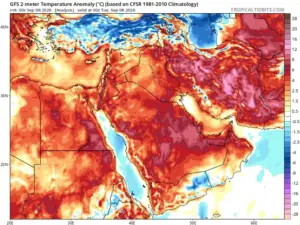
The Middle East is on fire in so many ways. While missiles blast away and tankers burn, in the second week of September is was 47 C – 116 Fahrenheit in Saudi Arabia. Deep in the humid Persian Gulf, Bahrainians suffered through their hottest September night on record. After daytime temperatures peaking at 45 C – 113 – the coldest point at night was 35.8 C – 96 degrees at night!
Feel for people roasting in North Africa, including Tunisians running out of water. Everyday people across two continents suffer through heat beyond human endurance. That is where the United States continues a war which itself pushes greenhouse gases over the limit. Peace and climate are not separate.
=======================
CLIMATE AND WAR TOGETHER
JODIE EVANS
The climate crisis: we talk about coal plants, industrial agriculture, and cars. But the world’s biggest carbon junkie is not a civilian industry. It is the military. We all know it. As campaigner Aaron Kirshenbaum says “The Pentagon budget is the most consequential environmental policy in years”.

Today, we are joined by Jodie Evans, co-founder of CODEPINK. That is the grass-roots group founded and led by women dedicated to peace and human rights. Jodie is also a Board Member of the Rainforest Action Network. She is well-placed to bridge the gap between environmental groups and antiwar organizers. Both confront the root causes of global war and ecological decay.
Listen to or download this 29 minute interview with Jodie Evans in CD Quality or Lo-Fi
Military men are super active on the planet right now. Every day big stuff blows up, tankers, warehouses, apartments, schools, you name it. Madness is running naked around the world. Officially the 2026 U.S. military and national defense budget is 890 billion dollars. Add all the rest, like the nukes, intelligence, and veteran’s care. Independent analysts find American military spending is well over a trillion dollars a year. All of it is wasted – or worse.
We took a peek at the climate cost of the military in my March Ecoshock show “War Against the Atmosphere”. Dr. Patrick Bigger, from the Climate and Community Institute talked about his report “Confronting Military Greenhouse Gas Emissions”. Meanwhile, the Intergovernmental Panel on Climate Change leaves military emissions out of plans and projections. Do you see willful blindness in science and the climate movement?
Every Patriot Missile fired makes more greenhouse gases. A single Navy Destroyer burns about 1,000 to 1,500 gallons of fuel per hour. At high combat speed the Destroyer burns over 4,000 gallons – or 15,000 liters an hour! Neta Crawford at Brown is one of my favorite sources for hard numbers.
I GET TOLD
On air, I said “I am torn about blasting oil tankers, gas fields and refineries. Maybe a fuel shortage and high prices will push more people toward solar or wind. electric cars and public transport. Is it wrong to find that bit of hope in these wars?”
Jodie’s immediate reaction: “Wash your mouth out with soap…war is never the answer, and we’ve known that forever.”
More from Jodie Evans in our interview:
“...we live in a culture where most of the people in the United States live in anxiety. And that anxiety is driven by that money that is spent on war, while the rich make a killing on killing.
I want to say the other thing that has happened in those 25 years is the rich have got increasingly richer, where two billionaires own the same value as the bottom 50 percent of the country. All of that, by the way, the work that we’ve done at Code Pink and our Wars Not Green campaign has been work to expose that this cost is to the planet. It is to life.
It is to the water we drink, the air we breathe, the capacity to live without our homes being washed away. That was hidden. And we have worked years to bring that to the surface.
Brown University did a study, after they did a study on the cost of war, which exposed how many millions have died from our weaponry and how much it’s cost. This was to finally show the cost of war to the planet, because at Code Pink, we’ve always known. When I started Code Pink, I was on the Board of Reinforcement Action Network in my community.
It was the environmental movement. And I would stand at our marches to end war and wonder where my people were, when I knew weapons and war had to be the worst thing happening to the planet. It’s taken us years to get a study done.
And then Addie Martin has done an amazing film, Earth’s Greatest Enemy, that she set out to tell when we were talking about the cost of war being what the fossil fuel usage is, which is more than anything. But what her film really shows is the unfathomable cost to the earth that is really being hidden from us and that we need to pay attention to. And our campaign is meant to bring the environmental movement together with the antiwar movement to stop the cost of war, to stop this budget, Hegseth’s most recent $1.5 trillion budget, where the money just goes to the AI billionaires.”
And this:
“We’re made to hate Iranians. We’re made to hate people, instead of understanding we are all people on this planet, interconnected, and all the science, you know, for hundreds of years have shown the only way we survive is interconnected cooperation. So, if we are not cooperating and learning how to live together, but instead destroying each other for resources to control the planet, we’re doomed.“
THE ALTERNATIVE TO WAR ECONOMY – THE PEACE ECONOMY
That alternative to the war economy which is blowing up the climate is: the peace economy. Jodie says:
“Since 15 years, since we started, billions of dollars have flowed into peace economy projects across the country. They’re happening near you. You can check out our project peaceeconomy.org and find what is near you. We have 4,000 projects across the country. People, and I would say Trump is the greatest political education teacher of all time because he’s really exposed what’s always been happening.
He’s brought it to the surface and people, especially young people, are seeing the lie that we live inside of, the full-on rape and pillage of those in power and those that own the White House, and they are moving away from the war economy and developing peace economies locally. Peace economies are local because they are the interconnected tissue that helps us stay human, helps us care for each other. The peace economy is the giving, sharing, caring, thriving, relational economy without which none of us would be alive.”
SERVE THE PLANET
Jodie Evans
“We know what to do together with each other, and when you get in your local peace economy, you learn that. Be engaged to help you out of your grief and your horror at what’s happening. Go to codepink.org when you’re feeling it and find a way to act, and go to peaceeconomy.org and start practicing a peace economy habit, and quit letting them distress your life.
When they do, when you’re in horror, when you’re in anxiety, they are winning. Take back your life. Take back your agency and serve the future. Serve the planet.”
EARTH’S GREATEST ENEMY
“Earth’s Greatest Enemy” is a new film directed by investigative journalist Abby Martin and co-written/produced with Mike Prysner (via The Empire Files). It is a feature-length documentary that examines the link between United States militarism and the global climate crisis.
The central idea is that while mainstream environmental talk often is about individual consumer choices – such as thrifting, recycling, or switching to electric vehicles – it ignores the single largest institutional consumer of fossil fuels and polluter in the world: the U.S. military.
Martin investigates the toxic footprint left by modern warfare. The documentary details how military exercises – such as the massive biennial RIMPAC naval war games in the Pacific – result in heavy ocean pollution, ship-sinking exercises, and severe harm to marine life. It also highlights how conventional warfare (e.g., in Iraq, Afghanistan, or proxy conflicts) releases vast amounts of heavy metals, lead, and depleted uranium into local ecosystems.
The film makes the case that the fight to stop ecological collapse and the fight against global militarism are fundamentally the same battle. Rather than treating war and environmental degradation as separate issues, Earth’s Greatest Enemy argues that saving the planet requires dismantling the infrastructure of global war.
Find out how to get a screening at your club or community at earthsgreatestenemy.com.
=======================
So listen. You must realize these interviews take a ton of work. Many guests are surprised that I read the paper and more or less get it. That I look into their previous work trying to understand the arc of their thinking and career. Hours of research go into each guest, building on years of talking with other experts. Then it takes more time to distribute the show, in three different formats, to 108 (at least) radio stations in four countries. Because these stations are community owned, they always need to appeal for money to keep going. So individual producers, like myself, are not allowed to solicit donations on air.
That leaves you, the blog reader as my only hope of some support to keep going. Meanwhile Google AI is feeding my content to people without even linking to this blog or the audio. It isn’t going to work, but if you can help, this would be an important time to either make a single donation, or set up a monthly donation. I need your help especially now to keep going.
Here is the page to act to help Radio Ecoshock.
============================
AGAIN: WILL NORTH EUROPE FREEZE WHILE EARTH HEATS UP (AMOC)
RENE van WESTEN
When we talk about climate change, we usually focus on a number like 1.5°C or 2°C of global warming. We assume as long as we stay below that, Earth’s critical systems will remain stable. But what if the danger isn’t just how warm it gets, but how fast we get there?
Let’s talk about the Atlantic Meridional Overturning Circulation or AMOC. It Is a mouthful, but this current a massive ocean heat mover, a planet level heat distribution system in the ocean. The AMOC keeps the UK and North Europe warmer than their latitude would suggest. Scandinavia, Iceland and Ireland too. A new study reveals a startling phenomenon called “rate-induced tipping”. The great current could stall, not because we crossed a distant temperature red line, but because we pushed the carbon accelerator too hard, too fast.
Joining us today is Dr. René van Westen, lead author of a new groundbreaking study. It reveals the speed of warming changes everything we thought we knew. From the University of Utrecht in the Netherlands, van Westen is the Lead Author of the paper “Failure to Track a Stable AMOC State Under Rapid Climate Change”.

Listen to or download this 19 minute interview with Rene van Westen in CD Quality or Lo-Fi
THIS MAY BE THE BIGGEST CLIMATE STORY ON EARTH
In November 2024 van Westen told Dave Borlace of “Just Have A Think” – the AMOC ocean system tips by 2057 if emissions continue as they are. Rene’s previous review article with Henk Dijkstra investigated “The Probability of an AMOC Collapse Onset in the Twenty-First Century”. This is survival level information for people living Iceland, the UK, Northern Europe and Scandinavia.
ONE SIGN THE AMOC IS WEAKENING
There’s a lot of confusion about the Gulf Stream and then AMOC, the Atlantic Meridional Overturning Circulation. I ask Van Westen to explain each of them so we can get started, and then tell us about his February 2026 paper about how they interact.
“Yeah, so the AMOC is like the large-scale circulation in the Atlantic Ocean. You can imagine it as a big conveyor belt, and the Gulf Stream is only a teeny tiny part of this conveyor belt. So, the Gulf Stream is only part of the northward-flowing branch of the AMOC, and they are both connected because they are part of the same system. But what we usually refer to is as the AMOC, that is the thing that we’re most interested in, because that can collapse to a completely different state. And the Gulf Stream will always be there because that is more of the wind-driven component of the AMOC.
So, what we looked at in February is, what would happen if the AMOC were to shut down? Will this influence the Gulf Stream? And in our studies, we found that the Gulf Stream actually shifts northward when the AMOC becomes weaker until it also collapses. And this kind of evidence is very useful because then we can look, for example, at the Gulf Stream position and see whether it is actually moving northward.
And this is indeed the case. So, from available satellite altimetry, but also from older records, we see a very persistent northward shift of the Gulf Stream. So, this is an indirect indication that the AMOC is actually weakening under present-day climate change.”
Model results in that February paper are amazing. The Gulf Stream could shift a couple of hundred kilometers in just two years, and that could be decades before the full collapse of the AMOC.
THE LATEST PICTURE OF AMOC STABILITY
Rene van Westen in this Radio Ecoshock interview:
“We are trying to assess whether the AMOC will become critically unstable under future climate change. So, previous assessments, they assessed that this could be the case, for example, at about four degrees warming. And our study from last year, but also novel insights from my colleagues, they actually showed that this can already be happening at a much lower temperature level, maybe all around plus 2.5 degrees warming.
But now also with our latest study out there, we also put a slightly more nuanced picture to that. Over decades of research, there’s been conferences and alleged government climate plans, and the assumption is, once we hit a certain level of warming over pre-industrial, a switch turns and the system tips into something else.”
A NEW UNDERSTANDING OF TIPPING POINTS: R-TIPPING
van Westen:
“The most general picture that people have about the tipping point is that you fall off a cliff. So, you are approaching, for example, a cliff. You can take a few more steps, but eventually you are on the edge. And any additional step, that will result in a fatal punch. And this can happen, for example, with the AMOC.
So, if you push the system way too far, that means that you can fall off the edge. And then, of course, you have a transition period for which you fall until you hit the ground. But for the AMOC, this takes about 100 years.
So, in contrast to the [movie] “Day After Tomorrow”, in which it unfolds over a couple of days, this kind of transition takes much longer time. But, of course, that doesn’t mean that there won’t be any impacts, because we will transition to a completely different kind of climate when the AMOC shuts down. You can get large-scale cooling over the Northern Hemisphere, you get drier conditions, additional sea level rise over the North Atlantic Ocean, and these kinds of climate shifts typically unfold over decades up to a century.
So, that is like the typical kind of bifurcation-induced tipping, the falling off an edge, what we call “B-tipping”. But with rate-induced tipping, you don’t actually cross the edge, but you push the system so far out of an equilibrium, it also actually falls off or is transitioning to a different state. So, we actually just push it out of its equilibrium without a critical value being crossed.”
That is where this new work gets really wild. Against everything we’ve been told, this science team suggests there may be no temperature switch involved when AMOC flips into a different state. Global warming may not even be the trigger! Warming may be the indirect driver while the actual force of AMOC change could be due to changes in salt level in the sea.
SALT ADVECTION? WHAT IS THAT?
As I understand it, hotter sun overhead around the Equator and the Tropics evaporates more water into the atmosphere (compared to the cooler north with less direct sun). But when water evaporates the salt does not go into the air. This makes for saltier waters – which are then driven northwards by a variety of forces, wind being the principle one.
Saltier water is heavier than fresh water. So when salty water arrives near to the North Atlantic, it meets fresher water (from glaciers and lower general evaporation), and sinks to the bottom. From there is move slowly back toward the Southern Hemisphere. That mixing down is essentially the north Atlantic overturning circulation, or AMOC.
Van Westen suggests as the world warms, and there is less temperature difference between the Tropics and the Arctic, less salty water arrives, less sinks, and so less circulates around the ocean. The AMOC slows down. As it slows down, that draws even less water from the south (salty water), forming a kind of feed-back loop of ever-less salt circulation. At some point, the circulation gets too weak, the Gulf Stream moves, and less heat is brought up from the Equator. That leads to colder oceans in the North Atlantic and colder weather for all those around it, particularly on the eastern side of the north Atlantic, like the UK and Northern Europe.
Scientists can tell (by evaluating layers in the cores drilled up from the sea bed) that the AMOC has “stopped” before. This may mean it became very weak or actually stopped. I am not sure.
Rene says:
“In order to have a very stable AMOC, you need to have density gradients across the Atlantic Ocean. They need to be at a certain kind of equilibrium.
What is actually happening, if we force the AMOC too fast, only the surface is getting warmer, so that becomes too buoyant, so it becomes too light, and therefore it cannot sink to the deep sea. So, this sinking of water mass is the driving force of the AMOC. So, you get like a mismatch of your density structure within the ocean.
Between the surface and the interior, there is a mismatch, and therefore the AMOC shuts down. But if you do it like at a very slow pace, for example, a factor of 10 slower than the present-day warming, both the interior and the Atlantic Ocean surface, they can keep up, they can warm at the same kind of rate, and therefore all this kind of density structure remains the same, and therefore the AMOC remains stable throughout. But if you do it way too fast, what is currently happening with our climate, there becomes a mismatch, and that causes the AMOC to tip.”
=================
PREVIOUS COVERAGE ON RADIO ECOSHOCK
In March 2021 I interviewed a young Johannes Lohmann from the University of Copenhagen. Like other scientists before him, he worried the speed of climate change may be as dangerous as the final amount of change. His 2021 paper with Peter Ditlevsen was titled “Risk of tipping the overturning circulation due to increasing rates of ice melt”.
PREVIOUS ECOSHOCK APPEARANCE for RENE
From Utrecht University, Rene van Westen predicts AMOC collapse before 2057 and an extra meter of sea level rise to boot. There is another paper on AMOC timing, published in Science Advances April 2026 “Observational constraints project a ~50% AMOC weakening by the end of this century”.
In my November 2024 program I played two key clips from Rene van Westen, PhD Candidate at Utrecht University, interviewed by researcher and presenter Dave Borlace on his popular YouTube show called “Just have a think”.
RELEVANT EARLIER SHOW:
Posted on August 9, 2023
Are you ready for real disaster news? If the warming currents in the North Atlantic weaken or collapse, Ireland, England, and North Europe will become stormy and cold, even as the world warms. A collapse of the ocean system known as “AMOC” has happened before. New study: destabilization could come again soon, even this decade. Hear it straight from author Susanne Ditlevsen, followed by analysis, including by Stefan Rahmstorf.
OTHER SCIENTISTS TALKING AMOC ON RADIO ECOSHOCK INCLUDE…
Dr. Alice Carter-Champion
Susanne Ditlevsen
Levke Caesar
===============
TO DIG DEEPER: DIFFERENT KINDS OF TIPPING POINTS
This paper would be helpful, but it is behind a paywall. However, you can ask Google’s AI search function to summarize the main points, with quotes if possible, and likely get a good idea. Search for: “Tipping points in open systems: bifurcation, noise-induced and rate-dependent examples in the climate system.”
Here is the Abstract:
“Tipping points associated with bifurcations (B-tipping) or induced by noise (N-tipping) are recognized mechanisms that may potentially lead to sudden climate change.
We focus here on a novel class of tipping points, where a sufficiently rapid change to an input or parameter of a system may cause the system to ‘tip’ or move away from a branch of attractors. Such rate-dependent tipping, or R-tipping, need not be associated with either bifurcations or noise.
We present an example of all three types of tipping in a simple global energy balance model of the climate system, illustrating the possibility of dangerous rates of change even in the absence of noise and of bifurcations in the underlying quasi-static system.”
Sebastian Wieczorek is an applied mathematician and specialist in nonlinear dynamics. He is currently a Professor of Applied Mathematics at University College Cork. Wieczorek also published another paper in 2023 specifically on Rate-induced tipping points. That is: “Rate-induced tipping: thresholds, edge states and connecting orbits.”
THE KEY NEW THING TO LEARN
This is key: rate-induced tipping (r-tipping): occurs when a system transitions to a completely different state not because a safety threshold (bifurcation) was crossed, but because external parameters changed too fast for the system to track or adapt.
And if you want the deep rabbit hole, the scientist who laid out how major ocean currents and overturning work, you need Professor (but not Doctor) Henry Stommel. You could start on his Wikipedia page.

We also learn about the work of Edward Lorenz (1917–2008), an MIT meteorologist and mathematician. Lorenz divided dynamic systems, like the climate/ocean system, into either Transitive Systems which vary but always return to a central value or state, and Intransitive Systems that possess multiple distinct stable regimes (“attractors”). Once placed in one state, it stays there forever and never visits the alternative states.
But now, with AMOC and Rate-induced tipping, we revisit Lorenz’s added states, the “Almost-Intransitive System”. The concept Lorenz applied to climate: The system spends long intervals (centuries or millennia) operating in one stable state, but an internal fluctuation or tiny nudge can cause it to suddenly flip to another stable state.
I told you it was deep.
=================
Here is recent Radio Ecoshock guest meteorologist Jeff Berardelli with a quick 3 minutes of the record-smashing summer for everyone in the Northern Hemisphere. Most of you just lived through it, and this could be the coolest summer you see in the future.
Jeff Berardelli on Facebook Reels: “Earth just had its hottest summer on record – Again.”
I mentioned the heat and water crisis in the North African country of Tunisia. In the show I play a clip from France24 public TV reporting. In scalding heat, the public water infrastructure broke down so there is no fresh water for the main Tunisian cities including Tunis. With temperatures in the very high forties C, way over 100 F, people are scrounging for water bottles trying to stay hydrated, trying to stay alive. This would be a case for international disaster aid, but we don’t do that any more and anyway extreme heat and drought is happening in so many places, too many places.
Imagine 50 degree days, on and on. Infrastructure including the whole water system breaks down. Tunisia was comfortable and cultured when I traveled there in the 1970’s. Now the nation of gardens and oasis is too hot for humans. The tide of people trying to escape Africa and the sizzling Middle East will come.
Southern Europe cannot be their destination. A new study in Nature, September 7, finds Across 34 countries, 2022-like heat mortality events were 26.5× more likely in Southern Europe than under pre-industrial conditions, ~10× the European average. They are talking about tens of thousands of deaths due to extreme heat. That may already be the new normal.
We end with another ending. Long-time inspiration for living and growing with nature Wendell Berry passed on August 31, 2026 at age 92. He was a seventh generation farmer in Henry County Kentucky. University educated, back to the lander, poet, anti-war activist, sage. Wendell Berry fed so many in mind and spirit.
Get to know Wendell.
I’m Alex Smith. Thank you for listening, and caring about this world.