Global late May harsh heat waves pop up: UK and Northern Europe, India, even Moscow. First science: Dr. Ben Poulter of Spark – methane emissions from wetlands passes human emissions and getting stronger. Another climate emergency. You need to hear this.
Listen to or download this Radio Ecoshock show in CD Quality (57 MB) or Lo-Fi (14 MB)
NEW SONG: “MR. METHANE”
The gas industry wants to power the world. Wetlands are cranking out gas too. I think Mr. Methane needs his own little song. Listen to or download the song “Mr. Methane” – lyrics Alex Smith, AI music, Creative Commons License (use all or part of the song free, in you project, but not for business use without permission.)
WARMING WETLANDS RAMP UP METHANE
BEN POULTER
What if Nature produces even more warming gases as humans try to cut back? Have we already triggered a methane-machine that warms Earth for centuries? New science shows methane is pouring out of wet places as the planet heats up. A study on future methane emissions from global wetlands contains surprises and new worries. This landmark paper was published May 19th in Nature Geosciences and led by Dr. Zhen Zhang from the Chinese Academy of Sciences.

Here to explain is Dr. Benjamin Poulter. Ben was Deputy Director of the White House Office on Greenhouse Gas Measurements, Monitoring and Verification in the Biden Administration. He’s been a team leader at NASA and is a recognized expert in satellite monitoring and greenhouse gases. Now Ben is the Warming-Induced Emissions Program Director for the NGO Spark Climate Solutions in San Francisco.
Listen to or download this 28 minute interview with Dr. Ben Poulter in CD Quality or Lo-Fi
War, high prices, crazy politics – we have a lot on our minds, but probably not wetlands. Yet swamps and bogs are a critical piece of the climate puzzle now.
In this interview, we work on the paper “Emergent constraints on future methane emissions from global wetlands.” This Open Access article was published 19 May 2026 in Nature Geoscience by Zhen Zhang, Benjamin Poulter, 17 authors in all (including Radio Ecoshock guests Josep “Pep” Canadell and Robert Jackson.)
Methane, sold by humans as “natural gas”, is responsible for about 30% of increased warming. Methane in the atmosphere has steadily risen, mainly due to human activity. Measured in parts per billion, methane was around 900 ppb in the year 1900 (estimated from ancient air trapped in polar ice cores). By the year 2000 that doubled to about 1,775 ppb (direct measuring from atmosphere). Just 25 years later methane reached 1,935 ppb (according to NOAA Global Monitoring Laboratory). This dangerous greenhouse gas is at least 80 times more powerful in warming than carbon dioxide.
According to NOAA the rate of methane growth in the atmosphere peaked in 2021 when about 17 ppb was added. Since then methane growth slowed to about 5 to 7 ppb per year (but still increasing every year).
The Record Peak (2020–2021): The rate of methane accumulation accelerated to an unprecedented historical high, peaking at an increase of 17.68 ppb in 2021.
The Recent Slowdown (2022–2025): While the total amount of methane is still going up, it is rising at a less aggressive pace. Methane increased by 8.43 ppb in 2023, 7.57 ppb in 2024, and 5.55 ppb in 2025.
Trying to control this growing threat, in November 2021, world nations agreed to the Global Methane Pledge at the United Nations Climate Change Conference (COP26) in Glasgow, Scotland. Participant countries commit to a collective goal of reducing human-caused methane emissions by at least 30% below 2020 levels by 2030. That could reduce global warming in 2050 by 0.2°C. However, this new research shows growth in “natural” sources of methane (in wetlands) could add that much methane back into the air.
Stimulated by warming and human changes to land use, new methane emissions from global wetlands could overwhelm human efforts to control the gas.
The paper Abstract says:
“Recent palaeoclimate records suggest that the response of global wetlands to climate change is a major mechanism driving the rise in atmospheric CH4 levels during past abrupt warming climate events. This evidence supports the hypothesis that natural CH4 emissions (eCH4) will increase in response to projected warming during the twenty-first century.”
The paper finds methane emissions from wetlands goes up with every degree of warming, increasing anywhere from 20 to 250% by year 2100. All this reflects what we heard from UK scientist Euan Nisbet on Radio Ecoshock. Nisbet found more of the methane increase is coming from tropical bogs, especially in East Africa but also South America. This paper also finds wetlands methane hotspots in the Amazon Basin, Pantanal wetland (Brazil, Bolivia, and Paraguay), Congo peatlands, Southeastern Asia and the Ganges Delta.
PROBLEMS IN THIS STUDY?
This study uses models assuming “the climate scenario Representative Concentration Pathway (RCP) 8.5, which predicts an average of ~5 °C global warming at the end of the twenty-first century.” A number of scientists (name them) say RCP is implausible and not going to happen, due to energy constraint issues and some decarbonization or bending future emissions. Does that affect the validity of this paper? Also, the authors use the short life-time for methane of about 12 years, while other scientists say it lasts much longer. Measuring methane’s lifetime up there is not easy. So here is the transcript from the interview for these two concerns.
——————
TRANSCRIPT FROM RADIO ECOSHOCK June 3, 2026
ALEX SMITH: As I understand it, this study uses models assuming the climate scenario representative concentration pathway 8.5, which predicts an average of about 5 degrees C of global warming at the end of the 21st century. A number of scientists say that high-end scenario is not going to happen due to energy constraint and bending future emissions. Does that affect this paper?
BEN POULTER: Yeah, so this is a great point. RCP representative concentration pathway 8.5 has definitely been in the headlines the past couple of weeks as the modeling, the integrated assessment modeling community has come out with a new set of emission pathways that the community will use to help inform the intergovernmental panel on climate change’s seventh assessment report. We used RCP 8.5 not as a projection of what will happen or what might happen in the future, but we used RCP 8.5 because it gives us the largest temperature range that helped us derive the relationship of the emissions to one degree warming. If we’d used a lower temperature range, we wouldn’t have been able to have the information to generate the statistics.
So the conclusions of the study are not sensitive to any particular emission scenario. The emission scenarios are simply used to help us derive those scenarios.
[ALEX NOTE: American scientist Ken Caldeira agrees. He recently posted this: “For climate science, if not policy development, RCP8.5 is still very useful. It has high signal to noise. It gives some idea of what might happen if models are underestimating climate sensitivity. It gives a good end-point so that reduced-form models can interpolate rather than extrapolate.”]
METHANE LIFETIME
ALEX SMITH: In 2024, I interviewed Dr. Michael Prather from the University of California, Irvine. His team found methane lasts much longer in the atmosphere than 10 to 12 years usually suggested. How did your group handle this problem of methane’s active lifetime?
BEN POULTER: Yeah, so methane is interesting for lots of reasons. Sort of as we’ve discussed, there are lots of natural sources, complex biogeochemical pathways responsible for the natural sources, lots of sources related to human activities.
But then conversely, the removal of methane in the atmosphere is due to chemical processes. And so there’s two main pathways for how methane gets removed. One is through chemical reactions with the hydroxyl compounds, or the OH, which is often referred to as the detergent of the atmosphere because it’s so reactive. It removes many different trace gases through those reactions.
And then the second main sink for methane is through chemical reactions with chlorine found at the marine boundary or in the stratosphere. But OH [hyroxyl radical] is the main sink or source of removal.
And so these removal mechanisms determine how long methane sticks around in the atmosphere. And as you mentioned, the lifetime is sort of assumed to be around 10 to 13 years, making it what scientists refer to as a short-lived climate pollutant. The lifetime of methane is quite difficult to estimate.
So there’s estimates that maybe a little bit less than the 10 to 13 years. There’s estimates out there that might be longer than those 10 to 13 years, like the work of Michael Prather and his team. What this means is that we need better measurements. We need better ways to estimate the lifetime of methane. It’s another sort of very fascinating topic in terms of how we measure the lifetime of methane.
Over the past two decades or so, the lifetime of methane was measured indirectly using a methyl chloroform compound that was produced from human activities. And this was used as what we refer to as a proxy for determining the lifetime of methane. But through the Montreal Protocol, fortunately, methyl chloroform concentrations, which is another potent greenhouse gas as well as a destructor of stratospheric ozone, the methyl chloroform no longer exists. And so that proxy is not as effective as it was to determine the lifetime of methane.
And so to cut a long story short, there’s still work being done to constrain what the lifetime of methane actually is. But we know that the sink processes that control the removal of methane are also equally important in determining the change of methane concentrations from year to year.
—————————–
MORE NOTES FROM POULTER INTERVIEW
The increase in methane is not constant in all regions. In a December 2025 paper Dr. Poulter co-authored, scientists found the rate of methane emissions from the Amazon decreased after record increases the previous two years. That was during an El Nino in 2023.
In the interview Poulter refers to testimony by George Woodwell. This was June 23, 1988: George Woodwell testified before the Senate Committee on Energy and Natural Resources, warning that “global warming has begun“.
If the planet continues on a high-warming trajectory, this study suggests wetland emissions could skyrocket by 50 to 60 percent by the end of the century.
THE THIRD POLE
When we think of methane risk, we think of the Amazon or thawing Arctic permafrost. But your paper highlights an unexpected hot spot: the Tibetan Plateau. The Lead Author Dr. Zhen Zhang is a Professor at Institute of Tibetan Plateau Research. I ask Ben Poulter why this high-altitude ‘Third Pole’ is showing such a dramatic surge in microbial activity.
The paper says:
“... the Tibetan Plateau and Southeast China. Note that despite the large uncertainty, the Tibetan Plateau is projected to have average eCH4 in the 2090s that surpass well-known high-latitude wetlands, such as the West Siberian Lowlands and Hudson Bay Lowlands, indicating its considerable potential for CH4 feedback under a severe warming scenario, probably driven by rising temperature and CO2.”
In July 2024 legendary physicist and climate scientist Drew Shindell released a key paper called “The Methane Imperative”. Poulter was a co-author. The study found we don’t need to aim for “Net Zero” methane emissions. That seems strange when we need every tool to halt warming. I ask Ben to explain this in the interview. It sounds wrong but can make sense.
TERM TO LEARN: FUMEMIP stands for the Future Methane Model Intercomparison Project
Led by researchers at the Chinese Academy of Sciences (specifically Dr. Zhen Zhang and Dr. Xin Li from the Institute of Tibetan Plateau Research) alongside an international team from the US, UK, Canada, France, Japan, and Australia, FUMEMIP represents a major leap forward in quantifying Earth’s natural “climate feedback loops.” Find the FUMEMIP web site here.
THE SPARK
Dr. Benjamin Poulter is the Warming-Induced Emissions Program Director for Spark Climate Solutions. Spark is a a science NGO dedicated to accelerating solutions for overlooked, high-impact climate risks, with a focus on super pollutants like methane and nitrous oxide.
=================================
MORE ON METHANE FROM ALEX
These findings on increasing “natural” methane under warming blows up the argument that we need not control human methane emissions because that warming gas is so short-lived. Methane is going to keep on coming, so we need to slash human sources.
Also, the United States is doing very little to control methane, especially under the Trump Administration. It was only recently we got a publicly accessible satellite reporting and pinpointing methane leaks. When big companies are told about high emissions they put repairs on a long list, to do eventually, if finances allow. There is no government force to control methane.
Also, we picture Russian gas fields and Texas Permian Basin as large methane sources, and they are. But even East Coast cities with old gas distribution pipes leak a lot of methane. Cornell scientist Robert Howarth found that more than a decade ago. Invisibly, methane was leaking up through pavements and even near schools, with pipes up to 100 years old.
London was one of the original cities with gas lamps and pipes. Has there been a dedicated search to find and fix methane leaks in London’s old gas system? There have been mobile “sniffers” around London sent by Imperial College London and Royal Holloway. But it’s an on-going battle as Victorian age pipes rupture and leak gas.
In 2022, a major study by Imperial College London revealed that the city’s atmospheric methane levels were up to one-third higher than UK greenhouse gas inventory estimates suggested. Crucially, isotopic analysis showed the primary culprit wasn’t landfills, but rather the cumulative effect of small, chronic leaks from the city’s aging, Victorian-era natural gas infrastructure.
That science here: Continuous CH4 and 13CH4 measurements in London demonstrate under-reported natural gas leakage – Eric Saboya et al. March 17, 2022 Copernicus Open Access
=========================
PLANET HOT
Deadly May heat ran from Northern Europe to Russia, to the Middle East with punishing heat in war zones. Along the Persian Gulf, at night it only cooled down to 36 degrees C in Oman – 96.6 at night. In late May it was 49.5 degrees – 121 F – in Pakistan. Extreme heat stretched to India bearing the unbearable, heat and humidity beyond human limits. In this program, we visit London and hear from Delhi and Moscow.
This transcontinental heat wave is part of a known configuration of big waves around the planet, with a badly bent Jet Stream above us. The planetary waves in the atmosphere are called Rossby Waves. They may split the Jet Stream or form patterns. The patterns are called zonal wavenumbers and the wave-5 condition rules Earth’s northern hemisphere, at least for a few weeks.
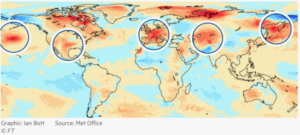
Instead of these waves moving eastward, carrying weather along, in the wave-5 condition systems can stall, becoming quasi-stationary. waves in the atmosphere become ridges, forming high-pressure blocking configurations (such as Omega blocks or Rex blocks). These blocks act like giant boulders in a river, forcing the normal progression of weather systems to grind to a halt or detour around them. So the heat wave lasts weeks instead of a day.
Scientists are not sure whether we will get more of these wave-5 events. The record shows the stalled weather systems get more extreme as warming increases. The wind storm is stronger, the heat hotter, the thunderstorm carries much more rain. Welcome to now.
===============
INDIA – TOO HOT!
Back on the ground, let’s start in India. That is where hundreds of millions of people are suffering, and some dying, in a marathon of record heat. Hot times before the Monsoon rains is not new in India, in April and May. But this is record-breaking stuff. The ten hottest cities in the world in late May were not in the Sahara or the Southwest, but in India. Long lines of traffic built into grid-lock as those with cars literally headed to the hills. Water ran out in many regions, just when it was needed most. Women trudged miles in 45 degree C heat (113 F) with large jugs on their heads. Workers in big cities roasted in paved streets and shacks with no power, much less air-conditioning.
With temperatures reaching almost 50 degrees C. India is already approaching that apocalyptic scene of mass heat death, described in the novel “Ministry of the Future” by Kim Stanley Robinson. Listen to my March 2024 with author Robinson. Links in my blog at ecoshock.org.
Listen to or download this 30 minute interview with Kim Stanley Robinson in CD Quality or Lo-Fi
You may see videos of people in New Delhi cooling off in a government tent with AC, or dancing in a fountain. Don’t fall for the propaganda. It is true the Indian Government made some improvements, especially with weather warnings. Perhaps fewer people are dying in heat waves today than 20 years ago (when nothing was done). But investigative journalist Vidya Krishnan writes: “India is being left to die in the heat”
“Modi has denied climate change for years. Now, as the death toll climbs uncounted, his government offers branding instead of protection.”
That was published in Al Jazeera May 22nd. She points to “an orgy of tree-felling across the worst-affected cities” removing cooling shade. Vidya warns “The heat pummelling India’s megacities is reinforcing longstanding inequalities of caste, class and gender in poor and marginalised communities.”
Krishnan finds a paper from Harvard’s South Asia Institute describing limits to human heat tolerance, which adds “380 million Indians are living in conditions that exceed the capabilities of human physiology.” Meanwhile Prime Minister Narendra Modi says “Climate has not changed. We have changed. Our habits have changed”. The government invests heavily in a coal-powered future and not much in renewables. The people and the economy pay the big price.
=========
MOSCOW SIZZLING IN LATE SPRING!
Before we go to London’s big heat, a quick excursion to Moscow. It is hard to believe so many places are so hot in late May! Moscow is as far north as Thompson Manitoba, and that is north! Nobody in the mainstream western news tells us. This week’s program features a news clip comes from the Indian news service WION May 26.
“The heat is being felt elsewhere as well. Moscow recorded its hottest ever May with temperatures climbing to 30.5 degrees celsius as an unseasonable heat wave swept across the Russian capital just days before summer officially begins. The previous record was set in 1979 and according to Russian weather officials the scorching temperatures shattered the previous historical record for May 19 after unusually hot conditions settled over the city earlier this week.
For many residents the sudden heat has been difficult to handle. It’s physically challenging, even my colleagues at the office weren’t feeling well yesterday including me. As temperatures surged many Muscovites headed to lakes, rivers and waterfront areas in search of relief.
While the water still remains cold for most people to swim comfortably crowds still gathered along the banks to escape the heat. Many linked the extreme weather to broader climate concerns.
[a Russian-speaking woman says]
’What do we want? We pollute the planet so much. We have plastic, we have cars and what do we want? We cut down forests, we destroy rivers, we ruin the land. There you go, all of nature is responding.’
Just weeks ago a winter storm had pelted Moscow breaking a daily snowfall record that stood for nearly 150 years.
This early heat wave comes as parts of Europe and Asia continue experiencing increasingly erratic weather patterns with scientists warning climate change is making extreme temperature events more frequent and more intense.”
That was from WION news May 26.
DROWNING IN THE HEAT
In the May European heat wave, a French government spokesperson reported at least five deaths from drowning as people went into any lake, river or water they could find. More drowned in the Britain last week. This is exactly what happened in Russia during the 2010 extreme heat wave. People who did not know how to swim, or were too drunk to cope, went into lakes, rivers, and fountains to cool off. It is a human instinct. Drownings are a foreseeable result of extreme heat and failure of society and governments to appreciate the danger, to prepare, and to provide cooling shelters.
That became a compound event with legendary mass forest fires and deadly smog in Moscow. This is from Voice of America during the Russian heat wave of 2010.
“As temperatures associated with Cairo afflict Moscow, portable air conditioners, oscillating fans, and inflatable pools are flying off the store shelves. After a Japanese tourist died from heat stroke near Red Square, the Kremlin suspended the weekly Changing of the Guards ceremony. After two men died of heat-related causes in Moscow’s metro, a consumer group sued the to bring down temperatures to the legal maximum of 32 degrees centigrade.
In St. Petersburg, almost on the same latitude as Anchorage, Alaska, residents are cooling off by jumping into the normally icy canals. Across Russia, almost 2,000 people have drowned since June, well higher than normal. In one tragic case, six children at a summer camp drowned because camp counselors were following a Russian summer tradition, trying to cool off by drinking alcohol.”
And yes, I keep radio recordings from overseas events in 2010.
=========
LONDON BAKES
What is going on in the UK! Poster MetJam reports:
“Oxford, the longest running continuous weather station in UK history, with temperature observations stretching back to 1815, has preliminarily broken its maximum temperature record for May yesterday by OVER 3ºC with a temperature of 33.7ºC. Unprecedented in its 211-year history.”
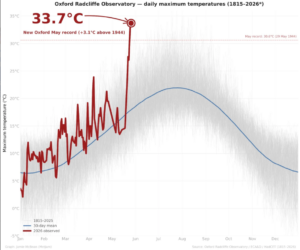
Record temperatures are usually a fraction of a degree higher. Not 3 degrees C, over 5 degrees Fahrenheit higher! This is a climate-breakout, an early bubble from the coming hot future. As Michael Burchert posted on BlueSky:
“London is so, so not prepared for what is coming. People were telling me it has ‘mild’ climate, when I asked about the single pane windows and lack of insulation. You’ll get the extreme heat first and then the AMOC downturn with extreme cold. (In northern Europe).”
Michael is talking about increasing possibility that the Gulf Stream, or AMOC, will weaken. That stops mild waters and mild air from reaching Ireland, the United Kingdom, Iceland, Scandinavia, and Northern Europe. That ends most agriculture there. Michael predicts the UK will experience extreme heat events, along with the rest of the world, but eventually – decades or more away – the ocean current may change and a bit of the ice age folds down into the North Atlantic. For now, it is the heat.
In just the last three years, air-conditioner use has doubled in the UK. In the show we hear from Richard Lowes of RAP on UK public radio recently – and why adding AC may not be a disaster. Yes, more electricity is being used, Lowes says, but so much solar power is coming on stream in the UK these days, especially on hot summer days, that may offset the added demand from AC.
=============
EUROPE TOO HOT, TOO SOON
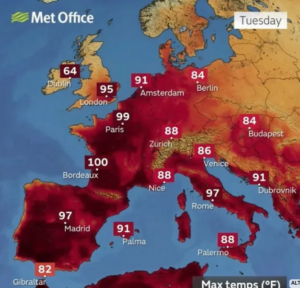
The May heat wave was certainly not confined to the UK. It was sizzling in France, Germany, the Low Countries and beyond. The best coverage I could find, not heard in America, is from the German state broadcaster Deutche Welle, May 27th. They do good stories with real reporters – although I heard one possible AI voice in that clip. Look for DW News on YouTube.
One last thing: the wave-5 pattern we began with created another relatively rare event: two major heat waves at the same time. We just reported on Europe but another blocked system kept unreal heat in central Canada, ranging up into the Yukon, and down in the U.S. Prairies, including major crop zones, the breadbasket. The wheat crop is in terrible shape, but that is another story.
London has cooled down of course. Southern India is getting relief as the Summer Monsoon starts a bit early. That won’t help North India, but eventually that heat will break, for a few weeks.
All of this comes before we the fearsome El Nino even started. This is going to be a tumultuous hot summer. Anything could happen.
I’m Alex Smith. Thank you for listening, and caring about our world.