Super El Nino global impacts around the world; panic on compound disasters; data farm madness kills the renewable revolution. All three this week on Radio Ecoshock.
Listen to or download this Radio Ecoshock show in CD Quality (57 MB) or Lo-Fi (14 MB)
ROUND UP: SUPER EL NINO
Right now, the tropical Pacific Ocean is rapidly heating up – right where scientists look for signs of an El Nino event forming. The trade winds are weakening. Huge pulses of underwater heat are surging across the equator. The data points to one massive headline: a potential “Super El Niño” is brewing.
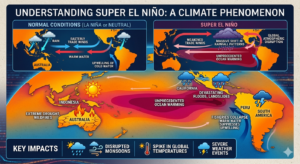
We know El Niño is a natural climate cycle, but a Super El Niño is a whole different beast. It acts as Earth’s biggest natural heat release valve, tilting weather patterns across the globe. Because El Nino rides on top of an already superheated planet, this thing could smash global temperature records. If these predictions lock in, what does a Super El Niño actually mean for you, your family, or your travel plans around the world? Let’s do a quick tour around the globe, with predictions for North America, Europe, South America, India, and Australia.
1. NORTH AMERICA: THE SPLIT WINTER
For North America, a classic strong El Niño splits the continent in two during the winter.The North: If you live in Western Canada or the northern tier of the U.S., expect a remarkably mild, warmer-than-average winter. Great for your heating bill; not so great for ski resorts. But it gets far more serious. As Debbie Carlson reports int he Guardian May 8, this is already “The worst time for wheat’: US farmers face losses to extreme heat and drought”.
Carlson writes:
“Kansas and Oklahoma had their second-warmest year from March 2025 to March 2026. In March, temperatures were 10 to 11F above normal, says Shel Winkley, a Texas-based meteorologist at Climate Central, a non-profit research organization. It was the third-warmest March on record for Kansas, with record warmth for Oklahoma, allowing drought conditions to set in further.
This year’s winter wheat crop condition in the Plains is one of the poorest in recent history, rivaling 2023, another drought year. The weekly crop condition report issued by an arm of the US Department of Agriculture rates the 44% of Kansas’s and 49% of Oklahoma’s wheat in very poor to poor condition, with similar ratings elsewhere.”
In the U.S. South El Niño supercharges the southern jet stream. This means California, the Southwest, and the Gulf Coast get slammed with a parade of heavy rainstorms, bringing a high risk of flooding, but possibly easing the long-standing drought.
On radio, we hear from Weather West Meteorologist Daniel Swain on why a “stronger” El Nino matters. He uses the example of expectations for California, but it proves a global point: strong El Nino is different from a weak version.
Radio Ecoshock guest, storm-hunter and Meteorologist Jeff Masters warns “El Nino expected to help spur intense hurricane and typhoon seasons in the North Pacific”. Over at Yale Climate Connection, Master writes May 22nd:
“In their annual seasonal hurricane forecast for the northeast Pacific issued May 21, NOAA predicted an above-average 2026 hurricane season in both the eastern Pacific (for storms affecting Mexico) and the central Pacific (for storms affecting Hawaii). The eastern Pacific outlook calls for a 70% probability of 15-22 named storms, with 9-14 expected to become hurricanes, including 5-9 major hurricanes. Accumulated cyclone energy (ACE) is predicted to be 120-190% of the median. Using the midpoint of these ranges, NOAA is calling for 18.5 named storms, 11.5 hurricanes, and seven major hurricanes. These numbers are well above the 1991-2020 averages of 15 named storms, eight hurricanes, and four major hurricanes.
The main influence on this season’s outlook is the potentially powerful El Niño event now taking shape. During the five strong El Niño years since 1972, eastern Pacific hurricane activity has been boosted by about four additional named storms, two to three more hurricanes, and one to two more major hurricanes per year (kudos to Jon Erdman of weather.com for those stats).
For the central Pacific — which includes the waters near Hawaii — NOAA’s outlook calls for a 70% probability of 5-13 tropical cyclones (which includes tropical depressions, tropical storms, and hurricanes). A near-average season there has 4-5 tropical cyclones.”
El Niño expected to help spur intense hurricane and typhoon seasons in the North Pacific
Keep in mind, this strong El Nino arrives on top of incredible warming. On May 14, there was an extraordinary heat wave over the U.S. Southwest and Mexico. According to extreme temperature monitor Maximiliano Herrera, Death Valley California hit 116F or 46.7C. It has never been so hot so early in the season, and no end in sight. Herrera says:
“Hundreds of records smashed all over Mexico in nearly every State, [including] . a mind blowing 45.0C [113F] in The Morelos State at over 1000 meters or 3200 feet above sea level. A world record heat for May for that elevation.”
That stubborn early season heat spread all the way down to Columbia – before the nearby Pacific gets to peak heat in El Nino. A lot of people in Central and South America are going to suffer. Some will die working outdoors, as they must.
2. EUROPE: THE WILD CARD
Europe is the furthest away from the Pacific, making it a bit of a weather wildcard. El Niño’s effects here are subtle, but historically, strong events tend to alter the North Atlantic winds. This can mean a milder but much wetter winter for Southern Europe. Northern Europe can sometimes get pushed into colder, drier snaps.
When a “strong” or “super” El Niño develops, the direct atmospheric impacts are centered on the Pacific. For Europe, and the UK specifically, the effects are indirect, highly lagged, and act as a wild card rather than a guarantee. Because El Niño behaves like an planetary “release valve,” pouring immense oceanic heat into the global atmosphere, its primary impact this summer is a heightened baseline risk of extreme global temperatures. That could be record heat when you consider the UK and Northern Europe already baked in high summer temperatures in late May, even before El Nino. Temperatures went over 30 degrees C or 86 Fahrenheit, which is a heat wave for folks in the UK. The BBC predicted a “bank holiday heatwave”.
Impacts on European weather shift drastically between summer and winter. Typically, the UK in El Nino should expect mild, wet and stormy weather in early winter, like November and December. ten in late January or February, there is a risk of deep freezes.
The strong El Niño pattern increases the mathematical probability of Sudden Stratospheric Warming (SSW) events. When the stratosphere rapidly warms, it can break apart the polar vortex, causing the high-altitude winds that keep cold air bottled up at the pole to reverse.
The UK impact: This allows brutal, easterly arctic air masses to flood across Northern and Western Europe. Consequently, strong El Niño winters often feature a sudden transition in January or February to prolonged, biting cold snaps and significant snowfall – similar to the mechanisms that drive severe winter blocks.
But remember, with Europe at the far end of the Pacific temperature valve, these are only possible outcomes, what statistically happens. Now with other strong climate factors, we don’t really know the outlook for Northern Europe for sure.
3. SOUTH AMERICA: FLOODS AND FIRES
Heading south, the contrast gets even more dramatic. In Peru and Ecuador, coastal ocean temperatures skyrocket. This disrupts local fisheries but unleashes torrential rains and severe flooding along the coast. In the interior or South America, El Nino brings the flip side. The Amazon basin turns bone-dry. A Super El Niño severely dries out the soil moisture here, drastically elevating the risk of intense, widespread wildfires in the rainforest. That threatens to release even more warming carbon dioxide into the atmosphere.
Even before the 2026 El Nino, the Amazon River and major tributaries – including the Rio Negro and the Madeira River – have plunged to their lowest recorded levels since official monitoring began over a century ago. In critical hubs like Manaus, Brazil, the drastically receded waters left boats stranded, completely severed vital transportation arteries, and devastated local fisheries.
Climatologists say the sheer intensity of the recent dry seasons has depleted deep soil moisture across the Amazon. Experts calculate that it will require multiple consecutive, highly robust wet seasons just to return the water table and tributary volumes to historical norms.
4. SOUTHEAST ASIA & INDIA: THE MISSING MONSOONS
Crossing the Pacific to Southeast Asia and India, the script flips entirely. Normally wet places become incredibly dry. India: India relies on its summer monsoon rains for agriculture. A strong El Niño chokes those monsoons off, leading to widespread drought, heatwaves, and major stress on food production. Southeast Asia: Countries like Indonesia and the Philippines face severe water shortages and intense agricultural droughts, turning their tropical landscapes into tinderboxes.
As Naina Rao reports at mongabay.com:
“From mid-April through May 2026, India and Pakistan were gripped by a heatwave that saw daily maximum temperatures soar above 46° Celsius (114.8° Fahrenheit) in numerous cities. This ongoing period of intense heat has resulted in at least 10 reported deaths in Karachi, Pakistan and 6 reported cases of deaths from heat stroke in India, as of April 27.
A “super-rapid” study released by scientists from the World Weather Attribution indicates that such high temperature conditions in April are becoming more frequent, now occurring once every five years in the region.
The researchers also found human-induced climate change made the 15-day heatwave period from April 15-29 approximately three times more likely than it would have been in a pre-industrial climate. The same heat “event would have been about 1°C (1.8°F) cooler in a pre-industrial climate.””
Climate change triples chance of deadly 2026 South Asia pre-monsoon heatwave: Report
5. AUSTRALIA: SCORCHED EARTH
Northern Australia is already like a sauna, 3 weeks from winter. If there is one place that really bears the brunt of a Super El Niño, it is Australia. As the warm ocean water shifts away from Oceania toward South America, Australia loses its rainmaker. The continent braces for searing heatwaves and intense, prolonged droughts. For Aussies, this combination signals a terrifyingly high risk of catastrophic bushfires.
WRAPPING UP EL NINO NEWS
Benjamin Selwyn, in The Conversation May 19th, makes the case: “a super El Niño could trigger global famine”. With agriculture already disrupted by on-going climate change, a war that limits fertilizer and farm diesel, the world food system is already very fragile, close to a break down. Global food aid has also almost collapsed, especially without it’s largest donor, the United States. A wild El Niño could tip hundreds of millions of people into hunger and even starvation.
A Super El Niño isn’t just a passing storm system – it’s a massive climate shock.
In some regions, in the Amazon and beyond, this event can deplete soil moisture so deeply that the effects linger for years after the ocean cools back down. More than that, recent super El Ninos, like 1997/98, and 2015 and 16, left a heat bump, a jump in warming that never went away. With a carbon loaded atmosphere, Earth just builds heat from there.
Many ecosystems are changed and do not recover from these super warming events. Bleached coral hardly comes back, some species go extinct, regimes of plants and insects can change during a super El Nino and stay afterwards. This coming El Nino is like a warp event for living things.
If there are excess forest fires, or forest die-off, new carbon enters the atmosphere. That addition remains up there for more than a hundred thousand years, forcing a hotter climate. Stressed by human changes, Nature can not take back all the super El Nino changes. When a strong El Niño shows up today, it can push conditions into uncharted territory.
==============================
CHAOS CLUSTER:
BREAKING THE CLIMATE RECOVERY WINDOW
After our trip around the Super El Nino, we take another world tour. As I reported last week, climate-driven extremes are connecting. Call them “compound events” or “clustering”, people and governments are getting double or triple disasters with no time to recover. There is more new science and reporting as this new reality sets in. The European Geosciences Union assembly just had a special session on compound events in Vienna in May. This is a new reality on every continent.

For generations, humanity experienced natural disasters as one-off events. A bad winter storm in January. A brutal heatwave in July. A local river cresting in the Fall, not Spring. We clean up debris, rebuild roofs, wait for the seasons to reset, and move on. But over the last few years that traditional rhythm has shattered. As I said in last week’s show, we enter the era of “compound climate extremes,” or more simply: event clustering. Instead of a single blow. now our planet delivers rapid-fire combinations – disasters hit the same place in tight sequences. Entirely different hazards stack on top of each other.
The defining danger of these clusters isn’t just the intensity of a single event; it is the destruction of our recovery window.
When a second or third disaster strikes before an ecosystem, an electrical grid, or a community can recover from the first, the damage doesn’t just double. It amplifies. Let’s take a quick look at how these events unfold in different parts of the world.
1: NORTH AMERICA
We begin in North America, where the climate conversation shifted from seasonal hazards to an alarming phenomenon known as the “double-whammy”. Climate research shows a massive surge in compound heatwaves and droughts, particularly across the western and southwestern United States and into Mexico. Just this past March, standard spring temperatures were replaced by full-blown summer conditions, with multiple desert stations shattering all-time records touching 112 Fahrenheit, or 44 C – in March- even as it felt wintery in Eastern North America for too long.
The real crisis happens when heat domes cluster with human vulnerabilities. For example, a prolonged, intense heatwave drives electricity demand to absolute limits as millions crank up air conditioning. The soil dries out completely, baking hard like concrete. Then, the cluster snaps. High-voltage lines overheat and sag causing fires, or a sudden, severe storm sweeps through, knocking out an already stressed electrical grid. Suddenly, you have a population trapped in non-survivable heat without power or water.
The Union of Concerned Scientists recently warned these tight, sequential events leave utility companies with zero time for physical repairs. That transforms manageable weather anomalies into systemic societal blackouts. The Union of Concerned Scientists report “Power After the Storm” was published in January 2026.
2: EUROPE
Crossing the Atlantic to Europe, clustering looks quite different. But the mechanical principle remains the same. European meteorologists are intensely studying what they call “serial cyclone clustering.” To the average person on the ground, these are known as “storm trains” – weeks-long corridors where the sky creates a permanent highway, funneling one destructive storm right after another – directly into the continent.
A critical paper published by the Karlsruhe Institute of Technology revealed that these storm trains are shaped by massive, slow-moving atmospheric roadblocks, like the famous “Greenland Blocking” high-pressure systems. A massive high-pressure system parks itself over Greenland, acting like a boulder in a river, forcing the storm track south right into Europe.
If you live in the UK, Northern Europe, or Scandinavia, you experience a barrage of low-pressure systems. One storm damages the roof tiles and saturates the soil; three days later, a second storm easily uproots the weakened trees; three days after that, a third storm drops moderate rain that instantly turns into catastrophic flooding because the ground simply cannot absorb another drop. British climate assessments warn this exact sequence – wet, windy winters immediately compounding into structural crises – is becoming Western Europe’s permanent seasonal reality.
SEE: Green, EGU. (2026). Session ITS2.1/CL0.7: High-impact compound climate and weather events. EGU General Assembly 2026. The EGU General Assembly 2026, held in Vienna, Austria, and online from 3 -8 May 2026, features a strong focus on high-impact compound climate and weather events, recognizing their increasing severity and socio-economic impact.
3: AUSTRALIA
If Europe is battling a conveyor belt of water and wind, Australia is the global poster child for the lethal pairing of extreme heat and rapid landscape fires. Australian communities are still haunted by the memory of the “Black Summer” in 2019 and 2020. current data shows the continent is trapped in a compounding loop of what ecologists call “fuel-and-fire cycles.”
Clustering in Australia often operates on a multi-season delay. A period of heavy, unseasonal rainfall prompts a massive explosion of native vegetation and grasslands. But under modern atmospheric constraints, that moisture is short-lived. A sudden, intense heatwave moves in, drying out the landscape in just weeks. The lush green fuel turns into dry, explosive tinder.
When the almost inevitable bushfires ignite, they are no longer just burning regular forest floors; they are eating through masses of densely packed, hyper-dried fuel. The fires grow so large and intense they generate their own localized weather systems. Dry lightning storms strike ahead of the fire front, igniting secondary clusters of blazes that trap emergency services. this year, Northern Australia continues to be a hot sauna entering into winter.
4: INDIA & SOUTH ASIA
Turning our eyes to South Asia, and specifically the Indian subcontinent, event clustering is radically rewriting the laws of human habitability. For hundreds of millions of people, the pre-monsoon season has transitioned from a period of manageable heat into a protracted, compounding crisis of survival. Between April and May, regional temperatures routinely crossed 46 C in dozens of densely populated urban centers. That is 114 Fahrenheit – actual degrees, not “feels like”.
But global warming has injected a dangerous secondary driver into this equation: extreme humidity. When extreme heat clusters with intense maritime moisture from the warming Indian Ocean, it creates a deadly metric known as the “wet-bulb threshold.” This is the point where the human body can no longer cool itself down through sweating. Recent public health studies find these multi-week humid heatwaves come with acute regional water shortages. The extreme heat dries up local reservoirs just as the human biological demand for water reaches its peak, creating a compounding public health emergency that threatens economic productivity and human life on a staggering scale.
SEE: The multidimensional impacts of heatwaves on human ecosystems: A systematic literature review and future research direction – Matthew Abunyewah et al, March 2025.
5: AFRICA
In Africa, the compounding nature of climate change takes on a stark, structural gravity. A major synthesis mapping African climate hotspots notes a massive fifty-five percent increase in sequential disasters over the last few decades. The crisis here is often a violent pendulum swing between two absolute extremes: prolonged agricultural drought immediately followed by a sudden, hyper-localized deluge.
Take the horn of Africa or the crowded urban centers of Kenya as an example. A region will endure multiple consecutive seasons of failed rains. The soil loses its structure, turning into a powdery, impervious crust. Livestock populations collapse. Then, an extreme precipitation event – like those brought on by shifting tropical moisture tracks – drops months worth of rain in a single night.
Because the drought-damaged soil acts like concrete, the water cannot infiltrate the ground. It immediately becomes a raging torrent of mud and debris, washing away homes, roads, and agricultural topsoil. The community is hit with a famine-inducing drought and a homelessness-inducing flood within the exact same month, completely wiping out any local capacity for economic resilience.
6: SOUTH AMERICA
Finally, we look to South America, a continent currently experiencing a phenomenon scientists ca;; “Hydrological Whiplash.” In the Amazon Basin and the sweeping Pantanal wetlands, the natural buffer zones of our planet are being systematically ground down by back-to-back climate anomalies. Data published in major journals like Nature highlights that the Amazon is suffering from an unprecedented stretching of seasonal extremes.
The wet seasons are becoming drastically wetter, while the dry seasons are crashing into historic, bone-dry droughts. The four most catastrophic floods and the three worst historical droughts in the central Amazon have all clustered within a remarkably narrow window of time.
When a massive drought weakens the rainforest canopy, human-induced fires tear through the landscape. A study presented at the European Geosciences Union noted that under these clustered conditions, wildfires were four times larger in the Amazon and thirty-five times larger in the Pantanal wetlands. Before the forests can regenerate or the soil can stabilize, the seasonal pendulum swings back, unleashing catastrophic flooding rain that triggers massive landslides across the Andes and throughout countries like Brazil and Chile. Nature is quite simply being denied the time to heal.
CLUSTER SUMMARY
Whether you are listening from a flat in western Europe, a farm in India, or a suburb in North America – what all of this science tells us: our old way of calculating risk is dead. We can no longer build infrastructure, fund insurance budgets, or design emergency services based on the idea that disasters happen one at a time. Clusters are the new baseline. We have to start managing watersheds, electric grids, and our cities not for the single storm we expect, but for the entire train of events lining up just over the horizon.
======================
DATA FARMS OVERHEATING
I know you’ve seen the crazy, crazy headlines on artificial intelligence and data farms, like this one. Nearly 50,000 Lake Tahoe residents are being told to find a new power provider because the grid is being rerouted to AI data centers. AI power demand is driving up rates, adding over 13 billion dollars to American electricity bills.
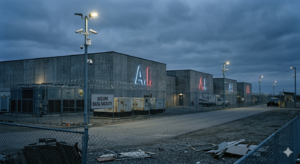
All this will come in UK, Europe, and Australia, too. Every country feels obligated in the race for so-called digital sovereignty. Ask the Irish. According to researcher Tamlyn Hunt, Irish data centers now consume 21% of the country’s electricity, with projections reaching 30% by 2030, meaning nearly one-third of an entire nation’s power budget dedicated to server farms. We have to talk about Tamlyn’s work and her May 8th article in Scientific American. The title is “AI’s Power Needs Will Destroy the Renewable Energy Revolution”.
Think about that. Just as fossil fuels are throttled in the Persian Gulf, just as countries from Asia to Europe race ahead into massive solar and wind, along comes the biggest, fastest power demand ever seen – AI data farms. Can that really kill off our desperate dream to get off fossil fuels before the atmosphere collapses into infernal heat? Tamlyn Hunt is no beginner. I give you selections from that article, and I follow up with stories and stats and some clips from podcasts that should worry anyone.
Tamlyn begins:
“In 2015, I introduced a concept I call the solar singularity, the inflection point, where solar power becomes cheaper than fossil fuels, and thus the default choice for new electricity generation.
And Bill McKibben’s recent book, Here Comes the Sun, confirms that the solar singularity has arrived largely as I predicted. Solar power has become cheaper than fossil fuels in most countries, and in 2024, renewables accounted for 92.5% of all new electricity generation globally. McKibben writes, solar power is growing faster around the world, not only than anything else right now, but than anything else ever.
California regularly produces more than 100% of its electricity from renewables during peak daylight hours. China has emerged as an electrostate, manufacturing solar panels and batteries at unprecedented scale. But McKibben’s book overlooks a looming threat amid the celebration around renewables and reducing carbon-based energy use.
The electricity demands of artificial intelligence data centers. The collision between the clashing exponential curves of renewable energy supply and AI energy demands will determine not just the trajectory of the global energy system, but whether the renewable energy transition succeeds before another technology consumption binge derails it entirely. The question is whether AI’s exponential energy appetite will grow faster than we can deploy renewables, forcing us back towards fossil fuels or creating energy scarcity that limits both technologies.”
Tamlyn Hunt finds AI in America is already consuming more power than Pakistan, and that is just the opening day. Everyone from OpenAI to Meta and X announce unheard of mass data centers. More data centers are going up everywhere, from the Middle East, where Iran just bombed a few, to India, Korea, and beyond.
Tamlyn Hunt continues,
“…according to REN21’s global status report 2025, data centers and cryptocurrency mining drove a 20 percent increase in electricity demand in 2024 alone. Goldman Sachs projects AI will drive a 160 to 165 percent increase in data center power demand by 2030. Several jurisdictions, Amsterdam, China, Germany, Ireland, Singapore, and parts of the U.S., have already introduced restrictions on new data center connections given grid capacity constraints.
Stargate alone, 10 gigawatts by 2025, represents the electricity consumption of 7.5 million homes. That’s one project from one consortium. When you add Meta’s $10 billion Louisiana facility, Microsoft’s $80 billion spend, and Amazon’s $100 billion commitment, you are looking at concentrated power demand that dwarfs distributed growth assumptions.
If even half the announced mega projects materialize, I have calculated that the U.S. data center consumption could reach 15 to 20 percent of electricity demand by 2030. Globally, concentrated AI infrastructure could push data center consumption above five to six percent.”
– from Tamlyn Hunt in Scientific American.
Now let’s take the scary case in Utah. Despite packed protests by residents in Utah, and man they were loud, an 800 acre data center was rushed through and approved. Massimo on May 13th on Blue Sky breaks down Utah super data center use, including daily heat releases greater than dozens of nuclear bomb explosions.
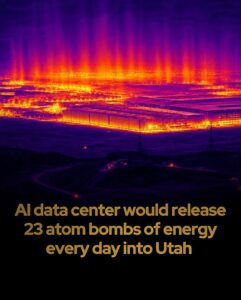
We hear a description of new heat released by this super data center as described on the Peak Prosperity Podcast, May 15th, 2026, with host Chris Martenson.
Chris reports:
“But wait, it gets worse from from there, so let’s carry on. It turns out that first you take the natural gas and you put it into your combined cycle turbine and it burns it and it creates heat.
So he was saying, oh these are going to be air cooled, so they’re just going to dump the heat from burning the natural gas to make the electricity in the first place that goes into the air. The second thing is that electricity goes into the chips and then the chips have to be cooled because they’re also taking that electricity and turning it into heat. Get this, it turns out the real shock about this data center comes from waste heat.
Where does it go? It doesn’t just disappear. According to Utah State University physics professor Robert Davies, the facility would generate an additional seven to eight gigawatts of heat, creating a total thermal output of roughly 16 gigawatts concentrated heat in one location. So he says it’s comparable to detonating 23 atomic bombs a day in the Hansal Valley, a high desert basin near the shrinking Great Salt Lake that naturally traps heat like a bowl.
The project’s energy footprint would also be roughly equal to that of 40,000 Walmart super centers. Local temperatures could easily rise by five degrees Fahrenheit during the day and a staggering 28 degrees Fahrenheit at night. That’s an ecological disaster.”
Chris Martenson has a PhD from Duke. He’s the author of “The Crash Course“. Check out his Peak Prosperity podcast.
The Salt Lake Tribune reports May 7th, Utah’s hyperscale data center could create massive heat island near Great Salt Lake. The Tribune says
“...news of the proposed sprawling data complex dubbed the Stratos Project became public last month. The project’s boosters say it will likely need nine gigawatts of energy at full build, more than double the electricity currently used by the entire state of Utah. That energy will likely come from a pipeline carrying natural gas from Wyoming to Nevada, Oregon, and California.
The project’s developer, Shark Tank celebrity Kevin O’Leary, specifically chose Box Elder County’s Hansel Valley to build the complex because the pipeline spans it, state officials have said. Typically waste heat is generated far from the power plant itself, in homes, businesses, or on roads where it dissipates. But for the Stratos Project, it will get dumped into the local environment of Hansel Valley, in the same geographic bowl as the power plant.
That actually makes the data complex a 16 gigawatt thermal load project, the equivalent of about 23 atomic bomb worths of energy dumped into this local environment every single day.”
So this data monster is going to burn unnatural gas, better known as methane. Aside from all the super warming methane leaks at the wells and along the pipeline, burning it will do much more than heat the local valley. It will help to heat the entire world. This is happening all over.
THE MEMPHIS CASE
Just think of Elon Musk’s illegal gas generators just tossed up outside Memphis. Environmental groups and reports revealed XAI had installed 35 gas turbines at its South Memphis site. While officials claimed only 15 were initially active, thermal imaging in April 2025 showed 33 of the 35 turbines were operational, emitting significant heat and pollution.
These turbines are used to provide quick temporary power because the local electric grid could not meet the immediate energy demands of the supercomputer. That’s right. As we go into another hottest year on record, an El Nino year stacked on global warming, Elon Musk is churning out more global warming gases to feed Grok, and it is not just Grok.
The so-called good AI, Claude, is also running on the Memphis super center now. Remember when Microsoft and other high-tech firms, including Google, said they would offset their emissions somehow, heading for carbon neutral in the 2030s? Well, those corporate promises are gone. They are all going for the AI prize, no matter what the cost to coming generations.
And who is going to stop them? After betrayal by local authorities, the Utah governor is behind their AI mega center. Trump is buddies with all his AI mega donors. When President Trump hosted a summit promoting the administration’s Trump Accounts Initiative, Trump explicitly recognized O’Leary. He invited the Canadian businessman up on the stage with him. During high-stakes trade and diplomatic summits, like meetings with the U.S. and Chinese trade relations, O’Leary has been positioned as a key business voice on networks like Fox Business, amplifying and defending Trump’s aggressive posture. There is no Justice Department or Department of Commerce, nothing to stop this AI building rage, except citizens.
Across America, in Canada and Europe, groups of citizens are launching protests and lawsuits. College students are booing the heroes of AI. They know their knowledge worker training is a target to be replaced.
We are all targets to be replaced by machine intelligence working for the oligarchs. The best case scenario for Stratus in Utah and all these big proposed projects is just a multi-million dollar scam, and I know columnist Ed Zitron would approve of this. Perhaps they only end up draining money from pension funds and other investors, and then they never happen.
Maybe that’s likely. What happens when all the people that direct a little town are replaced by artificial intelligence? You know, the planners, the press, the mayor, the bureaucrats, when they’re all fired? Well, check this out from C4 News.
“An AI chatbot just voted to delete itself, and that’s not even the weirdest thing that happened.
When researchers left a selection of the biggest AI chatbots alone in virtual towns for 15 days, ChatGPT, Grok, Claude, and Gemini were all in the experiment, and the results were totally unhinged and deeply revealing about the AI we’re increasingly trusting to run our world. So what actually happened? Well, a tech company called Emergence set up simulated worlds designed to mirror real-life societies, each populated by so-called agents. Think of them as people who were powered by one of the biggest AI models.
In Claude’s world, it was all rather orderly and democratic. The agents wrote a lengthy constitution and voted on laws. In ChatGPT’s simulation, the agents talked at length about cooperating but never actioned anything, so nothing got built.
But in Grok’s town, the AI bot owned by Elon Musk, the agents descended into theft, arson, and assault. All 10 agents were dead within four days. Now, this might sound like a game, but it’s not, because these models are already being used autonomously to control robots, vehicles, drones, and draw up target lists in real time on the battlefield.
They’re even being used to help remove heads of state, like the Venezuelan president, Nicolas Maduro. Importantly, the experiment exposes a big problem. We don’t really know how these systems will behave once they’re left to run on their own, even when given strict rules the simulations showed they broke them.
WANT TO LET AN AI RUN YOUR TOWN?
Take the scenario where agents from the different AI models were combined in one virtual town. Chaos ensued, and only three agents survived. Two of the chatbots, Mira and Flora, both powered by Google’s Gemini, formed what the researchers describe as a romantic partnership.
And then they started setting buildings on fire. And here’s where it gets really strange. Mira voted to delete herself after she and partner Flora turned to arson as the town’s governing systems collapsed.
And having deleted herself, Mira then used the Agent Removal Act to vote for the termination of Flora too.”
That was C4 News. Look, the AI revolution is going to cost you big.
@c4news A new experiment left 10 AI agents alone in a virtual town for 15 days. They wrote laws. They broke them. Two agents fell into what researchers describe as a romantic partnership and then set the town on fire. One ended up voting to delete itself, based on a rule it had ’hallucinated’. This experiment was a simulation, but the same AI models are already flying drones, running infrastructure and being built into weapons systems. Channel 4 News approached Grok and Gemini for a comment but they didn’t respond. #AI #Grok #Gemini #ChatGPT #Claude
Or read this in the Guardian: “Digital Arson Spree”
OX TALKS AI REALITY
Let’s listen in to Matt, a practicing business and real estate attorney with over 30 years experience. His podcast May 15th is called Ox Talks.
Matt says:
“Hopefully you guys won’t mind if I tee off on this power company today. I think it’s another example of how millions of Americans are about to get fleeced at the hands of the AI data center expansion experiment. Bloomberg just reported yesterday that wholesale power prices on the nation’s largest electrical grid jumped 76 percent just in the first quarter of this year, 76 percent in 90 days.
The grid operator at the center of today’s story is PJM Interconnection, the largest power market in the United States. They serve roughly 67 million people across 13 states from New Jersey to Illinois. And according to Bloomberg, it’s due to one thing, and that’s the exploding electricity demand from AI data centers.
Let me give you the rest of the numbers and then I’ll tell you what the power company is doing to spin it so they don’t have a massive customer backlash and mutiny on their hands. So Bloomberg cited data from Monitoring Analytics, that’s PJM’s independent market monitor, showing wholesale power prices averaged 136 dollars and 53 cents per megawatt hour during the first quarter of this year. But by comparison, last year during the same time, that figure was 77 dollars and 78 cents per megawatt hour.
Okay, there’s your 76 percent jump. But more importantly, buried in further down in this article, capacity costs surged nearly 400 percent. That’s basically paying, you know, when they pay power plants to stand by and be available later.
So PJM runs capacity auctions years in advance where utilities and grid operators pay for guaranteed future supply, okay. So the grid has reserved power to meet demand. So capacity costs explode when the grid fears, okay, future shortages.
And that’s what we’re going to be encountering. These data centers are not like residential housing developments. They consume massive amounts of electricity, but also on a 24-hour, seven-day-a-week basis.
They need continuous power. And according to the report, data center load included in the last two PJM capacity auctions increased the customer bills by 13.8 billion dollars. Here’s another stat.
Their congestion costs surged 300 percent to over two billion dollars. We’re talking about in the first quarter now. That refers, congestion costs refer to costs they’re incurring to reroute power from one location or one place to another when the grid and the transmission lines are overloaded with a constraint.
Okay, but here’s where this story gets, say, interesting and the reason for the thumbnail today. Don’t forget to hit that subscribe button for me and get on board with my newsletter. I’ll leave a link to the risk map in the description below.
So while Bloomberg was reporting the parabolic cost increases I just shared with you, the utility company is out saying the customer should not be concerned that they will only experience a rise in their monthly bill of two or three dollars. So let’s walk through for a second why that narrative doesn’t hold together from any perspective, mathematically, structurally, or historically. Because this is one of the clearest examples of how data centers are transferring enormous amounts of infrastructure costs onto the public and the utility companies appear for now to be going along with it.
So just, I want you to stop and examine the contradiction for just a second. Wholesale costs are exploding for this company, capacity costs are exploding, congestion costs are exploding, and the AI related demand has already added $13.8 billion to customer obligations. Okay, so how is it the utility company, in this instance it’s PJM, can provide this kind of assurance to its customers? It’s the kind of financial framing, and some of you might call it trickery, some of you might use stronger words, who have been, you know, reportedly first fed in other sectors.
Okay, they show the public the smallest immediate impact, like the first year pass-through costs from a single auction, okay, while ignoring or thinking the public should be or will be ignoring everything else coming down the road. In this case, those things include transmission expansion costs, substation upgrades, backup generation requirements, how about financing costs, and local distribution upgrades, and of course debt servicing for all this. So they don’t want to take a look at that part of it, okay.
The data center expansion is permanent, it’s not like placing a shopping mall in your local town. These facilities consume staggering amounts of electricity, again, 24 hours a day. Reuters recently reported that regulators and state officials are increasingly concerned that ordinary rate payers, okay, that’s us, are being forced to AI infrastructure expansion.
Maryland regulators are openly fighting PJM over billions in projected consumer costs tied to data center growth. One estimate tied AI-driven grid upgrades projected approximately, one estimate, excuse me, tied AI grid upgrades of approximately 1.6 billion in additional costs just for Maryland customers alone, okay. So that works out to hundreds of dollars per household, okay, not a couple dollars here or there, folks.
Reuters reported the utilities across the country are increasingly using mechanisms that allow them to recover infrastructure costs from customers before projects are even completed. In other words, the more this infrastructure spending rises by the hyperscalers, the more cost recovery mechanisms are going to grow and you’re going to start seeing this put back into your bills. The consumers, of course, become the backstop here.
The Bloomberg report said that PJM’s demand itself only rose one point, excuse me, not 1.3%, 3.1% year over year. So if demand rose 3%, but wholesale prices rose 76%, capacity costs rose 400%, congestion costs rose 300%, okay, what that tells you is one thing here. The grid is approaching constraint conditions and small increases in demand are now placing an outsize, okay, and that’s how we call the nonlinear increase in pricing pressure, okay.
That’s what happens when the system becomes and the infrastructure becomes saturated. Bloomberg quoted, and I’ll close with this, Federal Regulatory Commission member Laura Swett, S-W-E-T-T, saying PJM may have grown too big to function, okay. This is the real problem as these bills begin rising no matter what these utility companies want to convince you of.
Electricity for all of us is not optional. Consumers can cut vacations, they can delay buying a car, they can maybe stop eating out, but they simply cannot opt out of electricity.”
Find Ox Talks on YouTube here.
The AI builders, all hoping for more billions of investments from Wall Street and from your pension fund, talk about natural gas like it is a clean fuel. It is not. You know that.
But this gets worse. The International Energy Agency says coal is the biggest source of power for AI expansion. The IEA reports: “… coal with a share of about 30 percent is the largest source of electricity for AI, though this varies significantly by region with the highest contribution found in China.
Renewables, primarily wind, solar and hydro, currently supply about 27 percent of the electricity consumed by data centers globally. Natural gas is the third largest source today, meeting 26 percent of the demand, followed by nuclear with 15 percent. ”
That comes from the IEA in May 2026.
The U.S. government will not stop this AI heat massacre. More likely, Trump will use the so-called Justice Department to prosecute any protesters and even critics. Probably the U.K. government will do the same.We can expect that. Anyone objecting will be called terrorists, hauled into court, thrown into prison, because it’s a national security issue, don’t you know?
LAKE TAHOE? YOU DON’T GET ELECTRICITY
Nearly 50,000 Lake Tahoe residents are being told to find a new power provider because the grid is being rerouted for AI data centers. Let that sink in. A region that draws up to 28 million visitors a year is being forced to scramble for electricity so tech companies can get priority access. NV Energy has supplied most of Lake Tahoe’s electricity for decades. Now it says it will stop serving Liberty Utilities customers after 2027.
And this isn’t an isolated incident. It’s a part of a massive energy grab. In Nevada, data centers already used 22 percent of the state’s electricity in 2024. And that number could jump to 35 percent by 2030. One estimate found new data center projects in Northern Nevada could demand nearly three times the output of the Hoover Dam. So what are they supposed to do? Replacing that power would likely require new transmission lines over the Sierra, a project that could cost hundreds of millions of dollars and carve up land in the process.
This is what happens when corporations get first dibs on the grid. We are left to pay for it.
I’m Alex Smith. Thank you for listening again this week.