Could the closure of the Strait of Hormuz help save us from Hellish climate change? At least 20 percent of the world’s oil and gas has been shut down. What does it mean? The awful bright side of this crazy war – or is it? Then two scientists with unseen stories of climate change, from Greenland to global sea life. Plus: songs for dark times.
Listen to or download this Radio Ecoshock show in CD Quality (57 MB) or Lo-Fi (14 MB)
Who can focus on anything with explosions all around us. It is not just cities into rubble and oil tankers exploding. Long-held institutions are blowing up in pretty well every country. There is so much sadness and trauma. I have to play this little song…
NEW MUSIC IN THIS SHOW
Lyrics by Alex Smith, AI music. Creative Commons free for any non-profit use.
“What if I blow up the world?”
TORN UP WORLD
As you hear in this week’s music, I am torn up by the crazy human suffering buried in the headlines. Little kids are huddled in basements with explosions all around. Dreams of living are shattered by the insanity of a few leaders, their cultish followers and military men.
Meanwhile, this year’s Arctic Sea ice is set for another record low. Unseasonal heat appears around the world. If the forecast of an El Nino event is correct (we don’t know yet), it is only going to get hotter by end of this year,. The last El Nino in 2023 was a burner, breaking heat records, burning out lives, burning down forests. 2023 was a heat step that did not go fully down again with this past year’s La Nina. Each time, El Nino rides our non-stop emissions pushing further up the line to climate Hell.
Knowing the climate emergency is here and real, we can ask:
Is losing Gulf oil and gas a good thing for the climate and our civilization?
Climate activists – all the worried people – see a rapid drop in fossil fuel burning as a pre-requisite to save a livable climate. This may be it. For an unknown amount of time, roughly 20 percent less oil and gas is available to the world to burn. In this view, the longer the Strait of Hormuz remains closed, the better our chances. Emissions from burning many millions of barrels of gas and oil do not happen. That strengthens the push for alternative energy and electrification. Bad-mouthed “green” development gets translated into a pressing national security issue – that we all can see.
What should have happened all along is beginning to happen as energy markets crack. As reported by the New York Times “Climate Forward”:
“The European Union, which imports 90 percent of its oil and 80 percent of its natural gas, is trying to ease energy prices by making more carbon emissions permits available, and Denmark’s energy minister asked people to avoid driving.
To reduce demand, Sri Lanka has declared every Wednesday a holiday for public officials. Myanmar is limiting the use of private vehicles, allowing drivers to use them every other day. Bangladeshi colleges have canceled classes. South Korea lifted limits on burning coal, and local governments in the Philippines shifted to four-day work weeks.”
Hopefully under the crunch of higher gas prices and expensive airline tickets, travel mania in the developed world might give the atmosphere a break. Our kids and their kids cannot afford our polluting habits. Sadly though, the wealthy who burn by far the most fossil fuels – may be the last to actually change their consumption. That is why humans need emissions rationing to survive ourselves.
Just today (Wednesday March 18) more amazing events for the world’s oil and gas supplies developed. The world’s largest natural gas production facility – located in Iran – was bombed by the Israeli air force. They did not totally destroy the installation but did wreck key parts of it, forcing a shutdown and likely months to repair it if the war ends. It’s called the Pars gas field.
In response, Iran attacked the world’s largest LNG plant – Ras Laffan in Qatar. There will be no more LNG ships from Qatar to China or Europe, probably for months at best, maybe longer.
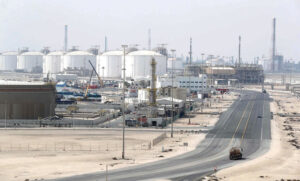
The implications are mind-boggling. It is one thing to bottle-up tankers in the Persian Gulf cutting global delivery. But that could be solved by opening up the Strait (although the long time-lag or empty tankers waiting out side the Gulf has disrupted global oil and gas shipping). But destroying or disabling actual production, including gas fields or oil fields, means about a quarter of world oil and gas is NOT COMING BACK any time soon. We may be witnessing the largest collapse and re-arrangement of this industrial society seen in generations. It will take time for to unwind, but unwind it will.
THERE IS A FERRY…
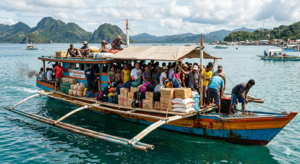
There is a private ferry connecting an island in the Philippines to the mainland. Like many in the developing world, this ferry is privately owned. It is a hub in the local economy, essential to the lives of many poor people. Now the ferry is not running. Fuel is just too expensive, and the owner can’t raise ticket prices for people already living at the edge.
As always, the poor – in America and around the world, suffer first. The rich will pay anything for gas. People without the means do without a lot, like using a car, eating meals, heat or cooling, electricity, jobs, holidays. This means deep cuts for millions of people. Nobody is cheering this unplanned “excursion” into an energy shut-down.
A couple of decades ago, professors and peak oil activists called for a planned descent, organizing group withdrawal from fossil fuels. It was to be humane, and intended to deliver new benefits of enjoyment in our lives. That was turned away by profits, habits, who knows? Now we have the worst case: a sudden shutoff leading to earthquakes in the economy, and possibly the fall of governments. The Greens never wanted to cut greenhouse gas emissions with a senseless war. But here we are. Can it work?
In theory, a sudden 20% drop in available fossil fuels might seem like a “win” for the atmosphere, but as of March 2026, the real-world data suggests that the “Iran War” shock could actually lead to a net increase in certain types of greenhouse gas (GHG) emissions in the short term. The impact is driven by a phenomenon called fuel switching, where the world’s energy systems scramble to replace missing clean-burning gas with dirtier alternatives. The biggest climate risk right now is the loss of Qatari and Emirati Liquefied Natural Gas (LNG).
Countries like China, India, and Vietnam have spent the last decade moving away from coal toward natural gas to reduce smog and carbon. With LNG prices up over 75% this month and supply physically blocked by the Strait of Hormuz, these nations are being forced to restart aging coal-fired power plants to keep the lights on. Because coal is roughly twice as carbon-intensive as natural gas, burning coal to fill the “gas gap” can cause total emissions to rise, even if total energy consumption falls slightly.
Also: as covered in last week’s Radio Ecoshock show, this is a war against the atmosphere. All the military jet fuel burned, the missiles, navy ship fuel, logistics – it adds up to significant emissions that replace some of the hoped-for reduction as oil and gas shipments falter. Plus, as countries bomb oil refineries, storage tanks and pipelines, fossil fuel emissions leak out into the atmosphere, likely for long periods after the war ends. That program pretty well set new records for broadcasting and downloads. People know this outbreak of violent madness is harming the atmosphere, but hard data is hard to get.
There are other problems with a supposed war-time emissions cut. For example, ships are being diverted around Africa, adding 10 to 14 days of heavy-fuel-oil burning to every voyage. Other countries restart their oldest, least efficient refineries at maximum capacity to compensate for the loss of refined products. It is so complex. We may only know whether this war actually helped reduce greenhouse gas emissions, at least from what they would have been, in a few years time when all the data is in.
I often wondered, even aloud in my blog, whether climate disruption will be so severe that some countries bomb coal mines and oil wells in a desperate bid to control emissions. I would not want to count on climate benefits from the blockade of the Gulf or any other part of this strategic blunder. War is not the answer to anything.
SCIENCE INTERVIEWS
FISH IN WARMING SEAS
SHAHAR CHAIKIN
If living things in the ocean are killed or damaged by rapid changes in ocean temperature we are all in danger. Ocean life provides oxygen we breathe. The fisheries provide key food for billions of people. And amazing life in a billion forms in the sea have their own rights to keep living without our permission or needs.
What will happen to fish as oceans heat up? Can we assume bad news? We have answers in a new paper: “Long-term warming reduces fish biomass, but heatwaves shift it”. We reached out to the Lead Author, Dr. Shahar Chaikin. With a PhD in Marine Ecology, Shahar is currently a Postdoctoral Fellow with the Department of Biogeography and Global Change National Museum of Natural Sciences.
Listen to or download this 23 minute interview with Shahar Chaikin in CD Quality or Lo-Fi
Back in 2003, marine ecologists like Boris Worm in Nova Scotia predicted “Rapid worldwide depletion of predatory fish communities”, But the main concern then was industrial fishing cleaning out stocks, as happened to the East coast cod fishery. This new work doesn’t investigate overfishing, ocean acidification, or pollution – just changes in ocean heat.
In addition to relatively slow general warming, we see more extreme marine heat waves. According to a 2020 study, the infamous hot “blob” in the North Pacific in 2015-16 killed about 70% of Pacific cod in the Gulf of Alaska. It turns out marine heat waves damage fish already near their heat tolerance, called “the warm edge” but may be better for fish already at the colder edge of their tolerance (“the cold edge”). This is what makes the fish and warming picture so difficult.
This mixed reaction to warming seas could trigger bad fisheries management for sure. Suppose one country finds a huge increase in one species and sends out the boats to harvest it, not knowing there has been a collapse of the same species closer to the “warm edge”. Another problem: one country may point to abundant fisheries and deny warming is bad for ocean species. It looks like international management of fisheries is the only way to keep essential stocks in a warming world.
The study concludes:
“Long-term warming was associated with an annual biomass decline of up to 19.8%. However, on shorter timescales, warmer years and marine heatwaves were linked to sharp biomass losses of up to 43.4% in populations at the warm edge of the species’ range and biomass increases of up to 176% at the cold edge.”
Here on the West coast people marvel when tropical fish show up in our normally cold waters. I know you have new work out on that, waiting for review, but are these exotic fish arriving due to marine heat waves or chronic warming? Shahar Chaikin has a new work coming out in Science Advances to answer that question. The working title is: “Chronic warming, not heatwaves, drives tropical fish colonization”.
There is a frightening chain of impacts in warmer seas. Relationships between predators and prey change and a list of changes to primary food sources and ocean stratification ensue. Shahar talks to us about the knock-on effects, beyond who survives in warmer seas and who does not.
The authors do not explain WHY fisheries will decline over long-term warming (what are the mechanics of slow death and are there tipping points?). That is for another study. We want a simple answer and there isn’t one. We may be fooled by a seeming explosion of some species as the ocean warms, in some places, while overall fisheries may be declining.
For more on big fish die-offs during marine heat waves, check out my 2025 interview with scientist Kevin Trenberth. In that program, Kevin said he hot blob that showed up in the North Pacific in 2015-2016…
“...led to the loss of over 100 million cod. It had profound effects that have been measured throughout the entire food web, from the phytoplankton to the zooplankton, the small fish, large fish, all the things that prey on the fish including the whales. There was a big loss of whales that was documents. And then there are things like sea otters and marine animals along the coast…Just recently there has been a marine heat wave in the South Tasman Sea which is right near New Zealand and there was one there about 2016 as well.”
The full interview with Kevin Trenberth is here.
ANOTHER NEW DEVELOPMENT:
EXTREME MELT EVENTS IN GREENLAND
JOSEP BONSOMS
Anyone paying attention hears about extreme weather events all over the world. The news comes in all year. It makes me nervous, but seems important. But until now, I did not know about extreme melting events.
Wherever you live, we suffer through extreme heat waves. On Greenland, amplified heating leads to extreme melt events that change the ocean and weather far away. Water from Greenland glaciers could eventually flood coasts and drown island nations. It takes a long time, right? Except new science shows “Record-breaking Greenland ice sheet melt events”. Just like short-but-deadly heat waves, extreme ice events are here and they are growing.

The Lead Author in this February 2026 paper in Nature Communications is Dr. Josep Bonsoms. He is a a researcher and postdoctoral lecturer at Universitat de Barcelona, in Spain. Bonsoms’ PhD is about climate impacts on glaciers in Greenland.
Listen to or download this 16 minute interview with Josep Bonsoms in CD Quality or Lo-Fi
Scientists have studied and modeled how much the Greenland ice sheet is melting and it’s contribution to sea level rise. They developed standards based on long-term melting. Now we have to add a new factor: extreme melt events. They release more freshwater into the ocean, contributing to changes in salinity and rising seas. They may also cause structural changes (like new lakes, waterfalls, water under the glacier) that changes how the long-term deglaciation proceeds.
Models used by the IPCC and major institution do not consider short, extreme melt events. It turns out that leaves out almost half of all the melting, plus significant changes to the ice (making less permeable layers) that will also affect how the glaciers loose water.
The first extreme melt event I saw was in 2012. Surface melting occurred virtually across the entire Greenland ice sheet, including the normally frigid summit region at the highest elevations. There have been many more since. I was surprised to find a hub of Spanish researchers working on Greenland’s past, present and future.
Here is a Press Release about this new work, from the University of Barcelona: “Greenland ice melt surges unprecedentedly amid warming”.
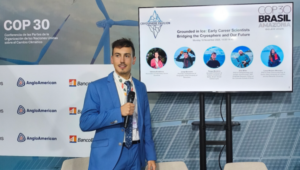
Here is a short video of Josep Bonsoms presenting at the COP30 conference in Brazil, 2025.
ALEX RETURNS:
RESERVATIONS ABOUT PETROLEUM RESERVES
In March, thirty two member countries of the International Energy Agency (IEA), including Japan, the United States and European nations, agreed to release oi from national reserves.
On the big oil and gas blockade in the Gulf, experts have serious reservations about whether opening petroleum reserves will accomplish anything meaningful. The oil reserve promised represents about 4 days worth of global consumption (100 million barrels a day global vs. 400 million barrels promised).
Getting the oil out of American strategic reserves is slow. In the United States, experts estimate it will take four months to deliver 172 million barrels of oil from the strategic reserve, as promised by Trump Administration. Meanwhile prices stay high. This reserve ploy is a mirage. The transfer be stopped at any time the President changes his mind. There is no obligation to tell the public. The one-time show for the stock market has been expended. Actual delivery over several months does little.
SAVE IT FOR HARDER TIMES?
It is possible all countries, including America, should not be releasing now, because there is a lot longer and likely a lot worse to go? Reserves used now to keep transportation and industry as is, without any sacrifice or cut-back, will seem wasted if that fuel is need just to keep food trucks going, hospitals operating and other essential services. In the mean time, recreational flying needs to be dropped, gas rationing is already in the works for several countries, and factories will shut down. More countries will only offer electricity for a few hours a day, or not at all.
There is no oil reserve for natural gas. For a lot of countries, especially in Asia, either the gas just stops, or an insane bidding war grabs gas vessels intended for Europe. For a lot of people, the gas just stops until the peace arrives, and likely for months after peace.
THE FERTILIZER PROBLEM
We need to talk about food – and if food fails, mass migration and it’s impact on politics. Agriculture experts say we are entering a “nightmare scenario” for global fertilizer markets. Between 30 and 50% of all the nitrogen-rich fertilizer, ammonia, sulfur for phosphate fertilizers – all mass through the bottleneck of Hormuz. That fertilizer has stopped flowing out to the world.
According to a U.N. report on closing the Strait, Pakistan will be deprived of more than a quarter of the fertilizer keeping their 250 million people alive. Half the fertilizer for the war-torn state of Sudan comes through the Strait. At least, it did.
The real impact, including mass hunger or starvation, may not show up until this summer or fall as crops fail or the harvest is greatly reduced in agriculture addicted to fossil-made fertilizer. This war will have a long tail of difficulties not easily seen now.
Meanwhile the climate emergency grows.
That’s it for this week. One note: I know musical taste is so different among us. If any of these new show songs touch you, please pass them on to others. They may need a voice from the heart to help a throbbing brain.
Thanks for listening, and caring about our world.
Alex
Pingback: Ocean warming, fish biomass and the global media response to our NEE paper -