While record heat pummels the West, two great scientists explain a speeding ocean heat pump pushing the planet hotter – in steps. Dr. Kevin Trenberth Distinguished Scholar at the National Center for Atmospheric Research explains ocean heat storage, El Nino – the way the world works, unseen from land. Then from Columbia University Dr. Suzana Camargo on the future of hurricanes, typhoons or cyclones. They cause more than fear and damage. Big storms change weather and drive heat and water toward the Poles. Tropical cyclones are bigger than we thought.
Listen to or download this Radio Ecoshock show in CD Quality (57 MB) or Lo-Fi (14 MB)
On social media, you click through war and scandal thinking “There must be something else.” There is. It is outside your door, waiting for you. Step out. Tune out the propaganda drumbeat. Tune in top scientists laying out how the real world is changing – now and for centuries to come.
Carbon bombs are falling. In the U.S. southwest last week, 40 million Americans got summer heat in winter. Five thousand feet up (1,600 meters) near the Rocky Mountain, Meteorologist Chris Bianchi did his 9NEWS TV weather in swim trunks. It was 85 degrees F. (29 C). In March. Which is winter.

The all-time U.S. March heat record set in Rio Grande City, Texas on March 30, 1954 was 108 degrees F (42C). That was broken on the 19th March 2026 with 110°F at Martinez Lake, Arizona. That is 43.3 C. Going back to the 1800’s when records began, it has never been hotter in March in the United States than now.
Now a group of scientists at worldweatherattribution.org showed this giant “heat dome” carried temperatures 11 to 17 degrees C – 20 to 30 degrees F hotter than average for March – across more than a dozen states, over half a continent in fact. The scientists concluded: “events as warm as in March 2026 would have been virtually impossible without human-induced climate change.”
When you get summer in winter, it is time to admit he awful truth.
Climate change is here, right now, no matter what humans think they are doing in business, war, or online gaming. We all need to learn how this beast works, and what to expect.
====================
THE DANCE BETWEEN OCEAN HEAT AND THE ATMOSPHERE
KEVIN TRENBERTH
Ninety percent of all the extra heat being absorbed by this planet goes where? – into the ocean. That heat will come back out. When and how fast? Is it unstoppable? For that we go to one of the most published scientific authors on ocean heat and the atmosphere, Dr. Kevin Trenberth. He is a Distinguished Scholar at the National Center for Atmospheric Research.
Listen to or download this 27 minute interview with Kevin Trenberth in CD Quality or Lo-Fi
Kevin Trenberth authored or co-authored multiple studies on ocean heat in just the last year. Lots to talk about there. But we begin with a theory posted by UK Climate Science Writer Tom Harris, and researcher Jan Umsonst in Germany. They worry more heat is piling into the upper layer of the ocean, where it overloads and releases in bursts of heat. That accelerates warming on land. This theory (no peer-review) is found in this Substack article: “The Great Decoupling: How Ocean Stratification is Boosting Global Warming”. The pair just released a second part to this theme: “The Great Decoupling 2: Changes in Ocean Biochemistry Driven by Strengthening Stratification”. They say “The oceans are losing their breath”.


Tom Harris (left) and Jan Umsonst
Co-author Jan Umsonst – a kind of volunteer science scout and climate theorist – explains it this way in a Facebook post. I was also inspired to look into all this by another Umsonst post on Facebook saying “earth’s climate system is a discharge/recharge oscillator.”
“The Great Decoupling” article cites several of Trenberth’s papers. For example, Kevin and co-authors suggested temperatures rise in steps in this 2015 paper, and again in this article in The Conversation.
In a private communication, Trenberth told me:
“Why is this ignored? It shows that it is not forcing or natural variability or aerosols. Changing aerosols have played a bit role in the Northern Hemisphere but biggest warming is in the southern hemisphere. What we show in our article is that the increased heating is from increased absorption of solar radiation (not just the greenhouse effect) because the skies are opening up in the subtropics especially as the atmosphere and ocean circulation has changed in response to climate change from the increased carbon dioxide etc.
This means the changes are not linear or directly linked to forcing but involve profound changes in the atmospheric winds as the weather systems: jet streams, storm tracks etc, shift polewards over the oceans.”
OCEAN STRATIFICATION ADDING TO WARMING?
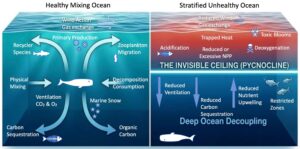
The heat problem in the upper ocean gets worse as solar energy (and heat reflected by greenhouse gases) piles into the sea faster than it can be distributed further down. The ocean layers become more pronounced, called “stratification”. This also reduces food bits coming up from the lower ocean, and so can harm fisheries in the more highly populated upper layer.
Last September, Kevin co-authored a paper in Nature on “Ocean stratification in a warming climate”. I ask Kevin: What is ocean stratification, is it important, and is it changing? A free .pdf of that article is available here.
If you prefer video, check out Paul Beckwith’s helpful video “How Ongoing Ocean Stratification is Already a Really HUGE Deal and Will Mess Up Our Future Prospects”.
WHAT ABOUT CHINA?
We hear a lot about the state of the ocean heat, especially El Nino events – and how they impact North American or European weather. What about China? Are changes in ocean heat affecting China as well? Kevin advises the Chinese Pacific Coast is on the East, while most winds and weather come from the West. So it is more a question of how climate changes on mainland China will affect the warming seas, rather than the other way around. See this paper by Kevin E. Trenberth et al April 23, 2025 “Distinctive Pattern of Global Warming in Ocean Heat Content”.
A paper in 2022 suggested, quote ““anthropogenically-forced changes in salinity are likely enhancing the ocean heat uptake.” What does the balance of salty and fresh water have to do with marine heat retention? Kevin explains how that works, mainly as salt adds density, causing waters to sink, moving surface heat deeper. That reduces greenhouse warming now, but leads to heat release later, likely for centuries after the human experiment with fossil fuels is over.
WORRIES OF A BURP IN THE SOUTHERN OCEAN
Not discussed in this interview, but another factor to watch: models led by Ivy Frenger at GEOMAR Helmholtz Centre for Ocean Research in Kiel warn Southern Ocean heat could “burp” back – at least a century after human emissions peak. That release could potentially re-accelerate warming, despite human emission controls.
NCAR AND CURRENT AFFAIRS
Just as climate is smashing America with weird winter heat waves, drought, wildfires and crazy storms, the Trump Administration is closing America’s premier institute for research into the atmosphere – NCAR the National Center for Atmospheric Research in Boulder Colorado. Kevin has spoken up about the great loss of scientific knowledge and scientists if NCAR is closed. This just in: UCAR sues its partners to block Trump administration’s “arbitrary and capricious” selloff of Boulder NCAR lab – The Colorado Sun March 16, 2026
KEVIN’S LATEST ARTICLE ABOUT NEW ZEALAND IN THE CURRENT ENERGY CRISIS
“NZ’s energy dependence won’t be solved by the private sector” 25 March 2026
NZ’s energy dependence won’t be solved by the private sector
PREVIOUS APPEARANCE OF KEVIN TRENBERTH ON RADIO ECOSHOCK
====================
CYCLONES AS PLANETARY HEAT MOVERS
SUZANA CAMARGO
Temporary extremes can leave big impacts. Call them hurricanes, typhoons or tropical cyclones, as scientist do. They crash quickly through our lives leaving a trail of damages. We are just beginning to discover these big storms are a much bigger part of how the climate works. They change global energy and water. This is a fundamental new understanding of cyclones on this planet.

At Columbia University in New York, Suzana Camargo is a Professor of Climate – at the Climate School. Educated in Brazil and Germany, Camargo is widely published and respected in her field. She continues to teach and mentor young scientists. Along with Kevin Trenberth, Camargo is co-author of the new paper “Interactions of tropical cyclones with global energy and water cycles.”
Listen to or download this 23 minute interview with Suzana Camargo in CD Quality or Lo-Fi
This study talks about petawatts (PW) of energy shifted by tropical cyclones. That is many times the energy capacity of the entire modern world. This new paper raises the question of feedbacks: how might changes in cyclone statistics under global warming feed back onto the climate system itself, for example via ocean mixing or heat uptake?
Is there a plausible world where reduced storm frequency but higher intensity changes the balance of energy and water transports in ways that matter for long-term climate projections?
Are tropical cyclones a force that helps cool the world, or do they add to heating? The Abstract for this paper says:
“The cumulative effects of Tropical Cyclones (TC’s) can have long-term (over 1 month) effects on global ocean heat uptake (annual mean 0.13–1.4 PW), ocean circulation and the El Niño–Southern Oscillation.
Anthropogenic warming is likely to alter TC intensity, track and frequency, and the associated precipitation; however, projections of the future impacts of TCs on energy and water transport remain uncertain.“
NOT JUST EXTREME WEATHER
These giant storms do not “cool” the planet. They may leave wakes of cooler conditions behind them because they are transferring heat somewhere else, generally toward the Poles. Estimating the exact “share” of heat transport attributed to tropical cyclones (TCs) is a major topic of debate in climate science, but current research typically places the figure in the 15% to 35% range for specific regions or components of the global system.
You could say Tropical Cyclones act more like a global thermostat. Conceptually, Ma et al. argue that TCs should be treated as “engines” embedded in the global energy and water cycles, rather than only as extreme weather hazards.
=================
ALEX: FORCED CARBON REDUCTIONS
Isn’t it strange to see the International Energy Agency publishing tips on how to save energy and money during the Middle East oil and gas crash? “Use public transit” “work from home” “fly less”. You think? We’ve been saying this for years.
Two quick things as we wrap up.
1. This energy squeeze is not temporary.
Some production infrastructure wrecked in the Gulf War will take up to five years to repair – according to the Government in Qatar. Shipping will take a long time to rebalance. More people and countries will turn to cheap renewables. Plus a crash of consumer demand and economic depression could cripple the consumer’s ability to go back to fossil-burning lifestyles.
2. It is not enough.
The proposals to cope during the Middle East shutdown are tiny band-aids, no where near enough. When we get summer in winter, violent storms, drought threatening millions – a long list of damage – then we know this really is a climate emergency.
I assume gas prices in America could reach European levels, so maybe 8 to 10 dollars a gallon. Already news reports show airport security workers not showing up because they cannot afford gas to the airport. America built affordable living hours away from workplaces, with no walkable shops and giant gas-guzzlers as the solution. Where people must drive to live, and only the rich can afford gas, then it is time for gas rationing. We don’t need cards in a digital age. Some people get gas rations who don’t need them – so they sell them to others. But overall use and emissions are capped, and the cap gets lowered every year. This is war-time, but not with each other.
We need war-time emergency action to save a livable climate now, for our kids, for our descendants. Ban private flights. Invest in mass transit, and quickly divest from fossil fuels. Return national bus service. Rebuild railways. Buy less, use less. That is where every country needs to be – starting yesterday.
There is no time left to keep killing each other, no time left for blowing up cities, or fighting for male dominance over and over. The only winners are climate survivors. We are the ones to become those survivors. The living world you save may be your own.
That is how I see it. Thank you for listening when many won’t. Keep caring for each other.
Alex.
Hi Eco shock, i have co authored a few pieces with Tom Harris and i think one important question still remains unanswered, To what degree natural bioaerosols create a livable climate and how does their reduction effect all the problems we are currently facing. From East Africa to the southern ocean we are seeing massive deforestation or the ocean equivalent of fishing (krill exploitation and reduction)
I posted this note which may be of interest
https://substack.com/@tcrethers/note/c-235763411
bioaerosols are climate creators and their reduction effects most of all cloud creation and longevity plus the ability to circulate massive amounts of heat into the lower pressure upper atmosphere for easy release back to space. All of this is reflected in albedo loss and heat retention and needs to be more seriously discussed.