From New Zealand and the U.S. National Center for Atmospheric Research, Dr. Kevin Trenberth talks ocean heating, new science and his provocative new article. But first we run away to the past. Oregon State University Professor Peter Clark just published “Global mean sea level over the past 4.5 million years” Can we find a rear-view mirror that helps predict our future?
When it comes to kicking the fossil habit, the scales don’t lie. In 2024, carbon dioxide in the atmosphere increased by 3.5 parts per million. That is the biggest jump since 1957 when Keeling’s Mauna Loa lab started accurate records. Humans continue to hit the accelerator on global warming.
Here we go. It’s Radio Ecoshock.
Listen to or download this Radio Ecoshock show in CD Quality (57 MB) or Lo-Fi (14 MB)
ALERT!
Fewer people now visit web sites because AI summarizes everything first. Search engines are no longer guides but interpreters (with their own agendas). This blog has been the only source of funding to keep Radio Ecoshock going – thanks to listener donations here. But search engines no longer take us here. Some say the Web is dying… I don’t know.
If you are ready to donate, please use this page.
As you know, the rule of non-profit radio networks like Pacific prohibit me from asking for donations on the air. Probably the majority of listeners to not even realize we need donations. Now the web/blog model that asked for help is starting to fail.
I’m just not a huckster or a salesman. I don’t want to mail you a T-shirt, coffee cup or any consumer waste. Even worse, as I age, I don’t have the energy to promote this show through social media. I find key issues, talk with the scientists or experts, get that out on radio, and that takes all I’ve got. Please don’t suggest my next advertising campaign or whatever.
We have enough monthly subscribers to keep paying the basic bills, especially free downloads of the show for everyone, anywhere. As long as you good folks keep up, the show goes on. But I also have bills and costs to keep going. That is where a few generous donations can make all the difference. If you can spare a few hundred dollars, or more, please help me produce this radio show with your donation. This project should survive. Can you help?
Alex
=======================
SEA LEVEL OVER MILLIONS OF YEARS
PETER CLARK
As the first humans evolved, big ice dominated the world. Before that, scientists found a warm period with carbon dioxide levels similar to today. In that ancient warming, sea levels were 20 to 25 meters, or 65 to 80 feet higher than now. Is our future to be found in the past?
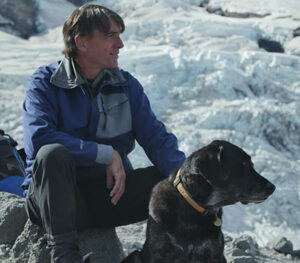
Scientists using new advances just released a study “Global mean sea level over the past 4.5 million years“. It also tells us about ice, oceans, and Earth in space. The Lead Author is Dr. Peter U. Clark, Distinguished Professor of Earth, Ocean, and Atmospheric Sciences, at Oregon State University. He is also Professor of Quaternary Studies at University of Ulster.
Listen to or download this 25 minute interview with Peter Clark in CD Quality or Lo-Fi
ICE AGES BECAME LONGER, MORE SEVERE
The last million years contains a huge change: the cycle of ice age and warm inter-glacial moved from around 41,000 years to every 100,000 years. Ice ages became more extreme with longer periods of glaciation.
The 41,000 year cycle of warmth and ice appeared to be synchronized with different positions of Earth relative to the Sun – due to our long orbit path being elliptical rather than a pure circle. There are bulges when we are further from the Sun, and flatter spots where we are closer.
One hundred thousand (roughly) year cycles are a different variation of three planetary changes called “Milankovitch cycles.” Instead of influence by changes in orbit, these ice ages seem triggered, or at least co-existent with changes in the tilt of the Earth. Our planet wobbles, putting one Pole or the other a bit closer to the Sun.
Exactly why Earth changed from shorter to longer Ice Ages, relatively recently and during hominid evolution, is not totally known. We discuss possibilities in our radio interview. All this matters because:
1. knowing natural cycles well enough could help us calculate their influence on climate habitable for humans
2. we need to be able to separate natural cycles from data about warming and climate change, to know which is which (and how they might influence each other).
3. climate deniers often say warming is natural, it happened before – or that warming by pollution saved us from the next ice age which was just around the corner…again, we need facts. Peter Clark said the next ice age might have been 50,000 years from now.
4. specifically for sea level, can we eliminate natural cycles as a cause of continuing sea level rise?
NEW SCIENCE SHOWS “global sea level over the past three million years cannot be explained by orbital cycles alone as has been previously hypothesized. Instead, they likely involved internal climate feedbacks, particularly those linked to the Southern Ocean carbon cycle and atmospheric carbon dioxide.”
WHEN ICE SHEETS SURVIVE WARMING
The new study findings show some ice survived in Antarctica during a warming that developed about 3 million years ago. Carbon levels in the atmosphere at that time may have been around 400 parts per million – a bit lower than today. Called the Mid-Pliocene Warm Period, (and sometimes Mid-Piacenzian Warm Period or mPWP – Earth was over 3 degrees C hotter than today.
In our radio interview, Peter Clark suggests Antarctic glaciers may have been so tall – so deep – that simple elevation kept them frozen. Think of ice on top of mountains not melting in Summer. We also discussed the Mid-Pliocene Warm Period in September with Dr. Georgia Grant, Senior Sedimentologist with Public Research Organisation Earth Sciences New Zealand.
However, Dr. Clark says the Mid-Pliocene Warm Period is not a viable model for what we should expect in our future. It can tell us very little directly. That is partly because climatic and ice world changes millions of years ago were so much slower than anything today. A fast climate change might take 10,000 years. Many changes in carbon dioxide, heat, and sea levels developed over millions of years. Today we are talking about extreme change over a few hundred years, and even visible in decades. That is a wholly different game.
Past periods of warming, with similar greenhouse gas levels, might point to destinations. For example, it seems reasonable to expect tens of meters, even a hundred feet of sea level rise coming from this current warming – eventually. We don’t know when. There is no historical or deep time analog that moved fast enough to tell us about our near-future. Anybody selling you a YouTube video presenting 2035 based on events 3 million years ago is just clicks without scientific content.
We don’t know if there is a limit to how fast Polar ice sheets can disappear. Classic science said no matter how hot we make it, even 3 or 4 degrees C of global warming (and many times hotter at the Poles) – these big ice sheets will still take at least hundreds and maybe thousands of years to melt and release their stored water to the sea. Could there be cracking or other fast-moving events in the ice that do not show up in the pre-human record, and that we don’t know about? We can’t count on the past record for this extraordinary – unique – warming.
=======================
“CROPS NOW GROWN WILL NO LONGER SURVIVE”
KEVIN TRENBERTH
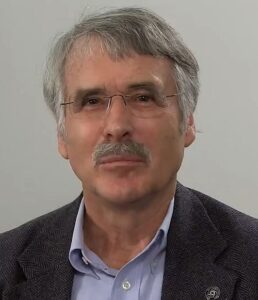
Crops feeding billions depend on a climate currently disappearing. Expect food and water shortages and millions of environmental refugees? Who says so? Dr. Kevin Trenberth is a long-time Distinguished Scholar at the U.S. National Center for Atmospheric Research. Now in New Zealand, after hundreds of papers Kevin is still publishing on “High Temperatures in the Ocean in 2024” and “Distinctive Pattern of Global Warming in Ocean Heat Content”.
Listen to or download this 21 minute interview with Kevin Trenberth in CD Quality or Lo-Fi
Kevin has a “provocative” a new article, published October 10th in the New Zealand publication “Newsroom”. With his years of working on international projects, like the Intergovernmental Panel on Climate Change, Trenberth now says “Net-zero is a pipe dream”.
Net-zero is a pipe dream: civilisation now faces an existential threat
The sub-head for his new article in New Zealand says “Crops now grown will no longer survive”. That’s a big statement, so I did a bunch of digging. Sure enough there are at least a dozen articles in the last six months about climate limits to crops that feed billions. One finds “World’s critical food crops at imminent risk from rising temperatures”.
New studies suggest in a 3 degree C warmer world, staple crops in tropical and equatorial zones will likely become unviable on a large scale. Warming and unstable weather threatens production of coconuts, yams, cowpeas, rice, maize, wheat, and soybeans. But mid- to high-latitude regions may see less severe impacts, maybe within adaptation or change of crops. I have more comments and science about crops and climate below.
OCEAN HEATING IS UNFAIR
We might think water tends to warm up evenly, but your April 2025 paper finds ocean heat clustering around 40 degrees North – at the level of America, the Mediterranean and North China Sea – and 40 degrees South, which means near the south tip of South America, Tasmania, and your own New Zealand. Does abnormal ocean heat translate into more extreme weather on land and peoples in those mid-latitude belts? Kevin explains in the interview.
A SEA LEVEL DEBATE: GLACIERS OR RAIN?
As you hear in this new interview with Kevin Trenberth, how much sea level rise comes from ice sheets versus groundwater loss is still debated. According to a new study published July 24 in Science Advances, groundwater loss is raising sea levels more than any ice sheet melt at either Pole. In my September 10 show, I spoke with study co-author and long-time NASA scientist Jay Famiglietti about that paper.
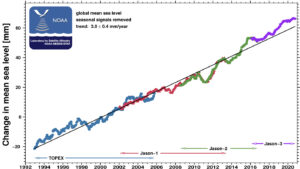
In this week’s interview, Kevin Trenberth, as an initial reaction, doubts that transfer of ground water to the oceans contributes more to sea level rise than either Greenland or Antarctica currently (but not more than both). Trenberth says global sea level is going up at around 5 millimeters per year (estimates vary slightly, and some years rise more than others).
Trenberth raises his own work in a 2011 study which is sobering: a big rainfall event over Australia dropped so much water it led to a rare drop in sea levels, temporarily, despite long-term rising seas. Thousands of people fled flooding communities. Australia’s Bureau of Meteorology reported the second half of 2010 was the rainiest since record-keeping began in 1900. The Christmas 2010 rains flooded an area the size of Germany and France combined. Forty Queensland coal mines closed. Wheat to surgar cane crops were ruined. It was epic. Those who lived it never forgot.
The study on that 2011 extreme rainfall event is: “Australia’s unique influence on global sea level in 2010–2011”. It was led by John T. Fasullo. Kevin was not an author but his work was heavily used in the paper. It was published August 12, 2013. This was a temporary “bump” in sea levels – the decline lasted several months, but overall the year 2011 still saw higher sea levels, like every year this century.
Combined with heavy snows in North America and rains in South America at the same time, Trenberth said this unique event in recorded history temporarily lowered global sea level by 5 mm. They called it a sea-level bump. Water was removed from the ocean and dumped on land. Nevertheless, satellite measurements say the 20 year trend shows land losing water to the sea at a rate which also contributes to sea level rise
—————————
The paper about groundwater transfer to oceans adding more to sea level than either Greenland or Antarctica was published July 24 in Science Advances. It is titled: “Unprecedented continental drying, shrinking freshwater availability, and increasing land contributions to sea level rise”. The Lead Author is Hrishikesh Chandanpurkar, an Earth Systems scientist at Arizona State University . We reached co-author Dr. James (Jay) Familglietti. He is the former director of the Global Institute for Water Security at the University of Saskatchewan and previous Senior Water Scientist at NASA’s Jet Propulsion Lab in Pasadena.
———————-
We know more energy in the Troposphere, due to greenhouse gases and warmer oceans, leads to more evaporation and a higher capacity of the warmer atmosphere to hold moisture. It won’t all stay up there. The key is: where does the resulting rainfall come down?
A simplistic answer: because ocean covers far more of Earth’s surface, more rain will fall there – and unlike land, there is no where for it to run-off. However, Earth systems are complex. For example mountains may trigger rainfall, air currents may steer rain-heavy storms toward certain regions, and we know some human emissions, and even plant emissions, lead to particles over land (aerosols) that can stimulate rain formation in clouds. Another complication: more rain is reaching and falling on the ice sheets of Greenland and Antarctica – which adds to their load and sea level contributions – but later, after a time delay.
Even so, the Chandanpurkar, Famiglietti et al study is not based on models or conjecture. As far back as 2014, Famiglietti and NASA’s Grace satellites published measurements of California losing mass. The rocks don’t change, so only missing water could explain that loss of gravity. Now with a global study, measurements show land losing mass on a global average, despite large regional variations.
The debate would be: how much water has been transferred to the ocean, and can that water be returned by super-storms or atmospheric rivers and their extreme rainfall events over land, as Trenberth studied in Australia?
Also, a current boom in water transfer from land to oceans may be temporary. That trend may increase or decrease depending on human actions, like whether we continue to pump out groundwater on such a scale, and whether we continue to add greenhouse gases to the atmosphere.
It is possible Greenland ice melt, or Antarctic ice melt will increase beyond this land-sea transfer, to become dominant. Given past ice history and the amounts of water stored in glaciers, that seems likely. We are not going to get 25 meters, or 82 feet of sea level rise from groundwater running or falling into the sea. That requires the ice realms to release water collected over millions of years.
=========================
SAVE THE CROPS!
A headline cut from Kevin Trenberth’s article says “Crops now grown will no longer survive”. Kevin tells us he means to be provocative. Hardly anyone is talking about this threat – as we add billions more people to the planet amid shrinking resources and accelerating climate change.
According to a paper March 2025 paper led by Finnish researcher Sara Heikonen:
“Potato, maize (corn), wheat, and soybean: These staple crops account for much of global food supply. At 3 °C, large parts of their production (especially in low-latitude regions) could fail or face drastic yield reduction, though impacts are more moderate in higher latitudes.”
“Rice: Particularly threatened, with as much as 17% of production already outside suitable zones at 2 °C; impacts become more severe at 3 °C, especially in low-latitude Asia.”
Sara Heikonen and colleagues conclude:
“Under a 3 °C warmer world, many staple and specialty crops currently grown—especially in tropical and equatorial zones -will likely become unviable on a large scale, with particular risks to coconut, yam, cowpea, pigeon pea, rice, maize, wheat, and soybeans. Mid- to high-latitude regions may see less severe impacts, but widespread crop adaptation or migration will be necessary to avoid catastrophic food supply losses.”
Add in climate-induced or aggravated droughts, some lasting years, plus extreme rains as hit Australia, and generally destabilized weather – well, crops will fail in places, likely leading to mass migration by anyone able to leave, as Kevin suggests. Check out my April 2023 show “Nomad Century” with UK author and broadcaster Gaia Vince at ecoshock.org. That’s the real sauce on climate, crops and mass migration.
==========================
DESPAIR, FORECLOSURES AHEAD FOR CALIFORNIA HOMEOWNERS…
As we check out, a worried hello to our many listeners in California. Everybody knows insurance is going nuts there, especially after years of wildfires. Allstate stopped writing new homeowner, condo, and commercial insurance policies in California since November 2022. Other companies left the state, or stopped writing any property insurance in the state.
Those who can’t get insurance can apply to a government run program called “Fair”. According to blogger Susan Crawford, “California’s FAIR Plan seeks 36% rate increase as wildfire risk and insurer exits surge. With $650B in exposure but just $1.5B cash on hand, the math no longer works. Homeowners face costly coverage, rising assessments, and a volatile market going forward.”
With layoffs and rising prices, more California properties may go without insurance – except then banks won’t provide a mortgage. What will it be this week kids? Food or a home? When human failure meets implacable climate change, the math of life no longer works.
We are at a hinge point. Massive social and economic change could lead to survival, possibly with better more meaningful lives. As Bishop Tutu said: “I am not an optimist. I am a prisoner of hope.”
I’m Alex. Thank you for listening. Tune in again next week for more Radio Ecoshock. We talk about new science on tipping points and “The Long Heat” with Andreas Malm.
The one hour version ends with the song “When the Rain Came Down” – lyrics by Alex Smith, AI music, Creative Commons license. It is about extreme rainfall events – as seen by those who experience it.