The markets! The war! Hacked banks and freezer attacks are just the start. Which is bigger: AI or the climate crisis? Is warming accelerating? We talk new science with Dr. Senne Van Loon, Research Scientist at Colorado State University. Also in today’s mix: both American coasts flood and nobody can say “rising seas”. Is the system collapsing – and would that be a good thing? We go back to my 2016 chat with radio broadcaster and educator Eddie Yuen: “Can we count on catastrophe”?
I’m Alex. Welcome to this meeting friends.
Listen to or download this Radio Ecoshock show in CD Quality (57 MB) or Lo-Fi (14 MB)
Crazy crazy times. American voters repudiate Republicans and the war in a big swing. Tech stocks crash – literally trillions of dollars of stock value lost. The AI bubble is fizzling, even while criminals and hostile countries use powerful AI tools to crack into banks, and the food supply. You had freezers across Europe hacked to become heaters instead. Even blood banks in France were hacked. Maybe it is part of hybrid war by Russia against Europe. Maybe it is a frustrated 20-something with AI on a laptop.
Someone got into the citadel of cyber-stashes – Binance – and stole 6.3 billion dollars. It is the largest theft in history. But hey, who can remember what happened yesterday? The FBI blames North Korean hackers. Binance claimed to be the safe place to keep your money outside government view and financial rules, the Libertarian dream. It is like the hackers got hacked. There is no time to figure out what this means before the next shock.
Politicians, Libertarians and others on the right, want to put all your money in digital currency. El Salvador played with it. In Canada, Opposition Leader Pierre Poilievre campaigned to get the Bank of Canada off the dollar and into cryptocurrency. In the UK Nigel Farage is crypto-friendly. Donald Trump pledged to create a “strategic bitcoin stockpile“.
In Paraguay businessman, Trump friend and cryptocurrency investor Santiago Pena became President last year. He decided to place hundreds of millions of dollars of public money and pension funds into his former bank call Ueno – U-E-N-O. That bank suddenly closed on November 5, seized by Paraguay’s central bank.

The collapse froze the accounts of nearly 3 million customers (about 60% of the country’s adult population) and trapped hundreds of millions of dollars in public and pension funds. Massive protests erupted the same day. President Santiago Peña resigned before he could be impeached. By the way, this is Spring in Paraguay and it is unnaturally hot – at least 44 degrees C or 110 Fahrenheit. Mothers and people in wheel chairs are out in that heat, in the streets of Asunción crying for their rent money, their pension, their small savings.
A bank collapse, people locked out of their money, is a fever. One country gets it and everybody knows it can happen anywhere. The French bank story is worse: experts admit on France 24 TV that advanced AI can crack into almost anywhere. Listen to this from France24 TV:
“So what happened at Crédit Mutuel Arkéa, a bank that just a few weeks ago was being recognized for its innovation in cybersecurity? The hackers managed to access the bank’s servers and steal a portion of its own capital, subsequently converting those funds into cryptocurrency. This is the first incident of its kind. The last time such a large sum was stolen was perhaps during a physical heist involving a vault.
That was a different era. The hackers dispersed the money across several accounts hosted on cryptocurrency platforms. According to this expert, they then broke it down into smaller amounts to make recovery virtually impossible.
“Could an attack of this nature one day affect the bank accounts of individual customers? The possibility of accounts belonging to hundreds of thousands of customers being drained is a risk that must be taken seriously. It’s a real threat. It could happen.”
“Essentially, we’re dealing with a superintelligence capable of bypassing and circumventing all existing security controls.”
I am not sure my local credit union knows anything about this. They do not have 24-hour teams of cyber defense experts. Even the Wall Street investment firms may not be able to defend their accounts from advanced swarms of AI agents. This whole scene suggests an international run on the banks as people flee back to money under the mattress. It may start as a trickle, but the AI safe-cracker is on the loose, looking, prodding, and probing without rest, for anything humans do not expect.
There is probably nothing frontier AI cannot hack into. Anyone with a few thousand can build an off-book personal AI and get into the game. No doubt hackers and agents from several nations steal or buy working copies of frontier models. Some of those escape, are sold on the black market, or go home with a fired tech worker.
The big news: an unstoppable hacker has multiplied and moved out. Swarms of agents encounter an archaic human system built on belief in security, belief in safe institutions. This is a new kind of war, cyberwar as we never imagined it.
The enemies are known and unknown. It may be China, Russia, the America NSA, or North Korea. It may be disgruntled Jimmy or Joan, tech nerds who recently inherited a little money and a large grudge. It may be a start-up in New Jersey or Lagos trying to make a fortune, as one does. The actual source of the attack may become less important than the tool. When the best security tool on the planet is the attacker – is there any defense? Are we back to gold coins buried in the back yard? Should I take my paltry couple of thousand dollars out of the bank before someone else does? If millions of people feel that, bank runs can become a new Depression.
Beans, Bacon, and Gravy clip, Pete Seger 1931
And even with all that, I don’t think artificial intelligence or the energy war are the drivers of final human demise. A great depression maybe. Only one force is grinding away, pushing us off the planet. That force is rapid climate shift. Global warming kills slowly at first. It wrecks crops some places, some years. It creeps up on the coasts turning land into sea. It reduces life expectancy, burns landscapes, and changes life in the ocean. Humans have a common living space and a common enemy. We continue to arm that enemy by living as we do, in a system of countless fossil-powered machines.
Some of us think a massive financial crash and economic slowdown is the last chance to save a livable climate. We talk about that with broadcaster and educator Eddie Yuen in the second half of the show. Nothing else has worked and diplomacy has failed. I might think “If that is what it takes to change our ways, so be it.” But you know, innocent others far way from our sight will lose their lives first, without voice or choice. Unlike every AI, I am able to say “I don’t know the answer”. I was only given enough to know the questions.
==========================
HOW TO REPORT GLOBAL WARMING WITHOUT EVER MENTIONING GLOBAL WARMING.
As October became November, both coasts of the United States flooded. Cars floated around the streets. Old people told TV crews their homes had never been knee-deep in water before. Weather reporters and news anchors tied themselves in knots trying to report global warming without ever mentioning global warming.
It was the moon (partly); it was El Nino (sort of); it was King Tides, a Kelvin wave – anything but two words “rising seas”. All those other drivers go higher and higher because hotter seas expand in volume and glaciers of the world melt into the ocean.
The last glacier on the highest peak in Slovenia disappeared last summer. The Triglav glacier was part of Slovenian identity. It was almost gone by 2003 but hung on until this past scorching summer. Groups of young people hiked up to say good-bye. Scientists gave up after 80 years of monitoring. Photographic retrospectives of the glacier were organized, but there will be no funeral. Disappearing glaciers are normal now.
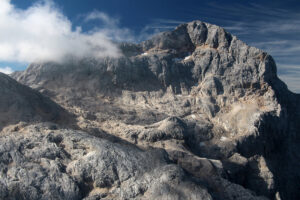
This is where the glacier was.
Back in the USA, media heads were mystified, unable to name a certain something about water in streets and homes, about that cove where the beach used to be, about places falling into the sea.
The only place I could find “rising seas” was on a YouTube channel: “EWN | Extreme Weather Network” with a title: “EAST COAST FLOOD CRISIS! Charleston Tide Flooding UP 400% in 60 Years as the Sea Keeps Rising”. Yes, the sea keeps rising. But a week later, YouTube tells me this account has been “terminated”. OK.
FLORIDA – ALWAYS A STRANGE CASE
Surprising floods showed up all along the East Coast, but Florida is always a special case, isn’t it? Last week a few places in South Florida got well over a foot of rain in about six hours, just monstrous 1-in-a-thousand year downpours. But East Coast streets were flooded a week before that, and a week before the King Tides. There was no hurricane – just a lot of communities got hurricane-level flooding under a clear blue sky.
Millions of you know Miami is living on borrowed time. The sea encroached further again this time. Note the harsh reality: pumps can’t save the low parts of Miami. The rising sea bubbles up inland through the porous stone below the city. When the sea is too high, as it was last week, where are you going to pump this water? It can’t go back to the sea.
Earth.Org notes that modest sea-level rise can reduce coastal Miami’s natural flood-control drainage capacity, up to 70%. Heavy rains, expected with climate change, have nowhere to go.
That is why Miami cannot build tide and flood defenses like London or Rotterdam. As J. Court Stevenson told us after Hurricane Sandy flooded downtown Manhattan, New York Harbor could be protected by three sea gates. In 2012, that might have cost about ten billion dollars. That seemed cheap compared to repairing Manhattan. Nobody did it. But it could be done, giving New York more decades before withdrawing from high seas. There is no solution for Miami other than move to higher ground.
Seas rise faster and higher if the world heats faster and higher. Is it? Is climate heating accelerating?
================
We have mental skip mechanisms when the money ask comes. But here is reality: trying to create a free public service like Radio Ecoshock is getting harder and harder. Some folks are quitting. They have to pay the rent. Whatever you can give to help keep this program free and advertising free – please do it here. Your support helps me physically, mentally and spiritually. Can you help?
================
MORE PROOF: WARMING IS ACCELERATING
SENNE VAN LOON
We need to know how much the world is warming – and is it accelerating? We used to depend on weather stations around the world, including ships and sea buoys. More recently famous scientist James Hansen said satellite measurements of heat energy going back into space is better. He posted about Earth Energy Imbalance.
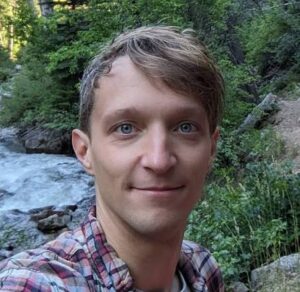
New science refines that. We get close to real-time warming data. With a little help from AI, scientists discovered a new force adding significant warming to the world. You have not heard about it. The Lead Author for the study is Dr. Senne Van Loon. Senne is a Research Scientist at Colorado State University. He is a physicist working on atmospheric science.
Listen to or download this 20 minute interview with Senne van Loon in CD Quality or Lo-Fi
The title of the June 2026 paper is “Recent Weakening of the Global Radiative Feedback”. The paper is Open Access so feel free to check it out. At first glance, to a layperson – it sounds like a climate feedback is weakening, which would be a good thing. This is not a good thing. A process that helps cool the Earth (radiating heat back into space) is weakening.

Many of you are familiar with James Hansen’s warnings about warming acceleration. Hansen insists comparing incoming solar energy to the amount of energy bouncing back into space is the best tool. It is called Earth Energy Imbalance. Other scientists now use a related but different measurement to track warming: Effective Radiative Forcing, (ERF). This adds more reality by taking into account things like volcanic ash or clouds in the sky. It reflects how the system is actually working. By the way, don’t confuse our guest Senne van Loon with Harry van Loon who worked with Hansen before his passing in 2024.
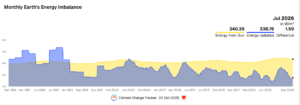
I’ve seen graphs of Earth Energy Imbalance over the past 40 or 50 years. The imbalance goes up in some periods and down in others, with year to year changes. The most recent period I could find of near-balance was in the 1970’s, before global warming really started to bite. We got closer to balance for a couple of years after Mount Pinatubo erupted in 1991. That put a lot of cooling dust and water into the stratosphere.
Effective Radiative Forcing also go up and down with year-to-year differences. However, starting in the 2000s, and accelerating rapidly through the 2010s and 2020s, the net ERF curve breaks upward into a much steeper trajectory. Total net ERF, which sat around 1.5 to 1.8 W/m² in 1980, climbed past 2.7 W/m² by 2019 and has recently surpassed 3.1 W/m². Earth’s climate system has become noticeably less efficient at cooling itself over the past decade.
This paper also answers another problem. In this field (of global energy balance) climate models have a weakness we can’t afford in a time of increasing climate pressures. The big model runs only took us to 2014, We need to know what just happened in the last few record years. This paper employs a further Artificial Intelligence step to achieve that. It is a well-known method, first developed in the 1980’s: a “convolutional neural network.” or CNN. The strength of this technique is the ability to recognize patterns in images.
DISCOVERY:
BIG FLIP CLOUD COOLING TO OCEAN HEATING
For years I dreamt of a massive AI hooked into masses of Earth data – from satellites, ocean measuring systems (like Argo), land weather stations, the works. This AI would look for patterns and long-distance connections or teleconnections – that humans have not seen. This paper does that.
The goal was to find what changed in recent decades that could explain why Earth is retaining more energy/heat. The AI scans very large pools of data (satellite images, ground data). Previously scientists examined changes to the low cloud deck off South America. Another paper discussed on Radio Ecoshock looked at cloud changes right around the Equator. This team found something new to me: clouds off the Pacific West Coast are declining. Technically, these are marine stratocumulus clouds.
The Abstract (and paper) say this weakening of energy return to space is NOT due to El Nino, the Southern Oscillation or the Pacific Decadal Oscillation. But the ocean is involved. The paper finds that the “warming in the subtropical Northeast Pacific is an important driver of the recently weakened feedback”. This is NOT the cause of global warming. This is an atmospheric reaction that adds to the warming our fossil fuel burning creates.
We are talking a large area over the ocean off California and down to Panama. In the late 1900’s, banks of low clouds tended to form over a relatively cool sea in the Pacific. It was hot on a California beach but the sea felt fairly cool out there. Those clouds reflected some of the Sun’s energy back into space, helping keep those waters cool.
In the most recent decade, and especially the past three years, the Pacific has been hot – hotter than ever recorded in many places. These warm waters are persistent. That discourages the formation of clouds, allowing the sun to heat the ocean even more. It is a feed-back loop.
These clouds are physically fragile and intimately tied to local sea surface temperatures and atmospheric stability. When the subtropical Northeast Pacific warms up, it destabilizes those low cloud decks, causing them to thin out or break apart.
Perhaps as important is the speed of the change. While we might think one area of the Pacific is not large enough to change the energy balance of the whole planet, this is not so much a gradual change as a flip from cooling to heating. Think of it like disappearing Arctic sea ice.
Although this patch of cloud-ocean change is along the Eastern Pacific (but the West Coast) – the same process could develop in other parts of the world. I ask Dr. Van Loon about that in the interview. But so far in pattern-recognition, this subtropical Northeast Pacific Ocean cloud flip is what stands out.
THE WHAT NOT THE WHY
This paper does not investigate or explain the root physical cause of why the subtropical Northeast Pacific is warming. Instead, the paper treats that regional warming as a given spatial pattern observed in real-world temperature data and focuses entirely on tracing its consequences for the global energy balance.
FIND THE NERDS
On a personal note, to encourage science Senne van Loon has for years hosted a “Nerd Nite” in Fort Collins Colorado. There are over 100 “nerd nites” around the world, so check if there is one near you. Life doesn’t have to be about the latest meme or political fight. Make room for science, technical skills and intellectual challenges – with real people in a real room! If you can’t find one near you, there are some videos available on the Nerd Nite site.
Senne Van Loon speaks about “Observation-based Estimate of Earth’s Effective Radiative Forcing” on YouTube (van Loon starts at 31 minutes). The talk is pretty dry, but gives you another way into this new science.
RELEVANT EARLIER PAPER WITH SENNE
Senne led a paper published in June 2025 in PNAS finding a way to estimate Earth’s effective radiative forcing based on observations rather than models. Observation-based estimate of Earth’s effective radiative forcing
Senne Van Loon, Maria Rugenstein, and Elizabeth A. Barnes – PNAS June 10, 2025
That paper says: “We highlight that our method allows us to estimate F instantaneously as soon as observations of surface warming (T) and radiative imbalance (N) become available and does not rely on model intercomparison protocols, bottom–up emission estimates, or expert assessments.”
=====================
COUNTING ON CATASTROPHE
You know it’s kind of scary when an Ecoshock show from ten years ago sound just like today. Even Donald Trump is there. In the show, part of my discussion with KPFA broadcaster, author and educator Eddie Yuen, recorded October 19, 2016.

The producers of the long-running radio program “Against the Grain” teamed up with others, to write an influential if controversial book about all that. It was published in 2012 with the title “Catastrophism: The Apocalyptic Politics of Collapse and Rebirth.”
Why bring that back now? Three reasons: some listeners suggest I’m too fixated on collapse, at the expense of solutions. Meanwhile, in America Donald Trump, and others in Europe, feed on creating public fear. And finally, there are signs more people are afraid something awful is about to happen, or already happening behind the scenes. Not to mention the science of the rapidly developing climate catastrophe, which is all too real.
I’ve reached out to one of the authors, Eddie Yuen. Eddie teaches in the Urban Studies Department at the San Francisco Art Institute. He is the co-editor, of the book “Confronting Capitalism: Dispatches from a Global Movement.” published by Soft Skull Press in Brooklyn. He’s written about popular movements, the politics of Right and Left, and the role of apocalypse in environmentalism. Along with Sasha Lilley, another author in the book, Eddie has been a radio producer for “Against the Grain” on KPFA, the Pacifica flagship station in Berkeley and the Bay area.
Listen to or download this 26 minute conversation with Eddie Yuen in CD Quality or Lo-Fi
Read the rest of the blog for this discussion here.
I begin by asking: Why did you and your co-authors publish a book on catastrophism?
EDDIE YUEN
“Back in 2012, we were having a conversation, and we were struck by the fact that the end of the world, the concept of apocalypse and catastrophe, was ubiquitous in the popular culture and remains so. We were interested in the politics of this, whether the politics of being constantly aware and reminded of the end of the world, the fact that it’s in popular narratives, films, video games, what have you.
We also were, of course, reminded of a famous quote some of your listeners might have heard from Frederick Jameson, which goes, it’s easier to imagine the end of the world than the end of capitalism. The idea is, what does this do for the imagination that we’re so easily imagined various apocalyptic scenarios, but it’s much harder to imagine alternatives to the system that’s destroying human communities and certainly destroying the planet. That was part of the inquiry.
We were interested in making a map of different versions of catastrophe and the end of the world, and really, especially concerned with the politics of this. But one thing that’s clear from the start is, we distinguish between some catastrophes which are not real, you might say spurious, especially right-wing ones, which are very much ubiquitous in the culture. The stuff that Donald Trump promotes, the Republican Party in general, things about the government taking the guns every four years, they have this one, the gold bug kind of theories, Lou Dobbs’ theory of immigrants spreading cholera, all these kinds of things which bring about fear and panic.
The difference between those, the religious ones, which talk about the end of the world, we’ve had a few of those in recent years, and of course the real catastrophes which are in fact happening, and principally I’m talking about the environmental catastrophes which are in fact even worse than scientists a few years ago were predicting. In fact, this is not something in the future, it’s ongoing, and the climate catastrophe is one of these scenarios. So it’s absolutely real what’s happening, it is catastrophic, and so our question is really what politics emerge from these kinds of catastrophes, what politics are available to our imaginations, and so we go from there, you might say.”
==================
I’m Alex. Thank you for listening. God knows what happens next week. Hopefully there will still be an internet next week and power for antennas. Let’s continue caring for one another and our world.