Weird weather is popping up all over the world. Climate change is accelerating. Eliot Jacobson, Professor of Mathematics and Computer Sciences published three books on casinos. He doesn’t like our climate odds in this take-no-prisoners interview with a heart. Dr. Brenden Jongman is Senior Disaster Risk Management Specialist for the World Bank. He explains growing concern – governments MUST plan for chance failure of AMOC, the Gulf Stream current keeping Ireland, the UK and northern Europe from bone-chilling winter cold.
Listen to or download this Radio Ecoshock show in CD Quality (57 MB) or Lo-Fi (14 MB)
IN ALARMING TIMES –
ARE TRUTH-TELLERS “ALARMISTS”?
ELIOT JACOBSON
Are you feeling lucky, Punk? You want to bet against the climate? We live in a climate casino, gambling away the future. Now we talk to a Professor who wrote three books about casinos.

[photo credit: Carl Perry, Santa Barbara Independent]
Dr. Eliot Jacobson was a Mathematician teaching at Ohio University. He moved on to become a Lecturer in Computer Science at UC Santa Barbara. Then his combined skills led to consulting for the casino industry. Eliot found a whole different casino in climate change – with bad odds for fierce fire storms, floods, deadly heat, and chaos in the sea. Jacobson helped a number of non-profits nationally and around Santa Barbara. He started writing, Tweeting and making videos about climate change and the polycrisis in 2020 and never stops.
Listen to or download this 29 minute interview with Eliot Jacobson in CD Quality or Lo-Fi
As a mathematician who occasionally like to gamble, Jacobson learned to reverse engineer any casino game into it’s underlying math of risks. That revealed weak spots which could tip the odds of winning away from the house and toward the gambler. He was banned from many casinos. Instead of keeping this valuable knowledge close to his chest, or selling it at a premium, Jacobson almost gave it away in one of the cheapest books on Amazon. He’s had heat and death threats because of it.
This is a good friend to have when we need to decode complex systems interacting, like oceans, the atmosphere and living things. Eliot applied himself to the biggest gamble on Earth: a rapid climate shift. He pours through science and facts incoming – and daily pushes out just a couple of key things everyone needs to know, along with a source to follow up. A few Radio Ecoshock shows were inspired by Eliot’s Tweets (which at one point reached thousands of followers) – and now his BlueSky posts. I left Twitter and my own small group of followers. Twitter/X became too toxic and it’s owner worked against our best interests.
In the interview, Eliot mentions Roy Scranton. Here is a quick quote from Royce Scranton, author of the 2025 book “Impasse, Climate Change, and the Limits of Progress” from Stanford University Press.
CLIMATE EXCEEDS OUR CAPACITY TO NARRATE, TO MAKE SENSE OF IT
Roy Scranton in an interview about the book:
“The problem that we’re dealing with now is, it’s climate change, it’s biodiversity collapse, it’s civilizational complexity, it’s rapidly accelerating technological change, it’s toxins and poisons in the atmosphere and in the Arctic ice and everywhere.
It’s a whole raft of environmental problems that are variously characterized as overshoot, or the Anthropocene, or etc., etc. And these problems are so large and so complicated, planetary, so global in scope, that they’re beyond our capacities to manage or cope with them. And what’s more, beyond our capacities even to really comprehend the problems, right? The ways that they’re changing human life on Earth, the biosphere, our habitat are so complex and have so many feedback dynamics and unpredictable consequences, that we can’t really know, for all the modeling and all the good efforts people are making, where it’s taking us. And it sort of, in a lot of ways, it exceeds our capacity to narrate or make sense of. We didn’t evolve to be globally thinking creatures, coping with the responsibility for an entire planet.
This problem, this impasse, as I call it, both the set of problems themselves and then our inability to manage, solve, or even really comprehend them, puts us in a unique and very difficult situation, right? We face a future that is at once incomprehensible and unknowable, and also, according to the best evidence we have, likely to be very, very difficult. And that’s putting it mildly. We’ve launched, you know, we’re on a trajectory into a very grim future, but also one that we can’t understand or even really imagine or anticipate.”
I ask Eliot Jacobson about the crazy hot stats coming out about very hot oceans in many parts of the world. He reports:
“…off the coast of Santa Barbara. We’re running about 10 degrees Fahrenheit above our long-term average. Just north of us in Santa Maria, they measured 13 degrees above average.
And these temperatures are rising right now. There is a way you can sort of describe it, which is the amount of heat our oceans are absorbing. The oceans absorb about 90% of the total excess energy due to greenhouse gases that the planet sort of holds on to. And what that means in practice is that our oceans are heating by the equivalent of about 1 million Hiroshima bombs worth of thermal energy per day. Don’t think of the explosive energy. Think of the heat from a Hiroshima bomb.
Put a million of those a day into the ocean. That’s how fast our global oceans are heating. And the scary thing is that that is not going to slow down. That number is accelerating. That’s our Earth energy imbalance. It’s just getting bigger and bigger. And it is going to get bigger for as long of a time horizon as you can look into the future. The oceans are going to be heating. And it doesn’t matter what we do to greenhouse gases.
If we stop them, whatever, the current greenhouse gases are going to lead to centuries to millennia of future heating of the oceans. So that process is just getting started. And that’s really what’s going to sort of change the face of the planet over the scale of decades to centuries to even millennia.”
Not all scientists agree the ocean will continue heating once human-induced greenhouse gases are controlled and reduced. Both Michael Mann and Kevin Trenberth say ocean temperatures will stop heating once the warming gases stop. Other scientists agree with Prof. Eliot that warming will continue. The issue is not settled.
Eliot Jacobson’s outlook (from the interview):
“I am not optimistic that there is any way that we’re going to stop this runaway freight train. It’s leading to a very challenging situation for civilization in the very near future. So I’m not much of a prognosticator about exact times things might happen. But it is very unlikely we will stay below three degrees Celsius total temperature gain, which really equates to the collapse or near collapse of global industrial civilization. And that is what we’re looking at as this century plays out. We are starting to run out of time here.”
Yet with all his concern, Eliot ends out chat on a very human note:
“I mean, I always want to help people with something to do because they’re like, you know, if you feel this way, well, what should I do? And I always encourage people to just find some way of being of service, something to do that they can contribute, whether it’s cleaning up a beach or walking dogs at a local animal rescue or whatever it is. Find a way to be of service. Find ways to be generous.
This is a good time to give things away, to not hold on to your possessions, to share with people who are more needy than yourself. And to the best you’re able, I’m not an expert in this, but to the best you’re able, to be as kind right now as you can to other people, because it is a very tough time and it is just going to get harder.”
===============
COMING NEXT WEEK
Prominent scientist Stefan Rahmsdorf joins us for an update on two of his publications this year. The first (in March 2026) confirms global warming is accelerating. We’ll find out how they know. Then a deep-dive into the AMOC problem. Rahmsdorf was among the first to warn about this, starting with a solo 1995 paper that stimulated world attention.
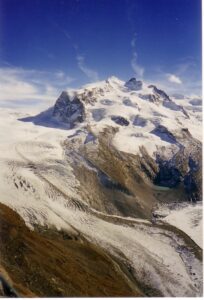
Then we are off to the Swiss Alps, where iconic glaciers are retreating back into the mountain tops. In fact mountain glaciers all over the world are disappearing, from Slovenia to Indonesia. We knew that from our last conversation with Zürich scientist Lander Van Tricht. Now he returns with new work showing past methods of estimating glacier loss are missing key information. The glaciers are leaving us faster than we thought – and that means even higher sea level rise this century.
Please don’t forget to support Radio Ecoshock. I need your financial help. There is no big donor or grant funding this climate outreach work. You can give a one-time donation of any amount, or help with a big each month here.
===============
GETTING NOTICED:
COLLAPSE OF THE NORTH ATLANTIC CURRENT (AMOC)
BRENDEN JONGMAN
Scientists are worked up about it. The PBS special just got two million views. Even Chicago weathermen were talking about it this week. Now the World Bank is warning too. The big worry? The Gulf Stream keeping Europe warm could break down at any time. That changes everything, as far away as India and Brazil. The real name is Atlantic Meridional Overturning Circulation, but everyone just calls it AMOC. It may be the biggest climate trouble looming over the world, and your government has no plan to deal with it.
Dr. Brenden Jongman is co-leader of the World Bank’s global work on nature-based solutions. Trained in the Netherlands, Jongman is a Senior Disaster Risk Management Specialist. He is currently based in Mexico City. His Comment “Adapting to the risk of Atlantic circulation change” just came out in Nature Sustainability.
Listen to or download this 29 minute interview with Brenden Jongman in CD Quality or Lo-Fi
Jongman’s Comment in the journal Nature Sustainability is behind a paywall. But he and co-author Jim Hall at Oxford worked hard to get this out to the public as well. For example there is their October 28th piece in The Conversation. The title is “Key Atlantic currents could collapse this century, but the risk is missing from almost all national climate plans”.
FYI: NOT COMING FROM GREENLAND MELT
According to physical oceanography and climate model intercomparisons, increased high-latitude precipitation and direct ocean thermal warming currently drive more of the observed and near-term AMOC weakening than glacial meltwater from Greenland. However, Greenland melt is widely considered the wildcard tipping hazard for the future. For science on that see this: “Limited impact of Greenland meltwater on abruptness and reversibility of future Atlantic overturning changes” Oliver Mehling et al (mostly Italian authors, Sept 29, 2025. All this is still being studied and debated.
WHERE DID THIS IDEA COME FROM?
I went back to the roots of ocean science on AMOC. In 1961, Henry Stommel found the ocean may have two stable states, not just the one we experience now.
The pioneer who brought this concept into the public and paleoclimate consciousness was geochemist Wallace Broecker of Columbia University’s Lamont-Doherty Earth Observatory. In landmark papers throughout the late 1980s and 1990s (such as his 1987 Nature article and his 1997 paper Thermohaline circulation, the Achilles heel of our climate system), Broecker warned that the Earth’s climate system had operated like an “angry beast” in the past, capable of abrupt shifts triggered by freshwater input into the North Atlantic. Before Broecker, scientists expected gradual and predictable climate change.
This September I interviewed Dutch scientist René van Westen. Studying ocean circulation changes in ages past, he found:
“Whether the AMOC collapses depends not only on how much the planet warms but also on how fast: in model experiments, CO2 rising at today’s rates collapses the circulation at around +2 degrees C, while the same increase imposed slowly leaves it stable even at +5.5 degrees C.”
That’s pretty amazing. Emissions continue to climb, going over 42 billion tons of CO2 in 2025.
GLOBAL IMPACTS OF AMOC SHIFT
When I look up the top ten countries or regions at risk from a collapse of AMOC, there are surprises. We expect Iceland to top the list. They are already on the ice edge. The UK and Ireland are next followed by Scandinavian countries and Northern Europe.
Despite bordering the North Atlantic, the United States and Canada are NOT next on the doom list. Number five is the Sahel Region, like Burkina Faso, Mali, Niger, and Chad – when the West African Monsoon fails completely. Rain for crops and cattle never comes when the big Atlantic current changes. India is next as their monsoons are disrupted. Brazil and the Amazon die back under a mega-drought.
GOVERNMENTS NOT EVEN PLANNING FOR AMOC SLOWDOWN / COLLAPSE
Jongman and Hall checked national planning by 91 countries to see how many were AMOC aware.
From the interview:
“What we found in these plans, surprisingly, is that almost no one even mentions the AMOC in their national adaptation plans. So of the 91 plans that we reviewed, only two of them mentioned the AMOC, and neither of those actually prepare or propose any specific measures for that scenario. And that shows basically two things. One is that the awareness around this potential scenario is still relatively limited, so countries are not yet aware of this potential.
It also shows that if it happens, countries do not know if their country may be affected by it. They may have understood this from the scientific literature that this could be happening, but no one has really worked out the national implications for other countries around the world. And then finally, it’s also a scenario, as I said, that is quite difficult to prepare for if we don’t know exactly in which direction it will swing.”
BIG CHANGES FOR THE UK
The United Kingdom is high on the list of countries at risk of drastic change if the North Atlantic current fails to bring up heat from the Caribbean. On the other hand, like practically every other government, the UK is busy approving new fossil fuel projects, primarily new gas. That will make an AMOC collapse and the undoing of that “green and pleasant land” more likely and sooner. I mean, they’re talking about glaciers starting to come down through Scotland and Northern Ireland again.
Jongman tells us:
“Western Europe is the region that is probably most exposed to this scenario in terms of the temperature changes. Some of the studies that we are quoting, which I have not been involved in, show that winter extremes go down to minus 20 or minus 30 in places like London or Edinburgh. And I see now a lot of awareness in governments.
I was actually in Iceland a few weeks ago for the Arctic Circle Assembly, where the AMOC shutdown was a huge topic. Iceland has made this a national security concern for their government. The UK is also talking about responses to it, so is Scandinavia.”
IS ADAPTATION POSSIBLE?
This seems like such a mega-risk, I’m not sure the world can do much to prepare for this other than retreat over time from some less habitable countries – especially when all governments are in serious debt already. Even major supporters of previous World Bank programs to aid other countries, is now withdrawn, and other developed nations are slashing international aid – despite being the source of this possible ocean change.
Stefan Rahmstorf (our guest next week on Radio Ecoshock!) has said an AMOC shutdown would create such drastic changes in the North Atlantic – and around the world – that adaptation is not really possible. So I ask Brendan what sort of planning most-affected nations could do? Brenden told us:
“Most investments that we take now, most decisions we take now that are relevant for the next 10, 20 years, they’re unlikely to be affected by something like the AMOC change. But if we look at the big dams, big dikes, flood protection strategies, land planning, things that you want to be relevant until, you know, for the next 80 years or something like that, it is very important that we at least stress-test it. We can still use current regular climate change scenarios as the basis for these kind of adaptation investments, but it is very useful given the amount of evidence that we have now that this change in the AMOC is actually happening, that we stress-test long-term investments and policies to make sure that if this scenario does play out, we at least are prepared and that the investments we make are not basically for nothing and that the direction of change is not flipping the other way.
And that is maybe the last point I want to highlight here, because we have tipping points and increasing climate change signals that point basically into the same direction as we’re currently preparing for, so the world is getting warmer, sea level is getting higher. The difficulty and the challenge with AMOC is that in some place in the world it flips some part of the climate change impact into a completely different direction where we think we have to prepare for extreme heat, now we may have to prepare for extreme cold winters in addition to warm summers and that will probably change some of the optimal investment and adaptation scenarios, so the best we can do is at least improve the models to make sure that we can stress test for those scenarios.”
But Brendan adds:
“The best way to prevent the AMOC from collapsing and from critical tipping points that will affect all of our lives, including some of the ones I mentioned, on the ice sheets melting and the coral reefs disappearing, the main focus should be on reducing emissions, and that remains critical.”
FOR MORE OF MY COVERAGE OF AMOC SEE THESE SHOWS
On Radio Ecoshock, I talked with scientists like Levke Caesar, Susanne Ditlevsen, and Johannes Lohmann.
(also on YouTube here). https://www.youtube.com/watch?v=4jdOemUu1tc
========================
Join us again next week on Radio Ecoshock. From Potsdam we will talk with Prof Stefan Rahmstorf about AMOC science (he was early to warn of the threat) and acceleration of global warming. Plus: new science shows estimates of glacier loss and sea level rise have been underestimated, according to Swiss glaciologist Lander Van Tricht. This is big. Be sure to tune in.
Please don’t forget to support Radio Ecoshock. I need your financial help. There is no big donor or grant funding this climate outreach work. You can give a one-time donation of any amount, or help with a big each month here.
I’m Alex. Thank you for caring about this world.