Deadly historic heat strikes across the world. Meteorologist Jeff Bernadelli on heatwaves in UK, Europe and America. Heat risks for pregnancy. From Switzerland, Coral Salvador: excess heat leads to more premature births. Heat reporting from Mark Hertsgaard and Jeff Goodell. Dr. J. Mijin Cha with a climate plan for America’s biggest coal mining.
Listen to or download this Radio Ecoshock show in CD Quality (57 MB) or Lo-Fi (14 MB)
Yeah, it was over 100 degrees F, about 38 C in New York City last week. The air was thick and muggy, making it feel like over 108, 42C. Fourth of July parades and events across half the United States were canceled. It was just too dangerous for crowds to be outside.
You are living through heat history
More than 20,000 people likely died during the June 2026 European heatwave. Although not yet been peer-reviewed, study author, Christopher Callahan of Indiana University, applied standard methods for estimating heat mortality. He concludes 5,210 people likely died in France, 4,543 in Germany, 3,163 in Spain, and 2,709 in Italy. It is too soon to know the number of people lost in the great heatwave in America, where heat deaths are not well reported.
As Nahel Belgherze posted during the recent heat wave: “Paris, the capital of France, has recorded more days above 40°C this week than during the 147-year period spanning from 1872 to 2019. Historic is an understatement.” Germany hit a national all-time high temperature – above 41 degrees C – three days in a row. Tourists said lack of air-conditioning in Berlin hotels made their rooms unusable. They escaped to parks, along with thousands of Berliners.
When you add months of heat beyond human endurance across the Middle East and especially India – climate-driven heat will kill millions of women, men, children and babies just this year. We are at the beginning of the heat ladder. The El Nino ocean heater is just loading up. According to science, next year, 2027 will be even worse for extreme events.
You might never know it from mainstream media reporting in America. According to the journalist group Covering Climate Now in a June 30 release quote:
“Despite the unequivocal link between climate change and extreme heat, a distressing number of news stories have not made the climate connection to this unfolding disaster. In the US, the evening news shows of ABC, CBS, and NBC led their June 23 broadcasts with the European heatwave but ‘failed to mention climate change even in passing,’ reported the media watchdog Fairness and Accuracy In Media. Given the advanced state of climate attribution science in 2026, that is simply not journalistically defensible.“
We’ll get back to the CCNow webinar with clips from Jeff Goodell and Mark Hertsgaard in a few minutes. First, let’s get the climate news perspective with a seasoned American weather reporter.
==============
THE CLIMATE-WEATHER CONNECTION
JEFF BERARDELLI
They were the hottest of times and getting hotter. Over a hundred million people in the UK, Europe and the United States suffered through long-lasting heatwaves – like we’ve never seen. Who’s watching? Master Meteorologist Jeff Berardelli explains the weather up to 5 times a day for WFLA TV 8 serving Tampa, St. Petersburg and Sarasota. After his Master’s degree in Climate and Society from Columbia, Jeff served as News Meteorologist and Climate Specialist for CBS, based out of New York.

Listen to or download this 16 minute interview with Jeff Berardelli in CD Quality or Lo-Fi
In the first week of July the heat was brutal up the East Coast. Nobody wants to feel like it’s over 106 in New York or Philly. Predictions and warnings for this start-of-July heat wave were as bad as I’ve heard. Do you think this blistering heat is something new, something historic? Jeff says the heatwave in central and eastern U.S. was hard to bear, but not necessarily historic. But the heatwave in Europe is definitely historic, far above anything we have ever seen.
Sweltering tourists in Berlin complained hotels had no air-conditioning. They had to abandon their rooms, including at night. Apparently only 3 percent of buildings in the United Kingdom have AC. This recent heatwave may change that. So many frightening news stories about dangerous heat come with photos of kids having fun in a pool or at the beach. The reality is that a funeral home outside Paris had to turn away 180 bodies in 24 hours. They had no more room.
The EU’s Copernicus Climate Change Service reveals that the world’s oceans just experienced their hottest June ever recorded. We are heating up the ocean with greenhouse gases. Ocean heat translates into the atmosphere pushing heatwaves on land. It was the hottest June ever in Europe, and second hottest June globally.
We hear about record-smashing heat in the United States and Europe. Hardly reported, the Middle East has been extremely hot, including in Iran. Sailors on aircraft carriers in the Gulf had to wear gloves on deck to avoid metal burns. More heat made Southeast Asia unbearable, and the Northeast tip of Siberia recorded the hottest day above 70 degrees north latitude. Now extreme heat seems like a dangerous rash breaking out almost anywhere.
When I asked about oppressive heat in the central and eastern U.S., Jeff said:
“It’s a very strong heat wave. It’s somewhere in the 98, 99 percentile range. And we could see a couple of cities break all-time records, but I don’t think this is going to be necessarily a historical heat wave.
What I think is most interesting about it is it comes on the heels of what was an unprecedented heat wave in Europe, the worst heat wave that they have ever seen there. And I don’t think it’s a coincidence that we’re seeing these heat waves pop up all over the world right now, and very strong ones at that, because we have a combination of El Nino and climate change as well.”
THE WORST HEATWAVE EVER?
Speaking of the European heatwave of late June/early July 2026, Jeff told us:
“It was, in fact, the worst heat wave on record. In Europe there was a study done by World Weather Attribution, and they found it was the most severe heat wave in Europe. And also they found that climate change likely made it about 3.5 degrees, up to 3.5 degrees Celsius, or about 6 to 7 degrees Fahrenheit warmer than it otherwise would have been.
And they also said, if you’re looking back at heat waves in 1976, which everyone talks about in the U.K., that this heat wave wouldn’t have even been possible, most likely back about 50 years ago, that this heat wave just couldn’t have happened in a cooler climate just 50 years ago. So we’re seeing a brand-new state of affairs. “
I ask Jeff why he went back to Columbia for his Masters in the climate field and still talks about climate on mainstream American TV. Jeff explained that in print in this blog post at momscleanairforce.org:
“Since I am already talking about climate change, I can give other local meteorologists the cover they need to talk about it or provide them a little bit of safety if they are concerned that they shouldn’t be talking about the issue. Not many meteorologists are willing to go as far as I am. I don’t go further than just telling people the honest science. I’m not getting into politics.”
Jeff finds “a huge increase in extreme heat across Florida!” My old stomping grounds around Tampa: 1950 20 days heat index 100 degrees, now 80 days. Miami was 15 days in the ’50’s, now 70. It’s cooking in Florida. No wonder wildfires and extreme precipitation are on the rise there – it’s not just sea level.
There’s been a huge increase in extreme heat across Florida! Look closely: In the blue 1950s #Florida averaged 20-30 days a year with a heat index of 100°+. Now in the red that number has 2X, 3X or even 4X due to hotter and more humid weather. It’s not coincidence, it’s climate change!
— Jeff Berardelli (@weatherprof.bsky.social) 2026-06-19T12:42:31.514Z
I follow Jeff on BlueSky here.
==============
ALEX REPORTS GLOBAL HEAT EMERGENCY
Freaky blisters of weird heat are breaking out all over the planet. In the dark Antarctic winter right now, a heatwave drove temperatures 36 degrees F. – 20 C – above normal with rain reported on glaciers. In June. Australia and New Zealand are barely getting any winter. New Zealand recorded the hottest June highs ever, reaching 24 degrees C – that is 75 Fahrenheit, a decent summer day in winter.
At the other pole, there were rare early wildfires on Greenland’s shores. A historian of extreme temperatures reported at the end of June “Beliy Island (73.3ºN) hit 28.3C (83F), apparently the highest temp so far north anywhere in the world. “ [quote from Rich Thoman on Bluesky]
This absurd no-winter continues in Australia and New Zealand.Full summer like temperatures again in New Zealand with up to 24.8C at Tai Tapu and 24.6C at Port Hills, smashing their June records of highest temperatures.This is beyond abnormal.
— Extreme Temperatures Around the World (@extremetemps.bsky.social) 2026-06-20T00:44:12.210Z
The South China Morning Post warns “Asia’s ‘dangerous’ humid heatwaves push human body to its limits
Parts of Southeast Asia are set to experience at least six months of dangerous humid heat days annually, a report says.”
The world’s oceans have never been hotter – at least during human times. Ocean heat is the primary driver of heatwaves on land. Plus, heat changes winds and ocean currents, often leading to the “blocking” patterns that keep oppressive heat hanging around for days, sometimes weeks.
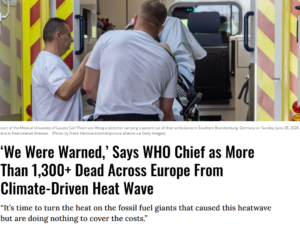
In a social post Sunday, WHO secretary-general Dr. Tedros Adhanom Ghebreyesus said, “Driven by climate change and global warming, the phenomenon of the ‘once-in-a-generation’ heatwave is now occurring nearly annual. We were warned.”
========================
THE BEST OF CLIMATE/HEATWAVE REPORTING – COVERING CLIMATE NOW
Let’s get back to that webinar for journalists, hosted by Covering Climate Now on June 30th. I attended and recorded the event with some of the best of climate and heat. Author and investigative journalist Mark Hertsgaard hosted. I selected quick clips from Jeff Goodell, author of “The Heat Will Kill You First” and Contributing Writer at Rolling Stone.
===========
MORE HEAT = MORE RISK FOR MOTHERS & BABIES
CORAL SALVADOR

As extreme heat strikes more often, countries across the world record more premature births. Some lead to health damages lasting a lifetime for mother or baby.
We need to know a lot more about this hidden risk from climate change.
A massive new study provides more answers. This Open Access paper is titled “The burden of premature births attributed to heat across 13 countries”. Dr. Coral Salvador is a co-author. Coral is Senior Research Assistant at the Institute of Social and Preventive Medicine at the University of Bern. The Lead Author is Dr. Carmen Iñiguez, Universitat de València.
Listen to or download this 10 minute interview with Coral Salvador in CD Quality
You can also read about this new study in an article in The Conversation, published May 26, 2026.
Introducing the study, Coral told us:
“This study group analyzed data from 36.6 million births occurring during the warm season across 250 locations in 13 countries. Most are developed countries where the data is available, but some are in the global south. And also, this evidence of this study supports that heat acts as a trigger of labor.
And if you want some estimates, half-impact estimates, we quantify that overall 1.4% of pre-teen births, representing 855 pre-teen births per million births, can be attributable to heat across all 250 study locations during the warm period.”
To understand the many impacts of high heat during pregnancy, we need to separate medical terms “mortality” and “morbidity”. Too many women and their unborn die in hotter times, that is mortality. Maybe the bigger story is the huge numbers, millions of mothers suffer damage during their stressed pregnancy leaving them with lifetime health challenges, and the same for their child. Babies born preterm can suffer health problems even later in middle age, as found by an earlier study led by Nathalie Roos. That paper is “Maternal and newborn health risks of climate change: A call for awareness and global action” – Nathalie Roos et al Feb. 11, 2021 Open Access.
BTW in another Roos study they found: Maternal loss of a partner or older child and loss of a close relative caused by unnatural causes the year before or during pregnancy were associated with increased risk of H[eart] F[ailure] in offspring. That risk can continue right into Middle Age. Strong stress during pregnancy can affect the health of the baby for life.
According to the World Health Organization, pre-term births are babies born alive before 37 completed weeks of gestation. And preterm births can be used to usually be classified into three subcategories based on gestational age. Extremely preterm, less than 28 weeks. Very preterm, from 28 to 31 weeks. And moderate to late preterm, from 32 to 37 weeks.
Don’t think of preterm babies as little humans like ourselves. Weeks before full term, babies may not have fully developed organs or physiological systems. Coral says:
“What is important here is to understand that preterm birth babies are not simply smaller, but are theoretically mature.
So these babies are born before key organs and physiological systems have fully matured. As a result, preterm birth babies face higher risks of breathing difficulties, feeding problems, temperature regulation problems, infection, and other health complications. It is therefore not surprising that preterm births remains the leading cause of neonatal mortality worldwide and a major contributor to child home morbidity, with consequences that might extend throughout the life course.”
CAN HEAT TRIGGER LABOR?
Can heat – like recent heatwaves – trigger labor? Coral tells us”
“There is growing evidence that extreme heat can increase the risk of preterm births and might trigger the onset of labor.
Also, the exact biological underlying mechanisms are still being investigated, so they are still unknown. Several pathways have been proposed or hypothesized. Heat exposure can lead to dehydration, which increases the secretion of antiretroviral molds and oxytocin, potentially stimulating uterine contractions.
It might also cause cardiovascular stress, systemic inflammation, oxidative stress, and reduce uteroplacental blood flow. All of this can contribute to the initiation of labor or to fetal compromise, requiring an early delivery.”
HEAT RISKS FOR PREGNANT WOMEN
Coral Salvador:
“Pregnant women are particularly vulnerable to heat due to physical and hormonal changes during pregnancy and mental strain, including increased internal heat production from fetal growth and reduced heat dissipation from weight gain. I have already mentioned the most important message here is that prenatal birth is only the tip of the iceberg. Prenatal mortality is only part of the story, and the broader burden is likely maternal and prenatal morbidity.
Pregnancy already places substantial demands from the cardiovascular, metabolic, and thermoregulatory systems, and extreme heat adds further physiological stress. As a result, heat exposure has been associated with a higher risk of complications affecting both mother and baby, including dehydration, hospital admissions, birth and safety disorders of pregnancy, impaired fetal growth, stillbirth, and pre-divorce. Importantly, this effect might not end at delivery.
In line with the concept of the Development Origins of Health and Disease, introduced by David Parker, we increasingly recognize that conditions experienced during fetal life can influence health across the entire lifespan. Pregnant birth has been associated with a wide range of lifelong morbidities, involving significant physiological and financial burdens on affected families and substantial costs on healthcare systems. Therefore, as heat waves become more frequent and intense due to climate change, protecting pregnant women from heat exposure is becoming an increasingly important public health priority.”
WHY SO MANY PRETERM BIRTHS IN WEALTHY AMERICA?
In Table 1 of the new study, we see which countries among these 13 have the highest preterm birth rates. Unsurprisingly, they are Brazil, Ecuador, and Paraguay, with numbers double places like Australia or Canada. But the USA is right up there. Why are there so many preterm births in the alleged richest country in the world?
Coral:
“Yeah, the level of wealth in a country does not automatically translate into better pregnant outcomes. The United States is a clear example of this paradox. Despite being one of the highest healthcare vendors globally, we still have relatively high rates of preterm births compared to other high-income countries. This is not due to a single cause, but rather a combination of factors.
This includes differences in access to prenatal care, which can vary depending on infrastructure, coverage, and socioeconomic status, social determinants of health that play an important role, such as chronic distress, living conditions, and broader population-level inequalities. So a high level of inequality can also influence induced prenatal health. In addition, clinical and demographic factors can increase the risk of prematurity, including advanced maternal age, health and medical conditions, and the use of assistive technology.
Other factors can also include the perception of heat as a risk, the design and construction of housing, and the level of preparedness. Taken together, these factors help explain why preterm birth remains a significant public health challenge in highly advanced healthcare systems ”
WHO IS MOST AT RISK?
What mothers are most at risk when it comes to education and status and so on? Coral:
“We found interesting patterns, and in the study, we found that the higher susceptibility was suggested for younger, single, non-pregnant girls, less educated and socioeconomically private mothers, and among female fetuses. But we need to go to explore in depth these vulnerability factors.”
In the study authors’ article in The Conversation May 26, they compare preterm birth risks to smoking:
“The magnitude [of preterm birth risk] is comparable to that of other well-established factors. For example, it far exceeds the contribution of maternal smoking in low and middle-income countries, and is on a par with that of malaria. And heat is already a major environmental risk factor for reproductive health.”
HUMANS HAVE BIRTH SEASONS
The seasonality of births is surprising. In the global north, more babies are born in Spring and early Summer. Two things on that: first, with global warming we already see heatwaves in spring and early summer. Look at the UK and Europe this year. So peak births start to coincide with peak heat.
Second, a pre-print study [by Lalgudi et al – “Global trends in human birth and death seasonality suggest temperature-dependent shifts in birth months” shows a growing delay. A new generation of babies now tend to be born during the hottest months of summer. Could all this make the pregnancy and preterm birth risk even higher?
A CAUTION
Keep in mind, most preterm births do not lead to acute or long-term health problems for mothers and babies. It’s just that heat increases the risk these serious conditions could happen. The hotter the world gets, the greater the danger for pregnant women and the future they bear.
I am concerned this big study measured heat exposure by the daily mean temperature, It does not account for a mother in a tin-roof home with no AC, versus a mother in air-conditioning or at least heat-protective shelter. Nor does it pick up things like availability of government-run cooling shelters. We need better data as the study acknowledges:
“…our exposure metric was based on ambient temperature data from fixed weather monitoring stations, which inherently leads to some degree of exposure misclassification due to spatial variability. “
At the end of the day, this study adds another dimension to controlling greenhouse gas emissions. Mothers and babies in the womb are more and more at risk of lasting health damage or death. As the world goes into never-before-seen heat, we need extra care and protection for pregnant women and the unborn.
Please tell others about this special risk of global warming.
PREVIOUS COVERAGE ON RADIO ECOSHOCK
Beat the Soaring Heat
Posted on December 20, 2023,
University of Sydney Professor Adrienne Gordon explains her specialty in care of mothers and the unborn during heat waves.
In 2018 I interviewed Dr. Maya Rossin-Slater from the Stanford School of Medicine. She led the PNAS paper “Relationship between season of birth, temperature exposure, and later life wellbeing.” They showed babies who experience even short periods of heat stress while in the womb show a statistical trend toward lower earnings 30 years later. Even if the baby goes full term, climate change is changing future lives right in the womb.
====================
So what are we going to do to stop frying humans and all the other creatures? We want to just close the coal pits, cap off the oil and gas wells, today. But that is a recipe for mass death and political extremism. Who has a plan that could work? Listen up.
COAL? TAKE IT OVER!
MIJIN CHA
If coal is a climate killer, should we nationalize it? Is there a right and wrong way to wind down coal? Two American authors call for public ownership of coal – in America’s biggest pits, Wyoming’s Powder River Basin. Dr. Emily Grubert from Notre Dame plans for “coordinated decarbonization in the United States”. Dr. J. Mijin Cha is Assistant Professor of Environmental Studies at University of California, Santa Cruz. Her book “A Just Transition for All: Workers and Communities for a Carbon-Free Future” was published by MIT Press. Dr. Cha is widely published on environmental justice and climate. I follow her on BlueSky.

Our focus paper for this interview is “Operationalizing publicly managed decline: Public asset acquisition in the Powder River Basin, Wyoming”.
Listen to or download this 22 minute interview with J. Mijin Cha in CD Quality or Lo-Fi
The Powder River Basin is the largest coal-producing region in the United States, supplying roughly 40% to 43% of the nation’s total domestic coal plus exports to Asia. These days with a coal President in the White House, the idea of public ownership sounds impossible and shocking – to Americans. Actually, as Mijin tells us, coal is nationalized in many countries.

We were told coal was sun-downing anyway. Two huge coal mining corporations went bankrupt, including Powder River miner Arch coal in 2016. Can’t we just let the coal industry die a natural death? Problem is: the climate does not have time for another decade or three of coal burning.
Dr. Cha and co-author Emily Grubert published an opening paper on pathways to public ownership of the Powder River Basin in 2025. That big coal mining operation is a good project for decarbonization of America. Technically Americans own the coal in Wyoming but lease it out. There are shareholders including institutional holders like insurance companies and pension funds. Yet their research suggests the real market value of all this coal and machinery is zero!
The Abstract says:
“Using data on asset market value, asset retirement obligations (AROs), labor obligations, and prospective climate damages, this work estimates that public acquisition of currently private assets in the PRB should be informed by an effective asset market value of ~$0 (in part due to ~$2 billion in AROs); business-as-usual labor obligations of ~$5 billion; and prospective climate damage of ~$1 trillion. Governments have numerous tools for acquisition, as demonstrated by recent (2025) US purchases and direct takeovers of equity stakes in extractive industries.”
Even with coal, the arch-enemy of a safe atmosphere, Cha and Grubert are not calling for an instant end to coal mining. The key they say is “managed decline”. We cannot instantly turn off. More than 100 U.S. power stations depend on Powder River coal to provide electricity to 60 or 70 million people. A massive build-out of renewables and batteries is needed.
With a life-long eye to justice, Mijin Cha calls for transition funding and programs for the coal miners and coal communities.
SEE: Community & Climate: A Just Transition for All with Dr. Mijin Cha
IT HAS BEEN DONE
All this reminds me of UK Prime Minister Margaret Thatcher literally decimating their coal industry. She started that campaign not to save the climate, but to save taxpayer money and wreck the union. Before the 1984 miner’s strike, there were 175 working coal pits in the United Kingdom, and about 180,000 miners. After Thatcher, by 1994 there were only 15 coal pits left operating with 10,000 employees. The coal industry was a shadow of it’s former self.
In September 2024, the UK closed its very last coal-fired power station, Ratcliffe-on-Soar in Nottinghamshire. This ended a 142-year history of coal-fired power in the nation where the Industrial Revolution began. None of the coal mined in the UK is used to generate electricity so the UK power grid is 100% coal-free.
The UK government formally introduced a commitment to implement an Energy Independence Bill to legally end the granting of any new coal mining licenses.
CAN WE TRUST GOVERNMENT TO WIND ANYTHING DOWN?
Some doubt Government ownership of fossil resources will do it. The Norwegian Government oil fund now makes more money from investment returns than it does from oil and gas they produce. With trillions of dollars saved up, still they won’t stop. It is never enough. It is never time to stop. How can we be sure a government can and will act quickly enough to stop the worst climate scenarios?
The Government of Norway built up the Government Pension Fund Global (commonly known as the Norwegian Oil Fund) to more than 2 trillion U.S. dollars. It is the largest single sovereign wealth fund on earth, holding an average of 1.5% of all listed stocks globally – the equivalent of roughly $390,000 USD for every single Norwegian citizen. And despite publicly accepting climate science as real, they have not cut back production. Government ownership is no guarantee for energy decline.
In 2019, I interviewed famous German environmentalist Heffa Schuecking, from the German non-profit group Urgewald. The show’s title is “Halting Mass Suicide by Coal”. At that time, global coal consumption was going back up, mainly due to demand from Asia. Chinese banks and Wall Street firms invested more billions into new coal plants meant to operate 60 years.
Since that time, the cost of renewables plummeted along with battery design and prices. Not only is it now cheaper per megawatt of power to build solar instead of coal – recent studies and reports found it is cheaper to install renewables and batteries than it is to keep operating current coal mines and coal power plants. Only various government subsidies are keeping the U.S. coal industry alive.
The federal government’s intake from PRB coal is no longer considered “significant” in the context of the federal budget, and the revenue streams that once brought in billions during the 2000s and 2010s have largely evaporated. This is partly due to no demand for new leases.
===============
There you go, another week reporting from the heat trap formerly known as planet Earth. I’m Alex Smith. Thank you for listening, and caring about our world.
These folks finally realizing that XR was Right food supply collapse & civilization collapse is right around the corner
Roger Hallam is hinting at a new XR-like movement he calls “Four Billion Dead”.
From his website: “It’s a new thing, I’m not going to call it a campaign, which involves silent processions with people holding signs saying “4 Billion Dead.” And, for reasons I haven’t got time to explain — you know, in my book — this will become the next XR. ”
The book he is referring to is the new one he wrote while recently in prison: “Suicide: The Political & Legal Implications of Endless Mass Death”
The “four billion dead” is a reference to a recent report by the British insurance industry that projects at least 50% of the human population is gonna die if we hit 3degC above pre-industrial.
I have a whole new respect for Roger, I recommend the recent interview he did with Nick Breeze: https://rogerhallam.com/suicide-interview/
He really gets to the heart of our dilemma and suggests there really are only two ways out: Either find Jesus or start Citizen Assemblies.
I’m being flippant, of course, but I actually find this perspective refreshing. Not because I’m a jesus freak but because it is just so god damn unusual to hear anything except the mindless parroting of utterly meaningless words like “renewable” or “clean energy” and other such vomit-inducing inanities.
Thank God for sapiens such as Roger Hallam.