“Climate change has already made the United States poorer” Arizona Economics Professor Derek Lemoine reports. How could carbon from our tailpipes make the sea acidic? Exactly how does that work? Tulane Chemist Bruce Gibb explains with a great 15 minute mini-lecture on Radio Ecoshock.
Welcome. I’m Alex Smith.
Listen to or download this Radio Ecoshock show in CD Quality or Lo-Fi
HELP RADIO ECOSHOCK THROUGH TOUGH TIMES
These are devastating days, but scientists are still trying, as are authors and activists. This show is a DIRECT PIPELINE to the public. While mainstream media pastes in a quote, we let lead authors speak. It does not cost a lot to do this, but there are bills to pay, especially maintaining our own website and server. Many gigabytes of radio interviews are downloaded – always free and advertising free. If you can help, I would really appreciate your financial support. Find out how here.
**************************
CLIMATE ALREADY COSTING AMERICANS
DEREK LEMOINE
Most of us are under a money siege. Everything costs more while the scam economy flourishes. Billionaires feast. Isn’t it a stretch to blame any of that on climate change? Let’s ask an expert.
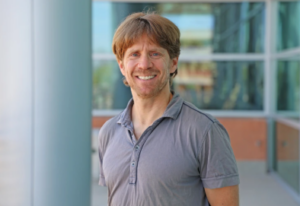
“Climate change has already made the United States poorer.” That study was published November 7, 2025 in the prestigious journal PNAS, the Proceedings of the National Academy of Sciences. The findings come from Dr. Derek Lemoine. Derek is Professor of Economics at University of Arizona and Co-Director of the Consortium for Environmentally Resilient Business.
Listen to or download this 16 minute interview with Derek Lemoine in CD Quality or Lo-Fi
The US company FirstStreet estimates a potential loss of real estate values of almost one and a half trillion dollars, in just the next 30 years, due to climate-related risks.
Immediately we think Californians with their fires and Floridians displaced by Hurricanes are front-line economic casualties as climate change increases weather extremes. But this study found the biggest losers in this heat race are in a surprising part of the country – the U.S. Midwest and Great Plains!
The group says the impacts of severe climate impacts like wildfires or extra strong hurricanes don’t just hurt local people and businesses. Due to widespread trade and business across the states, the later wave of costs are more distributed, wearing on the total economy and people in it.
2 DEGREES = DEPRESSION
Economist Adrien Bilal at Harvard says the potential losses from a 2 degree C rise over pre-industrial levels would be an economy basically like the 1929 Great Depression – forever.
SEE ALSO
“How Climate Change Could Upend the American Dream” by Abrham Lustgarten Feburary 3 2025 via ProPublica.
“Ongoing Climate Caused Disruption to your Home Prices and Insurance Costs and Utility Prices…”
Paul Beckwith on YouTube. Dec 16, 2025.
======================
ACID OCEAN? HOW?
TAKE THE TOUR
BRUCE GIBB

Bruce Gibb, a chemistry professor in the Tulane University School of Science and Engineering, has been elected as a fellow of the prestigious Royal Society of Chemistry. Gibb’s research deals with “aqueous supramolecular chemistry,” a highly interdisciplinary research area lying at the interface of organic chemistry, physical chemistry and biochemistry.
Pardon me. I’m stuck on how a gas becomes rock and changes survival in the whole ocean. There is some kind of mass magic here – well hidden from human understanding. Last week on Radio Ecoshock two scientists warned ocean acidification has already passed the Planetary Boundary for safety. Check the show web site at ecoshock.org for interviews with top scientists Richard Neely and Helen Findlay.
Frankly, I still don’t get it. I want a physical scientist to explain ocean acidification like I’m an eight-year-old. Luckily, a Louisiana chemist just wrote an approachable article about all that in the journal Nature Chemistry. I called him up, and here is our conversation – including a 15 minute mini-lecture for the public on the actual process of ocean acidification.
Dr. Bruce Gibb is an expert in aqueous supra-molecular chemistry at Tulane University in Louisiana. Bruce wrote an essay on ocean acidification published November 3, 2025 in Nature Chemistry. The enigmatic title is “Extinguishing the saturation horizon”. It describes little-known costs to changing carbon levels in the environment. Find the Gibb Group website here.
Listen to or download this 36 minute interview with Bruce Gibb in CD Quality or Lo-Fi
According to NOAA, about a third of human-made carbon emissions are captured by the sea. Without that, we would likely have overheated long before now. Are there limits to how much carbon dioxide the ocean can absorb?
The pH scale for the acid/base level is not really helpful for the public. What does pH mean and what does it tell us? We learn more about the mystery. The key measurement is the availability of hydrogen atoms. We discover it is not so much single electron knocked off leaving a bare nuclear. Really it is that nucleus with it’s positive charge (the Proton) that engages with other substances. All this can only happen on sea water (or other liquids). So pH measuring is not possible in the air, for example.
Gibb concludes the public knows very little about ocean acidification as the supposed “evil twin” of global warming. That leaves us even more exposed to ongoing major changes to the largest life system on this planet: Earth’s single ocean.
MY INTERVIEW NOTES
Can Earth’s carbon dioxide buffer fill up? In the long-term, the ocean can digest the excess CO2 in the atmosphere – the question is can ocean keep up with the RATE we are adding CO2 to atmosphere.
The answer to this question relies on two things:
1. the inorganic carbon cycle and
2. the nature of acidity.
1. THE INORGANIC CARBON CYCLE
99% of all carbon on Earth is in the Earth’s crust. Through subduction on the ocean floor, some of that goes below the surface. Then with heat and pressure it can re-emerge through volcanism and seeps into the atmosphere at carbon dioxide gas.
In the atmosphere CO2 mixes with water, and comes down in rain. This slowly mixes with mineral on land to form carbonates that get to the ocean by rivers. Eventually the carbon settles to the ocean floor, and the cycle continues.
The inorganic carbon cycle is very, very slow. It takes a long time to form a carbon-laden cave, or for plate tectonics to release more carbon. We are talking geological time periods.
Life evolved to use carbon. For example a large part of our bones is carbon (as the protein collagen and calcium carbonate).
2. WHAT IS ACIDITY?
There is an ever-going exchange of positive protons from hydrogen atoms, with hydrogen being one of the most prolific elements in the universe. Those substances that love to give or release these ions are called “acids” and those ready to receive them are called “bases”.
Some molecules don’t care one way or another and are called neutral molecules.
This is all measured by the pH scale. Lemon juice has a pH value of 3, meaning it is acidic. Tomatoes have a pH of about 5, weakly acidic. Pure water is neutral with a pH of 7. Drain cleaners have a pH of about 14.
In the sea, carbon combines with water to form carbonic acid: one carbon molecule with one H2O molecule. Being acidic, carbonic acid wants to donate hydrogen ions (charged particles) to other substances.
In reality, rainwater is generally slightly acidic, perhaps with a pH of 5.6. Conversely, the pH of the ocean is beyond neutral, being slightly basic at 8.1. It is ready to receive hydrogen ions, including from rainwater. The ocean is weakly basic because of the salts it contains, which tend to basic states.
Adding carbon dioxide to water creates 5 species (or chemicals) – and that makes the discussion more complicated. These include carbonate, bi-carbonate, carbonic acid and more. [Do not confuse carbonic acid with carbolic acid (otherwise known as “phenol”) a white crystaline organic compound.]
CAN GLACIER MELT LOWER OCEAN ACIDITY?
Technically yes, glaciers contribute fresh water to the ocean which weakens acidity. But as over 90% of all water on Earth is in the ocean, glacier melt is not enough quantity to significantly affect the ocean acidity process, happening on such a grand scale. Local pH of oceans near the melt may be less acidic, but globally glacier melt is not a big factor, he says.
FORECAST FOR 2100?
The ocean likely has an absolute limit to how acidic it can get. That may be around pH 5 or 6. Getting there is unlikely. It would make the oceans like tomato juice in acidity. Due to existing buffers, we will never get down to that pH5 or 6 in the ocean – and “if we do, we won’t be around to talk about it.”
A buffer is something that can handle an input of acid or base without changing the overall pH of the substance.
Carbonized substances become more soluble as water gets colder. We think of salt and sugar dissolving more fully as liquids get warmer, but calcium carbonate is the opposite. It is rare for chemicals to become more soluble as liquids get colder.
At the cold bottom of the ocean they are fully dissolved but near the surface there is too much calcium carbonate to be dissolved. There is a surplus that life-forms can use to build shells or exo-skeletons.
Actually, the saturation horizon is the level in the ocean where too much calcium carbonate becomes fully dissolved – it is the border between the two states: saturated and full saturated.
The saturation horizon is important for life in the ocean. For many life forms, the saturation horizon is like a cut-off zone. Below that level, shell-forming creatures cannot get the carbon they need in a form they can use it.
The depth of the saturation dividing zone changes as the ocean changes pH.
OTHER CHANGES
We don’t really know how changes in pH may affect ocean currents. There are changes of other factors like density involved. In terms of the grand carbon cycle, that is well defined and unlikely to change, Bruce says.
“The simple fact is – we don’t know what is going to happen.” We can calculate the chemistry, but unknown is the response of living things to those changes.
PALEOCLIMATE PET EOTHENE MAXIMUM
6 TO 8 DEGREES C HOTTER THAN PRE-INDUSTRIAL
Around 56 million years ago, Earth warmed by 6 to 8 degrees C for about 200,000 years. There was a massive increase of carbon from the atmosphere into the oceans. Many small plankton died, others changed morphology, some thrived. All this is still being studied. It’s called the Paleocene–Eocene thermal maximum.
But our rates of adding carbon by burning fossil fuels is so much faster, there is no analog for what will come by 2100. This has never to our knowledge been seen before.
As phytoplankton produce almost half the oxygen we breathe, their fate in a more acidic ocean is much more than just losing sea food for humans.
GEOENGINEERING?
Citing the large CO2 removal plant in Iceland, Bruce says we would need a million such plants to keep up with emissions. For Gibb, the only true answer is to stop burning fossil fuels and limit other greenhouse gas emissions where possible.
======================
GET USED TO EXTREME WEATHER
ALEX
Looking at weird waves of extreme-to-record heat and cold circulating Earth this winter of 25/26, I was wondering: are we seeing something new? How would we know with only the past as guide in a system so variable as weather?
There is a lot of weird weather in the Northern Hemisphere, including continental splits with rough cold winter blusters in the North and unusual near-summer weather in the south. We see that in North America and Europe. Cold in Germany, sizzling in Crete (new January high record), Turkey and southwest Russia.
SOUTH AUSTRALIA BURNING HOT
But the real kicker was blaring dangerous heat in South Australia. The government is freaking out about fire risks so extreme it is off the charts. Some fires flared up. Our guest next week- on growing wildfire risk around the world – just said forecast temperatures around his home were 45 degrees C. That is 113 degrees Fahrenheit. Unprotected people without AC will die. So will a lot of other species. Oh, and a tropical cyclone hit Queensland. It’s Hell weather in parts of Australia. We all hope this is not another Black Summer. Maybe our Aussie listeners will get through this one, this year. We’re thinkin’ of ya, mates.
THE AGE OF BIOCLIMATIC EXTREMES
When global warming drives widespread change to the whole ecosystem, these are called “bioclamatic extremes”. That is a new phrase in a January 7th paper about “bioclamatic extremes” in the Arctic. That is where we are: having to invent new labels for climate-driven extremes previously unknown to current earth systems.
We are entering an era of bioclamatic extremes. Already on this planet wildfires burn so intensely that forests do not return. Landscapes get washed away by record extreme rains in a day. The coral world, nursery to a quarter of all sea life, is dying and disappearing in hot acidic seas.
You may be insulated by the residue of carbon colonial wealth. You see, most of us did colonize the atmosphere, spreading our waste into air and sea somewhere else for decades, over a century. Carbon-based history subsidizes our food and transportation system. Most of us have that buffer against the first storms of climate damage.
Others, in Pakistan, Bangladesh and Pacific Islands, are already going under that wave of heat, floods, drought, storms and rising of the acid sea. In a minimal economy, millions slide further into poverty until millions flee.
Only a few Western-wealth people are getting burned out or storm wrecked. We absorb the first punches. But – Nature is always the champion. The bioclimate always wins.
For now, the pressing need is to decarbonize and adapt. That requires rebuilding community – which is not easy. Eventually, if we fail to refocus politics into the demands of reality and common good, then – and this is not yet – comes the time for survival during black-out breakdown.
Isolated TikTokers and screen minders do not know how to grow food, to shelter during extremes, how to survive on small power like a solar panel and battery, how to find firewood or drinkable water, how to work with insects and microbes without killing them all. Will we remember how to create social action for good – on the ground, with other people?
SEVEN YEARS
It takes seven years to train a Doctor. It takes seven years to rebuild a person capable of living in their actual environment, as a co-operating part of it. It takes seven years to construct a new economy and larger politics not built on death.
Prepare for a long struggle where the outcome is unknown.
Thank you for listening – and being part of this community that learns from science. Next week we will not be talking about the latest outrage on the Net. Instead we face a demon already emerging from climate change: a new regime of wildfires and disappearing glaciers. Please tune in next week for Radio Ecoshock.
Alex