New science shows ocean acidification has already passed the safety limit set by the Planetary Boundary Framework. We reached a founder in the field, recently retired NOAA Senior Research Scientist Dr. Richard Feely. That is coming up, but first an introduction from Biological Oceanographer and Lead Author Dr. Helen Findlay from the UK’s Plymouth Marine Laboratory.
Even if carbon dioxide was not a greenhouse gas, our emissions would seriously damage the majority of Earth’s life. Humans cannot directly see it. Acidification involves science few people have. No industry or even special interest gains by communicating this threat. Ocean acidification has been called “the evil twin of global warming”.
I’m Alex Smith, welcome to this in-depth reporting on ocean acidification.
Listen to or download this Radio Ecoshock show in CD Quality (57 MB) or Lo-Fi (14 MB)
WHAT THE HECK IS “pH”?
To keep up with changes in ocean acidity, we just need to know the measurement used by chemists and ocean specialists. Here is a quick one-minute primer on pH and then we go to our expert guests.
We measure how acidic of basic a liquid is using the pH scale, which goes from 1 to 14. Caustic soda, as found in some drain cleaners, is about pH14 – the strongest base or alkali. At the low end, battery acid or sulfuric acid has a pH of 1. pH stands for “potential of hydrogen”. Hydrogen atoms can lose or gain electrons fairly easily. When a hydrogen atom gains or loses it’s electron – the new atomic form is called an “ion”.
Since hydrogen only has one electron, when that is taken away only the central core, the Proton is left. That ion of hydrogen is not stable, and quickly bonds with a water molecule to form a new substance called “Hydronium“. I’d never heard of it. Anyway, the key factor for pH is the activity (or effective concentration) of hydrogen ions in solution, expressed on a logarithmic scale.
Maybe we don’t need to understand the technical part. Here is how it works for us in the real world. In the pH scale of 1 to 14, 7 is considered neutral. Pure distilled water has pH of seven. As when measuring earthquakes, this scale is logarithmic. So a change from 8.2 to 8.0 pH is not small but large, especially when applied to the huge volume of the planet’s oceans. That is what we need to know to have a conversation about ocean acidification.
CROSSING THE BOUNDARY ON OCEAN ACIDIFICATION
HELEN FINDLAY
Beyond global warming, there’s this other thing about fossil fuel burning. We seldom talk about it. Humans are making oceans more acidic. That is not good for tiny life in the food chain – or any of us. A study published in June 2025 finds ocean acidification has gone past the danger point.

Suppose carbon dioxide was not a greenhouse gas. Humans load up CO2 into the atmosphere but global warming is not a problem. That CO2 falls into the global oceans. That would still threaten global life even without warming!
Professor Helen Findlay specializes in carbon and the sea. Findlay is a Biological Oceanographer at Plymouth Marine Laboratory in the UK. She leads the paper “Ocean Acidification: Another Planetary Boundary Crossed”.
Listen to or download this half hour interview with Helen Findlay in CD Quality or Lo-Fi
ALL CLIMATE CHANGE IS REGIONAL
The paper by Findlay et al quotes a 2015 study by the late Will Steffen saying: “changes in control variables at the subglobal level can influence functioning at the Earth system level, which indicates the need to define subglobal boundaries that are compatible with the global-level boundary definition”. I have been harping on that for years. Global averages and long-term trends can hide regional differences that alter global systems in significant ways.
THE POLES
Why is it urgent to prevent Polar oceans from reaching undersaturation? Scientists found a 61% increase in acidification reaching mild impairment for Arctic sea life, and a 16% increase in places experiencing severe stress from ocean acidification.
There is an assumption that marine species will move toward the Poles as ocean conditions around them become too hot. But what if the second prerequisite for the base of the food web, acidity, is already changed in Polar waters, before relocating creatures arrive?
The paper says:
“The percentage of ocean area in the polar regions, averaged across the pteropod depth habitat (0–200 m), that has crossed the thresholds for mild and severe shell dissolution, has increased by 61% and 16%, respectively, between pre-industrial and present day.”
That sounds to me like an Arctic acid emergency.
ARAGONITE
In the interview and in the paper, these scientists use a form of calcium carbonate called Aragonite, as an indicator of ocean acidity. This is the weird state when carbon dioxide from air pollution mixes with calcium to form a rock-like mineral that can be quite beautiful. It is unstable on the surface, being buried in other rock or found around hot springs and caves. Some creatures, especially mollusks collect Aragonite to form all or part of their hard shells. Corals use it to build reef structures. Some believe crystals, with their order and growth, are on the boundary of living things. This may be why living things, from shell creature to a common American tree, use Aragonite as part of their bodies.

Stacked from 50 images
Aragonite Saturation State is a “key indicator” for Ocean Acidification (OA). It is a “habitability index” for marine life. While pH tells us how acidic the water is, aragonite saturation tells us how easy or difficult it is for creatures like corals and oysters to build their “skeletons.”
The “saturation state” is a ratio that compares how much calcium and carbonate are actually in the water versus how much the water COULD hold before it starts to dissolve those minerals.
THREE BASIC STATES:
(Supersaturated): There are plenty of carbonate ions available. Organisms can easily pull these minerals from the water to grow.
(Saturation point): The water is in a delicate balance.
(Undersaturated/Corrosive): The water is “hungry” for carbonate. It will actually begin to dissolve existing shells and skeletons to get it.
The “Double Whammy” of CO2
When the ocean absorbs CO2, two things happen simultaneously: pH drops: The water becomes more acidic (increases H+ ions). Carbonate ions decrease: The extra H+ ions “steal” carbonate ions to form bicarbonate. This lowers the saturation state.
MY REACTIONS TO THE PAPER
1. Acidification goes deep in the sea. In fact it sounds like the subsurface ocean is already more acidic than the surface ocean.
2. They establish a better planetary boundary number, but find we already passed that 25 years ago. It’s like 350 CO2 as a safe climate goal – vanishing in the rear-view mirror.
3. Are there further tipping points or unbearable impacts in the future we could avoid by slashing carbon emissions now? Or is the whole system committed already to a more acidic ocean?
4. Has the ocean been significantly more acidic in the deep past when there was hundreds of times more carbon dioxide in the atmosphere? Should we assume, as with surface warming, eventually new life forms will survive in a hotter world, as creatures of our times, including coral, disappear? Is this another case where the RATE of change in ocean chemistry is the real killer?
5. Have there been any geoengineering suggestions where humans could raise ocean pH again Can we fix this? Spoiler: No! – but of course there is a paper for that:
“Substantial Limitations of Ocean Alkalinity Enhancement in Mitigating the Negative Impacts of Ocean Acidification on Marine Calcifiers“. That just came out on December 28, 2025. It is Open Access – free for you to read. One of the co-authors is our second guest, Dr. Richard Feely.
IS THIS JUST GOING TO QUIETLY HAPPEN?
Is ocean acidification going to quietly knee-cap sea life and the billions of people who depend on sea life for food? And forget about us and our sea-food: calcium-shelled organisms form the basis of the marine food chain. These are the foraminifera, diatoms, coccolithophores, and more. There are far more of these creatures than known stars in the universe. Add countless initial stages of larger creatures including crabs and fish, calcium-hungry in microscopic sea water. We label all that basic unseen species “plankton”. If that world can’t function, fundamental support systems for life on this planet start to disappear. That is how serious this carbon pollution of the sea really is.
ANOTHER ACTIVISM?
We have regular climate conferences, without a lot of success. There are regular conferences and reports on ocean acidification? How about activist groups? – not that I know of. Maybe we need a pH 10% group, a 350.org for ocean chemistry.
====================================
THE ACID SHIFT
RICHARD FEELY
You want to understand ocean acidification? Here is an expert’s expert. Richard A. Feely is an American chemical oceanographer, gaining his Doctorate in 1974. From 2008 until his recent retirement, Dr. Feely was Senior Research Scientist at NOAA’s Pacific Marine Environmental Laboratory. Among over 160 published studies, Dr. Feely is second Author on the June 2025 paper “Ocean Acidification: Another Planetary Boundary Crossed”.

Since 1974, Richard Feely authored and co-authored over a hundred fifty works on ocean chemistry. We have reached a world expert on ocean acidification with a lifetime of experience in the field. His most cited paper is ”Anthropogenic ocean acidification over the twenty-first century and its impact on calcifying organisms” September 29, 2005 in Nature.
Listen to or download this 27 minute interview with Richard Feely in CD Quality or Lo-Fi
If I were a wild story-teller in the sixteen hundreds, no one would believe little humans could make the whole sea more acid. I think millions of people still don’t believe it. Ocean acidification is not directly visible to us. We can’t tell the difference by sticking our hand in the sea.
When scientists explain how much humans change the chemistry of the sea, it is reported as a decimal change in pH, like now the global average is 8.1 compared to 8.2 before the industrial revolution. That doesn’t sound like much. Remember, like earthquake ratings, the pH system is logarithmic. For example changing from pH 8.2 to 8.1 means a 30% increase in acidity. When this happens over the majority of Earth’s surface (the oceans) AND deep into the sea, the amount of change is mind-breaking to comprehend.
It took somewhere around 150 to 200 years of industrialization for that vast change to happen. But the rate of carbon emissions, and so more acid in the sea, is increasing. Will the sea reach pH 8.0 by end of this century? There would still be tiny plankton shell creatures but perhaps fewer – and as this OA Boundary paper explains, fewer can mean a weaker gene pool.
Also, acidity is not spread evenly. The 2025 Planetary Boundaries paper says:
“Ocean [acidity] conditions vary significantly across the globe, with levels in tropical regions being more than twice as high as those in polar regions (Feely et al. 2023; Jiang et al. 2015). These regional and seasonal gradients exists due to temperature-driven CO2 solubility, enabling colder high-latitude waters to store more CO2, along with other factors including circulation of carbon away from the surface into deeper waters, mineral inputs from land and freshwater dilution.”
Commercial shellfish farms may survive in one part of the world and disappear in others. As far as I can determine, there is no abrupt tipping point close in time for ocean acidity. Instead there is weakening of the whole community of ocean life, getting worse as we add more carbon pollution.
MORE SOURCES OF ACIDITY
In the interview, we go back to a PNAS study in 2007 co-authored by Richard Feely. They found other combustion and agricultural bi-products also add to marine acidity. Richard tell us about nitrogen and sulfur deposition and it’s impact on ocean acidification. The study is “Impact of anthropogenic atmospheric nitrogen and sulfur deposition on ocean acidification and the inorganic carbon system”.
THE BUFFER
Carbon capture by the oceans acts as a buffer to climate change. Can this buffer fill up and what is the Revelle factor? In oceanography, the Revelle factor (or buffer factor) quantifies the ocean’s resistance to absorbing atmospheric carbon dioxide CO2, representing the ratio of the fractional change in CO2 partial pressure pCO2 to the fractional change in total dissolved inorganic carbon (DIC) in surface waters. The Revelle factor shows the ocean’s chemistry resists pH changes as it takes up CO2, with higher values indicating less buffering capacity. It explains why oceans can’t absorb all human-emitted CO2, as this factor increases with CO2 uptake, making further absorption harder and leading to ocean acidification.
You can check out this 2004 paper on the ocean carbon buffer which Feely of course co-authored.
Human carbon emissions reached a record high of about 40 billion metric tons in 2025. Did world oceans react to this rapid change in the atmosphere, and was marine capture of carbon dioxide able to keep up? I asked Dr. Feely.
MORE LINKS FROM THE INTERVIEW
In the interview Richard refers to this international program of 14 countries measuring ocean CO2: Go-Ship
Richard also references The Oceanic Sink for Anthropogenic CO2
(Christopher L. Sabine, Richard A. Feely et al in Science July 16, 2004) That paper is available in full text here.
Dr. Feely also mentions the Global Ocean Acidification Observing Network (GOA-ON)
============================
OVER AND OUT
Are you still wondering how a gas in the air can turn the whole ocean too sour for billions of living things? Next week we finish this series on ocean acidification with the chemist’s view – the nitty gritty of how all this works with Dr. Bruce Gibb from Tulane University in New Orleans.
One last passing of note: the whole damn library of NASA research! The Trump Administration announced it closed NASA’s giant collection – tens of thousands of books, documents and journals as of January 2nd, 2026. According to the New York Times “Jacob Richmond, a NASA spokesman, said the agency would review the library holdings over the next 60 days and some material would be stored in a government warehouse whole the rest would be tossed away.”
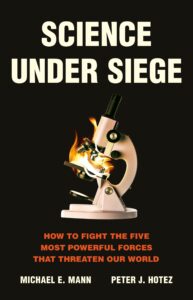
Famous climatologist Michael Mann responded: “Not since the ransacking of the Library of Alexandria have we witnessed such a wanton, intentional assault on scientific knowledge.” I recommend Michael Mann’s new book with Dr. Peter Hotez “Science Under Siege: How to Fight the Five Most Powerful Forces that Threaten Our World”.
The creme of American climate science – hidden away and tossed away. Just as we enter the real age of climate consequences some humans add a dark age of book burning. We will be flying in the dark.
Song “Flying in the Dark” – lyrics Alex Smith, AI music, Creative Commons License