Every day now is a week in any other time. It’s all too much, but underneath the rush – our planetary home is in trouble. If the North Atlantic current fails, Europe goes into a little ice age lasting a thousand years. That sounds important. We reached a founder of that science in Professor Stefan Rahmstorf in Potsdam. I also ask Stefan if global warming is accelerating. Swiss glaciologist Lander Van Tricht just released a warning: glaciers are going faster than we knew – and that means even more sea level rise, sooner. Plus: trying to track all the big names who went down this week? Got that covered with new song: the “Down Alphabet”. Plus Florida flood madness.
Listen to or download this Radio Ecoshock show in CD Quality (57 MB) or Lo-Fi (14 MB)
Just before we go to our guests, we all feel the AI shock. Is there anybody that hasn’t been hacked or gone down? Let’s review a few companies and agencies you might deal with. AI will tell us that too.
Listen to or download my song “Down Alphabet” in CD Quality
After our expert guests, we visit a real world case of water woes in Florida – and how not to deal with rising seas from all those glaciers.
“THE PLANET IS NOT DYING. IT IS BEING KILLED.”
In case you are wondering about coverage of the recent big climate conference in Turkei – COP31: they tried to wrap up with a big set of statements that managed to leave out any mention of fossil fuels. The EU and other countries declined to accept that. So COP31 with tens of thousands attending – failed. In my opinion, the COP process was taken over by fossil gangsters a few years ago, meeting in fossil producing countries where protests were not allowed. Thirty one years of meetings to “solve” the climate crisis just wasted time and left us with little hope of keeping a life-friendly planet. Dark but true. Maybe now we can all move on to what really matters, for what is left.

Swedish climate activist Greta Thunberg says it all.
“We are heading towards a future of more genocides and more ecocides, and the complete compromise of our basic rights, and where basic necessities become luxury. And it is more clear than ever in spaces like these, that the situation could not be less under control.
The planet is not dying, it is being killed, and we know by who, and it is being killed by the very same people often thought to come to our rescue. No one is coming to our rescue, when our human rights are being threatened by states and other institutions, it becomes our duty, everyone’s duty, but especially the more privileged you are, the bigger your responsibility to stand up, to be the adult in the room, and to fight for the rights of our human rights, and for everyone’s human rights.”
On to our great guests.
=====================
AMOC COLLAPSE AND ACCELERATED WARMING
STEFAN RAHMSTORF
Why is the weather so violently strange? Is global warming accelerating – and could we crash into a new climate state? In the thick of these questions we find Dr. Stefan Rahmstorf . He works with Earth System Analysis at Germany’s Potsdam Institute – and is Professor of Physics of the Oceans at the University of Potsdam. Rahmstorf is author of well over 100 papers – including his 1995 study founding modeling of ocean stability and tipping-points.
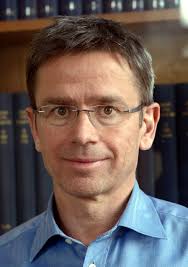
Listen to or download this 21 minute interview with Stefan Rahmstorf in CD Quality or Lo-Fi
A Lead Author for the Intergovernmental Panel on Climate Change (IPCC), co-founder of the influential climate science blog RealClimate, and recipient of the American Geophysical Union’s Climate Communication Prize, Rahmstorf has published over 130 peer-reviewed papers and several books translating complex climate physics for the public.
We break our radio time into two baskets. We start with the biggest threat to Europe and the wider world, a shift in the Atlantic Meridional Overturning Circulation or AMOC. Then we go to Stefan’s important March 2026 findings about accelerating global warming.
AMOC: HOW WE KNOW THE OCEAN CAN SHIFT TO A DIFFERENT STATE
We think of the ocean as always being the way it is. American oceanographer Henry Stommel first announced the sea has not one but two states. That was in his classic 1961 paper: “Thermohaline convection with two stable regimes of flow.“ He said a surge of freshwater into the ocean (like Greenland melting for example) could shut down the great Gulf Stream – and the pump in the North Atlantic that sends cold water along the bottom back to the tropics.
Then Wallace “Wally” Broecker took it further with analysis of the ancient ocean (using sea bed samples for example). Broecker called the AMOC the “Achilles’ Heel” or weak spot in the ocean circulation system we all depend on. Broecker warned that the Earth’s climate system had operated like an “angry beast” in the past, capable of abrupt shifts triggered by freshwater input into the North Atlantic.
Based on this, young scientist Stefan Rahmstorf more or less founded the science of tipping points in the North Atlantic with his 1995 sole-authored paper. He’s been working on it ever since. Just in the last few years, Rahmstorf changed his views on how likely this mega-change that could freeze Europe might be.
In the interview, Stefan tells us:
“And for many years, for actually the first 30 years of my career, I considered that to be a low probability but high impact risk. And that is serious enough because even if it’s a 5% probability, if something has really bad consequences, then of course you should take it seriously. I don’t think anybody would board an airplane with a 5% risk of crashing.
So that was also where the wider community located this Atlantic overturning risk, what we call the AMOC risk. In the last five years, though, a number of studies have come out which makes this risk look rather more serious. And by now, in the light of several studies, I now say it’s 50-50, if not more, is the probability that we hit a tipping point of the AMOC as a consequence of global warming.”
WEAKENING CURRENT MAY HEAT EUROPE FIRST…
Suppose the North Atlantic Ocean circulation does not stop, but weakens, perhaps by half. What happens? Rahmstorf:
“Well, first of all, from the latest studies, if it has weakened by half, it’s probably past the tipping point of no return. So that would be very serious.
It would mean it will not recover. It will weaken further. Just even a weakening by 50% would have pretty strong influences on our climate, on our weather, also on sea level. And in fact, I believe that the evidence is pretty strong that the AMOC has already weakened. However, not very much. Only 15% is our best estimate.
And even that is already influencing our weather, as several studies have shown. It does actually do that in a rather counterintuitive way. The consequence of this moderate weakening of the AMOC is that in the Northern Atlantic, the sea surface temperature has been cooling. It’s actually the only part of Earth where it has been cooling in the last 100 years, whereas the whole rest of the planet has been warming.
And this cold blob out in the subpolar Atlantic to the west of the British Isles already has an influence on our weather systems. Low pressure systems like to hang about there, which then leads to a pattern that brings warm air from the southwest into Europe. And that is considered one reason why Europe is such a hot spot of heat extremes in the summer. They have increased four times more than in other land areas at similar latitudes.”
Stefan explains the effect of AMOC weakening is much stronger in winter than in summer.
“...so if you have global warming and AMOC weakening, you will likely get warmer summers simply because of the global warming, because of more CO2 in the atmosphere. But you can get colder winters in northwest Europe because less heat is delivered by the AMOC, which is why Europe now has a relatively mild climate for its latitude.”
He says the ocean current does not “flip” rapidly. The process could take 50 to 100 years to play out. The biggest impacts come early in the next century. There could be blazing hot summers – even in the UK and Scandinavia – due to global warming, followed by winters more severe than any known today. European housing and infrastructure are not built for that. According to shutdown events in past Earth history, this great winter freeze could last a thousand years.
ALSO SEE
Tipping risk of the Atlantic Ocean’s overturning circulation, AMOC. Keynote by Prof. Rahmstorf
Jun 7, 2024 (about 190,000 views in late 2026, quite high for climate videos)
WARMING ACCELERATION!
Rahmstorf’s other major headline from 2026 (in my opinion) is his Geophysical Research Letters paper with statistician Grant Foster. The ominous title is “Global Warming Has Accelerated Significantly”. Once they removed the fingerprints of El Nino, volcanic eruptions and solar cycles, the numbers reveal warming has been getting faster since about 2015.
If you have followed recent Radio Ecoshock shows, this is a big story. In recent years former NASA head scientist James Hansen warned us all: warming is accelerating. That is very bad news – but is it true? A number of scientists cross-checked all the data, including Rahmstorf and Grant who nailed it down.
From the interview:
“We saw that in the last 10 years, we have seen nearly 0.4 degrees of warming in a decade, whereas the decades before that, since the 1970s, it was typically around 0.2 degrees Celsius per decade. So it was nearly a doubling in the speed of global warming.”
==========================
DISAPPEARING GLACIERS = EVEN MORE RISING SEAS
LANDER VAN TRICHT
New science reveals we underestimated how fast glaciers will disappear. That makes sea level rise worse. Today, we begin with one glacier with an expert just back from the ice field. It tells a global story.
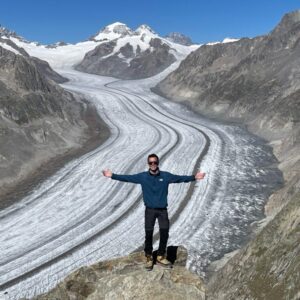
Lander van Tricht joins us. Van Tricht is lead author of the new paper “Resolving Short-Term Meteorological Variability Amplifies Projected Glacier Loss and Sea Level Rise”. He is Professor of Glaciology at ETH Zürich in Switzerland.
Listen to or download this 20 minute interview with Lander Van Tricht in CD Quality or Lo-Fi
“In the last five years, glaciers in the Alps have lost approximately 20% of their total ice volume.”
Europe just experienced five severe heat waves in the summer of 2026. Four of them swept over glaciers in the Alps. Van Tricht says:
“It was the warmest summer since the beginning of the measurements. And this resulted in the second worst year for the glaciers since the beginning of the measurements.”
Modeling constraints have led to underestimations of the amount of glacier loss and therefore the sea level increase. To save on computing time, glacier models used monthly averages. But just a few days of heat can be the big change driver. Van Tricht tells us:
“In most regions, the daily model is slightly more negative for the future than the monthly model because of the inclusion of, for example, heat waves in the future, more rapid ice loss in the future. But in some regions, especially the high-Arctic, high-latitude regions, the differences become very large. For example, in Svalbard and the Russian Arctic, our daily model projects up to 25% more ice loss in the future.
That’s really, really a big difference, and it results in 20 to 33 millimeters additional global sea level rise by the end of the century. “
IS THIS ADDED SEA LEVEL RISE SIGNIFICANT?
This hidden mountain melt adds roughly 20 to 33 millimeters, about an inch to projected sea level rise by the year 2100. In the grand scheme of rising oceans, is an extra inch coming from mountain glaciers significant?
Van Tricht:
“It is significant. There was a recent study showing in every millimeter, approximately it’s 300,000 to 400,000 people on Earth, which means that 20 to 33 millimeter could easily hit 6 to 9 million people more. So every millimeter matters and 20 to 30 millimeter is for sure not negligible.”
Where is Lander getting these numbers, like up to four hundred thousand more people displaced by less than an inch more sea level rise? That landmark research is the October 2019 study by Scott Kulp and Benjamin Strauss of Climate Central was published in Nature Communications titled “New elevation data triple estimates of global vulnerability to sea-level rise and coastal flooding” Open access Published: 29 October 2019.
Radio Ecoshock covered these findings in an episode from November 2019 titled “Hundreds of Millions to Be Flooded Out by the Sea”, which featured an interview with Climate Central scientist Benjamin Strauss breaking down how the new elevation data radically changed the baseline risk for coastal communities worldwide.
IS THERE HOPE FOR EUROPEAN GLACIERS?
Just a couple of weeks ago I reported the final loss of the Triglav Glacier in Slovenia. It was a famous symbol for Slovenian culture and now it is gone. This is a global phenomenon. In hot news: the last of Indonesia’s tropical glacier in New Guinea has dwindled to a few patches of ice.
What can we expect for the Alps? Van Tricht says:
“If we look at the bigger picture, the Alpine white scale, we have to be rather pessimistic and see that in the most optimistic scenario, we’ll lose about 80% of all the ice which is still present today. And in the worst case, we’ll lose about 99 to almost everything. So it means we still have a bit of ice to save if we limit global warming, but then in a rather moderate case scenario, according to policy decisions and projections today, we’ll lose about 90 to 95%.
So the Alps is really an example of a mountain range which is very sensitive. And where the difference between the optimistic and the pessimistic scenarios is rather small. Opposite to some other mountain ranges and also the Greenlandic peripheral glaciers, for example, where the difference between the optimistic and the pessimistic scenarios are much larger.”
Even if a miracle happens and humans act, we get off fossil fuels, these glaciers will continue to melt Van Tricht says:
“The glaciers would still keep melting because they’re still responding to post-climatic changes. They’re not in a steady state with the current climate, which means they would still melt for 30 to 50 years and then stabilize. But the glaciers as they are today are still too large for the present day climate, meaning that they would get smaller until they find an equilibrium with the present day climate.”
Even with the most optimistic scenario, Van Tricht expects only about a hundred glaciers left anywhere in the Alps. They will be very hard to reach, perhaps only by cable-cars, because the last hold-outs will be near the mountain tops. Today’s tourist industry in places like Zermatt in Switzerland is likely to melt away with the iconic glaciers around the famous Matterhorn.
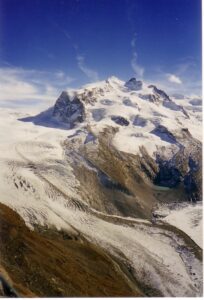
“Zermatt is a small mountain range in the southwest of Switzerland, located at 1,600 meters. It’s very remote. It’s only accessible by a train. And it’s located at the feet of the Matterhorn, the most famous mountain of Switzerland, and I would say also of the Alps.”
Scientists predict “peak glacier extinction” will be around 2040, just over ten years from now. I discussed this with Lander in our previous Radio Ecoshock interview.
=====================
FLORIDA STARTS TO GO UNDER
So, Florida. The ocean is hot. The seas are high and rising. If you get heavy rain, there is nowhere to put it. Dig a hole and the water is already there. And then, surprise! Climate-heavy rain arrives. Lots of it coming down by the feet. People evacuate, try to clean up, and then, two weeks later, the rain comes back even worse.
As reported in news coverage…
“In Hollywood, Florida, part of a hospital roof caving in from the heavy rain. The roof of a synagogue also collapsing. The weather forcing ground stops in multiple Florida airports as water flooded runways. High water rescue teams jumping into action as some cars were crushed by trees with other vehicles getting trapped in the rising flood waters.
The severe weather leading to some odd sights too. This fish winding up on a sidewalk as some cows searched for higher ground. Farther north, Florida’s space coast also slammed overnight. The area still recovering from historic rainfall two weeks ago.”
– Today Show, November 19th
Even Fox in Chicago covered this Florida flood madness.
“Torrential Downpours Trigger More Historic Flooding in Florida” Nov 19, 2026
The crazy doesn’t stop there. This is Florida with Ron DeSantis in charge.
Voters just decided to slash their own taxes. There will not be any money for flood help and recovery. Municipalities and country governments will not be able to collect enough taxes to fix things, much less prepare for more climate change. This is a super mess. One official advises they “might as well grow gills”.
In this radio show you also get clips from a good in-depth report from NRP radio about Florida voters cutting funding even as disaster strikes (again).
All this is just the beginning, the start of the start of lower Florida disappearing underwater as rising seas continue to build.
================
NEXT WEEK
Next week we’ll talk with Dr. Bjorn Stevens, Director at the Max Planck Institute for Meteorology. The big question raised in his latest paper: are satellites misreading the planet, or is Earth suddenly warming much faster than expected?
Goodbye and good luck for now. With all the crazy disruptions and shutdowns, I hope we still get together again next week.
Alex