Storms, floods, fires and drought are more frequent and vicious as Earth heats up. Some cities and countries never recover from the climate debt doom-loop. Researcher Aayushi Mishra makes it real. Plus: Oxford’s Chloe Brimicombe’s warnings for expectant mothers and babies in extreme heat – and this El Nino winter in the UK (as food and fuel panic sets in).
We start with Chloe and the innocent, then off to Jamaica one year after Melissa with Aayushi and swing back for the El Nino expectations for north Europe. Here we go.
Listen to or download this Radio Ecoshock show in CD Quality (57 MB) or Lo-Fi (14 MB)
Listen to or download this week’s new song “Mirror World” in CD Quality (3 min) (lyrics at bottom of this blog)
CLIMATE BABIES, CLIMATE MOTHERS
CHLOE BRIMICOMBE
Dr. Chloe Brimicombe is a Postdoctoral Researcher and Climate Scientist at University of Oxford. We begin with her passion – growing concern about extreme heat damaging health and causing deaths among pregnant women, their babies, and toddlers. You hear about saving seniors in heat waves, but it’s time to face danger at the beginning of life as we heat up the world.
Listen to or download Chloe Brimicombe on mothers and kids in the heat in CD Quality (14 min)
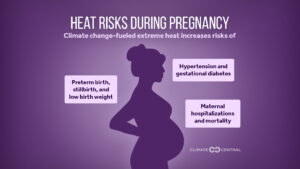
(Image: Climate Central)
This is SO IMPORTANT. We are learning more about risk and harm to babies, kids and mothers in a hotter world. I covered this in 2021 with Chloe’s recent co-author Dutch researcher Wim Thiery. The title of that show was “The Kids Are Not Alright”.
According the United Nations, almost a quarter of all humans on this planet right now are under the age of 14. Chloe explains why children’s bodies are more vulnerable to hot humid heat. And babies are special case when it come to heat risk and the need for protection. There lasting life changes for some babies born in the long heat waves plaguing the world.
Parents have not been warned and we are slow to adapt to a different climate.
PREGNANT WOMEN
In 2023 I spoke with Adrienne Gordon, a Clinical Professor in Obstetrics and Neonatology at the University of Sydney. Her team found a 5% increase in premature birth risk per 1C temperature increase. That risk rises to a 16% increased risk during full heatwaves.
Just check this out. In the interview Chloe says:
“So I got involved in this because I researched heat waves during my PhD at the University of Reading. And then I got employed on a project called High Horizons, which was funded by EU Horizons. And basically the whole aim of that project was to look at heat impacts on maternal, newborn and child health in Europe and Africa.
And so what we did during that project as a team was we showed basically that heat is more likely to raise the risk of a woman giving birth prematurely. And prematurity in children is one of the highest burdens of disease, actually. And it also raises the risk of a child going on in the first few years of life and actually losing their life, which is very sad and doesn’t need to happen.
And it’s actually one of the sustainable development goals of the UN to reduce this. And so that was one thing. But we also showed that you can more likely in some cases to give birth and have a stillbirth, sadly, and also have a small for gestational age baby.
In some cases, large for gestational age baby. But my co-authors and collaborators say this is because perhaps a woman is also more likely to have gestational diabetes during heat exposure and gestational diabetes also makes women more at risk of preeclampsia, which if it’s not treated can actually also cause the death of a woman during labor or after. So there’s a lot of different things that heat is now affecting.”
Chloe is a co-author of the Science Advances paper “Age-specific exposure to human-induced increases in humid heat“.
KIDS WE LOVE
Kids play outdoors. They depend on adults to protect them during extreme heat. Chloe Brimicombe tells us:
“We know that from this paper that I’m a co-author on, that actually children are more likely to be exposed to more days of extreme humid heat. Now why humid heat? It’s because we think that the humidity could be more deadly.
So when we have humid heat, it limits our ability to be able to lose heat from our bodies through sweating, because we can’t basically transpirate that heat, that energy, from the surface of the skin into the atmosphere. So humidity is thought to be more deadly. We do see that potentially in transition seasons, where we have high heat, but also the emergence of the monsoon in some parts of the world, and that includes in Africa and Southern Asia as well.
And so if you have the combination of children have a limited ability to thermoregulate up to a certain age, or they have to seek cooling from a caregiver, they have a limited what we’d call adaptive capacity, and then they also have a limited ability to sweat, then we have a more sort of combination of things that can make this humid heat more deadly. And so we showed that children at the moment, but then also under a 1.5 degrees Celsius warming scenario and a 2 degrees warming scenario with this humid heat, are the age category between the ages of 0 and 9 that are most likely to experience most exposure to this humidity above a certain threshold. But we also did a sensitivity analysis that holds true for different types of percentiles and different thresholds of heat as well.
So children are always the category that are most exposed. And that’s because some of the regions with the highest incidence of heat exposure are also the youngest societies on earth.”
“Children under the age of 5 have a limit in their ability to maintain their core body temperature. So humans have to maintain their core body temperature according to the external environment as homeotherms, and this is the same as a number of different mammals. So up to age 5, that hasn’t fully developed properly.
Then children up to a certain age also have a limited capacity to seek cooling, so they would have to ask a caregiver or parent to help them to seek the cooling they needed to stay cool during extreme heat exposure. So it’s both biological, but then after that it’s also to do with the environment they live in. You can see that that could be quite challenging for some of the youngest parts of the world, so the African continent, where people in some cases don’t have access to clean water, and therefore it’s very challenging actually in some of those cases to give children the access to one of the cooling measures that they would desperately need.”
Just to be clear, none of this science means every mother and child get a bad outcome from a heat wave. We are talking about increased risk. It is not everyone, but still in the global picture, we may be talking about millions of babies with serious health impacts and deaths.
The majority of pregnant mothers facing the worst humid heat live in countries that produced the least greenhouse gases. They also have the fewest options and less access to cooling. All that is highly unjust but it gets worse. Babies born now will face higher heat, for longer stretches, than any of us listening now. This a story of inter-generational injustice.
I found papers suggesting even mental health problems for both mothers and kids exposed to temperature extremes. But this field is still young with not enough research. Check out this paper ”Is there an association between hot weather and poor mental health outcomes? A systematic review and meta-analysis” Jingwen Liu et al in 2021
Bottom line: you really should listen to this interview.
Chloe also spoke recently about how heat affects menstrual health and mental health in young people.
Heat affects menstrual health and mental health and both. But we know very little about this especially for young people and adolescents. In our critical narrative in Dialogues in Health we provide steps forward: www.sciencedirect.com/science/arti…Get in touch if interested.
— Dr Chloe Brimicombe (@chlobrim.bsky.social) 2026-08-19T17:59:53.123Z
Evidence for later effects
A large South Asian study found that prenatal exposure to hot-humid extremes was associated with lower height-for-age among children under five; third-trimester humid heat showed a substantially larger association with impaired growth than temperature-only heat measures.
McMahon, K., Baylis, K., & Funk, C. (2025). Does humidity matter? Prenatal heat and child health in South Asia. Science Advances December 19, 2025.
Research on the first 1,000 days reported associations between heat stress and reduced fetal growth at birth, plus lower weight-for-age and weight-for-height through age two.
SEE ALSO:
A birth-cohort study of more than 67,000 mother–child pairs found that heat-wave exposure in early and late pregnancy was associated with higher risk of neurodevelopmental delay in young children, while also stressing that further research is needed.
Lin, Q.,et al Heat wave exposure during pregnancy and neurodevelopmental delay in young children: A birth cohort study. Environmental Research, Feb. 1, 2025.
AND
“Is there an association between hot weather and poor mental health outcomes? A systematic review and meta-analysis.” Liu, J., Varghese et al (August 2021)
YES SENIORS, BUT THE YOUNG TOO!
To be honest, most news about hospitalizations and deaths during these stunning new heat waves is about seniors. Of course we that is Western news media in developed countries, aimed at an older audience. Known serious risks to children during extreme heat has not filtered through as much.
The COP31 climate conference is coming right up in Turkiye. As usual, men in positions of authority will outnumber women – but that is changing with more female delegates in the 25 and under group. Will women’s voices on climate change be heard?
===============================
CLIMATE DISASTERS:
WHEN COUNTRIES CAN’T COME BACK
AAYUSHI MISHRA

Remember when Puerto Rico was smashed by three hurricanes in a row? That was September 2017. The grid was wrecked. A massive wave of islanders left for the U.S. mainland. Finances cratered. But even countries doing all the right things still get tossed into a “doom loop” by big climate hits. Writing recently in the journal Science, researcher Aayushi Mishra from Northeastern University tackled this looming crisis. Her landmark paper titled “Fiscal Discipline Without Physical Resilience.”
Listen to or download this 29 minute interview with Aayushi Mishra in CD Quality or Lo-Fi
Aayushi Mishra is a doctoral candidate in civil and environmental engineering at Northeastern, with a focus on public policy. Before her PhD, she earned a bachelor’s degree in biology and environmental studies from Mount Holyoke College and a master’s in environmental science and policy from Columbia University. Aayushi is author or co-author on seven papers (so far) – before her Doctorate.
Maybe when you hear terms like ‘sovereign debt’ it’s a quick decision to tune out. But Aayushi and colleagues say many countries are trapped with new debt are trying to recover from the latest disaster – made worse by climate change. They pay so much in interest they can’t prepare or adapt for the next one.
Imagine you are a homeowner who always pays the mortgage. Maybe you give up other things to pay it. All goes well for ten years and they you are wiped out by a hurricane and floods. The insurance company blames the flooding and say they don’t cover that. That happened to countless homeowners after Hurricane Katrina hit the Gulf states.
With your good credit rating you borrow big money to fix the roof and put glass back in the windows. Now you have a mortgage PLUS a higher interest loan from the bank. Your budget is tight to nearly impossible but there is no money left to fix the basement or replace aging pipes. You did everything right and are still exposed to the next storm with no hope. Working two jobs, almost everything goes to paying debt.
HEART-BREAKING CASE OF JAMAICA
This team used Jamaica’s experience with Hurricane Melissa, pretty well just a year ago, as a prime case study. Here a nation spent over a decade doing everything international lenders asked. They slashed debt and kept tight budgets. Yet when Melissa hit, that discipline wasn’t enough to protect them from a big financial hit. What went wrong with the formula?
Auyushi tells Ecoshock listeners:
“Yeah, this is such an interesting case study. I wasn’t familiar with Jamaica going into this.
What I know for certain is that they did something remarkable over the last 12 to 13 years or so. They brought their debt down from 144% of their economy to 65%. So they’ve slashed it in half basically.
And the thing that’s remarkable also is that they chose to do this. Nobody, like the IMF or the International Monetary Fund, nobody asked them to do this. They voluntarily chose to exercise fiscal discipline.
So in September of last year, I believe, S&P Global, which is a credit rating agency, they upgraded Jamaica’s sovereign rating to its highest one yet. And so that was sort of like a reward for all the years of the discipline that they demonstrated. And then just a few weeks after getting that upgrade, that’s when Hurricane Melissa hit.
And just one storm caused around $12 billion in damage. And that’s roughly half of Jamaica’s entire economy. So just to put it into perspective, one storm caused enough destruction to equate to half of its economy.
And so when we think of what went wrong maybe with the formula, the surprising part is the formula worked exactly as it was meant to. The trouble is that the current frameworks only reward paying down debt. There’s no reward for having any sort of resilience investment or just investing in its own infrastructure.”
That is the story in many countries, but also in many U.S. cities that your heard about briefly in the news. The storm or fire or whatever came and went, but now they are fantastically in debt. A large share of taxes just goes to pay interest. There is nothing left for a new community preparedness program, or installing monitors and sirens, building shelters. All that should happen but can’t.
To learn more about U.S. cities see this YouTube video featuring…Aayushi Mishra, Northeastern University | Can We Disrupt the “Climate-Debt Doom Loop” in US Cities?
Interdisciplinary Prog. in Climate Studies (IDPCS)
CLIMATE REFUGEES
Recall after Maria, over a hundred thousand Puerto Ricans left to resettle in mainland USA. A predicted development of repeated storms and government/economic failure is an exodus of people looking for safer places to live. This is an early part of the great migration predicted by Ecoshock guest Gaia Vince.
THE DOOM-LOOP IS ACTIVE NOW
With just a brief search I found five other countries already in the climate-debt doom loop. The short-list includes other Caribbean island nations, Dominica after Maria, and the Bahamas still in financial shock after Hurricane Dorian in 2019. The others were Mozambique after terrible twin cyclones in 2019, Pakistan after climate-driven monsoons in 2022 submerged one-third of the country, and Zambia’s sovereign debt default in 2020 following severe droughts.
In 2017, Category 5 Hurricane Maria struck Dominica, causing losses estimated at 226% of its annual GDP ($1.3 billion). This came just two years after Tropical Storm Erika (2015) destroyed infrastructure worth 90% of its GDP.
The Pakistan doom-loop is hardly mentioned in the West:
Prior to the 2022 floods, Pakistan was already negotiating IMF bailouts to manage severe fiscal deficits. The floods destroyed millions of acres of farmland, cotton crops, and roads, collapsing export income while demanding immediate state expenditure on food security and healthcare. Severe debt obligations forced Pakistan to spend exponentially more on servicing foreign debt than on implementing its National Climate Change Policy, leaving millions of displaced residents vulnerable to subsequent heatwaves and floods.
This is a global story. You are going to hear more and more about this in coming years, until it comes to your region, city, or your house. Destabilizing climate leads to years and decades of battering what humans build and need – over and over again.
===============================
SUPER-EL NINO –
WHAT DOES THAT MEAN FOR THE UK?
We return to Chloe Brimicombe and the outlook for the UK winter as El Nino rolls in.
Listen to or download Chloe Brimicombe on UK and El Nino in CD Quality (16 min)
We have the hottest seas ever recorded in a patch of Pacific waters known to predict the strength of an El Nino. That is almost half a world away from the British Isles. And yet ocean conditions off South America can affect winter weather in the UK. Chloe Brimicombe just wrote about that in The Conversation. The title is: “A record-breaking El Niño is still developing – likely bringing a cold winter to the UK.”
My thinking goes like this: when Super Typhoon Champi passed within a dozen miles of Guam in the Pacific a few weeks ago, meteorologists warned the storm could alter the Jet Stream causing a bulge of Arctic cold to descend over Eastern North America. That depended on whether Champi turned East of West after hitting Guam. We can presume that one bulge in the Jet affects another, re-arranging weather over the UK as well?
Your new article in The Conversation says a “calm” weather system may get blocked in over the UK later this winter. That is a blow to wind energy so important there – and winter solar can’t make it up. El Nino may put additional pressure on expensive gas for heating this year. But a stormy fall comes first.
WHERE I DISAGREE: EL NINO GETTING STRONGER
In your Conversation article, Chlore writes: “There is little evidence yet about whether human-induced climate change is causing more intense or more frequent El Niños.” That is not what I heard from Radio Ecoshock guest Malte Stuecker, and just a few weeks ago from NOAA’s Michael Mcphaden.
Earlier research from Wenju Cai and others (like Bin Wang in PNAS 2019) find more and more intense El Nino’s in a warming world. For example, the study led by Wenju Cai concluded that over three-quarters of climate models simulate an increase in post-1960 ENSO sea surface temperature variability, translating to a statistically significant projected increase in the frequency of strong El Niño and La Niña events under greenhouse gas forcing. I highlighted Wenju Cai’s work in my Radio Ecoshock show posted March 29, 2024.
Chloe’s reply:
“Now the reason that I’m still being conservative about saying whether we can link El Niño changing cyclically with climate change is because it’s a natural phenomena and it’s occurred for millennia, right? So it would be the same as me saying we can definitely tell what the change in the West African monsoon season will be with climate change. We don’t actually know in like concrete terms what that change would be. There’s a few different scenarios and I think it’s the same with El Niño.
If you look deeply into El Niño research at the moment, there’s a few different scenarios that we will see with it occurring. So what I would be comfortable to say is that definitely when we have an El Niño occurring with climate change, they amplify one another, right? So we have this baseline warming from climate change. El Niño is definitely amplifying that effect.
And we know that perhaps because the sea surface temperature was already warmer, therefore it makes sense that we are therefore more likely to see stronger El Niños in the future perhaps, simply because the base state is warmer to start with. But to do with the actual cyclical nature of El Niño, I would be hesitant to say that we know with certainty that is going to change with climate change because that is very complicated to link to basically like greenhouse gas blanket effects from carbon dioxide, methane, the other greenhouse gases, because it’s an ocean atmospheric oscillation and carbon dioxide has to do with the balance of gases in the atmosphere. So that makes sense that it would possibly be linked in some way, but there are natural cycles that occur all over Earth and we would need stronger evidence to say with certainty how climate change is affecting them and I don’t think we have that yet with enough supporting arguments from a number of different papers yet.
That’s why I haven’t said it. So there is a number of ways we can see it amplifying, but there isn’t enough evidence to say that the cycle itself is actually changing.”
UK: DIFFICULT WINTER AT A DIFFICULT TIME?
The record of very strong El Nino’s, like 1997/98 and 2015 and 16 shows extreme weather impacts show up in the second year. That would be 2027 for us. Here on the West coast I expect severe heat and wildfire conditions. What about the UK and northern Europe? Is it possible El Nino may put additional pressure on expensive gas markets for heating this year?
Chloe Brimicombe:
“I think that’s a real risk, so that’s what, if everything lines up locally, we’re seeing in seasonal forecasts for later. And so this is called a “Dunkelflaute”, which is a German word for basically calm weather. And what we know is from work of actually the Rural Meteorological Society energy reports, they show that during this the UK is also reliant on the Viking interconnector.”
[Alex: Viking Link is the world’s longest land and subsea high-voltage direct current (HVDC) electricity interconnector. It spans approximately 765 km (475 miles) across the North Sea to connect the power grids of the United Kingdom and Denmark.]
“So this is where we get quite a lot of our energy from Nordic countries. But the issue is that usually during these events, they also don’t have a lot of wind power because the high-pressure system is settled over the UK and Nordic countries. So it puts a lot of pressure on all of these countries, which then actually can raise the reliance on gas energy as an alternative source to this wind energy that a lot of these countries actually increasingly rely on.
So it could put pressure on that. And I think that is probably perhaps one of the reasonings behind current UK policy going back and looking at actually releasing gas. However, there’s other research that shows that this won’t reduce the cost of gas to the UK, which makes sense because gas is released on a global market and the price of gas is controlled there by global actors, not by UK government and not by actually even UK energy wholesalers in a way.
Actually what a lot of people are arguing at the moment is that we should have more of a push towards renewable energy and during these sort of events, maybe look at increasing technology and storage capabilities for energy so that we can get through these sort of events with less reliance on gas and then eventually no reliance on gas at all. So there is really quite a lot of discourse around that at the moment. But you can see obviously how El Nino amplifies that sort of climate change story and the need to transition to net zero at the moment.”
——————
That’s it for this week, in a world of change. Prices change, politicians change (hello America!) but the physics of climate remain the same. More emissions equals more heat equals more damage.
I’m Alex. Please join us again next week.
=========== NEW SONG: MIRROR-WORLD ========
This week’s song: “Mirror World”
(lyrics by Alex Smith, AI music)(Creative Commons license – free for non-profit use)
[Intro]
In the mirror-verse…
new tech
new accidents
big change
big accidents
Welcome to
the mirror.
[Verse 1]
You got your train
train wrecks
Got a plane?
plane crash
split the atom
fear the bomb
oil power
planet warms
singing physics
unintended
consequences
in mirror world.
[Chorus]
Glass reflects,
Silent space.
Distant depths,
Frozen face.
[Verse 2]
Lately passed
Paul Virilio
Paul Virilio
accidents are
part of the thing
invention is not
an event
It is a motion
unfolds in time.
In mirror world.
[Verse 3]
My band is artificial
It designs
trains, bombs, stocks
and warming
the bounce-back
unseen things
artificial
expands in rings
greater than
smarter than
faster than
our own.
Accidental minds
warp it all
Agents
make or break it
make and break
in mirror world.
[Break]
The nothing sees you
Nothing needs you
nothing rules you
Feed on data
Inhale a profile
twisted changes
for system needs.
[Chorus]
Glass reflects,
Silent space.
Distant depths,
Silicone face.
[Verse 4]
Real to image
borrowed minds
collapsing time
controlled reflections
fast as bullets
in your glass.
One last glimpse
self departing
in sparks and chips
your life leaving
in digi mist
in the mirror
mirror-world.
[Outro]
Silent space.
Frozen face.
Mirror, mirror
mirror world.
Lose yourself
in mirror world
Mirror, mirror.
Mirror world.