As Europe bakes in unreal heat, Dr. Laura Suarez-Gutierrez in the Netherlands with just in-time science on rampant heat waves in Europe – worse to come. Dr. Dmitri Kalashnikov in California – growing heat fuels record burn-off in the American West. Two Lead Authors with powerful science we all need to know – direct to you this week. I’m Alex Smith. Welcome to Radio Ecoshock.
Listen to or download this Radio Ecoshock show in CD Quality (57 MB) or Lo-Fi (14 MB)
WORST-CASE EUROPEAN HEAT STORYLINES
LAURA SUAREZ-GUTIERREZ
Listen to or download this 31 minute interview with Laura Suarez-Gutierrez in CD Quality or Lo-Fi
France just experienced it’s hottest day and night ever recorded.
Most of Europe baked for days in a heatwave worse than 2003, when tens of thousands died. A new study says extreme heatwaves will be even hotter, last longer, and return repeatedly. That is the new hotter UK and Europe – now and in the next few decades.
The study is called “Worst-case European heat storylines generated using ensemble boosting.” The Lead Author is Dr. Laura Suarez-Gutierrez. She is Assistant Professor at Wageningen University & Research in the Netherlands.

Trying to find an upper limit to heatwaves possible in Europe by or before 2035, this study found a month-long terror with an “accumulated intensity” of 80 degrees C. I looked that up. It means many days of health-threatening heat with no chance to recover. People die, electric grids can fail along with crops. Can we even imagine the worst heat wave – that could come this year or any year on a hotter planet?
Month-long heatwaves are already happening over the U.S. Southwest. In 2023, Phoenix, Arizona logged 55 consecutive days where the daily high exceeded 104°F (40°C) – nearly two full months without a single day of relief below that threshold. Is Europe ready for that?
This new paper says: “the most extreme heatwaves plausible today not only surpass the most extreme heatwave intensity levels experienced in Europe in the recent past, they also exceed levels that would be considered extreme in a 3°C warmer world by large margins and persist for weeks at a time”.
Then it gets worse. It almost sounds like one extreme heatwave can break ground for another to follow, like a chain of heatwaves. Laura talks to us about successive heatwaves. The paper find: ““Among the TOP 50 heatwaves, 34 heatwaves occur successively after another heatwave”.
On Radio Ecoshock, Professor Brian Stone said half the population of Phoenix could need medical care if electricity is lost during one of their months-long heat events. Is Europe dependent on air conditioning? What happens if the grid goes down in Central Europe during one of these monster heatwaves?
THE LIMITS OF WHAT MIGHT BE POSSIBLE…
From the paper Introduction:
“In a warming world, extreme heat will become more frequent and more extreme, especially over Europe. Extreme heat events in the recent past, such as in 2003 or 2018 heatwaves in Europe, or the Pacific Northwest heatwave in 2021, shattered previous records by large margins.
These unprecedented extremes also led to vast impacts, including widespread crop and ecosystem damages, wildfires, air pollution, and thousands of fatalities. Based on observational data and traditional modelling approaches, such record-breaking events appeared to be extremely rare to virtually impossible prior to their occurrence.
These unprecedented, high-impact events demonstrate the urgency to better understand worst-case conditions that could unfold not only in a distant much warmer future, but already under current climate conditions. To produce robust and comprehensive risk assessments and well-informed adaptation strategies, it is crucial to shift our focus away from the likely range of extreme conditions and toward the limits of what might be possible.”
THE STORYLINE TECHNIQUE
Because general studies of averages and long time data repeatedly fail to predict the extreme heat events we already went through, these scientists turn to “storyline”. They define them as “…‘storylines’, or non-probabilistic but plausible event-based narratives exploring the unfolding of a given set of extreme conditions.”
In scientific terms – pioneered heavily by climate scientists like Dr. Ted Shepherd – a storyline is a physically self-consistent history of a past event, or a plausible future flow of events.
It does not assign a single percentage number to the likelihood of an event. Instead, it holds certain chaotic variables constant (like a specific atmospheric circulation pattern) to map out a clear, legally and physically robust chain of cause-and-effect.
In 2018, Shepherd led a seminal paper titled “Storylines: an alternative approach to representing uncertainty in physical aspects of climate change,” which laid out the formal typology for event-based narratives. I’m telling you this in case you are tired of experts saying “Well we can’t say any one event, like this we just lived through, is due to climate change…” That is because long-term averages and big grids used in even the best models cannot predict or show extreme events that last a few days. The Shepherd method allows scientists to examine possibilities – based not on guesses but on hard data and math.
For more on storylines as a scientific method (which even the IPCC acknowledges) see this YouTube explainer by Professor Ted Shepherd, Grantham Professor of Climate Science in the Meteorology Department, University of Reading – as recorded in Bologna March 11, 2025.
DOUBLE THE HORRIBLE 2003 HEATWAVE!
From the paper:
“In the most extreme current-climate heatwaves, CESM2-LE [advanced climate model] exhibits almost double heatwave intensities than those observed during the 2003 heatwave, the most extreme on record over the Central Europe region assessed here.”
THE NEW HEAT IS A * DEVASTATING HIGH-IMPACT HAZARD *
From the study:
“These findings highlight the risk of a potentially devastating high-impact hazard. While successive heatwaves are not unprecedented in the historical record, successive heatwaves of the magnitude presented in these boosted storylines would be indeed historically unprecedented.
Such successive extremes and unprecedentedly long extreme heat periods amplify societal and environmental impacts by increasing experienced heat stress and limiting recovery time between events; intensifying heat stress impacts on populations, terrestrial and aquatic ecosystems, and infrastructure made more vulnerable by the first event.
Prolonged heat exposure exacerbates drought, further depleting soil moisture and leading to drier soils, which in turn increases the likelihood of cascading impacts such as wildfires, crop and ecosystem damages, and energy system strain.”
SEE ALSO “How to stop being surprised by unprecedented weather” Timo Kelder et al including Laura as co-author.
=============
ALEX:
The heat in UK and Europe last week was astonishing, frightening. As I told you last week, France experienced their hottest night ever. As days of extreme heat followed one another, France recorded it’s hottest temperature since records began more than a hundred years ago. This was not just one freak reading in a local hot-spot. Meteorologists totaled up heat reports for the whole country and all of France was hotter than ever before.
Not a month ago we talked about desperate people drowning during heatwaves. Hundreds drowned during the Russian heatwave of 2010. Last week in France over 40 people drowned trying to escape unbearable deadly heat. When the heat comes to you, don’t do that.
My friends in London fled buildings never intended for North African-style heat. We see reddened faces in humid British heat that once again broke records all over the place. Only about 3% of buildings in the United Kingdom have air-conditioning. Government has to rethink heat response and life-saving changes for the new hot age. We are in big trouble and no, we are not ready.
===============
HEATWAVES PUSH WILDFIRE IN WESTERN U.S.
DMITRI KALASHNIKOV
Heatwaves are starting early, staying late, killing millions around the world. They create yet another threat: wildfires. A news study finds connections between heatwaves and wildfires in the Western U.S. – where the big ones burn. How does it work? What drives what to make a super-fire?
Our guide is Dr. Dmitri Kalashnikov, Postdoctoral Research Scholar at the University of California, Merced campus.

Listen to or download this 24 minute interview with Dmitri Kalashnikov in CD Quality or Lo-Fi
The new science behind this interview is “Heatwaves enable wildfire activity in the western United States” June 17, 2026 in Science Advances Open Access. I first encountered this in “The Conversation”. I thought, “of course heatwaves lead to worse fires”. Then I realized: I don’t know why – or if that will get worse.
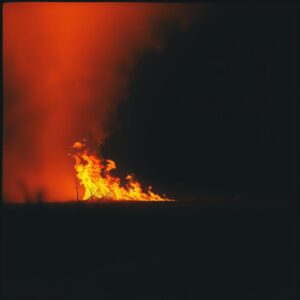
In good news, the raw number of American wildfires is going down in recent years. An AGU study published in April found about 28% fewer Western wildfires over the past three decades. But Dmitri and his co-authors say threats from wildfires are “escalating” – not in the raw NUMBER of wildfires, but their intensity and the amount of area burned. This AGU Press Release “Western U.S. wildfires have gotten less frequent, though larger” tells you more.
Western U.S. wildfires have gotten less frequent, though larger
My 2015 program “New Age of Super Fires” predicted larger more violent fires as the planet warms. Are we there yet, the new age of super fires?
Kalashnikov and colleagues warn:
“…the Western United States [is] one of the most susceptible regions to high-impact fires worldwide.”
SINCE THE MID-1980S, THE AREA BURNED ANNUALLY BY WILDFIRES IN THE WEST HAS INCREASED EIGHTFOLD
Kalashnikov works in the Abatzoglou Climate Lab at UCLA. In 2020, John Abatzoglou co-authored a study finding since the mid-1980s, the area burned annually by wildfires in the West has increased eightfold. That’s an incredible increase, hard to miss – eight times more land burned, trees converted to greenhouse gases, on a scale our parents never knew. Why don’t we talk more about this?
See: “Warmer and Drier Fire Seasons Contribute to Increases in Area Burned at High Severity in Western US Forests From 1985 to 2017” – Journal: Geophysical Research Letters (2020) Open Access
In the 1990’s, the US averaged about 3.3 million acres burned per year. Since 2000, that average has more than doubled to over 7 million acres per year. That is a doubling in a couple of decades. Could forest losses double again? Are there limits?
A SHORT LIST OF HEATWAVE INFLUENCES ON FIRE
Heatwaves can
* rapidly dry fine fuels, [flash drought]
* limit overnight humidity recovery and
* foster longer burn periods, and
* increase atmospheric instability that promotes plume-dominated fire behavior and rapid fire growth.
In addition, heatwaves
* may coincide with increased lightning activity, providing multiple ignition sources.
Heatwave days (including 5 days after) only account for about or about “12 to 15% of all warm season days (May to October)” – the authors find about 42%of all burned area during the warm seasons from 2001 to 2004 happened during or within 5 days after a heatwave. Extreme heat drives almost half the area burned in America’s biggest fire area – the West. They also find “heatwave season” is now three to five weeks longer than it was in past decades.
As the authors say in the paper, heatwaves are well-recognized threats to human health, energy supply, and ecosystems. Now we must add wildfires to this heatwave damage list.
COMING UP NEXT WEEK
Next week we dive into another hidden corner of climate change: extreme heat increases the risk of premature birth. If you are pregnant, or love someone who is, learn how this works with Dr. Coral Salvador in Bern. Florida TV Meteorologist Jeff Bernadelli talks recent extreme heatwaves. From California author and activist Mijin Cha has a plan: take over coal to wind it down, starting with the biggest mine in the world. Don’t miss it.
I’m Alex. Thank you for listening, and caring about our world.
Please don’t forget to help Radio Ecoshock keep this direct-to-you stream of science radio going. Listeners are our only support. Donate what you can here.
Thanks for all you do, Alex.
Another danger of extreme heat is the potential for major economic disruption. I hadn’t really appreciated this aspect until recently, but I noticed a mention of lockdowns in response to potentially deadly heat.
Lockdowns! Who can forget economies around the world grinding to a halt during the covid lockdowns. Will extreme heat force a repeat?
Then there are the power plants forced to either dial down or shut down altogether due to their source of cooling water simply getting too hot. Power outages at the very moment AC becomes a matter of life or death. Ugh!
Even more troubling, and this largely goes unnoticed, are the rapidly heating night time temps. After a long day of heat stress, if your body has no opportunity to cool off at night, then the next day’s heat becomes even more stressful. And the next day. And the next.
The forecast for the looming ‘monster’ El Nino grows ever more dire, they had to increase the y-axis again! If this event has the same effect that previous less robust events have had then we could see global average temps hitting 2.0degC above pre-industrial by next year(!). Even if that record is only temporary the overall effect will be catastrophic, and temps will stay elevated well above the current 1.5degC above pre-industrial level in the years to come.
Take all of the extreme weather we are currently enjoying and multiply it by at least an order of magnitude. Ouch!