Will we have yet another record fire year? – in the West, in Boreal Forest, in Europe & Russia? Explore little-known risks with new science. From VU Amsterdam, Max van Gerrevinke answers a hard question: are super-fires heating or cooling the planet? Then Professor Ben de Foy of Saint Louis University on ozone that burns lungs. Poking the inferno – to see what it’s made of – this is Radio Ecoshock.
Listen to or download this Radio Ecoshock show in CD Quality (57 MB) or Lo-Fi (14 MB)
Spain just hit record heat deaths for any May since records began. In New Delhi, India’s sprawling capital of 35 million people, thousands are dying in extreme heat. The Trump crew don’t want anyone to know. They are killing a world-valuable ocean measuring system, fully functioning and paid for, hauled out and junked. It is just another week in the crisis.
Across the Northern Hemisphere, a different fear lurks. As El Nino is born again in the Pacific, as long-drought covers some continents, fire danger is already high on the charts.
==================
ARE EXTREME WILDFIRES HEATING OR COOLING EARTH?
MAX VAN GERREVINK
In a hotter world, super wildfires are increasing. Obviously all those trees releasing carbon add to global warming. Obviously record smoke and land change from wildfires is cooling the world. Which is it? That question is harder than you think.

In March, Dutch scientist Max van Gerrevink published his findings titled “Climate impacts from North American boreal forest fires.” Now he’s published a follow up paper explaining why record Canadian wildfires are losing their cooling power. Max will defend his Doctoral Thesis “The influence of forest fires on climate” this coming October in the great hall at Amsterdam Free University, founded in 1880.
Listen to or download this 25 minute interview with Max van Gerrevinke in CD Quality or Lo-Fi
We begin with Max’s Open Access paper published March 3, 2026 in Nature Geoscience: “Climate impacts from North American boreal forest fires”. The authors find that wildfires may lead to more heating or cooling depending on where they burn. Wildfires in Alaska, burning in a drier soil environment, add more carbon than they reduce albedo due to landscape change. They are adding to global warming.
Conversely, further East wildfires in Canada’s northern Boreal forest create such changes to snow cover (more reflective snow for longer after the fires) – they can lead to cooling. Strange, but that is what an in-depth analysis of all factors finds.
One thing I don’t understand. We get cooling from more reflective denuded land in the far north, after a big fire. That might last how long – 70 years? But the great clouds of carbon released as forests burn – those warming gases last hundreds of thousands of years. Wouldn’t the warming factor be more important than any shorter-term cooling? I ask Max about that in the interview.
Before a fire: A dense canopy of dark green coniferous trees (like black spruce) acts like a dark t-shirt, absorbing the sun’s heat. Even when snow falls, it mostly settles under the canopy, hidden from the sun.
After a fire: The canopy is cleared away, leaving a wide-open, flat landscape.When winter and spring arrive, a fresh blanket of bright white snow coats this newly opened “burn scar.” Because there are no dark trees to block it, this pristine snow acts like a giant mirror, reflecting immense amounts of solar radiation back out into space rather than absorbing it as heat.
When a study refers to “climate-cooling fires,” it describes a temporary offset where open spring snow reflects more heat than the intact forest did. But as climate change drives earlier spring melts, northern wildfires are losing this cooling power and increasingly becoming a net-warming driver for the planet.
THE VERY LATEST ON WILDFIRE AND HEATING/COOLING
Max’s latest paper suggests the climate-cooling impact of fires is disappearing as a buffer against warming. The title is “Canadian wildfires are losing their climate-cooling influence from post-fire snow albedo.” That was published June 1st in the prestigious Proceedings of the National Academy of Sciences. Here they address those record Canadian wildfires of 2023.
Max says: “…in the last three years roughly 10% of the Canadian Boreal forest have actually burned”. 2023 emissions alone were comparable to emissions of India, it was like adding a new big industrial country to the world’s atmosphere.
Here is what the Press Release for this March study led by van Gerrevink says:
“Canadian wildfires and climate cooling
The climate-warming effects of Canadian wildfires are now less likely to be offset by cooling from albedo-related changes, compared with previous decades, according to a study.
In boreal forests, wildfires remove dark, low-albedo vegetation. Snow on the bare landscape is highly reflective, increasing the albedo of the area. Thus, the climate-warming effects of greenhouse gases released during the fires could be partially or fully offset.
Max J. van Gerrevink and colleagues combined historical fire records, satellite imagery, and machine learning to evaluate the impact from changes in albedo following the Canadian wildfires of 2023, which burned a large forest area. The fires released approximately 647 teragrams of carbon into the atmosphere. The authors found that the associated albedo changes created a climate-cooling effect of -3.41 watts per square meter over a 70-year period following the fires.
Although the fires produced a substantial cooling effect, the cooling impact of fire-related albedo changes has weakened by 29% since the 1960s. The weakening is likely due to decreases in snow cover and duration in recent decades. According to the authors, the findings show that wildfires in boreal forests are now twice as likely to produce a net climate-warming effect, compared with the mid-20th century.”
EUROPE RIGHT NOW
Europe and the UK just went through early heat waves. Amsterdam reached a high of 29 C or 84 Fahrenheit, which is way above average. What sort of climate do you expect in Northern Europe in ten or twenty years?In recent years, France, Spain, and Portugal all experienced an escalation in massive, highly destructive wildfires, during extreme heatwaves and prolonged droughts. According to Copernicus…
2025 was the most destructive fire season ever recorded in the European Union
Hardly anyone in North America knows that happened. Has anyone made assessments of their contribution to warming – or cooling? Max says recent European wildfires can be more damaging for humans because countries like Spain, Portugal or France are so built-up. Everything from long-standing olive groves and vineyards can be burned, but also homes, outbuildings and equipment.
However, from a global perspective, the warming effects of these fires (snow cover is not a huge factor) is far less a threat than from wildfires in Alaska and northern Canada. Those North American forests (and the soil below them) holds far more carbon than anything in Europe. From the global perspective, the big fires are the ones to study, Max says. Along those lines, I think a lot more could be done on wildfires in Russia, and climate impacts there.
========================
This is billionaire-free radio. Keep it going. Support Radio Ecoshock today. You can help keep my independent science reporting going. Please donate now here.
========================
WILDFIRES, OZONE, LUNG BURN
BEN de FOY

Oxygen we need, but it’s cousin ozone burns our lungs. Sure, regulations reduced ozone smog in many developed countries. But now it’s coming back with smoke from super wildfires. A new approach to science tracks the growing ozone factor. The paper is “Fires reverse progress toward ozone air quality standards in the United States” – published June 4 in Science. Pollution expert Benjamin de Foy wrote a helpful companion Perspective. Professor Ben de Foy is both teacher and researcher at the Department of Earth & Atmospheric Sciences at Saint Louis University.
Listen to or download this 18 minute interview with Ben de Foy in CD Quality or Lo-Fi
WILL FIRE BRING BACK SMOG?
Smog in Los Angeles in the 1970’s was legendary. You could not see the surrounding hills, with a brown smear in the air. With legislation, most of that was cleaned up by the year 2000. Similar progress with harmful air pollution appeared over most cities in the United States. Air quality improved. But this new study finds all those gains could be lost again – due to growing pollution from wildfire smoke.
Remember throughout this blog post and the interview, we are talking about “ground-level” ozone, or “low-level ozone”. When ozone is low enough for humans and other animals to breath it, bodies can be damaged – even to the point of early death. The same ozone (triple oxygen molecules) high up the atmosphere is our friend because it helps shield us from harmful radiation from the sun. Whether ozone is harmful or helpful depends on where it is in the atmosphere.
Here in British Columbia, we survived two weeks of dense wildfire smoke, staying inside, windows closed, with two HEPA air filters running day and night. We worried mostly about tiny particles that clog lungs and arteries but not ozone, which humans cannot see. (It turns out, because ozone is formed downwind away from the fire, our proximity to the burn zone possibly did not include dangerous amounts of ozone. Another study found there may even be reduced ozone right near the fire.)
Why would there be dangerous ozone in wildfire smoke? That is a question of atmospheric chemistry. Ben describes the process well in the interview. Essentially, wildfires do not directly release ozone (O3) into the air. Instead, they emit the raw ingredients that cook in the atmosphere to create ozone downwind. Because it forms in the atmosphere rather than being emitted directly from a source, ozone is classified as a secondary pollutant.
Because this chemical recipe requires time to “cook” as the smoke plume moves, the highest concentrations of wildfire-driven ozone are rarely found at the heart of the fire itself. Instead, they typically peak tens to hundreds of kilometers downwind, often impacting urban or rural areas that might otherwise appear to have clear skies.
REMEMBER, LOW-LEVEL OZONE IS ALSO A POWERFUL GREENHOUSE GAS
The formation of ozone downwind also raises heating. Tropospheric ozone is the third most important anthropogenic greenhouse gas, outranked only by carbon dioxide (CO2) and methane (CH4). This has to be included when trying to calculate whether wildfires are, in total, warming or cooling the planet. We could call ozone an “indirect Greenhouse Gas” – a topic I hope to cover next week.
While CO2 can linger in the atmosphere for centuries, tropospheric ozone has a short atmospheric lifetime – typically a few hours to a few weeks. Because it breaks down quickly, it doesn’t distribute evenly across the globe. Instead, ozone concentrates in regional “hotspots” downwind of major industrial areas, urban centers, or intense wildfire zones. Consequently, its warming effect is highly variable, exerting intense regional climate forcing rather than a uniform global squeeze.
LOSING DECADES OF AIR CLEAN-UP
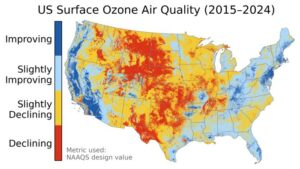
Until 2013, the number of Americans dying prematurely from surface ozone pollution was going down. Since then, ozone pollution driven by wildfire smoke rose 46% according to this in-depth study by Deng and colleagues.

Lead Author Weizhi Deng, University of Iowa
In the new paper, we find a map titled “US Surface Ozone Air Quality (2015-2024).” There are surprises. Despite very large wildfires in Western states like California, Oregon and Washington – air quality for ozone is less affected, and the same for New England. The places with the worst low-level ozone increases run from North Dakota down to Texas It’s the interior of the country.
In de Foy’s Perspective article – expanding on the paper by Deng – Ben writes: “there has been an increase in wildfires around the world since 2015, caused in part by increased agricultural burning and climate change.” Other sources find the number of wildfires has not increased since 2015, and global emissions from agricultural burning have declined. That is in a study published in November 2025 in Environmental Research Letters.
A September 2025 paper in Science suggested, quote “extreme wildfires in the west actually reduce fine particle concentrations in the eastern US by an amount comparable to the increases that they cause in the west”.
An overview at clarity.io finds:
“Global burned area from wildfires has declined over the past two decades, largely due to land use changes. At the same time, climate change is driving more intense, longer-lasting, and widespread fire seasons in many parts of the world.”
Ben explains atmospheric chemistry is difficult and still in a period of development. Critical issues are not settled, with different findings emerging. We can’t just recreate a test atmosphere in a lab. The real swirl of chemicals, energy, and even organisms aloft is much more complex. In a private email Ben told me: “In experimental physics or chemistry you can often control your experiments and get certain results. The atmosphere is a noisy place, and you often have to deduce the most likely explanation from partial data.”
INTRODUCING ABDUCTIVE REASONING
This is why, as found in the Deng-led paper, the authors employed a new type of scientific reasoning: “abductive”. Most science depends on deductive reasoning (draws conclusions from a general rule) or inductive reasoning which draws a general conclusion from multiple observation. But here, with artificial intelligence scanning massive patterns of data too large for human brains, new patterns emerge which point to specific causes. Collected observations (even hourly) of air quality (mandated long ago) revealed a surprising increase in ozone. Mass data revealed that only wildfire smoke could be causing a big change in ozone on a continental scale.
This exemplifies one of the new aspects of doing science in the age of artificial intelligence: abductive reasoning, which makes inferences to the most likely explanation. This is in contrast with deduction, which draws conclusions from a general rule, and induction, which draws a general conclusion from multiple observations. De Foy’s article does a much better job of explaining the three types of reasoning – and why abductive reasoning may help new waves of scientific understanding.
In the interview, de Foy cites learning from this paper “Fire heat affects the impacts of wildfires on air pollution in the United States,” published in Science in September 2025, by Qihan Ma et al. This study looks at an often-ignored physical variable: the massive thermal energy (heat) generated by the fires themselves, rather than just the smoke particles they emit. You see, there is still discussion in the field and much more to be known.
CANADIAN WILDFIRES BRED MORE OZONE
In 2023 and 2024, wildfires in Canada went wild. In just 2023, the area burned was over seven times the historical average. We’ve been waiting for more science on what that means, not just for Canada, but for millions of Americans.
The Press Release from AAAS says: ”Deng et al. examined O3 emissions from 2022 to 2024, a period marked by extreme fires and smoke in Canada. Results showed wildfire emissions alone exposed 43 million people to unhealthy levels of air pollution, in excess of the United States’ O3 air quality standard of 70 ppb.”
We tend to think of wildfire smoke impacts like elderly people with breathing difficulties. But a 2022 study found lower test scores in schools exposed to wildfire smoke. Could wildfire smoke be affecting intelligence and performance across the board, in everyone exposed to it?
WORST SMOG IN WORLD RIGHT NOW: NORTHERN INDIA
Deadly pollution in big cities has improved in China, but apparently not in India. Delhi is suffering deadly pollution now before the Monsoons. Analysis from air monitoring stations across Delhi finds ozone well above national and international health standards. Last year, Ben de Foy studied Asian smog – so I ask him about drivers behind the recent heat/smog emergency in North India.
See: “Ground-level ozone becomes a worry point for city” June 2, 2026 in Time of India
Looking up the health impacts of ground-level ozone is pretty scary. People can lose breath, or pass away with other conditions. Repeated bouts of ozone smog can leave lasting damage to our lungs. Ozone is a chemically unstable molecule made of three oxygen atoms. When it enters the respiratory tract, it immediately tries to stabilize itself by stealing electrons from the cells lining your airways. By the way, ground-level ozone is also very damaging to plants.
Ground-level ozone is especially serious for people with existing lung conditions, but also children (who breathe more air per pound than adults) and outdoor athletes (who are cycling more ozone-laden air in and out…) Why is the low-level ozone threat almost unknown to the public?
===================
WORLD-CHANGING AMOC COLLAPSE in simple words
JEFF BERARDELLI
The prognosis for carbon-burning disease is clear. The world gets hotter and hotter, which changes everything. But there are exceptions. One of those changes: ocean circulation in the North Atlantic could weaken or fail. Then Iceland, Ireland, the UK, Scandinavia and Northern Europe go into a deep freeze while the rest of the world battles heat. Like a mini ice age, a failing AMOC would be a climate change bigger than our imagination.

Jeff Berardelli explains AMOC and that strange future very well. Jeff is the Chief Meteorologist and Climate Specialist for WFLA-TV, the NBC affiliate station based in Tampa, Florida. After decades on the air, Berardelli has become loud about climate change, but patient in explaining it. In the show you hear eight minutes of Berardelli taking us from zero to full throttle on what AMOC means.
Jeff begins with a simple explanation of AMOC. Many of you already know about that. But I think this is still useful, because Jeff is skilled in putting all this in a story anyone can understand. We can learn from that and pass this critical information on to others. The Berardelli brings us up to date on the latest thinking, how serious this could be, and possible time-frames for a large-scale change in global ocean circulation.
===================
I’m Alex Smith. I truly appreciate your brain-time, keeping up with reliable news from the best minds of science – direct to you on Radio Ecoshock. Let’s meet up again next week.
Thanks for all you do Alex! Just a quick observation about ground-level ozone, not just harmful to humans, but at sustained high levels it also damages vegetation.
Your favorite chatbot can probably tell you more, but my admittedly limited knowledge is that it forces plants to close their pores, or otherwise somehow messes with photosynthesis on a really fundamental level.
Note that I said ‘sustained’, ground-level ozone disperses in the atmosphere fairly rapidly, so you really do need something like a big cloud of smog covering a large area to start doing real damage.
I recall a blog during the ‘peak-oil’ days, a woman would wander the forests of the east coast USA and take pictures of individual wilted leaves. Then she would post extensive links and excerpts from studies on the harmful effects of ground-level ozone and proceed to start screaming about how the world’s forests are “ALL DYING!!!”.
Ah, the good old days…
Really good song at the end. AI can make good music after all.