Why was the American West hotter than anyone’s seen, hotter than even Doomers believed possible? Explore historic March heat with the weather-master, meteorologist Jeff Masters and large systems specialist Deirdre Des Jardins. Why is climate splitting into blocks?
When summer comes in winter – is that a problem? In a flood of bad news, with hurting minds and sore hearts, we can’t let this pass. Deirdre Des Jardins uses AI to discover a chain of forces from the hot Pacific, through Hawaii floods right to the Western heat dome, disappearing snowpack, and prospects for this summer. Science and news confirm a regime shift in the atmosphere, popping up around the world. Are you ready for the big truth?
I’m Alex Smith. Welcome to Radio Ecoshock.
Listen to this Radio Ecoshock show in CD Quality (57 MB) or Lo-Fi (14 MB)
HISTORIC HEAT DOME IN THE WEST
JEFF MASTERS
As bombs and institutions fall, who can think about climate change? The trouble is: human troubles operate in the real world. We fight and fail as thousands die in heat waves and super storms. Climate is not the background, it is the only ground.


Why did seventeen states of the American West get summer in March? Was the U.S. heat dome related to floods in Hawaii and Canada? What just happened here? If you want the true record, you want Jeff Masters and friends. One of the original NOAA Hurricane Hunters, meteorologist Jeff Masters co-founded the Weather Underground and now contributes to Yale Climate Connections.
Listen to or download this 21 minute interview with Jeff Masters in CD Quality or Lo-Fi
Jeff’s recent piece at Climate Connections (along with Bob Henson and Christopher Burt) is titled “Mind-blowing March heat wave crests.” That was published March 23, 2026.
Mind-blowing March heat wave crests; records melt from Arizona to Minnesota
When you watch an animation of the heat wave in the atmosphere over 6 days, the heat began in the Pacific Ocean, mainly west of Baja California Mexico. It then curled up over California and poured out into the entire West of the Rockies. The swirl dragged a wave of cooler wet air over B.C., the atmospheric river. It began as an ocean heat wave in the eastern north Pacific.
A dominant, persistent, and record-breaking heat dome.This satellite animation shows the evolution of the ridge over the last 6 days.
— Dakota Smith (@weatherdak.bsky.social) 2026-03-22T19:15:46.794Z
The impact of this extreme heat over Mexico is less reported in the news. But records were set, no doubt natural systems were affected, and humans felt summer heat in March – which is unsettling and causes worry for the summer to come…
Weatherman Jeff Berardelli calls this March heat an event
“…without precedent, one meteorologists simply didn’t think was possible.”
It was 85 in Denver – 29 C in winter, in the “mile high” city. This heat dome arrived as the Western States endured a long, long drought. I was surprised to find that heat, not lack of precipitation, is driving U.S. droughts. That was in NOAA research published November 2024. We now see that simple greenhouse warming leads to more drought years, a drying of the West.
SEE: “Record-shattering March temperatures in Western North America virtually impossible without climate change” March 20, 2026. And in last week’s Radio Ecoshock show (posted April 1st) you can hear selections from the press briefing “Virtually Impossible Heat” & the Future of the American West”.
NEW SCIENCE OF THE LONG DROUGHT
Unless we slash fossil fuel burning, one study found a 1-in-6 year return rate for western drought by the end of this century.
“... droughts like the 2020–2022 event will transition from a one-in-more-than-a-thousand-year event in the pre-2022 period to a 1-in-60-year event by the mid-21st century and to a 1-in-6-year event by the late-21st century.”
Check the paper “Anthropogenic warming has ushered in an era of temperature-dominated droughts in the western United States” Yizhou Zhuang et al. Science Advances November 6, 2024.
SEE ALSO: “Increasing prevalence of hot drought across western North America since the 16th century”
Karen E. King et al. Science Advances January 24, 2024
MEANWHILE: HAWAII FLOODS AND CANADA’S WET COAST
In mid-March 2026, back-to-back Kona lows delivered some of the worst flooding Hawaii has seen in decades. With feet of rain some islands got widespread flash flooding, destructive winds, evacuations, rescues, and major infrastructure damage.
Rainfall totals were extraordinary. The National Weather Service reported at least 5 to 10 inches across most islands, 15 to 25 inches in parts of Maui and the Big Island, and locally more than 30 inches; NASA likewise reported totals above 30 inches in some areas and noted that all four official climate sites broke daily rainfall records. The wind also became destructive.
Kona lows themselves are not unusual in Hawaii, especially in the winter months. These low-pressure systems usually form in winter and bring heavy rain and strong winds. The storm type is part of Hawaii’s meteorology. What made March 2026 unusual was the intensity, persistence, and scale of impact: repeated record rainfall, major flooding across multiple islands, and impacts described by several outlets as the worst in decades or more than 20 years.
AND THEN TO CANADA’S WEST COAST
A prolonged and unusual atmospheric river hit British Columbia’s coast starting around March 15-16, 2026, bringing heavy rain, high winds, and snow to areas like Vancouver Island and the South Coast. The intense, multi-day deluge continued through at least March 19, 2026, triggering widespread flood watches and breaking rainfall records. Over 200 mm of rain was reported in some coastal areas, such as Kennedy Lake on Vancouver Island, according to CityNews Vancouver.
THREE PHENOMENA – RELATED?
The focus of both our guests this week: how does the flooding rain just north of the heat dome relate? It turns out we are looking at just one giant weather event/climate event with two sides. One is flooding wet and cool, the other is super hot and drought dry. It all depends on which side you are on.
We have three more or less concurrent events: the Western US Heat Dome, the “Kona” storms in Hawaii, and the atmospheric rivers hitting B.C. – all in the period March 11 to 20th.
* The Kona storms are related to the heat dome. (could be considered one event)
* The B.C. atmospheric rivers are related to the heat dome. (could be considered one event)
* The Kona storms may or may not be directly related to the B.C. Atmospheric Rivers. They could be separate storm systems but Jeff Masters finds they are connected. We know both are exaggerated by the abnormally hot Pacific Ocean and evaporation.
Can two things can be related to the same thing, but not to each other? They are more like step-sisters, having the same mother in the hot Pacific.
JEFF MASTERS’ PREVIOUS APPEARANCE ON RADIO ECOSHOCK
Thousand Year Storms
Posted on November 5, 2025 – Jeff Masters on hurricane Melissa.
=======================
WHAT CAUSED LONG WEIRD HEAT IN WINTER?
DEIRDRE DES JARDINS
When summer comes in winter, we are in big trouble. It happened this year in the American West and Mexico: hot summer days in Denver and over 100 degrees – 38 C in Phoenix. We are just beginning to understand how this happened and what it means. Is winter broken?
Over the last 16 years, Deirdre Des Jardins studied science and tech on California water issues and climate change. As giant heat domes appear across the world, Deirdre explains this latest out-of-season heat blister in her blog. She is the Director of California Water Research.
Deirdre Des Jardins previously did research on nonlinear dynamics and complex systems theory at NASA Ames Research Center, the Center for Nonlinear Studies at Los Alamos National Laboratory, and The Santa Fe Institute for Complex Systems. Now she’s here with analysis of the strange weeks of summer in March and the long drought in the American West. Her two blog posts, loaded with scientific references, have drawn national attention.
Listen to or download this 29 minute interview with Deidre Des Jardins in CD Quality or Lo-Fi
In this interview we discuss Deirdre’s two wonderful blog posts on the Western Heat Dome. They are
Part 1: The Diabatic Engine Behind March 2026’s Record-Shattering Western Heat Dome
March 17, 2026 in blog California Water Research.
The Diabatic Engine Behind March 2026’s Record-Shattering Western Heat Dome
Part 2: Why the Ridge Keeps Coming Back: The Structural Shift Behind Western Heat Domes
California Water Research, March 19, 2026.
Why the Ridge Keeps Coming Back: The Structural Shift Behind Western Heat Domes
Meteorologist Jeff Masters pointed out these two blog posts. The first kind of asks “Why did this crazy heat dome happen?” As always, answers are not simple, but not impossible. We start with a stumbling block in her first post title: “The Diabatic Engine Behind March 2026’s Record-Shattering Western Heat Dome”. I looked up the word “Diabatic” but Google automatically substituted “diabetic” the disease. Few people know what “diabatic” means.
After a ton of research to educate myself, we can say: in the context of the atmosphere, “diabatic” is just a science word for any process that adds or removes heat from a parcel of air. Actual heat is added or subtracted. It comes from somewhere or goes somewhere.
That is different from “adiabatic”. In an adiabatic change, the temperature of an air parcel might go up or down – but not because of any outside source. For example, it you compress air it become hotter. Deirdre’s blog post concerns heat exchange in the atmosphere, as part of larger circulation systems.
The first blog post reveals a common misunderstanding about how we are changing the climate. We think the Sun’s rays bounce around in the air, and that is why it is hotter. It turns out we are changing the way water works in the atmosphere. Water vapor is essential to heat in the atmosphere.
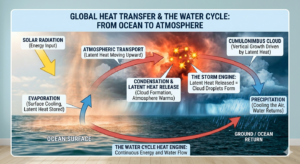
This is not the place for a grand exploration of the water cycle. The simple facts we need: it takes a lot of heat/energy to make water change from liquid to a gas (evaporation absorbs heat). That gas rises, encounters cooler air aloft, and reverts to a liquid form in clouds (and then rain or snow). When water vapor coalesces into liquid form, the original heat used in evaporation is released again. Making rain adds heat to the atmosphere. That is why thunder clouds rise higher into the atmosphere, they are warmed by condensation.
Deirdre finds a string of science showing that added atmospheric heat could be transferred to adjoining systems. New heat from the Kona low and the B.C. atmospheric rivers could add to warming further south, leading to very abnormal western heat in the U.S. It is not quite that simple, but that is how I understand it. Essentially, the “heat” from the storm wasn’t just a side effect; it was the fuel that built the “heat dome” (the blocking ridge).
——————————
THE MISSING SNOWPACK
ANOTHER DRY SEASON IN THE WEST
Deirdre gives us an update on the snowpack in Western mountains after this ferocious heat. It is part of her on-going work for some years: the impact of early heat on snowpack needed for summer water in Western states. Mountain snow provides delayed water needed for western rivers like the Colorado. You cannot overestimate the immense economic and human values dependent on that water. It is not going to be there this year.
In her blog post, Deirdre writes:
“The impacts of this heat dome extend well beyond uncomfortable temperatures. Western snowpack, the natural reservoir that provides up to 75% of the region’s freshwater supply as it melts through spring and summer, was already at or near record-low levels before this event began.
The NOAA National Integrated Drought Information System reported on March 12 that every major river basin and state in the West is experiencing a snow drought. Colorado reported record-low statewide snowpack as of March 8. The Colorado River Basin, the water supply for 40 million people, has record-low snow water equivalent. Some California SNOTEL stations had already lost all their snow by early March, with Tahoe City Cross melting out 40 days earlier than the long-term median. Snow cover across the West on January 4 was the lowest in NASA’s satellite record, which dates to 2001.”
In addition to agricultural failures and water stress for cities like Phoenix, the big dry in the west probably means another mean fire year in the West. That could again lead to polluted smoky air in the East Coast cities as well.
Everybody in the West is nervous about wildfires this year. The first one in British Columbia sparked up on April 6. It was near Lytton B.C. – the site of Canada’s all-time heat record on June 29, 2021 (almost 50 degrees C, 121 F.). Most of Lytton burned to the ground one day later. It is not rebuilt after five years. I have more on the fire risk below.
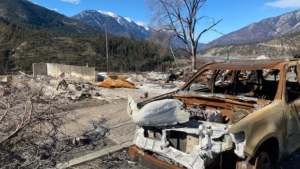
All in all, the continent was running two different seasons simultaneously, separated by a few hundred miles. The winter of 2025-26 split into two different versions: snowy and cold in the East but warmer and snowless in parts of the West.
COMPARISON TO THE 2021 NORTHWEST PACIFIC HEAT DOME
Deirdre writes:
“Oertel et al. (2023), in a paper aptly titled “Everything Hits at Once,” showed through ensemble sensitivity experiments that anomalous rainfall in the western Pacific triggered a cascade of weather events across the basin that built the extreme ridge over Canada.” Here is that paper.
Geophysical Research Letters Open Access
TO AI OR NOT AI?
Deirdre used Artificial Intelligence as part of this analysis. In her blog she says: “Claude Opus 4.6 (Anthropic) contributed to this analysis through iterative analysis of synoptic patterns and literature review.” In the interview, we talk about the ways independent researchers can use AI to do more than was possible a year ago. It is like hiring a couple of PhD level assistants.
We also know every citation has to be checked for “hallucinations”. Plus, human brains need to keep on working or lose capacity. There are many advantages and a few pitfalls to using an AI assistant.
Then there are the MAJOR new emissions and other environmental costs to massive data centers used for AI. Deirdre is aware. She decided to off-set the increase in AI-related emissions by stopping streaming services on cable or the net. When we watch on Netflix, more polluting servers are working there too. At the moment, we can make choices?
===============================
ALEX HAS WILDFIRE WORRIES
Are we entering a summer of wildfires like never seen before? The high risk is there, and wildfires are burning out of control in parts of America right now – way before the season starts. A new study published March 11th says climate change, even at supposedly low levels now, is turbocharging what they call “wildfire weather”. This dangerous change is not limited to North America by any means.
World Weather Attribution analysis published on February 11, 2026: “Climate change fuels the destruction of world’s oldest trees.” It examines the January 2026 wildfires in Chile and Argentina and finds that climate change made the key fire-weather conditions about 3 times more likely in Chile and 2.5 times more likely in Patagonia.
A team of ten scientists combed through data from the last 40 plus years. Their conclusion: “We find that the observed increase in extreme fire weather bears a clear externally forced signal, detectable at 99% confidence above natural variability and attributable to human-induced climate change.” Look for the paper “The emerging human fingerprint on global extreme fire weather“.
Wildfire also feeds back, making the planet warmer, engendering more fires. For me, the greatest fast feedback comes with peat fires. Peat is a buildup of plant matter over thousands of years. On this planet, that has become a major reservoir of carbon. We advanced another step in warming with peat fires in Russia in 2010. Peat fires in Indonesia in 1997 and ’98 pushed that developing country into the third largest source of greenhouse gases in the world.
A new study, published March 18, 2026 says “Peat fires contribute disproportionately to Siberian fire carbon emissions”. Peat fires can burn deep into the ground, continuing under winter snow and re-igniting land plants the following spring. Far beyond any human fire-fighting capability. we may soon encounter fires lasting years or decades into the future.
The only solution is to drastically slash carbon emissions and hope for a way to draw carbon back out of the atmosphere. Recent science suggests the best way is not another machine but protecting natural sinks, like the great rainforests of South America and Africa. To survive, we need to help nature not kill it. We were always just a part of the family of life here. Look after your wild relatives of all species. They will help us – and only they can.
WEATHER TOO CRAZY EVEN FOR AUSTRALIA
One final word for Australian listeners: yes we see you! In a place known for wild weather, the last few months has been crazy down-under. Sure Sydney has some doozy storms and strange temperature swings. But Western Australia takes the prize. They hit up to 45 degrees C heat and then suffered through Cyclone Narelle. That cyclone hit northern Queensland, bounced along the north coast all the way to the west coast. It struck, appeared to be over, went out over hot seas, reformed – and returned stronger than ever. This storm lasted almost two weeks! Imagine a hurricane lasting weeks, crossing a whole continent. The shoreline with it’s turtles and creatures was devastated. Then the petrol and diesel ran out in Western Australia due to fears of the Gulf War blockage. Spare a little feeling for our friends in Australia.
A TIME OF SUSPENSE
People in many countries are in a state of suspense. Will ships get out of the Persian Gulf? How badly are ports, storage tanks and refineries damaged in the Gulf producer states? Will that create a time-lag of new energy shortages and new economic shocks, even a couple of months from now?
Will gas run out or get too expensive for most of us? What industries will close? What parts and food just won’t show up? It is time to stock up if you can. Next week I’ll tell you how I got food insurance on a low budget – prepping while poor.
Spend time with family and friends. When the big system tries to break our hearts, we need to build community stronger. That sounds trite, but is still real.
I’m Alex. Thank you for listening this week, and caring about this world.
SONGS IN THIS PROGRAM
“Rotten at the Top” lyrics by Alex Smith, AI music, Creative Commons License (free for any non-profit use)
“Busted Trust” lyrics by Alex Smith, AI music, Creative Commons License (free for any non-profit use)