Forget conspiracy. Contrails are real and dangerous to climate – from Sweden’s Chalmers University of Technology, Dr. Daniel Johansson. While thousands died of heat in Europe in 2003, a marine heat wave ripped the North Atlantic. From Germany, Dr. Karl-Michael Werner, of the Thünen Institute of Sea Fisheries in Bremerhaven. Meanwhile, the Pillars of Wealth remain oblivious at Davos. Full speed ahead, fossil fuel for a hot militarized world.
This is Radio Ecoshock. I’m Alex Smith.
Listen to or download this Radio Ecoshock show in CD Quality (57 MB) or Lo-Fi (14 MB)
For a while, it seemed like money power got it. We are heading over the precipice of climate change and the limits of nature. Just six years ago, the chief executive of the world’s largest pool of wealth, Larry Fink, promised at Davos to transform finance away from fossil fuels. Banks in many parts of the world made commitments, weak and gradual, but promises to stop fueling disaster with more investments. Most of the Green Funds and green plans have been ditched. It’s every country for themselves, announcing emergency action – fossil fuels for nation-building, national defense, and even new colonization.
CLIMATE NOT SEEN AT DAVOS 2026
In the show you hear a short clip from New York Times reporter Davis Gelles on Davos, January 2026. See NYT: “Why Climate Isn’t a Top Business Priority at Davos” January 22, 2026
“The World Economic Forum in Davos, Switzerland, was once ground zero for an unofficial climate movement in the business community. David Gelles, a climate reporter for The Times, describes why climate is no longer a key focus in Davos today.”
With executives and the richest of the rich in attendance – Elon Musk presented – Davos previously featured whole sessions on meeting the climate challenge. This year, I found only Trump’s obsession with wind mills and this short clip from Swedish scientist Johan Rockström:
“With the three sources of scientific evidence that proves that we now have overwhelming evidence of the need to transition the global economy within prosperity, within planetary boundaries.
The first one is that the human pressures on the planet has now reached a crisis point. The era where we can continue with economic growth without putting the stability of the planet at risk has come to an end. Welcome to the Anthropocene.
The second is that these pressures on the planet are now at risk of causing irreversible, potentially catastrophic tipping points that would irreversibly drift away from the life support we depend on.
And the third is that we are now understanding, for the first time with scientific evidence, that our world economy depends on the extraordinary stability of the Holocene. We leave the last ice age 18,000 years ago and enter what you see here, this extraordinarily stable 12,000 year, which is a 14 degrees Celsius global mean surface temperature with a maximum variability – can you imagine? – a plus or minus 0.5 degrees Celsius, – which gives us the corridor of life that is the basis for all our life support.”

That was it. Johan Rockstrom – almost from another room, trying to pierce curtains of willful blindness in the men, mostly men, at the top of the money machine. Climate? This is no time for climate. There is gold to seize, weapons, castles, and monuments to build.
Scientists that still have funding continue observations and calculations. The whole environment is changing with us inside it. It is difficult to keep up. Some under-reported tidbits follow this week’s guests.
RADIO ON AIR – THE PLANE TRUTH
Let’s take to the air. Business Insider tracked 157 private jets arriving near Davos as billionaires and world leaders flew to the Swiss Alps for the World Economic Forum’s annual meeting. It was the busiest travel week in Swiss history. According to Greenpeace, the number of private planes this year was ten percent more than last, and triple the number in 2023. So let’s investigate what those planes leave behind in the atmosphere.
CONTRAILS, PLANES AND CLIMATE
DANIEL JOHANSSON
Here is a puzzle for you: flying causes 2.5% of global carbon dioxide emissions. But it adds about 4% to global warming. Why? Planes also create contrails and high clouds that add to warming. Yes THOSE contrails – doing the opposite of the “chemtrails” conspiracy theory. Is there an opportunity here to reduce warming impacts from all our flying around?

Our guest Daniel Johansson is lead author of the paper “The social costs of aviation CO2 and contrail cirrus,” published in Nature Communications. Daniel is associate professor at the Department of Space, Earth and Environment at Chalmers University of Technology. Chalmers is highly rated, kind of a Swedish MIT.
Daniel’s web bio says:
“Daniel Johansson has worked in the field of climate-energy-economic analysis and integrated assessment modelling for about 20 years and has written about 50 peer-reviewed articles and other research papers. His research has covered many different topics such as climate stabilisation scenarios, emission metrics, statistical estimation of climate sensitivity, fuel markets, negative CO2 emissions, food vs fuel, climate impacts of aviation, the role of autonomous vehicle in the future transports system etc.”
Listen to or download this 24 minute interview with Daniel Johansson in CD Quality or Lo-Fi
Aviation accounts for 2.5% of global CO2 emissions. But it has contributed around 4% to global warming to date because of warming from other parts of the exhaust leading to those wispy white clouds following planes – contrails.
What are contrails? The paper says:
“Contrail cirrus is formed when hot and moist aircraft exhaust meets ambient air that is cold and humid enough. In the formation process exhaust water vapor condenses on particles originating primarily from soot in the aircraft exhaust. For the contrails to remain in the atmosphere for more than a few minutes, the air must be ice supersaturated. Under such conditions, atmospheric vapor continues to deposit on the ice nuclei. Eventually, the cloud sublimates. Persistent contrail cirrus has atmospheric lifetimes on the order of hours.”
In the interview, we approach some misinformation about contrails and climate change. Previously on Radio Ecoshock (years ago) guests debunked theories that hidden global governments were already practicing “solar radiation management” by spraying chemicals out of specially equipped planes, or something. It turns out contrails – created by common aircraft exhaust in particular atmospheric conditions – do the opposite of what conspiracists claim.
We were told clouds generally help cool the surface by reflecting solar energy back into space. Daniel Johansson explains why a high cirrus cloud stimulated by passing aircraft can create more warming than cooling. This is important!
The Introduction to the new paper says: “…contrail cirrus, which currently has an effective radiative forcing (ERF) comparable to that of aviation CO2.” That is a big statement. Half of aircraft-induced warming is from contrails and not burning fossil fuels? If true, the authors say, it would be worthwhile to re-route some aircraft from contrail-prone areas. That would save on warming – even if slightly more aircraft fuel was burned to do it! This may be something airline companies are looking at. No doubt they will then say it makes aircraft travel greener, even as the planet continues to heat…
This paper by Johansson and colleagues also converts aircraft pollution into economic damages. Check out this Press Release from Chalmers U. in December 2025: “Contrails are a major driver of aviation’s climate impact”. It’s all laid out for you there.
I worry a move to avoid contrails might decrease action to reduce mass air travel. Given current weather disasters and scientific predictions, I think we need to slash air travel to a tiny fraction of today’s busy skies – at least until a clean source of energy for flight can be found. Could efforts to control contrails delay fundamental emissions reductions?
METHANE VS CARBON DIOXIDE
Last January Daniel co-authored an article asking a difficult question: “Should Climate Policy Focus More on Methane or Carbon Dioxide?” In the interview we cover warming from methane compared to carbon dioxide in the atmosphere. That is not easy to figure out.
The authors say
1. there is no really good way to compare the warming from the two gases, due to not only differences in lifetime, but different shapes of the pulse of warming and
2. “...no value for the time horizon is objectively correct – subjective choices, laden with value judgments, must be made.”
It sounds strange to hear methane could be emitted “in perpetuity”. My understanding: adding carbon dioxide is cumulative, so if we add another 100 tons we make the world warmer. But methane dissipates fairly quickly, going to half power in about 10 years. So there could be a state where humanity continues to add 100 tons a year of methane, but another 100 tons has decayed, so we just get the 100 ton warming but no more. That should create a balanced state – warmer than before – but not getting hotter. That’s what I get out of it – but check out what Daniel says in the interview.
If I understood this work, the later we leave emissions controls, the less relevant methane control becomes compared to CO2. It may be more economically effective to invest in methane control now, as we reach 1.5 degrees C of warming – but maybe not at 2.5 degrees C of warming, for example. The hotter it gets, the more critical carbon dioxide control and, if possible, removal becomes.
====================
ANOTHER TIPPING POINT IN THE REAR-VIEW MIRROR
KARL-MICHAEL WERNER
You know about tipping points – where natural states enter unstoppable change. From disappearing glaciers to ocean current flips, tipping points keep scientists up at night. We may not know critical change happens except in the rear-view mirror of time. Here is such a hidden case.
In 2003, tens of thousands of Europeans died in a heat wave beyond anything seen before. We did not know the same heat wave killed and changed ocean life in the North Atlantic. This single event changed everything from tiny crabs to giant whales. Marine heat waves are getting bigger, hotter, and longer as we heat up the world. Could another defining marine event be on the way?

We go to the new paper “Major heat wave in the North Atlantic had widespread and lasting impacts on marine life”. The Lead Author is Dr. Karl-Michael Werner, research scientist at the Thünen Institute of Sea Fisheries in Bremerhaven Germany.
Listen to or download this 22 minute interview with Karl-Michael Werner in CD Quality or Lo-Fi
For a quick review, check out this Press Release for the paper “How a heat wave in 2003 has changed the North Atlantic until today”.
There remains a bit of mystery: “We found that more marine heat waves occurred after 2003, but they did not have a similar effect compared to the one in 2003” says Werner.
This is like European land deaths during 2003. At least 50,000 people in various European countries died in the heat. Then governments and the public were awakened to the new danger in places where air-conditioning was never considered. All sorts of heat safety programs were put in place and many fewer died in subsequent heat waves of similar temperatures. Did ocean creatures adapt to the marine heat wave? Were the most vulnerable killed off and replaced with organisms better able to cope with hot seas? I’m not sure we know yet.
The authors say in the Introduction to the paper: “…there is no clear understanding about whether MHWs of similar extent produce comparable ecological impacts.”
The Press Release says
“OCEAN LIFE OF ALL SIZES WAS AFFECTED from whales to single-celled algae. Arctic fish suffered while warmer water species like cod and haddock move north.
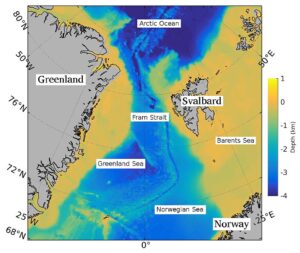
THE FRAM STRAIT was a theatre of action. This strait is the passage between Svalbard and Greenland. It is thousands of miles from the origins of the marine heat wave – but even two years afterward there were echoes of the 2003 heat event in the Fram Strait.
Meanwhile new species came north, ’where they abruptly changed the entire ecosystem from the sea surface to the deep ocean floor.”
CITED PAPERS INCLUDE:
“Ecosystem response persists after a prolonged marine heatwave.”
R.M. Suryan and many co-Authors Open Access
Published: 18 March 2021 in Scientific Reports.
In this paper, fisheries monitoring set up after the Exxon Valdez oil spill in Alaska in 1989 was used to assess impacts of marine heat waves. In fact “Ocean Station Papa”, about 1,000 miles (1,600 km) west of the coast of British Columbia, in the Gulf of Alaska, has one of the longest continuous records of oceanographic data in the world. It begins with a weather ship in 1949 and then a series of automated ocean sampling stations.
PROJECTIONS FOR MARINE HEAT WAVE BY 2100 ARE ONLY APOCALYPTIC…
“Marine heatwaves under global warming”
Published: 15 August 2018
Thomas L. Frölicher et al, Nature (paywall)
KEY POINTS
1. “MHWs have already become longer-lasting and more frequent, extensive and intense in the past few decades, and that this trend will accelerate under further global warming.”
2. There has already been a doubling in the number of days with marine heat waves since 1980. If the world warms to 3.5 degrees C by 2100, which is our current course, the area covered by marine heat waves would be “21 times bigger than in preindustrial times, last on average 112 days and reach maximum sea surface temperature anomaly intensities of 2.5 degrees Celsius.”
3. “Today, 87 per cent of MHWs are attributable to human-induced warming, with this ratio increasing to nearly 100 per cent under any global warming scenario exceeding 2 degrees Celsius. “
SEE ALSO: “Global warming drives a threefold increase in persistence and 1C rise in intensity of marine heatwaves,” by Marta Marcos et al in PNAS April 2025.
PAUL BECKWITH HAS A VIDEO on MARINE HEATWAVES
“Record Low Wind Speeds over Atlantic Ocean in 2023 Caused Massive Marine Heatwaves and Weather Chaos”. Paul is covering this important paper published June 4, 2025 “Drivers of the extreme North Atlantic marine heatwave during 2023” by Matthew H. England et al.
As a Canadian climate scientist, Paul says:
“So what happened to cause such enormous heat waves in 2023. In a new peer-reviewed scientific paper just published, there were record low winds over the northern Atlantic Ocean basis for large parts of May, June, July and August in 2023. This reduced the depth of water mixing across the ocean basin, so the surface layer gained more and more heat and exhibited larger and larger temperature increases. The warmer water, being lighter, meant that there was even less mixing, and the process jumped the temperature even higher, setting yet higher values. Lower winds also meant fewer waves and fewer breaking waves, which meant a lowering of the ocean albedo. Also, the lower winds meant fewer clouds and even more heating in a vicious feedback loop.”
SEE ALSO: See How Marine Heat Waves Are Spreading Across the Globe.
New York Times. By Delger Erdenesanaa (paywall)
AND
“Unprecedented heat in the North Atlantic Ocean kickstarted Europe’s hellish 2023 summer. Now we know what caused it.” The Conversation. Matthew England et al. June 4, 2025.
ALARM BELLS ON OCEAN HEAT WAVES GOING OFF ALL OVER THE WORLD
Look into marine heat waves and get blasted by news and science. This is much bigger than current wars and money worries. The largest part of the planet – the global ocean – is heating rapidly. Look at this stuff:
Record marine heat waves in 2023 covered 96% of oceans, lasted four times longer than average by Krystal Kasal, The GIST July 25, 2025
THE PAPER for this GIST article is:
Record-breaking 2023 marine heatwaves
Tianyun Dong et al. Dong and colleagues say…
“The year 2023 witnessed an extraordinary surge in marine heatwaves (MHWs) across Earth’s oceans, setting new records in duration, extent, and intensity, with MHW activity totaling 53.6 billion °C days square kilometer – more than three standard deviations above the historical norm since 1982. “
=======================
EVENT-DRIVEN CLIMATE CHANGE
The Werner et al. paper says:
“... it cannot be ruled out that the prolonged period of locally and regionally elevated temperatures helped sustain and reinforce the ecological reorganization following the 2003 MHW. This interpretation aligns with previous investigations, showing that repeated extreme events can limit ecosystem recoveries leading to persistently altered states compared to single disturbances “
This new science on the North Atlantic ocean heat wave of 2003 is part of new vision, and new capabilities entering climate science. We begin to have data and computer power to investigate particular incidents, events that may last only days with impacts that last years or longer. Some fast changes are irreversible.
This is part of a long-standing debate within science: uniformitarianism versus catastrophism. the founder of the theory of uniformitarianism was Scottish geologist and naturalist James Hutton in the late 1700s. His vision of slow change in rocks over times much longer than 6,000 years of the Bible revolutionized understanding of Earth’s history. It was then promoted by Charles Lyell in the 1800’s, who influenced Charles Darwin’s theory of the origin of our species.
Opposing the uniformists is the theory of “catastrophism”. It suggests Earth’s geological features were formed by sudden, violent, and short-lived events rather than slow, uniform processes. This view was raised by the French naturalist and zoologist Georges Cuvier in the early 1800’s. Catastrophism has a lot of friends on YouTube, but few in science.
Now short significant events are making a comeback. We don’t need to deny the importance of slow changes over long periods. We just need to add more science of particular spectacular events that leave irreversible changes in following time. The heat wave of 2003 is just such a case. It killed at least 50,000 people in Europe, but also many species in the sea. This may be the best-documented case of a combined heat wave on both land and sea. This is new to us.
===============
Radio Ecoshock News Bytes
* For the first time in human records, mosquitoes reached Iceland, previously mosquito-free. Too bad.
* While millions shiver in the Arctic vortex, unstable weather continues in the Southern Hemisphere. Wildfires in Chile displaced 50,000 people. The blaze was visible from space. Australia got through it’s first monster heat wave, followed by Cyclone Koji in Queensland. To be honest, was less extreme heat in the Southern Hemisphere overall this year than last – until this wild outbreak of record heat in South Australia end of January. Temperatures went to 49 degrees C (120 F in the shade!!). It was unbearable outside in Sydney, Melbourne and Adelaide. We know, day after day, more heat goes into the great southern ocean than comes out.
* Back in Europe, it is winter. Storm Harry battered the Mediterranean last week with floods in Italy, Spain and France. Earlier in January Storm Goretti has swept across the UK with exceptionally strong winds, heavy snow, and significant rain.
*North America just got wind chills of -40 in the U.S. Midwest – with Arctic temperatures and snow to the North East. Toronto Canada got its heaviest 24 snowfall ever! You all saw the bitter cold in Minnesota. Scientists disagree among themselves whether these incursions of the Polar Vortex are caused by climate change in the Arctic.
* This winter is a whole different story in the West. There is a “snow drought” in the West, except for coastal mountains. That may mean water shortages and wildfire conditions for the West this coming summer. Strangely, there has been no snow or ice outside my home in western Canada for the whole month of January. Folks are worried about trees budding too early and then getting caught in a late freeze. Winter? What winter?
* Canadian government forecasters predict 2026 will be another in the latest string of years far hotter than in previous decades. We will see what this new year brings.
* Insurance losses from natural catastrophes last year went over 100 billion dollars for the sixth year in a row, according to insurance giant Swiss Re. About 83% of those losses were in the United States. The 2025 fires in Los Angeles were the most expensive insured event in world history.
* Planned obsolescence. We heard it in the 1960’s – products designed to wear out or break, after the warranty expires. That keeps consumers coming back, return customers. Now with trillion-dollar new investments for more coal, oil, and gas, we get planned obsolescence for a civilization. People try to rebuild as fast as things break down, in wave after wave of natural instability. Until we can’t. Don’t tell the kids.
* Snatch what joy we can. Remember to treasure a “normal” day – old-style. Put love not waste into the atmosphere around you. We live on a truly magical planet.
I’m Alex Smith. Thank you for listening, and caring about this world.
Regards the methane greenhouse forcing:
Yes, the gas is relatively short lived
But, the removal mechanism is hydroxyl radicals, the abundance of which can also vary depending on climate
And, what are the by-products? Yes, that’s right, water and carbon dioxide!
So, probably best to use the ‘CO2 equivalent’ metric (CO2e), they’ve already done the math for you!