What does Trump’s push for more oil, gas and coal mean for our climate future? Alexis Normand, CEO of data firm Greenly adds it up: Texas, Venezuela, Greenland …Canada? An in-depth review. Plus: fossil decline has tipping points and economic land-mines. “Fossil energy minimum viable scale” with Joshua Lappen and Emily Grubert with a new warning in Science magazine.
Listen to or download this Radio Ecoshock show in CD Quality (57 MB) or Lo-Fi (14 MB)
AMERICA’S OIL GRAB – GEOPOLITICS AND CLIMATE
ALEXIS NORMAND

President Trump canceled two decades of American climate policy. At home he declared a National Emergency to bypass regulations and promote oil and gas. The Administration approved contentious pipelines while canceling major wind projects already under construction. Abroad Trump ordered the military to capture oil tankers on the high seas. How will re-fossilization of America impact climate change?
We can get answers – from the world’s first carbon accounting platform, Greenly. Alexis Normand is a founder and CEO. Greenly has a report called “How U.S. Energy Policy is Impacted with Trump’s Return to Office “. It includes developments in Greenland and Venezuela.
Listen to or download this 38 minute interview with Alexis Normand in CD Quality or Lo-Fi
AMERICAN OIL INDUSTRY – THE VIEW FROM EUROPE
The United States currently emits about 13% of greenhouse gases, but is historically responsible for about 25% of all the extra warming gases humans put up there. Here are a few tips from my notes on the Alexis Normand interview.
Alexis wisely points out Trump or the American Government can announce things – but really the price of oil determines investment, not regulations. Some of the talk is just talk.
Trump opened the Arctic National Wildlife Refuge (ANWR) to oil and drilling. Normand says if all oil and gas in ANWR was produced, that would at potential 3.8 billion metric tons of CO2 over lifetime of drilling in ANWR, and add 8 to 10 percent of current global emissions.
In the interview Normand cites Trump’s story-telling ability to get media, but the real “deciders” are investors and the market. Some energy announcements are just drama, Normand says, just to “entertain the crowd”.
Alexis says we are in a revolution where one system is dying, trying to rebuild itself. But green energy is cheaper and safer.
CURRENT STATUS OF OIL AND GAS ON GREENLAND
In 2010 and 2011, Greenpeace activists hung themselves from drilling rigs off the coast of Greenland. One of their many concerns is the fragility of the Arctic. It would be hard to cleanup should accidents occur. Shell abandoned their plans for Greenland drilling. According to OilPrice.com, “only around 15 offshore and 6 onshore wells have ever been drilled across Greenland, and none since 2011.”
In July 2021, the Greenlandic government officially banned all new oil and gas exploration. Although there is a ban on new licenses, the government honors legal agreements made before 2021. A British company 80 Mile PLC holds a previous license. With U.S. investment, 80 Mile plans two exploratory wells this summer of 2026. Perhaps Trump wants control of Greenland to overcome the local decision to ban oil and gas exploration.
Get views you won’t find in America media in this Greenly report released January 13, 2026: “Analysis: US’ pursuit of Greenland’s black gold sends the environment’s hopes up in smoke”
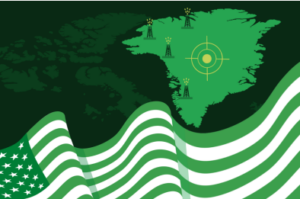
Image credit: Greenly
VENEZUELA
In 2019, Donald Trump imposed a “total economic embargo” against the Venezuelan national oil company PDVSA. As I understand it, after that unused heavy oil in pipes and pumps became clogged like asphalt. Over a hundred billion dollars of American investments were ruined. Now Trump insists U.S. oil majors should go back and rebuild all that, at their own expense.
Unless a few hundred billion more dollars are spent to rebuild and upgrade the Venezuelan production system, whether current shipments of heavy crude go to refineries in China or Texas won’t change global greenhouse emissions much. If that expansion does take place, we are in for more climate chaos.
AMERICA
Despite big climate talk and some green initiatives, the Administration of Joe Biden also went for “drill, baby, drill”. Biden approved thousands of new oil and gas projects, mostly fracking, on public lands. In fact, the new Greenly report finds Trump’s team has fewer drilling permits per month than Biden.
The best rock for oil and gas is the key U.S. Permian Basin, mainly in Texas. Oil and gas is getting harder and more expensive to get out of the ground. Do you think Trump is going after oil in Venezuela, and maybe Greenland ,out of fears of Peak Oil in the continental U.S.?
==================
ALEX ON NORMAND INTERVIEW
Trump and his backers are engaged in a transcontinental war against the climate.
By opening up protected Arctic lands to oil and gas drilling, buy enabling mass pipelines, through militarism to increase Venezuelan heavy oil, and his military threats to take Greenland’s untapped oil and gas, not to mention killing off clean energy wind and solar forcing continued fossil burning – all add up to a strike against climate hopes and the futures of our children, and all species.
Much of this fossil putsch is detailed in a new Greenly report “How U.S. Energy Policy is Impacted with Trump’s Return to Office” (not yet online, but viewed by Alex Smith).
All these actions to promote oil and gas over climate action might limit corporate profits, and with them, large funding of politicians. The U.S. military is already part of this process. We don’t know if there is a single plan and if so, who the planners are. Certainly this large coordinated series of actions is not coming from the brain of Donald Trump. He has no direct experience in the energy industry.
In his first Presidency, Trump made Rex Tillerson the CEO of Exxon/Mobile his Secretary of State from 2017 to 2018. Some initiatives like pipelines started in that period. But the Second Trump Administration “plan” is much broader. It includes military capture of the oil reserves of other countries, including both Venezuela and Greenland – so far. His threats to make Canada an American state may also be aimed at taking over billions of barrels in oil reserves in the Alberta oil sands. That is strange because American companies developed most of the tar sands with hefty government subsidies. They could have owned more, with amazingly low royalties, without an invasion.
HOW THE “GRAND PLAN” ACTUALLY WORKS
How should we see Trump’s oil geopolitics? Who is behind it? Rather than a single mastermind, this may be a networked project: fossil-fuel–aligned political appointees, national-security hawks, corporate lobbyists, and sympathetic think tanks work together to convert Trump’s impulses into multi-decade leasing plans, Arctic opening strategies, and leverage over foreign oil systems.
Trump’s role is lead actor providing political cover, and distraction. The operational vision – maps, lease calendars, legal arguments, diplomatic probes, and even talk of military leverage – emerges from this ecosystem of actors whose careers and ideologies are tied to expanding U.S. control over hydrocarbons and critical resources.
I ask AI Search engine Perplexity “Who is behind this coordinated push to continue fossil fuel expansion by the United States, How does the “grand plan” actually work?” Perplexity suggests there is no single mastermind, but a kind of fossil ecological network of actors with similar goals. This may be called an “Actor Network” using actor-network theory (ANT). In ANT, an apparently single actor is actually a heterogeneous network of many entities acting together.
However, that theory does not really fit. Actor-network theory says ideas of social forces are illusionary. A symphony of actors, human and non-human, are tied together, all with similar power of agency. Because we are inside the network, we can never capture reality in ideas. ANT theory is a deep rabbit-hole, probably worth your time, if only as brain stretching exercise.
The word “conspiracy” appeals to many people. In a December article, David Ollivier de Leth finds “The secretive cabal of US polluters that is rewriting the EU’s human rights and climate law”. He writes
“Leaked documents reveal how a secretive alliance of eleven companies, including Chevron, ExxonMobil, and Koch, Inc., has worked under the guise of a ‘Competitiveness Roundtable’ to get the Corporate Sustainability Due Diligence Directive (CSDDD) either scrapped or massively diluted.”
But conspiracy only partly covers phenomenon. These fossil actors may not have met, formed any overt agreement, or even know about some other players. They all proceed toward the same goals, with ruthless disregard for long-term consequences, killing as needed.
Personally, I think this is much bigger than conspiracy. You and I, innocently filling our gas tanks at the station, are in on the game. Karl Marx thought those at the top of capitalism were just as deluded as those as the bottom.
We could call it a “shared agenda”, or maybe better “conscious parallelism”. Conscious parallelism describes situations where multiple actors behave in the same way, knowing others are doing it too, but without an actual agreement between them.
TRUMP WHISPERERS
There must be someone whispering in Trump’s ear. He seems not coherent or bright enough to develop this on his own. It need not be just one person. A series of people, all aligned in their views and goals, have placed ideas in his head, which he adopts as his own.
That is the back-story of Greenland: years ago a cosmetics billionaire put the idea in Trump’s mind, to take Greenland for America. Trump has a history of finding ideas and causes in others – and putting them out as his own. Perhaps he sees his legacy adding land to America, like the Louisiana purchase, like Poland to Germany. Perhaps he assumes like Bismarck’s unification of Germany, all is forgiven with a greater nation?
Oil and gas companies want to drill in the Arctic. This may be the last frontier up for grabs. Hard-nosed executives may persuade themselves the world needs more energy to keep going, despite a few climate challenges. That delusion fills the halls of power in many, many countries.
Call it what you will. The freight train of calamitous climate shift thunders toward us, helped by leaders, institutions and banks. Do you think we will stop it? jump aside just in time? or what?
=============
MINIMUM VIABLE DECLINE
Trump tries to bring 19th century fuels back to life. Wall Street invests our savings into wrecking the future. But some countries struggle to do better. China adds more renewables every year than the rest of the world combined. Australian solar panels on homes add so much power, the utility gives away electricity free for parts of the day. No charge for a charge.
In our hearts – in most people even in America according to polls – we hope the pendulum of emissions will swing the other way. Year by year we will add so much green energy that coal mines will close and un-natural gas becomes rare in homes. But how will this green vision work? A new study finds there are tipping points in America’s fossil fuel system. If minimum levels of use are not met – and these are too high for climate control – large parts of the system become unviable and collapse.
For example, oil refineries are not all the same. They are built specifically to produce certain products and not others. If one specialized refinery closes, a whole ecosystem of pipelines, factories, and products could go down with it. Or another: who pays for gas when there are only a few customers, but pipelines cost hundreds of millions to maintain? The argument goes: we need a plan for designed decline of fossil fuels. Shutting down is just not as easy as we think.
The new paper is called “Fossil energy minimum viable scale”. The authors are Joshua Lappen and Emily Grubert, both from Notre Dame University. This was published January 29, 2026 in the journal Science.
The Press Release for this science paper says:
“According to Lappen and Grubert, this neglect is risky because such systems may fail once they fall below a minimum viable scale, the point at which their physical, financial, and managerial foundations can no longer operate as expected, triggering service collapses, safety hazards, economic shocks, and environmental harm. This could erode public trust in the energy transition itself. Minimum viable scales may be much larger and closer than commonly recognized, say the authors.“
Most of us won’t read this report because it is guarded by a paywall. To be honest the paper seems aimed at nebulous “policy makers” and academics in the field, rather than you and I. We need to read between the lines and imagine bad scenarios as the old fossil feeding tubes close off.
Josh and Emily appeared on a podcast from Science, hosted by Sarah Crespi. In the program we listen to a couple of clips. Find the full podcast free here.
ALEX: CAN WE REALLY “DESIGN” DECLINE?
Is it likely we will be able to “plan” any of this, like a design for the decline of fossil power? It seems more likely international oil shocks or a major Depression – with continuing climate disasters – just knocks parts of the system offline, with no plans or ability to control it.
Second, fossil fuel profiteers will use this study to call for a cautious approach or even government subsidies under threat of losing service – justifying more decades of dependence. This is a slippery slope. It is not as though we have more years to develop cautious plans, Climate disasters are already here.
Prior to 2010, we may have had time for managed decline. Now there is only time for emergency withdrawal, if there is any time at all to avoid climate disaster. But this discussion is not new. Most of it developed in Europe years ago for example. What lessons can we learn from Europe?
All of this harks back to “managed decline” that Peak Oil folks worked on for years. For example, check out my 2011 Radio Ecoshock show “De-Growth – the Alternative to Collapse II”.
What is happening to fossil infrastructure in China as it rapidly builds renewables, battery backup and the whole system? The Chinese government is anxious, in a state-regulated system, to close coal mines as quickly as possible – partly due to public demand for breathable air, an end to choking smog in many cities and regions. And yet China opened more big new coal plants this year than India did in the past ten years! It is a ten year high for new coal in China – despite adding huge amounts of solar and wind.
As far as I can tell, these two authors consider only America with no input from lessons already in place in Europe, China or elsewhere.
The authors call for nationalization of the energy grid. Is this just another example of private parties taking the profits and then getting public buy-outs as their market collapses? Oil and gas companies go bankrupt when a field becomes unprofitable, leaving leaking wells and machinery for the taxpayer to clean up, if anyone does. This paper does not examine these known abuses of capitalism during market changes, much less profiting from emergencies. It is not very realistic – and that is reflected in the general tone in this emergency situation.
Where is the historical perspective? What happened in the UK when Maggie Thatcher ordered every coal mine in the country closed? How is Germany managing their coal decline? What happened in America when various mines, oilfields or distributor systems went bankrupt and shut-down?
How can we avoid the pitfall of spending more to prop up a fossil fuel system than it costs replace it all with renewables and batteries? Instead of getting solar on every home roof, like Australia which also has private energy ownership, or mandating all new homes include solar as France did years ago, we just give tax money to fossil fuel owners or corporations. Discussion in the podcast makes it sound like this disorganized collapse is inevitable in America because:
1. we don’t know where we are because competitive business doesn’t release facts needed for assessment
2. American anti-trust laws prevent legal co-ordination needed if decline every happens
3. interlocking systems can’t survive independently (which renewables can do!)
Add a complete lack of Federal Government will and multi-level capture of governments and courts. The “plan” is make obscene amounts of money until collapse – and then good luck!
The American system is planning on collapse and energy chaos.
Thank you for your attention to this matter.
Alex Smith.
Thank you for listening, and caring about this messy world.
Hansen et. al. have a new paper out, they go in-depth on the dynamics of the ENSO, and discuss the recent forecasts of a potentially strong El Nino next winter, starting later in this year.
Yes, there are a lot of dynamics in play, but there is a clear signal in the data. After a strong El Nino (2.0degC anomaly on the Nino Index) the global average temps stay elevated above what would have been the warmest years prior to the El Nino.
You can clearly see it in the data, Hansen even calls out the events for 1997-98, 2015-16, and now 2023-24. If the pattern repeats we should see a few more years around the 1.5degC above pre-industrial level before the next strong El Nino comes along. Then another big jump in average temps within kissing distance of 2.0degC above pre-industrial.
Hansen thinks that could be as early as next year!