In 15 years, Earth will lose thousands of glaciers every year. New science on “Peak glacier extinction” – Swiss glaciologist Lander Van Tricht. Australia over 45 degrees C, 113 F. – and burning again. “Gazing into the Flames” – wildfire expert Hamish Clarke. More buildings lost to wildfires in the U.S. – Dr. Amanda Carlson. Cold to really hot this week on Radio Ecoshock.
Listen to or download this Radio Ecoshock show in CD Quality (57 MB) or Lo-Fi (14 MB)
PEAK GLACIER EXTINCTION
LANDER VAN TRICHT
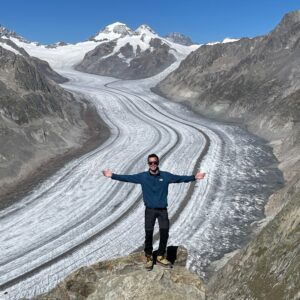
Under the barrage of worry, strange news and pop-up wars, something really big is happening. Earth is losing glaciers rapidly. There are already funerals for them. A new study finds peak glacial extinction is coming in the next few decades, depending on how hot and how fast we force the climate. Literally billions of people depend on glaciers, known as the “water towers” of the world. Can we slow down deglaciation?
The paper in Nature Climate Change is “Peak glacier extinction in the mid-twenty-first century”. We reached the Lead Author, Dr. Lander Van Tricht, glaciologist at ETH Zürich in Switzerland.
Listen to or download this 20 minute interview with Lander Van Tricht in CD Quality or Lo-Fi
PEAK GLACIER EXTINCTION DEFINED
“…we introduce the concept of peak glacier extinction – the year in which the largest number of glaciers is projected to disappear between now (2025) and the end of the century.”
We learn about the role of glaciers in the water cycle, and why they are key millions for people downstream.
Glacier melt threatens water supplies for two billion people, UN warns
According to the United Nations:
“Around 10% of the world’s land surface is currently covered by around 200,000 glaciers, which store approximately 70% of the Earth’s fresh water.”
But Lander says “For example, in the 2.7 warming world we lose 3,000 glaciers every year in the 2040’s.”
NORTH AMERICA
He tells us only a few medium and large glaciers will survive past mid-century on the west coast ranges of the U.S. and Canada – and they will be high and hard to get to. Large numbers of smaller glaciers will be gone by 2050. These western North American glaciers are also sensitive to climate change, not only because of increased melt in hotter summers, but also less snowfall (and more rain) in winter.
CENTRAL EUROPE
In a 4 degree C warmer world, only about 20 glaciers will remain in Central Europe by year 2100. They again will be the highest, least accessible – so current tourism and winter sports depending on glaciers will be no more. This is also a hit on tourism in the Alps.
“For example, under +4.0 °C, only ~20 glaciers are projected to remain in Central Europe, a 99% reduction compared with the present day...”
SOUTH AMERICA
Glaciers in the Andes are doing slightly better. But high warming levels could make a huge difference, while lower warming would save a lot of glaciers in the Andes. According to a report from Carbon Brief, “Colombia has lost 90% of its glacial area since the mid-19th century.” Also: “Shrinking Andean glaciers threaten water supply of 90 million people [in South America], global policy makers warned.”
POLICY BRIEF ON ANDES GLACIERS
Policy briefs
Davies et al., 2025. Policy brief: the future of the Andean water towers. Newcastle University, Newcastle, UK. 20 pp.
or in Spanish.
KYRGYZSTAN
Van Tricht has explored glaciers in Kyrgyzstan and published papers about massive mountain chains in Central Asia. Kyrgyzstan has about 10,000 glaciers, some low as 2,000 meters (6500 feet) above sea level going up to 7,000 meters (22,000 feet) over sea level.
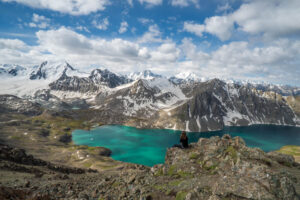
The Tian Shan (or Tien Shan), meaning “Celestial Mountains,” is a vast, dramatic mountain range in Central Asia. It forms borders between China, Kyrgyzstan, Kazakhstan, and Uzbekistan. This mountain network is famous for its towering peaks, massive glaciers, unique arid ecosystems. They are historically important as a Silk Road route, attracting trekkers, climbers, and nature lovers.
The Tian Shan’s glaciers are rapidly receding, losing 27% or 5.4 billion tons of ice since 1961— nearly four times the global average of 7%. By 2050, half of the remaining ice is projected to disappear. In 2024 Lander Van Tricht led an EGU presentation “Future glacier mass loss in the Tien Shan strongly impacts summer water availability.”
In Central Asia, there is a lot of snowfall in winter but very little rain in summer. So these glaciers are the key buffer that keeps rivers high enough in summer for irrigation and other needs downstream for many millions of people. The land around the mountains is very fertile but without glaciers would not have enough water for agriculture. The BBC reports increasing “snow drought” in parts of the Himalayas. Places normally white with ice and snow are bare and rocky.
REGIONS WHERE OVER HALF OF GLACIERS GONE IN NEXT TWO DECADES…
“In regions dominated by small and rapidly responding glaciers, such as the Caucasus, the Subtropical Andes (Low Latitudes), North Asia and the European Alps (Central Europe), over 50% of the glaciers are projected to disappear within the next two decades.”
Van Tricht et al
GLACIER FUNERALS
From the paper by Van Tricht et al: “As glaciers shrink, communities are confronted with these changes, sometimes marking their loss with symbolic rituals, such as the ‘glacier funerals’ for Okjökull glacier (Iceland, 2019)21, Pizol glacier (Switzerland, 2019) and Yala glacier (Nepal, 2025).
These ceremonies highlight the emotional and societal dimensions of glacier loss. Iceland has even established a global glacier graveyard, while initiatives such as the Global Glacier Casualty List aim to preserve the names and histories of vanishing glaciers.”
THE ICELANDIC MEMORIAL
In 2019, Iceland held a commemorative ceremony for Okjökull (known simply as “Ok”), the first of its glaciers to be officially declared “dead” due to climate change. The plaque, titled “A letter to the future,” was written by the prominent Icelandic author Andri Snær Magnason. It is mounted on a rock at the site where the glacier once stood.
The Message on the Plaque – The inscription, written in both Icelandic and English, reads:
A letter to the future
“Ok is the first Icelandic glacier to lose its status as a glacier. In the next 200 years all our glaciers are expected to follow the same path.
This monument is to acknowledge that we know what is happening and what needs to be done. Only you know if we did it.”
August 2019 415ppm CO2
WHY IT MATTERS
Glaciers have such high values that communities gather to remember them. The Global Glacier Casualty List has not only a record of places where glaciers were found but also some photos and cultural memories of them. Our grandchildren will have only these records of a former world.
If we can avoid 4 degrees C of warming (our current path?) – and keep warming to 2.7 degrees (Paris agreement goals) by 2100, we save about 25,000 glaciers! Earth would also keep more of it’s medium-sized glaciers.
All this matters because every individual glacier may provide tourism opportunities, fresh water downstream, and hold back water that would otherwise add to sea level rise. That is the hidden kicker of glaciers going extinct: water formerly held on land is transferred to the ocean. Sea level rise comes not only from Greenland and Antarctica but also from 200,000 glaciers melting on many continents.
SPECULATING ON AN ICE-FREE WORLD
In a 4 degrees world only 18,000 glaciers would remain, compared to 200,000 today. Lander says if the world warms to 5 or 6 degrees C. Earth would only have glaciers in Greenland and Antarctica and a very few high mountains. An ice-free Earth has happened before in long ages past. That would take thousands of years but is not impossible.
Van Tricht goes to glaciers whenever he can, but finds it sad to revisit them, seeing such big changes. Some places where he stood on ice are now rocky surfaces.
His passion for glaciers began early. Lander was taken on a glacier hike by his parents when he was five years old. Then later studying geography he learned to use drones to explore glaciers that were previously inaccessible.
CLIMATE SCENARIOS
Lander’s group finds peak glacier extinction around 2041 if we had kept to the Paris goal of just 1.5 degrees of warming. We are already passing that. You might expect peak glacier extinction to come even sooner in a hotter future, like 4 degrees C hotter than pre-industrial. But counter-intuitively, they find a hotter world delays the extinction line, and an earlier peak is more optimistic. That is because smaller glaciers become extinct more rapidly, and perhaps the giants remain less affected. Less warming gives an earlier time for peak extinction.
But in a hotter world, even medium sized and beyond can disappear. It takes a little longer to reach that peak in a hotter world, maybe a decade later – but the loss is really much greater.
===================
GAZING INTO WILD FIRES
HAMISH CLARKE

We are divided into two camps: those who personally fear wildfires and those who don’t. They should. Fires are popping up in unusual places, unhealthy smoke reaches almost everywhere, and carbon from super fires speeds up climate change. There is more, but that is the short list for why all of us need to get the big picture on wildfires.
We reached the author of a new review. It’s called “Gazing into the flames: A guide to assessing the impacts of climate change on landscape fire”. The Lead Author is Dr. Hamish Clarke. He is Senior Fellow at the FLARE Wildfire Research group, at the University of Melbourne.
Listen to or download this 27 minute interview with Hamish Clarke in CD Quality or Lo-Fi
A 2025 study led by Seyd Teymoor Seydi found “the population directly exposed to wildland fires increased 40% globally from 2002 to 2021 despite a 26% decline in burned area.” More people are moving into fire risk zones.
Another 2025 study found a period of extreme rainfall can swing into a “flash drought” quickly. They call it “hydroclimate whiplash”. It means new fuel for fire grows in the wet – and then burns when dry. The whiplash fire cycle is already happening and expected to increase with warming.
This team led by Clarke says:
“the consequences of climate change will lead to fire activity that exceeds the limits of suppression resource capacity.”
In other words, people in a heated planet should expect fires too large to fight or contain Are we already there?
Sometimes it is fire-time in North America, another year Siberia, and then Australia. If fires become more extreme partly because of climate change, I think international cooperation to fight fires may become as necessary as military alliances.
There is a new factor in fire impact not yet covered in this review. That is political retrogression – shutting down research into better fire prediction and reducing national support for fire-prevention, fire fighting, and public aid after a catastrophic event. All that is happening in the United States.
SEE ALSO
Climate-linked escalation of societally disastrous wildfires Calum X. Cunningham et al in Science October 2, 2025 (paywall)
AND
Climate change has increased the odds of extreme regional forest fire years globally John T. Abatzoglou et al March 17, 2025 in Nature Communications (Open Access)
=====================
BURNING IN THE USA
AMANDA CARLSON
It is not your imagination. More of the United States burned in recent decades, and more buildings too. Rising insurance rates tell the tale, if you can get insurance. This is no surprise in a hotter world, but as always, humans complicate the picture.
Scientists are racing to grasp and predict wildfire threat. Let’s get the facts. Amanda Carlson is Lead Author of the new study “Rising rates of wildfire building destruction in the conterminous United States.” Dr. Carlson is a Physical Research Scientist with the Geosciences and Environmental Change Science Center.
Listen to or download this 12 minute interview with Amanda Carlson in CD Quality (only)
From the Carlson et al paper:
THE WORST OF THE WORST FIRES
“Many of the most destructive events in modern history have occurred since the mid-2010s, including
the 2018 Camp fire in northern California, United States of America (>16,000 reported burned structures),
the 2019–2020 Black Summer fires in southeastern Australia (>3,000 structures),
the 2023 Lahaina fire in Hawaii, United States of America (>2,200 structures), and
the 2025 Palisades and Eaton fires in Los Angeles, United States of America (>10,000 structures).
Many of these events occurred in the western United States, where over 59,000 structures were destroyed by wildfires from 2010–2023. Wildfires since 2015 have caused USD $136 billion in economic losses globally, as well as enormous insurance losses that resulted in loss of coverage for tens of thousands of homeowners. Destructive wildfires also have severe long-term economic impacts, disrupt communities, and have lasting effects on public health.”
“…We did not observe a significant trend in numbers of exposed or destroyed buildings in the Eastern [U.S.] Forests …”
PREVIOUS ECOSHOCK COVERAGE OF WILDFIRE DAMAGES
Radio Ecoshock covered fundamental science on the increase of wildfire damages with Dr. David Bowman, University of Tasmania in this program: “The Great Acceleration” Posted on February 23, 2017.
The paper published February 6, 2017 in the journal Nature is “Human exposure and sensitivity to globally extreme wildfire events“.
Download or listen to this interview with David Bowman in CD Quality or Lo-Fi
=====================
Thank you for tuning into the news from the now un-natural world. I’m Alex Smith for Radio Ecoshock. As always, any donation your can make to help keep this program going is super-appreciated.