In the world of storms, there is before and after Melissa. Jamaica, insurance, hard times and lucky breaks this week on Radio Ecoshock. Hurricane Melissa with famous meteorologist John Morales in Miami and hurricane blogger Dr. Jeff Masters. Plus a short clip from Kerry Emanuel on big storms recorded previously Ecoshock.
“To be alive at the time when I witnessed the strongest hurricane on record, to hit land anywhere in the Atlantic basin – that’s historic.”
– John Morales on Radio Ecoshock
Listen to or download this Radio Ecoshock show in CD Quality (57 MB) or Lo-Fi (14 MB)
JOHN MORALES
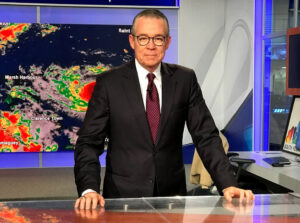
Often seen on major television networks, John Toohey-Morales is a professional meteorologist and founder of private forecasting company Climadata. John is the Hurricane Specialist for WTVJ – NBC6 in Miami, and a famous voice during the big ones.
John is one of the best communicators about the meteorology of major storms you will ever hear. Listen to this interview to understand how Hurricanes work.
Listen to or download my 17 minute interview with John Morales in CD Quality or Lo-Fi
JEFF MASTERS
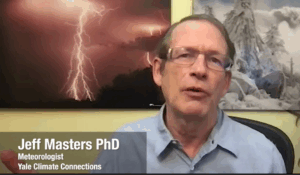
Who tracks every big storm? One of the original NOAA Hurricane Hunters, meteorologist Dr. Jeff Masters. Jeff co-founded the Weather Underground and now contributes to Yale Climate Connections.
Listen to or download my 12 minute interview with Jeff Masters in CD Quality
ALEX ON SUPER HURRICANES
Speaking of drowning storms, the environment ministry of Vietnam announced a new national record for rainfall in 24 hours. More than meter, about five and half feet of rain fell on the central Vietnamese city of Hue. The whole central coastal region was inundated. Thousands were evacuated. This is extreme rain without the typhoon. It’s just another story that does not get told.
Let’s quickly review key points from the interviews with Morales and Masters. Both of them raised surprising and unexpected turns to this story. That adds new dimensions about what to expect.
As you heard from Morales, a well-known weather voice in Miami, a tropical depression in the Caribbean can appear in Miami only 36 hours later. That barely leaves time for news and human reaction. Sometimes the possible does not arrive, we begin to discount the threat. That makes the real thing even harder.
After Melissa, communities in the Gulf, up the East Coast, and around the world need to run Hurricane drills. First responders, media, local governments and police need to know what to do – well in advance. How will evacuations work? Shelters? All that. You can call for storm drills in your own community.
Governments can follow Jamaica’s lead and prepare disaster funding years ahead. Getting disaster aid and rebuilding funds into a devastated city or region is like saving a person with a heart attack. The sooner help arrives and renewal begins, the better it goes. Recovery can be planned.
INSURANCE STORM
You heard John Morales explain troubles in the Florida insurance industry. After repeated billion-dollar disasters from hurricanes, some insurance companies stopped writing new policies, or left the state. There is a government-backed fund of last resort, but it isn’t easy to get.
Under-reported in the news, there is a crisis in Florida where monthly insurance rates can be as high as mortgage payments. You can’t get a bank mortgage without storm insurance. Regular working people are being squeezed out of housing by this double-whammy. Climate change pushing stronger hurricanes is a huge factor, whether the Governor believes it or not.
As I said to John, very few Jamaicans had storm insurance on their homes. Back in July of this year, IAJ, the Insurance Association of Jamaica, warned only about 20% of properties in the country carried insurance. Of that 20%, the IAJ estimates 95% are “under-insured”. Homes and businesses may have low-balled the value of properties to save on insurance premiums – or the insured value from 10 years ago is not anywhere near the real replacement cost now.
That leaves 80% of Jamaican properties with no insurance, just massive loss for individuals or small businesses. The economic ripple effects last years, not days. Find a link to that July article here.
JAMAICA: THE COUNTRY THAT PREPARED
However, Jamaica as a country was better prepared for a big hurricane than her neighbors, especially Haiti. Even in the poorer Western side of Jamaica where Melissa hit, infrastructure and government were functional before the storm arrived.
It turns out Jamaica really planned ahead. The Government of Jamaica bought it’s own insurance policy, called a “catastrophe bond”. CBC, the Canadian public broadcasting company reports:
“Last year, the country issued $150 million US in a catastrophe or “cat” bond — triggered in case of certain parameters related to how strong a hurricane is and where it passes through.
‘They are linked to the central pressure of the hurricane when it makes landfall,’ said Florian Steiger, CEO of Icosa Investments, a Swiss firm that focuses on catastrophe bonds. A third party needs to verify the trigger, but there’s no question in this case the necessary threshold has been crossed.
Funds could get to Jamaica in a matter of days. The country also has multiple eggs in its disaster risk basket — including insurance policies to cover extreme rainfall and tropical storms through a regional pool that provides disaster insurance to Caribbean countries. Additionally, it can draw on lines of credit with the World Bank and the Inter-American Development Bank.
‘Jamaica’s strategy is, in my perspective, one of the most comprehensive of any country globally at the minute,’ said Conor Meenan, a risk financing adviser at the U.K.-based Centre for Disaster Protection.
In total, Jamaica’s Finance Ministry says it has about $820 million US available in financing to draw from in the days and weeks right after a disaster. That won’t cover all of the likely billions of dollars in damages needed, but the insurance-related financing will flow to Jamaica much faster and help quickly restore the most essential services like roads, health care and telecommunications.”
For more check out CBC “How Jamaica took out an insurance policy for itself, and why it’s about to pay off after Hurricane Melissa” Oct 30, 2025
HAITI DOWN
Unlike Jamaica, Haiti barely has a functional government. Most of the capitol is controlled by armed criminal gangs. Melissa hit Haiti hard. Far more people died in Haiti during the storm, than in Jamaica which took the direct hit.
John Morales explains why. A week before Melissa was named as a hurricane, this extra large tropical storm was hanging around in the Caribbean. Day after day it gathered water from the sea. The outer bands of the storm dropped more than a foot of rain on Haiti and the Dominican Republic – and not much on Jamaica during that formative week. A further factor: most of Haiti has been deforested and land degraded. Landslides are too common. Nobody invested in flood control. In Haiti, at least twenty five people died during Melissa.
The Haiti situation wrecks official statements that everybody needs to prepare for extreme weather during climate change. Many countries cannot prepare, cannot protect themselves, and may never fully recover from the next disaster.
On the other hand, some countries are surprising. Bangladesh is one of the poorest countries in the world. They routinely lost thousands of people to cyclones roaring up the Bay of Bengal. We covered on Radio Ecoshock how government and communities in Bangladesh greatly improved storm survival. They built hurricane bunkers on low-lying deltas, worked out mass emergency plans, made it work and saved many lives.
Who expected Jamaica to be a world leader in financial planning for storm recovery? Who expected the United States to dismantle agencies for their own recovery? As always, it is a human problem as well as climate physics.
CAN STEEL AND CONCRETE BUILDINGS WITHSTAND CAT 5?
In our interview, Jeff Masters says steel-reinforced concrete buildings can survive a Cat 5 hurricane. That is technically true, the walls remain standing. But the interior, cladding and roof may be blown away, rendering the building a total loss. It maybe cheaper to tear down and build new than to repair., Perhaps no one has the money to repair.
All this happened when Hurricane Otis struck Acapulco Mexico in 2023. About 80% of hotels, mostly standing along the coast, were damaged. As of spring 2024, many hotels and condo buildings were still described as “abandoned, with missing facades,” and the skyline still bore visible scars. Some still look “skeletal.”
Is Acapulco ‘on its feet’ or a ‘grim scene’ 6 months after Hurricane Otis?
About half previous hotel rooms damaged by Otis have reopened for business. Repairs on other buildings are going slowly and may not reach previous levels for another couple of years, if ever.
Technically steel-framed buildings, especially those engineered for hurricane zones, are rated to withstand winds up to around 180 mph and sometimes higher, approaching or meeting Category 5 criteria (157+ mph). Melissa was above that, reaching 185 mph sustained wind speeds when it struck the coast. Future storms could be even stronger. As hotter oceans drive super storms, even concrete and steel buildings may face threats greater than their structural design. Even now, everything but the concrete can be wrecked, as we saw in Acapulco.
=============
WE CAN STOP PRETENDING
Antonio Guterres Secretary General of the United Nations now says the 1.5 degree C warming target set in Paris is no longer possible. We can stop pretending now.
Many of my expert guests suggest this planet will warm 2 degrees C over pre-industrial in the next few decades. Most of the new added heat goes into the oceans. Warmer oceans speed melting glaciers, change ecology, and threaten some species. Warmer oceans can turn into deadly marine heat waves. And as we heard today, warming oceans are guaranteed to power more intense storms.
We are already in a time of repeating disasters. Normal life, whatever that means, becomes a break between disasters. The time between hurricanes or wildfires or running out of water – becomes shorter with each added year of polluting the atmosphere with fossil waste.
============
KERRY EMANUEL

In this program we listen again to my conversation with a leading American hurricane expert, MIT’S Kerry Emanuel. Kerry followed storm lore for decades, even writing a history of tropical storm knowledge called “The Divine Wind”. This clip is from Radio Ecoshock, February 16, 2022.
You can listen to the whole interview here. Check out that program on Hurricanes…
Maybe James Hansen was right as he forecast “Storms of My Grandchildren”. The former NASA lead scientist expressly covered super powerful storms in the Caribbean in ages past. Far more powerful than anything seen today, ancient hurricanes drove boulders bigger than pickup trucks inland beyond the coast. Hansen expects a-historic storms as the climate shifts.
Extreme heat is dire, but super hurricanes or typhoons are close to cataclysmic when they strike at full force. Melissa is just the beginning. Meanwhile, do the best we can – in between.
I’m Alex Smith. Thank you for listening – and spending time to care about our world. If you can afford to help keep this radio program going out free to stations, please make a donation of any amount here – or join up as a monthly donor/subscriber.
Interesting and vital topic. Two questionsP
1) If you interview such an august set of meteorologists again, perhaps you could sneak in a question about renaming hurricanes as to cause,. i.e., Hurricane S/Hell, or Hurricane Exxon, or, Hurricane Aramco or…or…or…
2) Senator Sheldon Whitehouse has covered the climate issue for years, especially well describing the insurance collapse underway. are you familiar with his long series of presentations to an unheeding and unhearing us senate? https://www.youtube.com/watch?v=sw2GeAuWyHs&list=PLhyg5hj7I21jr7tP–id5EmMTmpTbdlw1
Two good points. I’ll try for the renaming next time – and we know there will be many next times. Just look at two typhoons striking the Philippines in a week… Thanks for the Youtube link – I’ll watch it. Alex