Driving around? Are you dying to get there? Nobody will tell you – except investigative journalist, film-maker and author David Obst. Hear it all as David talks about his new book “Saving Ourselves from Big Car”. What suddenly kills dolphins and millions of fish at a time? Did you know toxic particles from coastal blooms float into city air? Get the latest from one of THE global experts on algae blooms: Dr. Mark Wells from University of Maine.
This is your in-depth dose – on Radio Ecoshock.
Listen to or download this Radio Ecoshock show in CD Quality (57 MB) or Lo-Fi (14 MB)
DAVID OBST – BIG CAR
David Obst is an American journalist, publisher, film-maker and author. As a literary agent, Obst helped birth explosive works of investigative journalism including “All the President’s Men”, and Seymour Hersh’s exposé of the My Lai massacre. David’s 1972 book “Ecotage” with Sam Love triggered an ongoing debate in environmental activism. Now he’s out with a new book: “Saving Ourselves from Big Car”.
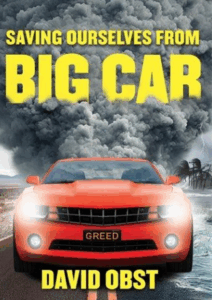
The press release says big car is a network that includes auto manufacturers, oil companies, insurers, concrete and asphalt producers, and the media and political forces that have protected them.
I would add a lot more: plastics companies (modern cars are part plastic), the steel industry, a large complex of high-tech industry for increasingly computerized cars, all the junk yards that receive dead vehicles, and spin-offs like the RV makers and RV camps, and possibly all the heavy four-wheeled All Terrain Vehicles. Plus the medical industry, hospitals for car victims that lived, rehab centers, wheelchairs, replacement limbs, that’s all huge – and should include medical treatment and long-term care for breathing polluted air from car exhaust, and coping from extreme weather hyped up by car emissions.
More fundamentally, they all depend on shared oil and gas production, and of course shared roads funded by taxpayers. They share government contracts and business, including defense contracts. Top executives and trained workers move around between General Motors, Ford, and Fiat and European and Asian manufacturers. The whole industry was seen as central to economic survivable: “…what was good for our country was good for General Motors, and vice versa”, Charles E. Wilson was the CEO of General Motors said at his confirmation as Eisenhower’s Secretary of Defense.
From David Obst:
“Each year, car crashes kill more than a million people globally. Air pollution caused by car emissions kills millions more.“
“Cars have killed more people than died in World War II. This year, a million of us will no longer be around because of the car. And, most troubling, is that nobody seems to care, and even worse, nobody is held responsible.”
A STAGGERING NUMBER OF JOBS DEPEND ON BIG CAR
“The number of Americans dependent on this business is staggering.
One out of every six people in the United States makes a living by manufacturing, distributing, or servicing our cars.
A full one-quarter of America’s retail trade is car-based.
Almost one-fifth of American steel production and nearly three-fifths of its rubber goes into the Big Car business.
It is also the nation’s largest consumer of machine tools.”
FROM THE BOOK: LOBBYISTS
“One last prominent – and perhaps the most crucial – member of the Big Car community is the United States Government, its regulatory agencies, and the lobbyists who serve them.
In the 2022 Congressional races, 96 percent of the seats were won by the candidate who spent the most money. Transportation lobbyists gave more than $68 million in contributions to members of Congress. About 70 percent went to Republicans.
During the last presidential cycle, transportation lobbyists contributed nearly $100 million.
In 2023, Big Car spent $120 million lobbying Washington. It is naïve to imagine that the U.S. Congress will ever enact policies that cut into fossil-fuel profits.
Senator Charles Schumer of New York was the largest recipient, bringing in a tidy $650,000 from Big Car.”
For more on lead sources to the environment, see see this new study: “Environmental lead risk in the 21st century” Published: 30 September 2025.
As I write, the most famous car safety critic Ralph Nader and author of “Unsafe at Any Speed” is still alive, age 91. But the fight against the car seems to have run out of gas. Think of the strong car campaigns by Greenpeace in Europe in the 1990’s, and the famous Adbusters commercial “Autosaurus”. And don’t forget this great picture book “Autogeddon” published in 1991 and still available online (free) from Internet Archive.
However, as we read in Obst’s book, there are a lot of alternatives being developed in cities around the world: street closures, walkable cities, free electric transit – dozens of solutions tested in the real world. We just need to see above the smog.
Strangely, as a very few activists still struggle to get rid of car culture, Big Car companies are on the verge of yet another breakdown. Chrysler went bankrupt a couple of times. General Motors got a taxpayer bailout in 2008. Stockholders get all the profits until the downturn, then taxpayers get the loses. With big SUV’s running over $100,000 and the lowly Jeep now at luxury prices, maybe we are at a turning point? Of course, governments are so in debt the Eisenhower big budget spending is not likely – when we need to rebuild electric railways or other infrastructure. At least the bicycle just needs minor changes for road safety and we can mass produce affordable bikes.
=======================
PASSING OF JANE GOODALL
Just before we get the inside scoop on killer algae blooms, let us stop to remember one of the great women of our times. Jane Goodall passed away last week at age 91. She was indeed good for all. Exploring and then living with African apes, from Chimpanzees to the great apes, Jane did more than teach us about other intelligent life here on Earth. With that mirror, she taught us about ourselves. She was kind and wise for decades, as her documentaries thrilled kids and grownups.
In the show you hear a clip of Jane Goodall at a conference, as played on Radio Ecoshock in 2006.
Jane, you showed us our better Nature.
==========================
MARK WELLS –
HARMFUL ALGAE BLOOMS
In May 2025 brown foam took over beaches near Adelaide Australia. That toxic bloom of algae grew to thousands of square kilometers leaving masses of dead creatures behind. You may think harmful algal blooms are increasing with global warming. Is that true?
Scientists who specialize in algal blooms have been working on this problem for over a dozen years. In 2015, experts gathered to workshop, and the summary paper was published “Harmful algal blooms and climate change: Learning from the past and present to forecast the future”. Professor Mark L. Wells was Lead Author then, and again in 2023 for an update on the science. Mark is Emeritus Professor of Oceanography at the School of Marine Sciences, University of Maine. He is the co-Chair of the Section of Harmful Algal Blooms of the North Pacific Marine Science Organization.
Another study led by Chris C. Lim in 2023 looked into Harmful algal bloom aerosols and human health. bits of the toxic bloom float inland and into our lungs.
On a personal note, I will be off for a week to check in with family. Then we dive in again – beating our heads against some mad bugger’s wall.
Thank you for listening again this week, and caring about our world.