Extreme heat and heavy rains amplify one another: a new conversation with “Earth systems nerd” Jan Umsonst in Germany. Jan explains why – with new science. Alex covers breaking science on extremes happening now: fires, flash floods and record smashing heat around the world, with audio from David Spratt, John Betts, and Jonathan Gourley.
Listen to or download this Radio Ecoshock show in CD Quality (57 MB) or Lo-Fi (14 MB)
—————–
HOW HEAT AND EXTREME RAIN AMPLIFY ONE ANOTHER
Jan Umsonst writes about the relationships between extreme precipitation events and neighboring heat waves. When water condenses into ice or water in the atmosphere, the original energy used to evaporate it is returned as heat in the upper atmosphere, or at least at cloud level. This heat can then strengthen nearby heat waves. Conversely, heat waves can increase chances of extreme precipitation events in low pressure areas around heat highs, he says.

Jan Umsonst “Earth System Nerd”
In an email, I asked Jan why giant waves of heat and extreme rain hover over big regions. often following one another like a train. It is in fact called a “wave train” and we discuss that in our interview. Jan wrote in a personal email:
“…large scale ocean fronts intensify, which support low pressure systems that reinforce high pressure systems and blocking patterns, which then produce wave guides triggering continental heatwaves and flooding in the extra tropics. The main Principle is simple: local feedbacks interact with regional feedbacks, supported by synoptic teleconnections what create air mass transports or induce ’persistent’ wave trains in the jets – all culminating in the intensification of single regional to continental events.”
And unlike many other climate-weather feedbacks, we don’t know what new limits might be for these extreme amplifications of heat and precipitation – assuming there are limits. Jan cites a breaking paper published July 7th, 2025 finding an “Accelerating increase in the duration of heatwaves under global warming”. The study was led by Cristian Martinez-Villalobos from Universidad Adolfo Ibáñez in Santiago, Chile. These scientists find, quote:
“...that the nonlinearity results in acceleration of the rate increase with warming; that is, each increment of regional time-averaged warming increases the characteristic duration scale of long heatwaves more than the previous increment.”
This is very serious. The most deadly and damaging impacts of climate change, heat and extreme precipitation, do not increase evenly as Earth warms. Every fraction of a degree of added heat ratchets up the extremes even more. Former NASA Goddard Director James Hansen also emphasized the non-linear relationship between global temperature increase and the severity of climate impacts. He says global warming is accelerating.
NOT A CLIMATE EXPERT?
So maybe you have not spent the last twenty years trying to understand how the world weather system works. You just wonder what the heck broke, why is life harder? Why are so many days unbearable, and insurance costs higher than the flood waters? We want to know why, and what to expect. Is it going to be safe to live here? Should my family get ready, or get ready to move out?
The information we need was never taught in school. Politicians don’t get it, and most journalists don’t either. The truth is: even the best climate models did not predict this chaotic new reality. Every week, even during the summer doldrums of publishing, startling new science is breaking with bad news. Yes, it is worse than we thought.
“People will only believe human-induced climate change is real when we experience enough discomfort to force change upon us.”
Jan Umsonst says people will only believe human-induced climate change is real when we experience enough discomfort to force change upon us. As I speak, flocks of lightning around my home have ignited dozens of fires in the tinder-dry bush of British Columbia. It is 96 degrees Fahrenheit – over 35 C. – in the shade out side my door. The lawn is brown, with only a teaspoon of rain in the last month or more.
It has already been another year of abnormal wildfires in Canada, with smoke adding to the heat waves across the Eastern U.S. and dimly visible in Europe. The area burned so far in Northern Canadian forests is already twice what was previously normal. A paper published May 30th, 2025 in PNAS has the title “Unprecedentedly high global forest disturbance due to fie in 2023 and 2024.” Canadian system scientist Paul Beckwith has an explainer video just out on that – on his YouTube channel. So the rise of the age of fire is global and now includes 2025.
In the distance, I hear helicopters in the hills dumping water buckets on flaming bush. We check our escape bags again tonight.
==================
FLOODS IN THE EAST
In the States it’s a different demon in the East. After thousands of flash flood warnings over the past month, and sadly many deaths, it’s all on again with unbelievable sudden downpours plaguing small towns and big cities.
Friends, I hope humans don’t take much longer, don’t deny the crashing blows, until it is far too late. Let’s not wait until we lose our homes, friends and lives. It is time for change – for real, no B.S. climate action.
===================
INTRO TO JAN INTERVIEW
A listener passed on a Facebook post by Jan Umsonst. He is not a scientist, but describes himself as an “Earth system nerd”. After 20 years of watching, digging, and taking notes, Jan describes this ongoing quest to know why – in his Facebook feed. Here, at the end of a tumultuous July, is our conversation – the first time we ever spoke.
Listen to or download this 40 minute interview with Jan Umsonst in CD Quality
I hope to have Jan back in the Fall as we try to find out why and how climate threat accelerate as we modify the atmosphere. Stay tuned.
CRAZY MARINE HEAT WAVES
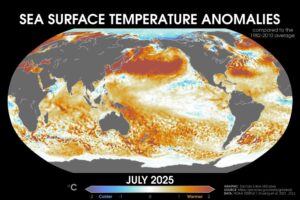
Jan began by saying it is a very bad idea to heat up a water planet. A new study, released July 24th, reports marine heat waves covered 96% of oceans in 2023, lasted four times longer than average.
Right now, there is a vast marine heat wave in the northern Pacific Ocean. No doubt that is twisting weather out of shape downstream in the atmosphere, which due to the direction Earth turns, is North America. Weather systems and atmospheric pressure patterns often originate over the North Pacific and then propagate eastward, impacting weather over North America.
This is not an El Nino. Although still early for a certain projection, it appears we are headed into another weak La Nina season – so it’s not that. It is just straight up too much energy, trapped by our greenhouse gas emissions, landing in the huge Pacific Ocean.
DAVID SPRATT:
1.5 C WARMING IS NOT STABLE
David Spratt is a climate policy analyst in Australia and Research Director at the Breakthrough National Centre for Climate Restoration. He’s known for his book and web site called Climate Code Red. He’s been on Radio Ecoshock a couple of times. In a recent interview with Nick Breeze of ClimateGenn, Spratt says the wide-spread idea that 1.5 degrees of warming is some kind of safe resting point is proven absurd by recent events.
Earth has already reached 1.5 C of warming, about 16 years ahead of predictions. Are we safe? I’m not. Nobody is. Spratt points to James Hansen’s position that 1.5 C warming is a point of instability. Nothing rests there. Either it keeps on getting hotter or humans somehow help it get cooler. David says either cool back to 1 degree or right back to pre-industrial carbon levels – with geoengineering of some sort – or zero – or we go to 3 degrees of warming over pre-industrial.
David says of 1.5 C warming:
“It is not a point of system stability. And the reason for that is obvious, and it’s before our eyes right now. That is: so many carbon cycles are now out of sync. And whether it’s forest, whether it’s permafrost, whether it’s boreal forest, whether it’s retreating ice sheets changing the reflectivity of the planet, 1.5 C is not a point of system stability. Either you’re gonna end up at three or you’re gonna have to cool back to zero.”
David Spratt, a long time climate activist, is now loudly calling for immediate experiments in cooling with sulfates, that is, geoengineering. Host Nick Breeze raises a concern that geoengineering might cause an unforeseen backlash in climate affairs, including icing over the UK. This is a conversation you should hear.
Nick Breeze, host of ClimateGenn
GOING BACK IS TOUGH TO IMPOSSIBLE
Here is a transcript from the clip I play in the show, with David Spratt talking to Nick Breeze of ClimateGenn.
HOST NICK BREEZE:
“Potentially gonna keep going to a degree, a whole degree of overshoot. Mhmm. And there’s a lot of dialogue. I know that there is a tipping points conference going on and we just had the Arctic Repair conference that I attended. And the people talking about the AMOC, the Atlantic meridional overturning circulation, the the ocean currents that transport heat around and keep the world as we know it climatically.
That’s potentially slowing down and stopping, which would transform, global climate. And yet when they analyze the impacts of climate intervention – so if you did stratospheric aerosol injection, for example, so you you pump stuff up to try and cool down, you really gotta start five years ago because of the the whole processes involved. I could repeat the science to you… but Yeah.
As you go further down this road and closer to it tipping, if it actually tips, the recent research seems to indicate if you try to cool then, you could actually cause a massive advance of ice sheets down to Southern England. Yeah. Now there’s stuff around that which…”
DAVID SPRATT:
“Well, look. I mean, I think there are two issues there. First of all, coming back this question of overshoot and getting in too late, I mean, there’s this thing which I won’t try and explain in detail called hysteresis, which basically says the path from A to B is not the same path from B back to A.
That is, for example, if you melt an ice sheet or slow down an AMOC, that can can happen really quickly in a hundred, two hundred years, very quickly in historical terms, but the path back is really slow. I remember talking to our Antarctic scientists saying, we think that the tipping point for the the really vulnerable Antarctic glaciers was around point five to point eight of a degree, looking back. But they said, you might have to get back to zero to refreeze it. So this idea of overshoot and being able to just, you know, open the blinds and and everything will be alright again, this is a problem. Overshoot, because of hysteresis and other things, makes it a very complicated question.
And the second issue you referred to is something that I think Mike McCracken, I don’t know whether he talked about it in your recent interview with him. He said, there’s there’s this view that climate interventions, sulfate, you know, cooling the planet is something that we’ll do when everything else has failed, you know, when we’ve got to two and a half or three degrees. But he said at two and a half or three degrees, it probably won’t work because the problem is too big. He said you need to start testing this early. He says at one, one and a half degrees, it might work.
At at two and a half or three, it won’t. And that’s the issue. And I think that’s parallel to the AMOC story that you were telling, that waiting until things get bad and thinking some magic bullet will reverse it is not going to happen.”
The Nick Breeze interview with Dr. Mike McCracken is out now on YouTube: “2.5ºC–3ºC Is Not Viable: Dr. Mike MacCracken’s Case for Solar Radiation Management “.
IS IT TIME?
Is it time for desperate measures? Personally I don’t think we know enough to mess with Nature. But David thinks we have no time left to wait.
It is late and I have to assess our situation and get ready. Tomorrow may be smoke, fire, or flood here in the climate casino.
Listen to or download a climate song: “When the Dragon Comes” (Lyrics by Alex Smith, music AI, Creative common license – free for any non-profit use).
Many experts have been warning this would come – for decades. As Canada burns right now, as Spain and Greece burned, Australia, and certainly Russia – Radio Ecoshock broadcast “The New Age of Super Fire” in July 2016. which is also available on YouTube. I interview John Betts, Executive Director of the Western Silvicultural Contractors’ Association in British Columbia, Canada. It’s still true as today.
FLASH FLOODS
For those of you fearing floods, from the Northeast of North America all the way to Beijing, we have at least a half dozen program on the why’s and wherefores of expanding flood threats as the planet warms. Two weeks ago I just covered the deadly floods in Kerrville, Texas; Ruidoso, New Mexico; Chapel Hill, North Carolina, and Chicago. I replayed an interview with UCLA expert Jesse Norris about extreme rainfall events, recorded in September 2021.
In this program I replay an excerpt from an interview on the new extreme floods with UCLA expert Jesse Norris on Radio Ecoshock September 2021.
Listen to or download this 28 minute interview with fire expert Jesse Norris in CD Quality or Lo-Fi
How about my show “Global Super Rain: the new face of climate change”. We talked with expert Jonathan Gourley from NOAA National Severe Storms Laboratory. Will that even continue to exist? That was in 2023, but it could have been today. In this show you hear a quick sample from that interview, with some tips on how to stay alive during a flash flood event.
Download or listen to the full 30 minute interview with Jonathan Gourley in CD Quality or Lo-Fi
===============
COMING NEXT WEEK: Everything you need to know about wildfire smoke.
My special thanks to all the supporters who continued contributing during the summer months. You keep Radio Ecoshock going out free to 107 radio stations, and podcast listeners all over the world. If you can help now, please do, with a donation large or small – or sign up to be a monthly donor.
I’m Alex Smith. Thank you for listening – and for caring about this world.