Canadian Prime Minister Mark Carney: the international order is broken. Is climate cooperation done for? What now? Political Science Professor Matthew Hoffmann talks us through it. But we begin with the biggest under-rated climate killer in America: wildfire smoke. Shocking new science with Dr. Chris Callahan. Plus scientist Sarah Berk: cities are getting hotter faster. Welcome to Radio Ecoshock, let’s go.
Listen to or download this Radio Ecoshock show in CD Quality (57 MB) or Lo-Fi (14 MB)
“The multilateral institutions on which the middle powers have relied, the WTO, the UN, the COP, the architecture, the very architecture of collective problem solving are under threat. …We are in the midst of a rupture, not a transition.”
– Canadian Prime Minister Mark Carney at WEF Davos January 20, 2026.
DO NOT UNDERESTIMATE DEADLY WILDFIRE SMOKE
CHRIS CALLAHAN
Weather extremes are in the news. But one of the biggest climate-pumped killers is not. Even experts gravely underestimated tens of thousands of people dying annually not from heat or storms, but wildfire smoke. This is not in some faraway land, but in the United States.

Christopher Callahan leads and co-authors numerous studies. His latest work shows increasing deaths in America as climate change goes to 2 degrees and beyond. This is a story of unmasking the wildfire threat spreading across continents. The paper is “Valuing wildfire smoke–related mortality benefits from climate mitigation”. Unfortunately it is behind a paywall, but even the Abstract (free) is worth checking out. Publication in PNAS was February 19, 2026.
Lead Author is Minghao Qiu is Assistant Professor (School of Marine and Atmospheric Sciences at Stony Brook University. He previously was at both Stanford and MIT (got PhD at MIT).
From the O’Neill School of Public and Environmental Affairs at Indiana University, we welcome Dr. Chris Callahan back to Radio Ecoshock.
Chris and I talked in December about mass heat mortality in Europe. Now we learn disturbing new facts about deadly wildfire smoke in America. North Americans grew up knowing breathing car and factory smog was bad for us. Nobody warned us about wildfire smoke. That happens every summer. It’s natural. In some ways, wildfire smoke is as toxic as industrial smog. Why are we still not taking it seriously?
Listen to or download this 20 minute interview with Chris Callahan in CD Quality or Lo-Fi
Looking at maps in the new paper of dangerous smoke particles in the United States, the Pacific Northwest looks periodically dangerous for health already. At 2 degrees C warming a lot of the West is gasping for clean air. Three degrees C is just crazy with only the Southeast and Florida keeping smoke-free air.
Despite most giant wildfires in the West (in both Canada and the U.S.), strangely most of the resulting premature deaths from the smoke are east of Iowa or Kansas. The scientists conclude “70% of smoke-related mortality come[s] from states that are east of 95deg W” [Longitude]. Why? A lot more Americans live in the Eastern half of the country. With a larger pool of people affected than in sparsely populated Western states, more people in the East die due to breathing too much wildfire smoke.
The team calculates the smoke dose for an average person in the United States for 2, 3 or 4 degrees of warming. At three degrees, which is highly likely, Americans on average would get more than 5 times more dangerous smoke particles. That sounds like a public health emergency that lasts for decades. We need to redesign public health and health care for growing wildfire smoke.
The new paper says: “Based on our estimates, reductions in wildfire smoke and related mortality are likely one of the most important benefits of Green House Gas emission reductions in the United States.” That’s a whole new picture for climate activism – fighting, adapting and compensating for wildfire smoke damage. Nobody is talking about this yet.
THREE DEGREES IS “DOABLE”?
Recently the European Scientific Advisory Board on Climate Change (ESABCC) said adapting to 3 degrees C of warming is “doable” for Europe.
Chris posted:
“Quick reminder that 3 °C of warming would set Europe up for heat domes that kill 30,000 people in a single week.”
In fact, Chris Callahan and colleagues studied exactly that in a February 2025 paper called “Present and future limits to climate change adaptation”. In the new Feb. 2026 paper in PNAS they find:
“Under 3 °C of global warming (relative to 1850–1900), we estimate that smoke exposure will lead to 64,000 deaths annually in the United States (95% CI: 33,500 to 112,300); calculated using historical population), a 60% increase above estimated annual smoke deaths during 2011-2020.”
COMING EL NINO?
We hear predictions the hotter El Nino condition could develop later this year. In 2023, Chris Callahan looked into the “Persistent effect of El Niño on global economic growth”. That was before the major El Nino of 2023 and ongoing residual heat in 2024, the hottest year ever (so far). His team found each extreme El Nino costs the global economy trillions of dollars in losses – with a lasting impact.
BURN-OUT
If massive wildfires continue to burn in the United States, in Canada, and across Russia – that could create a kind of burned-out state. With less fuel left, wildfires and deadly smoke could decline as the century progresses. But blackened parts of the planet where great carbon forests once stood means we are already at an extinction-level climatic shift.
THE SOCIAL COST OF WILDFIRE SMOKE
The new paper Abstract says:
“Incorporating wildfire smoke damages into existing nonwildfire damage estimates increases the US domestic social cost of carbon by 74%, substantially increasing the expected benefits of greenhouse gas mitigation within the United States.”
SIDEBAR: WILDFIRE SMOKE DEATHS IN CHINA
This paper is exclusively about the United States and numbers may not apply elsewhere. Check Callahan’s earlier work on wildfire and European health damage (below and in previous interview). Wildfire smoke deaths are forecast to increase in China as well.
“Deaths in China due to wildfire smoke could be higher than expected
A sophisticated model predicts that Chinese deaths linked to wildfire smoke will be higher than previous estimates.
A significant growth in the Chinese population’s exposure to wildfire smoke was tracked by researchers at Tsinghua University since 2021. Led by Yuqi Bai, the team found a 24.5% increase in the average annual exposure of people to wildfire air pollution in China for the period 2016–2020 compared to 2001–2005.
If low levels of carbon-emission control are implemented, China’s annual mean all-cause death attributable to fine particulate matter (PM2.5) pollution from wildfires is projected to increase by 37.38% in the period 2021–2040, compared to the period 1986–2005 period.
SEE ALSO: Projections of mortality risk attributable to short-term exposure to landscape fire smoke in China, 2021–2100: a health impact assessment study by Shuhan Lou BS et al in The Lancet Planetary Health October 2023.
SEE: Increasing frequency and intensity of the most extreme wildfires on earth.
C. X. Cunningham, G.J. Williamson, D. M. Bowman,
Nat. Ecol. Evol. 8, 1–6 (2024).
WHY ARE WE TALKING ABOUT WILDFIRES NOW, IN WINTER?
WIKI SAYS:
“In January 2026, the National Interagency Fire Center (NIFC), issued its National Seasonal Fire Outlook. This forecast projected above-normal wildfire risk for much of Texas, Florida, Georgia, Carolinas, and the southeastearn United States.”
According to the WIKI tally, there have been about 7,000 wildfires already in 2026 – counting only those that “burned more than 1,000 acres (400 hectares), produced significant structural damage or casualties, or otherwise been notable. “
These 2026 winter fires burned about a third of a million acres, or about 125,000 hectares. The largest fires, burning thousands of acres were in February in Colorado, New Mexico, Florida and the monster Ranger Road fire still burning after 283,000 acres consumed across Oklahoma and Kansas.
WILDFIRE SMOKE ACTION – WHEN INSTITUTIONS FAIL
Alex writes:
The authors argue we should know the real cost of increasing wildfire smoke – in lives lost and cost per ton of carbon emitted – to help planners and policy-makers establish a case for greenhouse gas regulations and reductions.
That entire assumption and institutions has failed. The country studies here, the USA, has abandoned not just Paris goals or regulations, but even the idea that greenhouse gases are a serious danger to the future. So now what? This paper and this interview are now trying to bypass the politicians, economists and business moguls to warn the public: more or us are going to die, every year, because a hotter planet burns more, and smoke from that damages our lungs, hearts, circulation and even brains. We the public need to take several steps:
1. Get more information on the real risk
2. Demand more public warning of smoke risk, including on TV newscasts and social media, with a clear scale.
3. Plan lung/brain protection from wildfire smoke when present (HEPA filters in homes, offices, cars, stay indoors when possible, avoid outdoor work and games during smoke events.
4. Work and vote for greenhouse gas reductions at every chance to prevent even more fires and deadly smoke.
We can all be part of that plan.
CHRIS CALLAHAN : HEAT DEATHS IN EUROPE
Christopher Callahan on Radio Ecoshock in December 2025.
A study by the Barcelona Institute for Global Health found over 60,000 heat-related European deaths in the summer of 2024. What will it be like when the whole Earth is significantly hotter due to climate change?
A new paper in Nature Climate Change investigates increasing risk of mass human heat mortality in Europe. The Lead Author is Dr. Christopher Callahan from Indiana University and the Doerr School of Sustainability at Stanford.
Listen to or download this 18 minute interview with Christopher Callahan, December 2025 in CD Quality or Lo-Fi
“mass mortality events remain plausible at near-future temperatures despite current adaptations to heat”
================================
CITIES GETTING HOTTER!
SARAH BERK
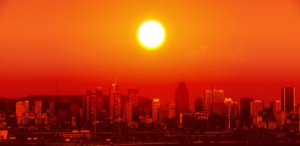
Deadly heat waves are a new fact of life in a warming world. Cities are even hotter than the surrounding countryside. We did not know: that urban heat island effect becomes more extreme as the planet moves to 2 degrees and hotter. It is another unpleasant surprise.

Here to untangle all that is Dr. Sarah Berk. After a time in finance, Sarah began serious study of the urban heat island effect in the Climatic Research Unit at the University of East Anglia . Now she’s a Postdoctoral Researcher at the University of North Carolina Data-Driven Lab. Sarah is Lead Author of the new PNAS paper “Amplified warming in tropical and subtropical cities under 2 °C climate change”.
Listen to or download this 19 minute interview with Sarah Berk in CD Quality or Lo-Fi
Let’s take a case like Raleigh North Carolina. It’s a sub-tropical city with half million people. In 2021, a community group measured the difference between downtown Raleigh and the countryside – finding an amazing 9 degrees Fahrenheit, or 5 C extra heat in town. If the global mean average temperature gets 1 degree C hotter, while both city and countryside heat up, that city-to-country difference becomes even greater, according to this study.
Quoting from this new paper from Sarah and colleagues: “In 2018, it was estimated that over half the world’s population resided in cities and this proportion is projected to increase to 68% by 2050.” So, it could be even worse with higher heat mortality in the future, as more people encounter unnatural heat in cities in coming decades.
I see this new paper as part of a trend in science now. In the early stages of climate study, with less compute, the best we could do was global trends and very large grids. Now scientists are able to include regional predictions and even specific forecasts – closer to the reality of where we live.
PRESS RELEASE FOR THIS URBAN HEAT STUDY IS HERE
===============================
CLIMATE ACTION IN A DISRUPTED WORLD
MATTHEW HOFFMAN
“The multilateral institutions on which the middle powers have relied, the WTO, the UN, the COP, the architecture, the very architecture of collective problem solving are under threat. …We are in the midst of a rupture, not a transition.”
– Canadian Prime Minister Mark Carney at WEF Davos January 20, 2026.
That is not cheery news from Canadian Prime Minister Mark Carney. He told leaders at the World Economic Forum the old rules are breaking and major institutions, including the United Nations – may not hold. Is this the end of international hopes to avoid extreme climate change?
As Matt Hoffman put it: How do we go about “Addressing climate change without the ‘rules-based order’”. In Canada, Matthew Hoffmann is Professor of Political Science and Co-Director of the Environmental Governance Lab at the University of Toronto. He published this first-look at the new climate landscape in The Conversation.
Listen to or download this 19 minute interview with Matt Hoffman in CD Quality or Lo-Fi
EMPTY INSTITUTIONS
After 30 climate COPs, greenhouse gas emissions are still rising. I loved Hoffman’s citation to a 2019 paper by Radoslav Dimitrov: “Empty Institutions in Global Environmental Politics”. (That is free to read). Dimitrov pointed to the Copenhagen Accord on Climate Change as just one of many “empty international institutions whose mandates deprive them of any capacity for policy formulation or implementation.” Is the COP process really an “empty institution”?
Until now, climate activism and decarbonizing have been all about “transition”. We had “Transition Towns” and transition movements and endless transition talk. What does it mean for climate-worried folks when Mark Carney buries the “transition” and acknowledges a “rupture”?
President Trump’s second term led to backsliding. Corporations and banks dumped green policies and constraints on new fossil fuel investments. Regulatory agencies like EPA promised not to regulate pollution or greenhouse gases. Is Carney finally and formally acknowledging a breakdown that began years ago?
“We actively take on the world as it is, not wait around for a world we wish to be.”
– PM Mark Carney, Davos January 20, 2026
Let’s be clear, the Canadian Prime Minister’s speech was not about climate change. It mentions the COP once, as a threatened entity. At home in Canada, Mark Carney tossed out a carbon tax, pushed for natural gas exports and introduced nothing to save the climate. And yet, I could interject the word “climate” in much of what Carney said at Davos and it reads true.
You can listen to Canadian Prime Minister Mark Carney’s speech at the World Economic Forum in Davos (posted by The Journal). I suggest the first 8 minutes are key.
That’s it for another week on one overheated planet. I’m Alex. Please support my continuing science journalism, providing expert voices to the public, absolutely free and ad-free, for almost 20 years. Just a little financial help from you can make a big difference to me and this project, Radio Ecoshock.
Thank you for listening, and caring about our world.