Are we ending this civilization? Climate warnings from 8 top scientists in the UK Emergency Briefing. First two new interviews: Prof. Brian Soden: phenomenal heat burst of 2023/24 NOT caused by change in ship pollution regs. Harvard’s Dr. Cheng He: “Escalated Heatwave Mortality Risk in Sub-Saharan Africa.” We burn it. They die. Harsh truth is a start.
Listen to or download this Radio Ecoshock show in CD Quality (57 MB) or Lo-Fi (14 MB)
Listen to or download this week’s theme song “Danger Zone”
“The way the science is going at the moment, we’re going to see a rise of about 2°C or so by the middle of this century. It’s very hard to imagine that we have any less than that. But there’s now a small but very real risk that we could hit 4°C by the end of this century. The prospects of 3 and 4°C of warming are absolutely dire. I mean, we cannot risk that at all. It is an extreme and unstable climate, far beyond any safe zone that has nurtured our civilization.
And we’re going to be seeing unprecedented societal and ecological collapse at these sorts of levels. We’re going to see escalating geopolitical instability and rising military tensions. And there will be no real economy to talk about. There’s no ‘reduction in GDP’. We’ll be looking at systemic collapse.”
– Dr. Kevin Anderson at UK National Emergency Briefing, London Nov 27, 2025
This IS what’s at stake. That dire warning of climate-induced collapse comes from Kevin Anderson, Professor of Energy and Climate Change at Manchester University and Uppsalla University. He is a former Director of the prestigious Tyndall Centre for Climate Change Research in the United Kingdom. Later in the show, you will hear Kevin and clips from a half dozen other top experts at the National Emergency Briefing in London November 27th.
First, two quick guests with science that matters. Why did Earth get hotter faster in the last few years? Professor Brian Soden says the phenomenal heat burst of 2023 and 24 were NOT caused by a change in ship pollution regulations. Then “yes,” Africans are dying in heat we added to the atmosphere. From the Harvard Chan School of Public Health, Dr. Cheng He on the study “Escalated Heatwave Mortality Risk in Sub-Saharan Africa Under Recent Warming Trend”. It’s not what we thought.
I’m Alex. Welcome to Radio Ecoshock.
WARMING JOLT: NOT SHIP EMISSIONS
BRIAN SODEN

Why did Earth get hotter faster in the last few years? Why is Earth retaining more solar energy? World-renowned climate scientist James Hansen pointed to ship exhaust particles changing clouds. Not everyone agrees.
PhD student Chanyoung Park and Professor Brian Soden investigated. They found “Negligible contribution from aerosols to recent trends in Earth’s energy imbalance”. That was published in Science Advances, November 28, 2025. Co-author Brian Soden is with the Rosenstiel School of Marine, Atmospheric, and Earth Science at University of Miami.
Listen to or download this 17 minute interview with Brian Soden in CD Quality or Lo-Fi
A NASA chart of Earth’s energy balance year-by-year shows a lot of variation. For example, it looks like the planet’s energy was completely balanced in 2010. But this graph from NASA clearly shows an upward trend in Earth Energy Imbalance (EEI).
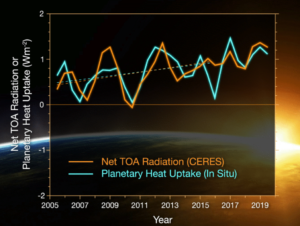
There is no doubt the planet hit new heat records since 2020, with 2023 a shocking shift and 2024 the hottest ever, so far. Satellites show Earth is keeping more solar energy and sending less back into space.
In 2023, a Dutch researcher Leon Simons became a co-author of a big paper by Dr. James Hansen, former director of the NASA Goddard Institute for Space Studies. That paper cited new regulations limiting sulfur in ship exhaust leading to fewer clouds in the Pacific shipping lanes – enough to reveal more heating since 2020.
But this new research find reduction in clouds and ship emissions is not a major factor changing energy balance. Why not? First, there is a suspicious lag between sulfate limiting regulations in ships (which began in 2015 and was ramped up in 2020) and the lurch in warming starting in 2023. More seriously, Soden and Park find aerosols in the Southern Hemisphere increased – enough to balance out any change in the Northern Hemisphere. The Southern aerosols came from wildfires in Australia and even a Pacific underwater explosion in January 2022, the Hunga Tonga–Hunga Ha’apai eruption (particles reaching the stratosphere).
In a 2018 interview, I talked with Utah cloud specialist Tim Garrett. He expressed doubts about spraying up salt to brighten clouds and cool Earth. Geoengineering might not work. I suggested adding more clouds over the northern hemisphere might result in fewer clouds in the southern hemisphere. In a way, this new paper found the reverse: fewer clouds in the North were accompanied by more in the South.
In the interview we discuss other factors in energy, like the Pacific Decadal Oscillation (PDO). Another possible primary driver of the recent Earth Energy Imbalance is technical and hard to grasp. Brian explains the difference between incoming “short wave” sunlight and “long wave” radiation going back out. We learn about the short-wave feedback in clouds and why that could lead to a large-scale change in Earth energy balance.
THE PAPER FINDS
“Our findings reveal that the radiative influence of SH aerosols is substantial enough to offset those from aerosol concentration reductions in the NH, leading to a negligible near-global trend in aerosol forcing. This challenges the understanding that declining anthropogenic aerosols in the NH would lead to the positive trend in EEI, suggesting instead that the global impact of aerosols on the EEI trend is minimal, although aerosols have influenced regional variations in the EEI. By providing an observationally based perspective, our research addresses the need for a more accurate understanding of the drivers behind the observed EEI trend. It suggests the importance of factors beyond aerosols, such as natural variability and cloud feedback, in shaping the EEI trend.”
At the end of the interview, Brian offers another possible reason for continuing Earth Energy Imbalance that was not in this paper. The imbalance of aerosols between the hemispheres might itself cause changes in atmospheric circulation. This may change clouds in the Intertropical Convergence Zone. The location of that narrow band of clouds is very sensitive to changes in that gradient of aerosol concentrations he says.
FOR MORE CHECK OUT
The 2023 global warming spike was driven by the El Niño–Southern Oscillation
Shiv Priyam Raghuraman, Brian Soden Amy Clement, Gabriel Vecchi, Sofia Menemenlis, and Wenchang Yang – Published October 10, 2024 in Atmospheric Chemistry and Physics (ACP)
RE DIFFERENCES IN HEMISPHERES LEADING TO CHANGES IN CIRCULATION
Emerging hemispheric asymmetry of Earth’s radiation
Norman G Loeb et al Sept 29, 2025 in PNAS
THE HEMISPEHRE IMBALANCE ALSO APPEARS IN THIS VIDEO:
The Far-Reaching Impacts of Extratropical Climate Perturbations | Sarah Kang (MPI-M)
Jun 25, 2025/
AI TRANSCRIPTION (at about 3 minutes):
…surplus, thereby shifting the tropical precipitation southward. And the extent to which this tropical precipitation shifts in response to extra-tropical perturbations is proportional to the amplitude of cross-equatorial atmospheric energy transport, which is modulated by the radiative feedbacks associated with water vapour, clouds, as well as dynamic ocean adjustments.
All right, so this energetic framework predicts that there will be shift in tropical precipitation in response to inter-hemisphere contrast at any given latitude. So as long as there is energy imbalance between the two hemispheres, the tropical precipitation and circulation will shift. And a number of studies then showed how tropical precipitation responds to extra-tropical energy perturbations. For example, the northern extra-tropical air pollution, northern high-latitude vegetation changes, Arctic ice loss, Antarctic ice sheet melt, and stratospheric ozone hole.
So all these extra-tropical energy perturbations have been shown to affect the tropical precipitation distribution.”
======================
Can you help keep this voice of science going? I provide this program free-of-charge to 107 non-profit radio stations. The studio, computer and equipment are paid for (as long as nothing breaks). There are costs to produce each show. Then there are fees for distribution services. Add the monthly expense of this server – providing gigabytes of free audio to anyone around the world. (We want everyone to know). I volunteer the 40 hours a week of deep research and contacts to make Radio Ecoshock. I need listeners (you!) to pay for on-going costs and maybe a fund for equipment replacement if needed. It’s easy to chip in, with either a one-time donation or a monthly contribution. Others see the good in this project and donate several hundred dollars or more. This help made this program possible. Please add your support.
======================
HEAT KILLS IN AFRICA
CHENG HE

More heat at the tropics – no big worry right? People there are used to that. Except large numbers of all ages are dying in Africa. We don’t have a number, nobody is keeping track. Now we get a look at heat mortality in sub-Saharan Africa and the new paper is loaded with surprises. The title is “Escalated Heatwave Mortality Risk in Sub-Saharan Africa Under Recent Warming Trend”. Our guest is Lead Author Dr. Cheng He from the Harvard Chan School of Public Health.
Listen to or download this 16 minute interview with Cheng He in CD Quality or Lo-Fi
“Africa has experienced some of the most pronounced warming trends globally, with temperatures increasing at approximately 1.5 times the global rate.”
– He et al.
We can find thousands of predictions for climate and heat in North America, Europe, Australia and China. There is very little work on Africa – and that continent is a blind-spot in global media as well. This paper draws back the curtain, at least for a few countries where records were found. In the interview Cheng tells us: when night time temps stay above 90th percentile of heat records for two consecutive nights – heat mortality increases by 80 percent!
The paper says:
“Evidence from high-income countries indicates populations are adapting to frequent heatwaves…Contrary to global trends, our findings suggest that heat vulnerability is increasing across African populations.” Surprisingly, males showed increased risks across all heatwave types, while females were less impacts by high daytime temperatures, dying only with high nighttime temperatures and compound heat (both nights and days very hot). “Children under 5 showed universal risk increases, while the elderly showed the highest increases for nighttime and compound heat.”
The Cheng He paper uses data from 4 countries in West Africa, including Burkina Faso, Senegal, and The Gambia. In East Africa, reporting stations are in Ethiopia, Uganda, Kenya, and Malawi. It’s a good look at two different weather regimes. It leaves a gap in the center like the Congo, and leaves out the most populous country (with huge growing urban populations) – Nigeria – due to a lack of reliable data over time. The risk and number of people dying from increasing heat in Africa remains unknown. Fossil-fuel burners do not even know who or how many they helped kill.
DISCUSSION IN SCIENCE
There is a new pre-print paper “Deadly Heat Exposure in an Urbanized World”. They find by 2080 about half a billion people in Sub-Saharan Africa will try to live through more than 30 days of deadly heat every year.
But another paper by Guillaume Rohat et al April 4, 2019 finds, quote: “the influence of changes in climate alone [are] minimal”. Their “Projections of Human Exposure to Dangerous Heat in African Cities…” says the real drivers are increasing population coupled with a rush from the countryside to big cities. That sets the stage for excess heat to become more deadly.
A 2023 study measured temperatures as high as 45 degrees C – 113 Fahrenheit inside living rooms in Ghana, mainly under metal roofing. That was right in the Capital Accra. Building on science about the urban heat effect, we now have to add extreme indoor heat in low-income housing. That danger should be included in future research.
BACK TO OUR GUEST CHENG HE
In the developed world governments and media send out heat warnings sometimes days in advance. The best tell us about hot nights too, showing expected minimum temperatures. Most Africans don’t get those warnings, especially about dangerous night temperatures. Even that communication could save some lives.
The paper says:
“Right now, more than 50% of Africans have no heat warning at all. The system currently in existence in Ghana and Nigeria for example only warn about daytime maximum temperature. But out study shows night-time heat is a real killer. Warning systems must include minimum temperatures in addition to the daily maximum and daily mean temperature we already have.”
A decade ago, top scientific reports left out changes in the Arctic. They did not have enough data to include it, even as fundamental changes like sea ice retreat were happening. There is more data blindness in Africa. Maybe we get comfortable about the smallest emitters taking big hits from global warming – because we don’t know? Who can step up to bring the plight of African people into our science, media, and minds?
THREE TYPES OF DANGEROUS HEAT
The paper by Chung He et al., published in Science Advances in November 2025, categorizes heatwaves into three types based on diurnal temperature extremes using local 90th percentile thresholds over at least two consecutive days from 2005–2015 data across 11 sub-Saharan African surveillance sites.
Daytime heatwaves: Defined as days when maximum daily temperatures exceeded the local 90th percentile threshold for two or more consecutive days.
Nighttime heatwaves: Defined as periods when minimum daily temperatures surpassed the local 90th percentile threshold for at least two consecutive days.
Compound (day-night) heatwaves: Designated as events meeting both daytime and nighttime criteria concurrently.
Frequencies increased significantly between 2005–2009 and 2010–2015 for all categories.
“Repeat exposures to ambient heat without an adequate period for thermal recovery create cumulative physiological stress such as dehydration, electrolyte imbalance, and increased cardiovascular strain that can ultimately lead to death, especially for those with existing health issues.”
– Cheng He et al.
HAPPENING NOW
This is happening right now. On December 4, 2025, temperature-watcher Maximiliano Herrera reports exceptional hot nights continue with Minimum temperatures of 28C in Benin [82 Fahrenheit at night!], 27.1 in Nigeria at Lagos (record) Ghana smashed December High Mins records as well: 27.3 Kete krachia, 26.0 Akso, 25.4 Ho
Max Temperatures are reaching 40C again in Cameroon and Chad. It’s so great when the nigh cools down to 104 degrees F in Chad!
SEE ALSO Why Africa’s heatwaves are a forgotten impact of climate change
Source: Carbon Brief
AND
Research Article Open Access
Guillaume Rohat et al April 4, 2019 in Earth’s Future
AND SEE
Comment Published: 13 July 2020 (paywall – but downloaded it free from a link at ReseachGate.)
Reconciling theory with the reality of African heatwaves
Luke J. Harrington & Friederike E. L. Otto in Nature Climate Change
================
NATIONAL EMERGENCY BRIEFING
ON THE CLIMATE AND NATURE CRISIS
Around my studio? We just went through three atmospheric rivers in the Pacific Northwest in about a week and a half. Rivers are cresting like spring but it’s December. There is flooding in some places. That train of rain is the north tip of a large block of warm air stretching down all the way to Texas and Mexico. They are getting summer highs like 96 degrees F (35C) this winter.
As listeners know, the other half of North America is suffering through an epic cold blast. The Jet Stream (weakened by lower temperature contrasts from the Equator to the Arctic) has taken super-cooled Arctic air from Canada down through Mid-West states and into the Northeast. Add tons of snow around the Great Lakes. More on the record extreme big weather systems next week.
So most of us get hammered with extreme weather, worse and more often. Decades of research from hundreds of thousands of scientists around the world show it clearly: we are headed into a disaster never seen by human beings. Where is the call for emergency action to save us?
It is in the United Kingdom. On November 27, 2025, over 150 Parliamentarians and business, media leaders, and more gathered in Central Hall in Westminster London for a “National Emergency Briefing on the climate and nature crisis”.
I was not planning on broadcasting this UK briefing on Radio Ecoshock. Neither was popular YouTuber Dave Borlace. The title of his weekly “Just Have a Think” video on November 30th is: “This is not the video I had planned to make”. This is too important. Our climate is destabilized – showing up as record smashing heat, rainfall, wildfires, winds, and whiplash from one season to another in a single day. Then it quickly gets worse.
The “Just Have a Think’ video channel is a home for balanced, rational thought. Here Dave Borlace brought together key clips we all need to hear – better than I could do. I edited this lightly for radio, keeping the best for an international audience. Let’s join Dave for a tour of the latest on extreme weather, climate, and Earth’s emergency.

Dave begins with a clip from Chris Packham BBC Nature presenter and campaigner. Packham begins with the “pale blue dot” – Planet Earth, the only home for life we know.
Then we include a longer clips from Professor Kevin Anderson, Manchester University. Anderson has consistently been frank that humans are failing the climate test.
As an aside, Kevin was distressed with the amount of greenhouse gases used by scientists themselves, flying around to conferences and so on. He resolved to live the life we need. He stopped flying and said so publicly. A few years later Anderson really belonged at a climate conference in Iceland. He took a berth on a commercial ship.
Anderson has been a Radio Ecoshock guest and we’ve rebroadcast a couple of his previous speeches.
Next we hear from Hayley Fowler, Professor of Climate change Impacts, Newcastle University.
Then Tim Lenton from the University of Exeter outlines the risk of tipping points – a subject where he often leads world research and reporting. Tim’s been on Ecoshock. We last heard from him in October 2024 with the 2024 State of the Climate Report.
Paul Behrens, Professor of Environmental Change, University of Oxford tackles a climate problem no wants to hear: how food production contributes to global warming, and how we could change that.

Then we hear from Angela Francis Director of Policy Solutions at the UK branch of World Wide Fund for Nature. She talks about climate and our economy. It’s costing us a lot and the bill will just go up and up.
Professor Natalie Seden of Oxford talks about how living systems are breaking down under climate change.
The problems of health in a unstable warming world is covered by Hugh Montgomery, a UK doctor with experience in Britain’s National Health Service and UK emergency wards. Wikipedia says:
“Since 1998, Hugh has been active in trying to address the health impacts of climate change. He initiated the First Lancet Commission on the subject in 2008, and led the first international conference on its Health and Security implications. He co-chairs the annual 47-country Lancet Countdown on Health & Climate Change. He’s written & lectured extensively on the subject...”

We wrap up with Tessa Kahn Founder of NGO “Uplift”. She is an international climate change lawyer and campaigner. Before founding Uplift, she was co-founder and Co-Director of the Climate Litigation Network, which supports groundbreaking strategic climate litigation around the world.
You can watch Dave’s whole presentation here: “This is not the video I had planned to make”. It had over 300,000 views last week. Pass it on.
Surely all our listeners in America, Canada, Australia and around the world know, right in our hearts, we all need this movement, this Emergency Briefing, and emergency action, right now in our own countries. Do what you can.
======================
Earlier in the program, Dr. Cheng He from Harvard explained the worst danger during heat waves: high night time minimum temperatures. When our bodies can’t cool down, heat damage increases in a cumulative way, getting worse each day of extreme heat. So the one hour program ends with my song about that: “Hot Nights”.
Listen to or download song “Hot Nights” (lyrics Alex Smith, AI music, Creative Commons License – free for any non-profit use).
We are out of time. I’m Alex Smith. Thank you for listening, and caring about our world.