Could a rapid change in microbes unbalance world systems? Biologist Trond Kristiansen. From Montreal, scientist Scott Sugden reviews “Current and projected effects of climate change in cryosphere microbial ecosystems”. From COP30 Brazil, permafrost thaw is NOW. Worrying news from scientists Gustaf Hugelius, Christina Schadel, and Fabian Seemann. Breaking polar science from Radio Ecoshock.
Listen to or download this Radio Ecoshock show in CD Quality (57 MB) or Lo-Fi (14 MB)
COP30 ON FIRE!
How it started and how it’s going at the COP30 climate conference in Brazil. We join a live presentation by Jóhann Jóhannsson, Icelandic Minister for the Environment, Energy, and Climate. After welcoming guests and Excellencies, Johann can only say: “There’s a fire! Oh woah!” – and everyone runs away.
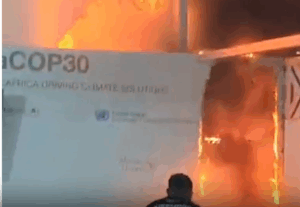
That’s right. In feels-like-100 heat (37.7C) – in the Brazilian jungle, the Climate Conference caught fire. American climate author and activist Bill McKibben said:
“People warned each other, and evacuated. Firefighters arrived and used their tools to put out the blaze.
In other words, everyone behaved in precisely the opposite way they’ve reacted to the fire that’s begun to consume the earth.”
By the way, McKibben’s flagship organization 350.org is suspending U.S. operations and cutting global staff. Funding is down. Are the wealthy afraid to help a climate cause in the new political atmosphere? Are ordinary people just too broke? We may tire of hearing about climate change, but climate is never done with you.
ARCTIC MICRO-WORLD MEETS MACRO-CHANGE
You and I we are going to the opposite Pole, where the cold isn’t so cold anymore. Biologist Trond Kristiansen explains “A gigantic light experiment is taking place in the Arctic” as sea ice retreat makes new marine environments. Meanwhile, cold-loving microbes go through a revolution of their own as the Arctic warms fast. This tiny world affects everything. Could a rapid change in microbial worlds unbalance things like oxygen or greenhouse gases – and threaten our own existence? From Montreal, scientist Scott Sugden reviews “Current and projected effects of climate change in cryosphere microbial ecosystems”.
Then we go back to Belem. Despite fire and a deluge of fossil fuel lobbyists, three experts reveal the latest worrying science on thawing permafrost – the carbon bomb in the north. From the International Cryosphere Climate Initiative at COP30, selected clips from Gustaf Hugelius, Stockholm University, Christina Schadel from the Woodwell Climate Research Center, and Fabian Seemann, Alfred Wegener Institute in Potsdam.
Welcome to Radio Ecoshock.
Listen to or download this week’s theme song: “Far, Far Pole” – a spiritual. Lyrics by Alex Smith, AI music, Creative Commons license.
Help me keep going with either a monthly donation or a one-time boost! All this work is completely funded by radio listeners and blog readers. Radio Ecoshock gets no corporate money or government grants. Everything, all this science of the future, goes out to over 100 non-profit radio stations for free, and to people around the world via podcast and downloads. Please help if you can.
THE GREAT ARCTIC EXPERIMENT
TROND KRISTIANSEN
“A gigantic light experiment is taking place in the Arctic” says a 2015 paper. Now we get an update with new science on the future of Arctic marine life – now that sea-ice is in full retreat. Just published November 6 in Nature Communications, we are joined by Lead Author Trond Kristiansen. Trond’s Doctorate in Biology comes from University of Bergen. While publishing science, Trond advises on marine climate risk for Actea, and the California nonprofit group Farallon Institute.
Listen to or download this 21 minute interview with Trond Kristiansen in CD Quality or Lo-Fi

In years of interviews with scientists, the talk was of more sunlight heating the sea. No one explored the impacts of more light. It is like someone turned a switch up there, illuminating a hidden undersea world. Now we get this new science: “Climate change impacts on ocean light in Arctic ecosystems” (Open Access, November 6, 2025 in Nature Communications).
The authors include a long list of other conditions that affect light arriving in Arctic seas. A big one: sea ice reveals more ocean waters to sunlight (other than in Polar night). But if deflecting clouds increase over the Arctic as warming progresses, maybe the ice loss and more clouds would cancel one another out, or at least affect the outcome.
Can we really predict what cloud cover might be in the overheated Arctic? The authors investigate and find “results suggest that changes in cloud cover are not a main driver of changes in PAR in the ocean, compared to the reduced extent and thickness of snow and sea ice.” PAR stands for “Photosynthetically Active Radiation” – select bands of light used by plants for photosynthesis.
This study uses tools to analyze bands of light. One key band is UV-B. They say:
“UV-B light (280–315 nm), which can be a significant stressor for phytoplankton, zooplankton, and fish embryos, and affects the development and growth of larval fish.” Trond tells us Polar Cod hide their eggs under the edge of the sea ice to protect them from UV-B light. Naturally, when sea ice retreats or disappears, that can be a problem for the delicate egg stage of cod reproduction. In included those eggs under the ice in the lyrics for this week’s song “Far, Far Pole”.
That is just the beginning of climate-driven changes for Arctic Cod. The paper warns:
“The thermal threshold of 4.5 °C for polar cod eggs suggests that expected temperatures will be lethal under SSP5-8.5 by the end of the century “
There are two levels to this study:
1. how much extra light reaches into the Arctic Ocean?
2. what is the impact of that on plankton and up the food chain to fish?
THEY PREDICT A HUGE INCREASE IN LIGHT
“We predict a 75–160% increase in visible light by 2100 in the Northern Bering, Chukchi, and Barents Seas.”
But it ends up being bad news for fish…
“We predict increased sunlight and warmer summer waters, with reduced phytoplankton levels, will negatively impact cold-water fish species growth and survival during summer, demonstrated here for polar cod.”
POLAR COD
Polar cod (Boreogadus saida) is a small, cold-adapted fish that plays a key role as a keystone species in the Arctic marine ecosystem. It is among the most abundant fish in the circumpolar Arctic, found from surface waters to depths of over 1,300 meters. Known in America as “Arctic cod” this fish is well adapted to icy sub-zero environments. That is due to the production of antifreeze glycoproteins in its blood, which prevent ice crystals from forming. Our guest Trond Kristiansen wrote his Doctoral Thesis on Polar Cod.
PLANKTON BOOM AND BUST
Like many species in the sea, Polar cod feed on plankton. You might expect plankton will flourish with added light, now there is less summer sea ice. Indeed plankton does grow rapidly, too rapidly, and uses up the limited flow of nutrients in Arctic waters. This gets worse as the summer progresses. Warming, freshwater input from ice melt, and reduced vertical mixing leads to stable stratification – which prevents the replenishment of nutrients from deeper layers.
For more on this see this paper published November 14, 2024: “Changes in Arctic Ocean plankton community structure and trophic dynamics on seasonal to interannual timescales”.
This paper also has a human commercial lens, looking at “productive” fisheries, 3 species in particular. It does not examine changing light impacts on marine mammals (like whales or seals), or marine micro-organisms.
THE NORTH ATLANTIC CYCLE
In 2018 Kristiansen co-authored a paper on the long cycle of cooling and warming in the North Atlantic, called the Atlantic Multidecadal Oscillation or AMO. This 60 to 80 year long natural cycle can bring serious changes to summers and winters around Ireland, the UK, and Northern Europe. In the interview Trond references this paper about the North Atlantic Oscillation (NAO): “Recent slowing of Arctic sea ice melt tied to multidecadal NAO variability” (Open access Published: 26 September 2025 in Nature.)
If you would like to know more about these decadal patterns of colder and warmer periods in the North Atlantic, check out this 2018 paper co-authored by Trond Kristiansen “A synthesis of the ecosystem responses to the late 20th century cold period in the northern North Atlantic.”
PUTTING THE WORST AT THE BACK?
This new 2025 study in Nature Communications puts prediction graphs for the IPCC Intermediate scenario, called SSP 2.5-4.5 into the main paper. Results for the much more alarming SSP5 to 8.5 scenario are back in the Supplementary Materials. Some expert guests say without a drastic change in human affairs – our current emissions path is likely to reach higher warming. I would have put results from those hotter scenarios right into the main paper. Not as many people get to the Supplementary Materials.
Listeners/readers can compare the two scenarios, intermediate and worst case, here (scroll down for helpful graphs).
ANOTHER TIPPING POINT?
Models on Photosynthetically Active Radiation showed a possible tipping point for the Arctic Ocean around Alaska. Trond explains this possible “bifurcation” which could emerge as soon as mid-Century, leading to changes in Arctic microbial life that are difficult to grasp.
The paper says:
“We also observe a sudden significant increase in PAR after 2050 for the SSP5-8.5 scenario in the Northern Bering and Chukchi Sea. This could indicate that the system will then reach a tipping point potentially caused by the collapse of sea ice concentration and a strong increase in air and ocean temperatures.”
RESULTS – NEW LIGHT INTO NORTHERN SEAS
“Based on climate scenarios SSP2-4.5 and SSP5-8.5, visible light (PAR) reaching the surface water column will increase by 55–160% annually by the year 2100 in response to the increased fraction of open water, mainly driven by reduced sea ice concentration, as well as other changes in physical factors simulated in the CMIP6 future model runs (e.g., changes in cloud cover, increased air temperatures, reduced sea ice thickness). “
“A GIGANTIC LIGHT EXPERIMENT IS TAKING PLACE IN THE ARCTIC”
That insight comes from another T. Kristiansen paper in 2015. The title is: “A fish-eye view on the new Arctic lightscape”.
All these papers are Open Access, free for you to read. In the new 2025 paper considered in this interview, the authors call it “Changes in the optical properties of the ocean’s skin”.
SEE ALSO PAUL BECKWITH VIDEO ON THIS PAPER
“Climate Change Impacts on Solar Light Reflection and Transmission into the Arctic Ocean”
MICROBES ARE CHANGING IN THE ARCTIC
SCOTT SUGDEN
It turns out life is everywhere. From glaciers to permafrost, strange species survive conditions in the dark, well below freezing. Now microbial life in the ice world is changing Earth’s climate, as climate changes them. A team of scientists reviewed what is known. They just published the paper “Current and projected effects of climate change in cryosphere microbial ecosystems”. The Lead Author is Scott Sugden, a research scientist and lecturer at McGill University in Montreal.
Listen to or download this 21 minute interview with Scott Sugden in CD Quality or Lo-Fi
“…the trajectory of our warming world will be closely linked to microbial activity within the warming cryosphere”
Here is how the authors explain their study approach:
1. “We first summarize current knowledge on the microbial communities that inhabit different cryosphere environments.
2. We then review how cryosphere habitats and their microbiomes are expected to change with a warming climate, focusing on both short-term drivers of cellular physiology and activity and longer-term changes in species assemblages and functions.
These effects are illustrated with three examples showcasing how rapid changes in cryosphere microbial ecosystems are already affecting the ecosystem services they provide.
3. Finally, we identify areas in which the current understanding of cryosphere microbial ecology in a warming world remains limited, and we provide suggestions for closing these knowledge gaps and better predicting the future of Earth’s cold-adapted microbial ecosystems.”
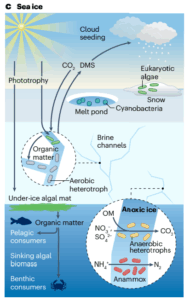
About a quarter to a half of organic carbon stored on land is in the Cryosphere, held there like a cold locker. Surprisingly, the authors find there is a richer microbial life on sea ice than in surrounding water!
“On a per-volume basis, sea ice is more productive than the surrounding pelagic waters, with thick algal mats forming under the ice or along the ice margins where light is available and inorganic nutrient concentrations and temperatures are highest. These algal mats form the base of the marine food web, accounting for up to 60% of total primary production in the polar oceans.”
There is even a lot of life in snow.
MICROBES ON SEA ICE MAY ALSO AFFECT CLOUD FORMATION!
“Some algal species also produce dimethylsulfoniopropionate, which can be converted by sea ice algae and bacteria into dimethyl sulfide, a volatile sulfur compound that can modulate climate by enhancing aerosol and cloud formation.”
MORE LIFE = MORE WARMING
“In icy biomes, increased microbial activity accelerates glacial retreat and acts as another positive feedback on climate change. Glaciers, ice sheets, snow fields and sea ice are important contributors to the reflection of solar radiation and the prevention of further global warming. Darkening of these environments reduces the surface albedo, which causes greater absorption of solar radiation and therefore localized increases in temperature and ice melt.
Although much of the darkening is abiotic (owing to dust or surface water), biological albedo reduction occurs where pigmented microbial communities increase local light absorption. Climate-driven increases in temperature, growing season length and water and nutrient availability are extending the habitable area and duration of biological activity on the surface of snowy and icy environments, thereby increasing the period of microbially driven solar absorption and melt.”
This paper includes this amazing fact:
“In Greenland, glacier ice algal blooms can reduce albedo by 30–40% and increase annual glacial runoff by 9–13%.”
FIND OUT MORE
You can dig in deeper to microbial changes to ice albedo with this paper: “Light absorption and albedo reduction by pigmented microalgae on snow and ice.” (2023)
There is a documentary related to microbial life in the cryosphere titled “The Last Ice Area: Searching for microscopic life in the Arctic.” It features a museum scientist describing fieldwork collecting water samples from Arctic lakes beneath ice, studying biofilms made up of cyanobacteria and complex microbial communities that thrive in extreme Arctic aquatic ecosystems.
https://www.youtube.com/watch?v=M28fvmEhLBc
Here is another good one: “Life in the deep freeze – the revolution that changed our view of glaciers forever” by Janet Crompton with good photos.
Life in the deep freeze – the revolution that changed our view of glaciers forever
ALEX: TINY THOUGHTS ON TINY THINGS
One thing we learned from talking with microbiologist David Thaler at University of Basel: there is no catalog of micro-life. That can never be constructed. Those tiny life-forms evolve so quickly that new living things tend to show up in every sample. We can only know a fraction of what is alive in the cryosphere. A fact sheet published in Nature says “...the fraction of microbial diversity that we have sampled to date is effectively zero…”
You think the recent pandemic was tough – it is all-out war every day in the microscopic world. A startling Nature Editorial in 2011 revealed:
“The rate of viral infection in the oceans stands at 1 × 10²³ infections per second, and these infections remove 20–40% of all bacterial cells each day.”
It almost sounds like viruses are a control mechanism on the populations of bacteria. Bacteria lose 20 to 40% of their troops in 24 hours and replace them in the same time period! The balance of this system could change when ice environments disappear and global oceans heat up. We, and all organisms large enough to see, totally depend on micro-life forms. While teams of scientists count the stars, our grasp of the microcosm is close to zero.
PERMAFROST:
BACK TO THE FUTURE PANEL
Keeping to our focus on the cryosphere, another disappearing realm of the north is permafrost thaw. About a quarter of all land in the Northern Hemisphere has been frozen for thousands of years. Now it is thawing. New science finds more greenhouse gases and climate twists, none considered by the Intergovernmental Panel on Climate Change or your government. I’ve selected key clips from three speakers at a COP30 presentation called “Permafrost Thaw is Warming the Global Climate and Impacts Communities, Health, and Oceans”. This panel at the International Cryosphere Climate Initiative Pavilion was recorded on November 14, 2025.
GUSTAF HEGELIUS
The first is Gustaf Hugelius, Professor Of Physical Geography at Stockholm University and Vice Director of the Bolin Center for Climate Research.
Hegelius tells us the most intense thaw of permafrost is in northern Siberia. That area is really cooking, coming alive again, in much larger areas than say in Northern Canada and Alaska. In North America, scientists find permafrost thaw is localized, forming a patchwork of sunken land, new small lakes and bogs. Hegelius suggests loss of sea ice is a major driver of permafrost thaw.
He says permafrost is losing substantial amounts of ice. Newly released water from permafrost is on a par with the amount of ice melting in Antarctica, and likewise adds to global sea levels!
During the presentation Gustaf Hegelius says:
“So there was a big project called Recap 2 which put together permafrost region greenhouse gas budgets for CO2 methane and nitrous oxide and taken together if you combine all of these greenhouse gases we see that the region is already a net source of warming.
So we’re already warming the global climate and this is contrary to what climate models typically show. The climate models don’t have all of these processes. So in the models the region still comes out as being a net sink because of growing carbon uptake in forest. But the the new estimates show that this is not is is no longer the case. The budget is still a little bit uncertain.”
DIRE NEWS
Looking into the future, permafrost will emit on the scale of of a large country perhaps more than the EU.
Later he continues:
“You get different scenarios depending on all of these different types of futures. But I think the important thing is that if you compare the the the permafrost emissions, they are really on on the scale of extrapolated emissions from major emitters. Looking into the future, permafrost will emit on the scale of of a large country perhaps more than the EU.
If we stay on path we are now and if we go on even you know up towards 3 degrees or warmer it’s on on on the scale of U.S. or China emissions by the end of the century. This is really dire news.
Summarizing the permafrost region is already a net source of greenhouse gases and affects near-term mitigation needs. It is already affecting us on mid to long term 2015 and onwards we will see committed and profound permafrost impacts decreasing emission budgets and really damaging infrastructure as well and overshoot warming – which we are unfortunately basically committed to now – would trigger irreversible force that drives additional warming for centuries even after the climate stabilizes.”
CHRISTINA SCHADEL
Next up from the Cryosphere Pavilion at COP30 in Brazil is Dr. Christina Schadel from the Woodwell Climate Research Center.
NEW: ABRUPT PERMAFROST THAW
Schadel says:
“I want to focus on two different types of thawing just to make sure we’re all on the same page. Generally across the landscape overall we have gradual thaw which is the deepening of the active layer where the top part of the soil thaws during the summer and then freezes back up in the winter. This is the most common form of thaw which is happening happening across the entire Arctic and each summer that thaw just goes deeper and deeper and then as Gustaf already said there is about 1.5 trillion tons of carbon in in the permafrost region.
The other form of thaw that is really important and has gotten much more attention is what we call “abrupt thaw”. In the picture to the left you see an ice wedge. Most permafrost contains ice but In some areas there are these massive ice wedges. There is a person in front of the ice wedge just for comparison of the size, how big those ice wedges are. (Woodwell image)
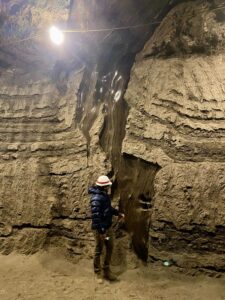
And now you can imagine if it gets really warm and the ice melts then that huge space that has been taken up by the ice – the ice goes away and then the ground collapses. Then you end up with a landscape that looks like the one here to the right where it’s all just collapsed.
And so this has impacts huge impacts for infrastructure that’s built on permafrost. But then it also has impact obviously on vegetation and ecosystems. And there are very deep soil layers that are suddenly exposed to much warmer temperatures than they otherwise would – because they would be really deep down – and that increases carbon emissions by quite a lot as well. Only about 20% of the landscape are affected by abrupt thaw, but that doesn’t mean it’s not important. That is a thing that has been relatively newly identified.”
FEEDBACKS BETWEEN WILDFIRE AND PERMAFROST
Again from the Schadel presentation at COP30:
“And then as Gustaf just mentioned that nicely before me, there is other impacts on permafrost thaw through wildfire. It burns a lot of the above above ground vegetation and with that of course a lot of carbon as well.
But then the other impact that’s really important to be aware of is the fire burns the organic layer. The organic layer insulates the permafrost and if that layer is gone then you have really warm temperatures penetrating into the ground. Then you end up with these ice wedges melting faster. You’re ending up with collapsing ground and much more destabilization. These disturbance effects that are really important but are not well enough quantified and especially not quantified in future modeling projections...”
NOT INCLUDED IN IPCC CARBON CALCULATIONS
“And if you’re including the abrupt combustion and post-fire thaw on top of gradual thaw, you’re adding 166 to 258% carbon. So more than twice as much carbon if you’re accounting for all these disturbance processes.
But these emissions are not included in the IPCC. IPCC does recognize that additional ecosystem responses to warming from like CO2 and methane fluxes would further increase concentrations of these gases in the atmosphere and that there’s very high confidence. But those numbers are not included. There is high confidence it will happen, but they’re not in there. And that causes a a big problem for negotiations here for example or in general when you’re talking about how much carbon do we have left be in order to avoid the 1.5 or two degree temperature target on a on a long scale long-term scale.”
SUBSEA PERMAFROST EMISSIONS – BIG QUESTIONS
FABIAN SEEMANN
Our final speaker is young scientist Fabian Seemann from the Alfred Wegener Institute in Potsdam Germany. Fabian is active in the Permafrost Young Researchers Network (PYRN) and the Association of Polar Early Career Scientists (APECS), and is involved in coordinating workshops for young researchers at Alfred Wegener Institute.
Here is a bit from Seemann’s presentation:
“I would like to shift the focus more now on subsea environments as well as coastal environments. as there have been key updates on this land to ocean continuum, but also specifically on subsea permafrost environments and coastal regions around the Arctic.
So subsea formed as terrestrial permafrost during glacial times when sea levels were lower compared to today. When ice was bound or water was bound in the ice caps. Now with uh sea level rise after the glacials, the sea levels rose and these yeah coastal regions became inundated and flooded by from from by the Arctic Ocean resulting in subsea permafrost today.
And the area that is covered by subsea permafrost actually equals the the area of the country size of Algeria which is the 10th biggest country in the world. just to uh to to stress the aerial extent of subse permafrost. Now subs permafrost is also warming and thawing with climate change and this is mainly regulated by sea ice. As sea ice extent is shrinking oceans temperatures are increasing and thereby also warming uh and thawing subsidy subsea permafrost. Generally, the subsea carbon pool is of low reactivity but still we have current emissions from subsea permafrost by about 50 Terra grams of carbon per year.”
Watch the whole presentation (1 hour 6 minutes) on YouTube here.
Obviously, we are out of time. I am amazed you got this far in a long dense blog. Thank you for caring.
Alex