Two Tasmanian experts with strange and shocking discoveries on the new emerging Continent, down at the bottom of the world. Dr. Edward Doddridge reports on impacts of abrupt Antarctic sea ice loss. Dr. Matt King, Director at the Australian Centre for Excellence in Antarctic Science talks latest science – planetary-scale shifts in currents, glacier melt and sea level rise. Not reported on the news, but this changes everything.
Listen to or download this Radio Ecoshock show in CD Quality (57 MB) or Lo-Fi (14 MB)
Listen to or download this show theme song: “Bottom of the World” (lyrics by Alex Smith and AI generated music).
Welcome back to a new season of Radio Ecoshock! Time is short, so let’s dive right in with our first interview.
====================================
ANTARCTIC SEA ICE CRASH – WHAT DOES IT MEAN?
EDWARD DODDRIDGE
About ten years ago, summer sea ice crashed around Antarctica. It exposed vast areas of the sea to full solar power, changing ocean currents and the atmosphere. Let’s explore what it means.
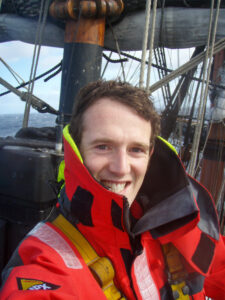
Edward Doddridge is Research Fellow in Physical Oceanography at the Institute for Marine and Antarctic Studies in Tasmania. On July 1st 2025 Doddridge and 24 co-author scientists published a list of serious impacts from missing sea ice at the southern Pole.
Listen to or download this 30 minute interview with Edward Doddridge in CD Quality or LoFi
OLYMPUS DIGITAL CAMERA
We discuss results from this new Open Access paper let by Edward Doddridge: “Impacts of Antarctic summer sea-ice extremes” (July 1, 2025 in PNAS Nexus).
In a handy explainer in The Conversation, Doddridge lists four major impacts when Antarctic sea ice fails to form. The article is “Antarctic summer sea ice is at record lows. Here’s how it will harm the planet – and us”.
In this radio interview, Edward explains these four big impacts: 1. ocean warming is compounding 2. More icebergs are forming 3. Wildlife squeezed off the ice and 4. Logistical challenges at the end of the world.
The paper says:
“Antarctic sea ice provides climate and ecosystem services of regional and global significance.
[1] The high albedo of its near-ubiquitous snow cover makes sea ice important in setting local ocean mixed-layer temperature, and the global energy balance.
[2] This is augmented by the freeze/melt cycle’s role for Southern Ocean uptake of heat and climate active gases, including CO2.
[3] Sea ice protects Antarctic ice shelves from potentially damaging ocean swells , which has implications for global sea- level rise, and provides habitat for a range of ice-dependent organisms and ecosystems on and around Antarctica.
Because the coupled climate system contains numerous feedback mechanisms and nonlinear interactions, the impact of an extreme change in sea-ice coverage may be significantly larger than linear extrapolation would suggest.“
OCEAN HAS MEMORY
Regarding ocean heat compounding, they say:
“The ocean provides a memory to the coupled ocean-sea ice-atmosphere system, meaning that sea-ice and ocean-temperature anomalies may survive for several years. If multiple sea-ice extremes occur within a persistence window, then there is potential for their impacts to compound. In the physical system, this may manifest as persistent changes in ocean temperature or salinity,...”
ANTARCTICA CONTINUES TO BREAK RECORDS FOR LOW SEA ICE
Again, from the paper “Impacts of Antarctic summer sea-ice extremes”:
“… the extreme warming observed in the 2016/2017 summer coincides with a record breaking summer minimum with sea ice extent dropping to its then lowest value since the beginning of the satellite record. This record has subsequently been broken in 2022 and again in 2023, while the subsurface ocean continues to warm.”
MORE SCIENCE DISCUSSED IN THIS INTERVIEW
Another new paper came out in Nature June 18, led by Elise Droste. It finds “Sea ice duration controls ocean stratification”. So more open ocean adds to mixing which brings up carbon-rich waters, increasing release of carbon dioxide, the main warming gas. Future warming may partly hinge on relationships between sea ice and the carbon cycle.
See: “Sea ice controls net ocean uptake of carbon dioxide by regulating wintertime stratification” Open access, published 18 June 2025.
An earlier study in Nature, December 18 2024 found “Record-low Antarctic sea ice in 2023 increased ocean heat loss and storms”. Approaching Antarctica is already the fear of sailors, with horrific winds, towering waves, and blowing ice to be expected. They call that approach toward the Poles “The Roaring 40’s” near 40 degrees latitude south. That may get worse? It will be harder to even get there.
Led by Simon Josey from the National Oceanography Centre in Southampton, this team also found lower summer sea ice led to “an unprecedented doubling of mid-winter ocean heat loss.” I ask Edward about that.
In the past, scientists reconstructed ice loss that generally occurred at one pole or the other. At times they alternated, with sea ice at the North Pole shrinking, for example, while sea ice grew around Antarctica – as was the case up until around 2012 in our common era. What does it mean that sea ice is now disappearing seasonally at both poles at once? We discuss in the interview.
Finally, I hope to find more about Antarctic sea ice loss and teleconnections. For example see this article by Cvijanovic et al Nature March 2025 about teleconnections from Arctic sea ice loss.
I found a half dozen papers suggesting teleconnections from tropical conditions influence sea ice in the Southern Ocean. What about the other way around? Surely such a large seasonal change in the Southern Oceans must influence weather beyond the Pole, maybe in South America, Australia or even up to North America? What do we know?
MORE SCIENCE TO CHECK OUT ON ANTARCTIC SEA ICE LOSS
(including tips from Facebook posts by Jan Umsonst)
“Rising surface salinity and declining sea ice: A new Southern Ocean state revealed by satellites” Alessandro Silvano et al June 30, 2025 in PNAS
“Tropical climate responses to projected Arctic and Antarctic sea-ice loss”
“The Relative Importance of Antarctic Sea Ice Loss within the Response to Greenhouse Warming”
“Robust Arctic warming caused by projected Antarctic sea ice loss”
Published 17 September 2020 Environmental Research Letters, Matthew England et al.
Abstract
Over the coming century, both Arctic and Antarctic sea ice cover are projected to substantially decline. While many studies have documented the potential impacts of projected Arctic sea ice loss on the climate of the mid-latitudes and the tropics, little attention has been paid to the impacts of Antarctic sea ice loss.
Here, using comprehensive climate model simulations, we show that the effects of end-of-the-century projected Antarctic sea ice loss extend much further than the tropics, and are able to produce considerable impacts on Arctic climate.
Specifically, our model indicates that the Arctic surface will warm by 1 °C and Arctic sea ice extent will decline by 0.5 × 10⁶ km2 in response to future Antarctic sea ice loss.
Furthermore, with the aid of additional atmosphere-only simulations, we show that this pole-to-pole effect is mediated by the response of the tropical SSTs to Antarctic sea ice loss: these simulations reveal that Rossby waves originating in the tropical Pacific cause the Aleutian Low to deepen in the boreal winter, bringing warm air into the Arctic, and leading to sea ice loss in the Bering Sea.
This pole-to-pole signal highlights the importance of understanding the climate impacts of the projected sea ice loss in the Antarctic, which could be as important as those associated with projected sea ice loss in the Arctic.
========================
OVERVIEW OF ANTARCTIC CLIMATE CHANGE
MATT KING
Sea ice loss around Antarctica is just ONE of the mega-scale changes in Antarctica as we heat the planet. For the overview and the latest we go to a well-known expert in the field.
We hear a lot about change in the Arctic, but not Antarctica. Yet the South Pole holds many world-scale risks and it’s own unique tipping points. In just one example, sea level rise from melting Antarctic glaciers could flood major coastal cities and delta crop lands around the world.
Dr. Matt King is Director at the Australian Centre for Excellence in Antarctic Science (ACEAS). He is a Professor at the University of Tasmania. We last spoke in December 2024 – before the voyage of a research ship – and before dozens of papers this year on Antarctica, many by Australian researchers.

Listen to or download this 23 minute interview with Matt King in CD Quality or LoFi
Most of us know about dangerous weakening of the Gulf Stream warming the East Coast, the UK, and Scandinavia. The movie “The Day After Tomorrow” popularized the Gulf Stream shutting down. But a major current in the southern ocean conveyor belt has already almost stopped around Antarctica?
New science about the state of the Antarctic Circumpolar Current complicates things. One author suggested the current was “reversed” – but that was modified. The original article July 1 was titled “News 01 July 2025 “Major reversal in ocean circulation detected in the Southern Ocean, with key climate implications”. After others reported on this “reversal” the headline was amended to “A change in the Southern Ocean structure can have climate implications”.
Apparently one of the authors stated more than what was in the paper. This was all quickly fixed.
TIPPING POINTS IN ANTARCTICA
We heard about tipping points in the Gulf Stream system, and in the Amazon. But until recent research, most talk about Antarctica looked at relatively slow changes. Then a December 2024 study found 8 possible tipping points in Antarctica.
Check out Paul Beckwith’s video on these S. Polar tipping points:
“How Antarctica’s Tipping Points can Cascade and Destabilize our Overall Global Climate System” Dec 21, 2024.
EIGHT TIPPING POINTS:
* ice sheets,
* ocean acidification,
* ocean circulation,
* species redistribution,
* invasive species,
* permafrost melting,
* local pollution, and
* the Antarctic Treaty System
MORE ON ANTARCTIC SEA ICE CRASH
When the Arctic sea ice crashed in 2007, we heard wide-spread surprise and concern from world scientists. The reversal and fall of Antarctic sea ice in 2014 was less noticed. The future of Southern Ocean ice still seems uncertain. We don’t know whether this is a permanent change to less sea ice, or maybe it will return?
One summer 2025 headline says “Southern Ocean Salinity May Be Triggering Sea Ice Loss”. Does this solve the mystery of why Antarctic sea ice was still growing until about 2012, and then pulled back precipitously? So far, there is no scientific consensus on the cause.
From a global perspective, I worry about the loss of that giant white mirror of ice that was bouncing some solar energy back into space. How serious is that change in sea ice for Earth Energy Imbalance? Edward Doddridge discusses this in our earlier interview.
AMERICA BAILS OUT OF ANTARCTICA…
Climate science funded by the U.S. Federal Government has been slashed and burned. The U.S. intends to dock it’s only U.S. Antarctic research icebreaker. Other countries will have to pick up that slack. China has been funding and producing a lot of new science on climate and Earth systems. China built two bases in Antarctica.
U.S. CUTTING OFF KEY SATELLITE FEED USED BY SCIENCTISTS
As Doddridge tells us, the U.S. Department of Defense announced an end to sharing satellite data that was used by Polar scientists to track sea ice and glaciers in Antarctica. Now that has been modified. The data will keep coming this year, but will be cut off next summer, when the satellites involved reach the end of their official service life.
Doddridge says there are newer satellites, with arguably better sensors, but there remains a problem. The best records are the longest ones kept by the same instrument. There are differences between satellites, and it can be difficult to match up the data from one to possibly new arrangements or modes on a newer satellite. It makes measurements of whether sea ice is growing or retreating more difficult over long periods of time.
Australia continues to play a major role in Antarctic research, but as Matt King tells us, that is no guaranteed. So far the Australian Centre for Excellence in Antarctic Science does not have next year’s funding nailed down. There are talks with government trying to make this funding more secure and reliable. Australia is not immune to right-wing swings a bit like America. Australia has mining kings and queens, especially in coal, who are happy to fund anti-science and influence governments. Then there is the whole gas lobby.
NEW ZEALAND TOO
Hopefully the current Australian leadership role in Antarctic research and science can be maintained. Sadly, New Zealand slashed their Antarctic funding with the new more Right government.
Here are a few links to follow up on Australian Antarctic research funding.
The Forgotten Frontier: Why Australia Must Rethink Its Antarctic Commitment
———————–
NEW ARTICLE FROM MATT KING
COMMENT 18 August 2025 Nature
Protect Antarctica — or risk accelerating planetary meltdown
To keep Earth habitable, humanity must recognize the value of Antarctica and seek to save it from irreversible damage.
By Ida Kubiszewski, Robert Costanza, Elizabeth A. Fulton, Matt A. King et al
———————-
SCIENCE & MEDIA FOCUS ON ARCTIC
BUT NOT MAJOR CHANGE IN ANTARCTICA
One example: There was concern for years and still that methane could rise from the sea floor, adding a boost in global warming. The Arctic Methane Emergency Group was formed, the Swedish Academy funded research vessels, the Russians warned about it. But hardly anyone knows large methane leaks were discovered in Antarctica this year. There is a science paper out on that. So far, the Antarctic undersea methane is dissolving in the water column, not venting to air above the ocean surface.
Second: scientists and the public generally know about dangerous weakening of the Atlantic Meridional Overturning Circulation which warms the U.S. East Coast, the UK and Scandinavia. The movie “The Day After Tomorrow” popularized it. But again, a major weakened current in the ocean conveyor belt has already happened around Antarctica. So few know what it means, it might as well be on another planet.
=====================
ALEX WONDERS
We call Antarctica the frozen continent at the bottom of the world. Is there any “top” or “bottom” to Earth? If most people lived in the Southern Hemisphere, and just discovered the Arctic Ocean in recent centuries, would that be called “the bottom of the world”?
I hope this little tour of climate change in Antarctica helps us all understand more of the big forces at work in the natural and physical realms. The sea level will rise for at least a thousand years, no matter what your politics or economy may be. We are at a point where humans can force a change, but then cannot stop it, much less change back. We can still stop extinction-level warming – only if we are brave and ready for self-sacrifice. Do it for the children and innocent species traveling with us on this space rock.
I’m Alex Smith. Don’t forget to donate to your local non-profit radio stations. Now, more than ever, we need free voices on free radio. Find a list of Radio Ecoshock stations and play times here.
Thank you for listening, and please stay on board for another wild ride this Fall.
Alex
