It is another frightening year of wildfires in Europe and North America. From the smoke zone, the latest fire news, science and analysis with world-recognized fire expert Dr. Mike Flannigan. With decades in the field, Dr. Flanagan is BC Innovation Research Chair in Predictive Services, Emergency Management and Fire Science at Thompson Rivers University.
Listen to or download this Radio Ecoshock show in CD Quality (57 MB) or Lo-Fi (14 MB)
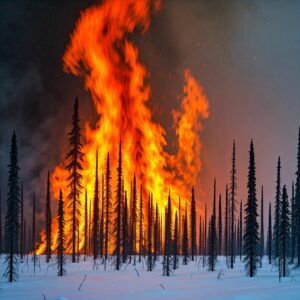
After a summer of stunning wildfires across Europe and North America, welcome to a deep dive into more extreme fires in an over-heating world. Whole landscapes have been devastated. Clouds of smoke took away summer for millions of people, feeling again like the pandemic shut-in. Wildfire smoke is deadly stuff, and you will hear tips to protect yourself and your loved ones. We need to change, along with the climate.
As Detective Joe Friday famously said on the old TV show “Dragnet”: “All we want are the facts.” Here we go.
ANOTHER FRIGHTENING WILDFIRE YEAR
MIKE FLANNIGAN

Listen to or download this 45 minute interview with Dr. Mike Flannigan in CD Quality of Lo-Fi
Mike was the Editor-in-Chief of the International Journal of Wildland Fire (2002-2008) and a leader in the US National Assessment on Global Change, the Intergovernmental Panel on Climate Change, and other global fire projects world-wide.
SMOKY TIMES ARE NOT GOOD TIMES
Flannigan reports his home base in Kamloops British Columbia was not directly threatened by wildfires this year. But he surely got the smoke. Mike told us:
“... this was a hot, smoky summer, and I was getting cabin fever. The smoke was awful for weeks, and staying indoors or wearing masks to go outside, and the smoke would sneak in inside over time as well. And we have air purifiers running. Yeah, it was a rough summer because, you know, we enjoyed long day lengths, the warmer temperatures, and we kind of lost it this year because of the smoke. That’s exactly how I lived it.”
For me, this is the first year that I got some smoke inside the house, despite having all the windows shut and the air purifiers running. So, something about that smoke this year was very penetrating.
Mike warned about tiny toxic particles in wildfire smoke:
“... the numbers were really high concentrations, PM 2.5. And some of the particles in wildfire smoke are actually much smaller than PM 2.5, so they can find their way inside over time. And actually, for a prolonged period, the air quality inside, if you’re not running air purifiers, can be as bad or worse than outside. So, it’s really important to have those air purifiers or having your furnace with proper HEPA filters, so that keep the smoke outside your house.“
“EXPECT A BAD FIRE SEASON EVERY YEAR”
Flannigan:
“To me, 2026 was a litmus test, particularly for Canada, because we had three bad fire seasons in a row. 2023, record-smashing.
2024, started off slow, but got really active. The Jasper fire, of course, birds threw the town down. And then 2025, we’re trying to give 2023 a run for its money, but came in second place in terms of the most active year in terms of area burned.
So, our modern-day record never had three bad fire seasons in a row. So, 2026, if it was a bad fire season, I was going to start changing my narrative. My narrative has always been that there will be bad fire years, and there will be quiet fire years.
And regionally, I still believe that. The Pacific Northwest, next year could be wet and cool. But at a scale of a country, like Canada or the United States, somewhere we’re going to see extreme fire weather episodes and ignitions and have lots of fire.
And that’s my new narrative. Expect a bad fire season every year. And, you know, so we’ve had four in a row, 2026, past 4 million hectares, which is twice the size of Lake Ontario. And I’ll say that clearly, Lake Ontario.
And, you know, this is just continuing this trend. If we go back a couple more years, 2021 was a very active year in Canada. And so that’s five out of the last six years were active. And that’s what I expect for the future. And much the same for the United States. I think it’s a little more dramatic for Canada because we’re higher latitudes, and we’re seeing more warming than lower latitudes like the United States. And I think the warmer world is driving what we see.”
Be sure to listen to the whole interview. We always learn from Mike Flannigan.
THE UNTOLD STORY OF WILDFIRE OZONE POLLUTION
One more part of this fire story: ozone. It is not just the tiny PM2.5 particles that threaten your health. Wildfire smoke also creates ground-level ozone leading to thousands of premature deaths in the United States alone. Usually I associate low-level ozone with smog, not wildfire smoke. But here is a new study: “Growing impacts of fire smoke on ozone pollution and associated mortality burden in the United States” led by Yangmingkai Li.
The strange thing is: ozone deaths were decreasing because industrial societies in the West spent money and a couple of decades to clean up smog. Part of that smog was ozone, and now it is coming back in some areas due to wildfires.
From a climate perspective, more ground-level ozone damages vegetation – meaning plants absorb less carbon dioxide from the air, the cleaning mechanism or “sink”. There is also a chemical reaction in the air. When ozone is present is depletes the agents which normally help methane break down. As you know, methane is a very powerful greenhouse gas, up to 80 times more potent than CO2. Wildfire smoke creates ozone which may prolong the lifetime of methane in the atmosphere. I have not seen a clear study of that yet. If you know that science exists, please send me a link using the Contact link in the upper menu bar.
DID THIS ALL HAPPEN BEFORE?
Wrapping up this special on wildfires in a warming world, a new paper in August investigated during a relatively fast rise in carbon dioxide in the atmosphere around 56 million years ago. From the journal Science press release:
“Ancient global warming drove forest canopy decline and ecosystem restructuring”.
“Forest fossils from Wyoming suggest that rapid and prolonged greenhouse warming during the Paleocene–Eocene Thermal Maximum (PETM) caused forests to thin, drastically reshaped plant communities, and reduced overall vegetation carbon storage. The findings could foreshadow challenges facing modern forests in our rapidly warming world.
Although rising atmospheric carbon dioxide initially stimulated plant growth across much of the globe, that trend has reversed in recent decades as increasing heat and drought place growing stress on vegetation. This shift raises concerns that forests may lose their capacity to store carbon, thereby accelerating climate change. However, the long-term effects of sustained greenhouse warming on forest structure and carbon storage remain poorly understood, leaving uncertainty about the future of today’s forests in our warming world.”
While that is helpful to know, human-made warming is much faster than the thermal maximum 56 million years ago. At the very least, that carbon injection and rapid heating beyond 5 degrees C, over 10 degrees Fahrenheit hotter – developed over several thousand years. We are doing it in two hundred. Our experiment is so fast, it is unique on this planet.
Most plants and animals cannot change as fast as the atmosphere these days. As David Spratt would say in Australia, all the signs are flashing Code Red.
=================
BREAKING CLIMATE STORIES
We just had time for a few breaking climate stories. For example, one paper published August 27 finds climate warming is amplifying El Nino in the Pacific. A Press Release from Science says
“The findings suggest that climate change is already amplifying one of the world’s most important sources of extreme weather, with potentially growing risks to ecosystems, infrastructure, and human societies.”
The paper “Recent strengthening of eastern Pacific ENSO in the last millennium paleorecord” is here, behind a paywall.
Or this in late August from Science Advances:
“Chicago study reveals wide-ranging ER diagnoses related to extreme heat
Kidney disorders, pressure ulcers, skin rashes, multiple sclerosis, varicose veins and cannabinoid-related disorders were some of the emergency room (ER) and urgent care (UC) diagnoses that increased during recent days of extreme heat in Chicago, Illinois, according to a new analysis by Hyojung Jang and colleagues.
The researchers also identified extreme-heat-related increases across a broad range of injury, assault, and accidental firearm discharge diagnoses, although the magnitudes of some of the associations were less precisely estimated than for disease associations.”
That is about the new paper “Identifying heat-related diagnoses in emergency department visits among adults in Chicago: A heat-wide association study” in Science Advances August 26, 2026.
We need a new kind of public health care and medical diagnosis in the new age of extreme heat. We are learning a hot humid event can create lasting damage to our bodies. This can be easily and unintentionally hidden. The true costs of high heat exposure are difficult to see at the individual level but appearing clearly in statistics that investigate emergency visits during and in days following extreme heat events.
SIBERIAN METHANE
Some of you follow the big Siberian methane threat we’ve been talking about for years. More new science about that just arrived. The title is “Decadal doubling of Siberian methane emissions due to warming-induced fires and methanogenesis”. Methanogenesis is conversion of stored organic carbon into methane by specialized microbes. But the other factor is the protagonist of this week’s program: more methane emissions from wildfires stimulated by global warming. More wildfires in the heat is not good news in many ways.
So the increase in methane from Siberia is not yet huge. The authors calculate an additional 1.9 teragrams of methane was released over a decade. That represents about .3% of annual methane emissions from all sources. Of course, any emissions that double every decade become big quickly, and everything added to the atmosphere adds to the heat crisis. The potential is huge: permafrost lands in the Northern hemisphere store about twice as much carbon currently found in the atmosphere. We don’t know fast this process is developing, but this new paper gives us first estimations.
There are people on YouTube and social media selling you panic over Siberian methane. But so far, the real threat is from humans, principally drilling, storing and transporting so-called natural gas. Where Siberia added another 1.9 teragrams over a decade, the global natural gas industry is releasing at least 35 teragrams, at least 17 times more – every year. We can do something about that and we will suffer if we don’t.
COMING UP ON RADIO ECOSHOCK
We’ve got some intriguing voices coming up on Radio Ecoshock. UK eco-activist Roger Hallam arrives to explain his new book on non-violence and pubic change. British author Bill McGuire has agreed to an interview, so we have the Doom factor covered. As promised, we have a world expert in extreme rainfall events coming soon. Code Pink co-founder Jodie Evans ties the climate and anti-war movements together. As rampant atmospheric change crashes into our lives, we search for answers.
I’m Alex Smith. Thank you for listening and caring about our world.
Here is a song about artificial lack of intelligence, lyrics by Alex Smith.