EU climate prediction expert Samantha Burgess on Euro stress and double-warming. Global fire news. WeatherWest Daniel Swain on new hot nights. Night firefighting. Burned towns. Global food outlook. New music. Welcome back.
Listen to or download this Radio Ecoshock show in CD Quality (57 MB) or Lo-Fi (14 MB)
Harsh extreme weather events are starting to dominate human lives and the economy. Many of us live it. Everyone can see. Climate change is here. We cover it all from breaking science to breaking news. Welcome back to a new season of Radio Ecoshock.
Listen to or download the new show song “Tell Me”
TOP CLIMATE STORY SUMMER OF 2026: EUROPE
I try to keep it real. There is no need to invent doom just yet. As scientist Michael Mann says, things are bad enough as they are. Later we find the world food situation is not that bad this year, despite war, drought, fires and repeated heat waves.
The lead story could be terrible home-burning wildfires in the Pacific Northwest. I lived through that smoke and fear of sudden evacuation again this year. It’s a thick gray cloud of stinking smoke outside my studio window right now. Later in this hour, you will hear a bit about Spokane, Houston, Reno and the B.C. Okanagan. Expect much more next week with wildfire expert Michael Flannigan.
Listeners in the Mid-West, like Indiana and east are going “Wildfires? That’s not our summer. We have floods everywhere!” Strange extreme rainfall events are popping up all over the world. Radio Ecoshock has an expert on that in coming weeks.
Thinking globally, the headline climate story in the summer of 2026 is really the UK and Europe, which is warming at twice the world average. We start right now with a top expert from the European Union’s Copernicus Climate service.
EURO EXPERT DR. SAMANTHA BURGESS
In the dangerous summer of 2026, Europe takes the top spot. Is it a climate turning point? The EU’s Copernicus world monitoring service watches it all. Dr. Samantha Burgess is Strategic Climate Lead at ECWMF, the European Centre for Medium-Range Weather Forecasts. That is part of the European Copernicus satellite and science service, particularly the Copernicus Climate Change Service.

Samantha does many interviews. Almost every one begins with the same question. Why is Europe warming twice as fast as most of the world. Apparently this is news to most people outside Europe and many Europeans as well. Samantha explains the various factors – and this is yet another example of how different parts of the world are reacting differently to climate change. There is no one-size-fits-all global number.
Listen to or download this 22 minute interview with Samantha Burgess in CD Quality of Lo-Fi
A TRAIN OF HEAT WAVES (and still going)
Europe started this hot season with strange May heat going over 30° degrees Celsius (86° Fahrenheit) in several countries, records tumbling. The Uk is getting yet another heat wave – in September! Swiss climatologist Sonia Seneviratne warned the heatwave season is getting longer.
A new study from the Potsdam Institute, released August 20, finds by the end of this century about 39% more land would be burned by wildfires in Europe every year year compared with today. In a high-emissions scenario it would be around 192%.
Wildfires in France were so serious the President called a National Emergency. It looked like the historic city of Bordeaux could burn. This is not just the Mediterranean but stunning fires even in Northern European countries. Samantha confirms the fire threat is spreading, with even countries like Norway and the Netherlands experiencing more heat and more wildfires.
From what I can see, this is not just due to El Nino. A massive European drought and bone-dry soils has been developing over the past year – which began as a La Nina. In any event, changes in ocean surface temperatures in the Pacific (an El Nino) have less impact on European weather than in North America. Probably more important are the very hot sea temperatures in the Mediterranean and along the coast of North Africa. A Copernicus Press Release issued August 12 found ocean surface temperatures around Europe reached record highs in July.
Samantha also points out Europe and Scandinavia are fairly close to the Arctic. We know the Arctic has warmed even faster, four times the global average. That – and reduction in sea ice in the Arctic, has many impacts on weather extremes in Europe. Greenland run-off and the cold blob in the nearby North Atlantic are also in play. Yet to be determined, is the Gulf Stream/AMOC weakening to the point of changing weather in Europe as well. There is no single simple explanations other than the broad array of forces set in motion when the planet warms, and warms faster than ever seen before.
Here is what Copernicus published in their 2025 State of the Climate Report, issued May 7, 2026:
“The average temperature across Europe has risen by approximately 0.6°C per decade since the mid-1990s, more than double the global average. Eastern and southeastern Europe and parts of central Europe, including the Alps, are warming faster, at 0.5–1°C per decade over the last 30 years, than western and southwestern Europe and Fennoscandia, the peninsula encompassing Norway, Sweden, and Finland, where the rate is generally 0.2–0.5°C per decade.”
Samantha Burgess appears in a YouTube video posted April 29, 2026 “From the Arctic to the Mediterranean records are being set.”
HUGE DEADLY WILDFIRES
– SO WHY DOES COPERNICUS TELL US FIRE EMISSIONS ARE WAY DOWN?
The facts of global greenhouse emissions often surprise us. A string of fire experts tell us carbon emissions from wildfires in the Northern Hemisphere are increasing rapidly. They are records for area burned but also for intensity that burns carbon not just from trunks and branches, but right out of the soil too.
So why does the Copernicus Atmosphere Monitoring Service (CAMS) say fire emissions are going down globally? A press summary of their latest August report says:
“While emissions have risen sharply in several fire-effected regions in recent weeks, lower than average emissions from seasonal biomass burning across tropical Africa mean that the year-to-date global total is still currently at lowest values in the 24 years of the Global Fire Assimilation System (GFAS) dataset. The GFAS dataset, and others, indicate that reduced seasonal fires in tropical Africa is a major contributing factor to the general decrease in year-to-date global emissions. “
But I think this apparent reduction in global fire emissions can be misleading. First it can lead to the impression that emissions are going better than expected due to changes in African agricultural methods. Actually, with the African reductions we could have seen real help for the climate – but that is being partly offset by growing mega-fires in the Northern Hemisphere. If we had fire seasons more normal to the 1980’s the atmosphere would be less polluted from this source of carbon.
Here is the important key difference: Most African savanna fires are fast-cycling; vegetation regrowth during the following wet season re-absorbs much of the released carbon dioxide. But northern Boreal fires and wildfires in the Pacific Northwest are releasing carbon stored over decades, even centuries, and it takes that long again to be recaptured. Forest fires release more lasting carbon that stays up there for a generation, heating everything more, pushing toward tipping points where nature cannot go back.
OH-OH. SMOKY INDONESIAN WILDFIRES AGAIN
Right on the Equator, Indonesia has burst out in wildfires again. This is an ominous echo of tropical forest fires there in the El Nino year of 1997/98. Burning trees ignited pools of underground peat, fuel built up over hundreds of years, up to 10 meters, 30 feet deep and more. That year, Indonesia rocketed to become the third largest emitter of greenhouse gases in the world, following only the United States and China. Permanent changes to the climate of the world likely came from that event, and certainly from that El Nino. That 97/98 El Nino was the strongest in human measurement – until this year.
In 98, vast clouds of smoke rolled over Singapore and Malaysia for months, souring diplomatic relations and causing mass health problems. Those fires could not be controlled or put out until the following rain season. Now it’s happening again in Kalimantan, the Indonesian side of Borneo.
On August 25, the Guardian newspaper reports:
“On Tuesday, the Malaysian capital, Kuala Lumpur, was the most polluted city on earth, followed by Jakarta, according to air quality monitoring company IQAir. Almost 600 schools in the Malaysian state of Sarawak on Borneo island closed due to hot and dry conditions. Singapore went on alert.”
=====================
** Please, if you can, spare some financial caring to Radio Ecoshock. This project stumbles along on a tiny budget – all of it from listeners like you. The bedrock are the $10 a month subscribers/donors – but one-time donations are always needed as well. Find out how here. **
======================
THE CONDITION THAT DARE NOT SAY IT’S NAME
By Alex Smith, September 2026
In Britain of the 1800’s homosexuality was crime worthy of prison. Famous playwright Oscar Wilde’s partner Lord Douglas called it “The love that dare not speak its name“. Now we are in the same position with climate change. Things are breaking badly as humans try to survive fire, flood, drought, and heat beyond heat, but the words “climate change” are not heard in news reports.
Take the latest astounding tragedy of Nepal. A wall of water up to 150 feet high (45 meters) smashed down through mountain valleys in Nepal and China. We don’t yet know the full death rate, but it is high and includes many tourists. Bridges, power stations, and towns were washed away in minutes. The water comes from melting glaciers in the Himalayas. But why are the Himalayan glaciers melting Mr. Newsman or Ms Newswoman? You would think this is just nature. Things happen. Meanwhile glaciers are melting, shrinking and even disappearing all over the world, for some reason.
Just as a test, I picked a random day to survey television news reports as much of western north America burned in the United States and Canada. I recorded 30 TV news reports about extreme heat, drought and wildfires on the evening of August 8.
Seven hundred homes burned in Spokane. Another 230 burned in a fire in Canada’s Okanagan valley with the city of Summerland evacuated. Many more people were burned out in ranches and rural homes across the West. Millions had to breath dangerous smoke polluted air. Many felt they were locked in by smoke smog – almost like COVID all over again.
Surprise, surprise. Not a single one of those 30 news casts, from commercial channels or those with government funding, mentioned “climate change” or “global warming”. Again, this stuff just happens. Climate change is the condition that dare not say it’s name.
We need a street chant: “Climate change! Say it’s name”.
====================
KEEPING IT REAL
WILL THERE BE A GLOBAL FOOD CRISIS THIS WINTER?
I said we need to keep it real. Keep checking the facts, when we can get them. No doubt you’ve seen reports on mainstream media and social media: stock up on food because global food production is taking a hit.
There are serious concerns. No grain shipments through the Black Sea for Russia (world’s largest grain exporter with 70% going through Black Sea) or Ukraine. Export terminals and ships from both countries have been attacked with drones and missiles. Some crops in Russia will not be harvested because farmers cannot get or cannot afford diesel for their tractors, nor trucks to transport produce. The last time Russia was unable to export grains, mainly wheat, through the Black Sea, bread prices doubled across North Africa. That was in the Russian heat and fire wave of 2010 and some think the revolutions of the Arab Spring the next year were fueled by that increase in basic food prices. Others disagree with that analysis, but it reached public consciousness.
Radio Ecoshock covered this connection directly, featuring prominent agricultural and climate energy researcher Lester Brown founder of Earth Policy Institute and the annual State-of-the-World reports. Brown – one of the world’s most cited experts on global food supplies – appeared in a recorded teleconference segment discussing the far-reaching political consequences of extreme weather. He outlined how the historic 2010 Russian heatwave obliterated a fifth of Russia’s wheat crop, forcing a total export ban. Because countries like Egypt and Tunisia relied heavily on cheap imported Russian grain to subsidize basic bread for their populations, the resulting spike in global wheat prices served as a primary economic tipping point triggering the 2011 Arab Spring uprisings.
Dr. Joshua Elliott from the University of Chicago was on the Radio Ecoshock “Food Shock” broadcast in March 2016. Dr. Elliott presented modeling on multi-region crop failures. His segment detailed how modern, tightly coupled global supply chains mean that a localized climate anomaly like the 2010 Russian heat dome rapidly escalates into systemic food instability and geopolitical unrest. I covered all this again with research led by Dr. Martha Vogel on multi-continental heatwaves. Ecoshock examined climate-driven socio-political destabilization.
2026 EUROPEAN CROP YIELDS DAMAGED BY HEAT
Now add this in 2026: European food production is expected to go down due to extreme drought and to a lesser degree fires. Irrigation from rivers was mainly cut off as well. A train of heat waves further stressed crops into failure.
The European Commission’s JRC MARS Bulletin indicates persistent summer heatwaves and severe water deficits across France, Germany, Italy, Czechia, Hungary, and Romania. Yield forecasts for summer crops have been cut sharply, trailing up to 14% below the 5-year average, with local crop failures reported.
Regional crop failures will create regional stresses but for once the global food outlook for this coming harvest in the Northern Hemisphere is not as bad as it looks.
CHINA, INDIA HARVESTS OK TO GOOD
According to the U.N. Food and Agriculture Organization (FAO) global food production in 2026 presents a mixed trajectory. The FAO says 2026 total cereal output will be almost 3,000 million tonnes. that is only a 1.9% drop from 2025 the record year. So this year’s global grain harvest is still the second-largest harvest on record. Global wheat is down a little, about 4%.
China reported a record summer grain harvest topping 150 million tonnes – a bumper crop. China also has good reported reserves of most cereals. That means less need to import things like wheat, which will reduce stress on the global market. That mirrors what happened with China’s big oil reserves offsetting the Persian Gulf closure.
India is also expecting a fourth consecutive record wheat harvest at 120 million metric tons (MMT) due to favorable monsoon conditions. Indian rice output remains near record levels, meaning India should be able to export more rice, helping to ease deficits elsewhere. Although… those are government agency predictions. Other news reports from Indian media are less hopeful about the harvest. This is from WION news July 17, 2026.
In their YouTube post, WION writes:
“India is facing its weakest monsoon start in nearly a quarter of a century, threatening crops, farmers, food production and bringing about fears of drought. India experienced a rainfall deficit of around 23 per cent between June 1 and July 16, compared to the usual. At the same time, rainfall for the week of July 9 to 15 alone was 51 percent below normal.”
Despite this negative media, it appears the world’s two most populous countries did well agriculturally this year. They got lucky in the climate casino. Food threats are reported by mainstream news (often in business news) – and amplified by social media that gets clicks for frightening stories. Better news, about near record harvests are less reported and make dismal YouTube video ratings. But maybe you and I can worry less about world food this year.
Next year, who knows. Cutting off the world’s biggest exporter of fertilizers – the Persian Gulf countries – could show up in poor crops next year. And we are all still waiting for the food clincher that several Radio Ecoshock guests warned about: what if two or more of the world’s major food baskets fail at the same time. We know some answers. There have been studies about that. That is when we find out who will eat and who will not, as Earth now hosts 8.2 billion people.
=================
HOT NIGHTS IN THE SOUTHERN HEMISPHERE WINTER
Strange heat waves in the Southern Hemisphere. Hot nights. In many parts of South America, and at times South Africa, it seemed summer never left and winter never came. On August 27, 2026 Brazil recorded it’s hottest winter night ever. As extreme temperature tracker Maximiliano Herrera reports, in Cuiabata Brazil the night-time minimum was 29.2 C, almost 85 degrees Fahrenheit. Cuiabata is about 1,000 miles or 1700 kilometers south of the Equator. They are used to blazing hot temperatures in the summer, comfortable days in the 70’s, around 25C in winter. They might expect lows of 66 Fahrenheit, 19 C at night – not 29C or 85 F.
Just as in South America, South Africa was hit by unusual winter heat waves. Some provinces in the interior recorded their warmest average June temperatures since 1979, and maybe ever.
People in the Southern Hemisphere count on those cooler days and nights in winter. The people, plants and animals regenerate then. When they can’t cool off, even at night, everything suffers.
DANIEL SWAIN
THE PAC NORTHWEST FIRES AND WARMER NIGHTS
The excellent West Coast meteorologist and Youtuber Daniel Swain touched on hotter nights in his end-of-August livestream. Here is a transcript of that short clip of Daniel as broadcast.
“So, today’s focus will mainly be on the significant long duration heat wave that is already affecting Southern California, and the effects of which will continue to grow as the heat wave actually peaks in intensity, not until the second half of this week.
So, whatever hot temperatures we’ve seen so far, they will be hotter Wednesday, Thursday, and or Friday of this week. So, significant impacts expected from a human health perspective, and then also potentially from a wildfire perspective as well. Talk a little bit about that, and also about why this heat wave, plus all the other heat waves you’ve seen recently, and any heat waves we see moving forward into the fall, will likely continue to be much more humid than average along especially the Southern California coast, but perhaps also increasingly along the Central California coast as well as we go later into the fall, and the effects that will have in terms of what it means or how we perceive these heat waves.
Something else I want to talk about is how so far this season what we’ve really been experiencing are conditions that are much warmer than average at night in particular, but less extremely warm at least during the daytime, at least in California. Now, in other parts of the West it’s a different story, but the story this summer really has been elevated overnight warmth as well, and I want to talk about that too. Finally, I do want to touch briefly on the potential still low, but definitely not zero, and probably rising, or some sort of tropical storm or hurricane remnants to affect Central or Southern California later as we get into early and mid-September.
I talked previously about how the marine heat wave, initially not associated with El Nino, but now as we get into August increasingly associated directly with this very strong developing El Nino event, might increase the odds of an errant tropical storm remnants making its way toward California late summer into the fall. There are some early hints that that that the odds of this will be rising as we go over the next couple of weeks. Nothing going to happen this week, but looking next week and beyond the odds of something like that are probably beginning to rise, and so that’s something else I’d like to talk about too.
Okay, so I’m not going to focus in particular on the wildfire situation in the West during this session. I see some questions coming in on that front that just isn’t the main focus today, but I will say this, which is that this is already in the Pacific Northwest by many metrics the worst wildfire season on record, not just to date, but even if we just assume the season ended today based on the number of acres burned. It’s been a very destructive season in terms of structures burned in Washington state, in Utah, and in Colorado in particular, and it remains very active with an increase, a further increase, in fire activity again expected later this week as the ridge begins to break down and as windy conditions return to the Pacific Northwest.
So once again, a drought and wind driven escalation in wildfire risk up there rather than a heat driven one, which is sort of the pattern we’ve seen for a good chunk of the summer, although there have been some significant heat waves up there as well. A little bit closer to California and these fires, some of these fires technically have been burning at least a little bit on the California side of the California-Nevada border. The Hawk fire started north of Verde, just northwest of Reno in Nevada over the weekend.
This was a wind driven fire under, well, I guess a slope and wind driven fire under red flag conditions. It’s been very hot with very elevated overnight temperatures, we’ll talk about that a little bit more in a minute, in the Great Basin in western Nevada, far northeastern California in recent weeks, and that fire unfortunately did burn quite aggressively up and over the mountain peak. There was a little bit of a mountain wave effect that sort of pushed the fire aggressively back downslope into some populated areas on the northwestern side of the Reno suburbs.
Reno has sprawled out so much in the last 20 years, it’s a little hard to know exactly what to call some areas since I’m not a local, but anyway, on the northwestern side of Reno, there was some structural loss. I don’t think the toll has been completed yet, but it may be as high as in the dozens, which believe it or not, because of some relatively low population density in Nevada and some relatively good luck in terms of lack of disastrous fires on the Sierra Front, this will probably be among, if not the single highest structure loss event from a wildfire ever observed in the state of Nevada, which will then mean that the state of Washington, the state of Utah, and the state of Nevada may have experienced their worst structure loss events on record already this fire season with some very high losses also in Colorado.
So although California again has not seen a particularly active fire year thus far, nor a significant number of structures lost, and that may continue, which is consistent with the seasonal outlook, it has been a very, very different fire season across the rest of the west with some states experiencing by far their worst fire seasons on record in some states by acres and other states by structures lost, and also including a notably high number so far of season-to-date wildland firefighter-related incidents, including entrapments and deaths.
It has been a very challenging fire season for a number of reasons, part of which is because it’s been particularly extreme and part of which also arises from disruption at various wildland firefighting entities within the federal government, despite reassurances. To the contrary, that has been, according to almost everybody who’s actually on the ground, that has been the experience, is that there is significant disruption and there simply aren’t enough people available to manage the growing load. So again, not a focus of today’s discussion, but I just wanted to mention it.”
——— END DANIEL SWAIN TRANSCRIPT
Find Daniel Swain at WeatherWest on YouTube and follow him on most social platforms I do. He is one of your best trackers and sources. During the Los Angeles fires, Daniel was streaming through the night, pulling video from obscure trail cameras, up-to-the-minute live news coverage, his own weather analysis, while tracking live user reports, looking at the camera, and while quite sick. He is amazing.
HOT NIGHTS FORCE FIRE FIGHTING CHANGE
By the way, hotter nights in this new climate have completely changed wild fire fighting. Until the last decade or so, wildfire fighters generally stopped for the night. With night cooling, the fire slowed down, and it was not safe for fixed wing or rotary helicopters to operate in the smoky dark. Now with climate change, many nights are not cooling down as before, and some wildfires are further exploding overnight.
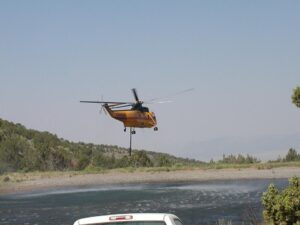
Also, perhaps to cope with that, night flight technology has improved and fire-fighting flights continue in the night. A lot of that new tech and technique was developed by the military and then transferred to the civilian need to contain wildfires even at night. That is happening in Europe as well with the new fire regime there. And it’s not just night choppers, but soldiers with shovels and hoses being called in the last resort.
Expect more of that. As climate change continues as the ultimate threat to civilization, we will see military merged into trying to protect cities and crops – because we failed to prevent over-carbonization of the atmosphere. We can STILL act to prevent utter disaster for us all.
Thank you for caring.
After the summer, with fewer listeners and donations, Radio Ecoshock bank accounts are low. Now we are back for a new season. Please, if you can, spare some financial caring to Radio Ecoshock. This project stumbles along on a tiny budget – all of it from listeners like you. The bedrock are the $10 a month subscribers/donors – but one-time donations are always needed as well. You can help here.
Alex, Radio Ecoshock.