Retreat from New Orleans! Professor Torbjörn Törnqvist from University of Tulane finds its inevitable and start now. Carbon dioxide is cooling the Stratosphere. Lamont-Dorherty scientist Sean Cohen explains. Much of America in frightening drought, going into hot El Nino year. And new science finds “Enhanced response of extreme compound events to cumulative CO2 emissions “. Covering the world, this is Radio Ecoshock.
Listen to or download this Radio Ecoshock show in CD Quality (57 MB) or Lo-Fi (14 MB)
HISTORIC DROUGHT IN AMERICA
Before we get to our scientific guests, two quick clips of the most serious drought in American records. It is developing into a world event. First off, the anonymous “Space Desk” video, possibly AI, reports verifiable news of the under-reported Great Drought. ”The Space Desk” May 13, 2026
Getting specific, this from Fox News and a related anonymous channel called The Lithosphere. It is good information but where is it coming from?
Lake Powell Just Hit a Critical Threshold – 40 Million People Could Be Affected
The Lithosphere May 14, 2026
There you go. AI is warning us a terrifying drought is gripping most of the U.S. South and West. I’m living in it and fearing the coming summer. What a world – a world where major cities are already threatened by rising seas and super storms. New Orleans leads the pack into retreat. Will it be planned or forced chaos?
=========================
RETREAT FROM NEW ORLEANS
TORBJORN TORNQVIST
Ah New Orleans – we love its music, unique culture and long history. Now a leading Professor there says it is time to start getting out. Iconic New Orleans has passed the “point of no return“. Rising seas, sinking land, and more powerful storms mean the Gulf of whatever-you-want-to-call-it is taking over. Is the ’Big Easy” an example of “climate-driven depopulation” that will happen in coastal cities around the world?
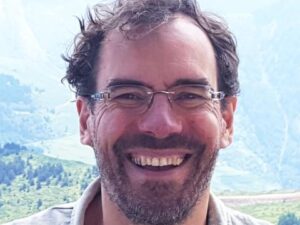
Joining us from the University of Tulane in New Orleans, is Professor Torbjörn E. Törnqvist. With a Doctorate from Utrecht University, Torjorn joined Tulane just a few days before Hurricane Katrina re-shaped the city. He specializes in sea levels past and present, coastal subsidence, and resilience strategies. It must be very strange to do research in a city with a deadline.
Listen to or download this 21 minute interview with Torbjorn Tornqvist in CD Quality or Lo-Fi
Tornqvist is Lead Author of the paper “Climate-driven depopulation and adaptation realities in America’s coastal ground zero”. That was published in Nature Sustainability, May 4, 2026.
In August 2005, Cat 5 Hurricane Katrina struck New Orleans. That lead to the largest and fastest displacement of people from any city in modern American history. Torbjörn tells us about the early exodus in the first weeks after the hurricane. In fact, with warnings in advance, most who could afford to get out (and had transportation) left the city even before the Hurricane arrived. The poorest and most vulnerable remained. Citing fears of violence, tens of thousands of people were left without any help or public order in a giant sports stadium. Even the world’s strongest military was apparently unable to air drop water to drink much less medical supplies. It was an appalling moment in American history. More than half the black population of New Orleans never came back.
That’s where we start, with parts of New Orleans below sea levels which are rapidly rising. Strong hurricanes are predicted to become more common. Parts of the city are sinking (subsidence). The outer barrier islands that once helped shelter New Orleans have been disappearing, partly due to a century of damage by the oil and gas industry.
Projected sea level rise for New Orleans runs from 4 to 9 feet by year 2100. Dr. Tornqvist says 9 feet of sea level rise is highly unlikely. But even one foot added to stronger storm surge is bad, and four feet (just over a meter) is the lowest rise expected.
Within months of the August 2005 storm and subsequent levee failures, the population plummeted from approximately 455,000 to an estimated 230,000 – a loss of nearly 50% in a single year. While the city has rebounded significantly (to about 362,000), it never fully “recovered” its humans.
If New Orleans lost 20% of its population – permanently – after a single event, what happens to the smaller Delta communities that face ‘chronic’ flooding rather than a single big storm? There is a point where recovery simply doesn’t happen.
This new work shines a light on a developing global phenomenon of major cities going under the waves. I’m thinking of Jakarta, Ho Chi Minh City, and Bangkok – but many American cities, especially along the East Coast will be invaded by the sea. It starts with floods after storms, then becomes flooded streets and backup sewers in certain areas, just in high tide. Insurance for those homes and businesses ends. People move away. That is retreat.
You can read more about this in the Guardian article by Oliver Milman, a true environment reporter in the UK: “‘Point of no return’: New Orleans relocation must start now due to sea level, study finds.”
About a decade after Hurricane Katrina, in late October 2012, Hurricane Sandy flooded parts of Washington D.C. and about a third of lower Manhattan. A week later I interviewed Professor J. Court Stevenson from the University of Maryland. He said the Port of New York could be protected with floodgates costing around ten billion dollars. Other cities around the world are building coastal defenses against storm surges and sea level rise. That is the hope for London with Thames River flood control.
Professor J. Court Stevenson, storm surge expert in CD Quality or Lo-Fi
But Miami, with it’s porous rock below and few high points, can not be defended from rising seas and more powerful storms. The days of America’s largest naval port, Norfolk Virginia, are numbered. It will be abandoned sooner or later. But New Orleans looks like the first, the poster-child for cities depopulating due to climate change and other factors.
==============
CO2 COOLS THE ATMOSPHERE TOO!
SEAN COHEN

Carbon dioxide warms up the atmosphere right? Actually, CO2 only heats the lower atmosphere where we live – in the weather zone. Further up, carbon dioxide makes the stratosphere colder? How – and so what? A new study reveals the mechanism of stratospheric cooling – which can affect the Polar Vortex, planetary waves and the ozone layer. Here to explain is the Lead Author, Dr. Sean Cohen. He is a Postdoctoral Research Scientist at the famed Lamont-Doherty Earth Observatory at Columbia University.
Listen to or download this 27 minute interview with Sean Cohen in CD Quality or Lo-Fi
Dr. Sean Cohen is Lead Author of the new paper “Stratospheric cooling and amplification of radiative forcing with rising carbon dioxide” – published in Nature Geoscience on May 11, 2026.
READ MORE about this new science in this Columbia University press story.
A New Study Explains How Carbon Dioxide Cools the Upper Atmosphere—and Warms Earth Below
HIGHLIGHTS
“• Researchers have solved a long-standing atmospheric puzzle: how rising carbon dioxide cools the stratosphere even as it warms Earth’s surface and lower atmosphere.
• The study shows this cooling is largely controlled by how CO2 interacts with different wavelengths of infrared light.
• As CO2 levels rise, the range of infrared wavelengths involved in stratospheric cooling expands.
• The findings help explain how stratospheric cooling strengthens CO2’s heat-trapping effect.”
SO WHAT?
While it may seem counterintuitive that a gas warming the surface would cool the upper atmosphere, the mechanism is a fundamental part of the greenhouse effect. In the dense lower atmosphere, CO2 absorbs and re-emits heat, trapping it. In the thinner stratosphere, CO2 actually acts as a radiator, shedding heat out into space more efficiently than it can absorb it from below.This cooling isn’t just a side effect; it has significant “top-down” impacts on Earth’s systems:
1. The temperature difference between the cold poles and the warmer mid-latitudes drives the Polar Vortex. A stronger, more stable vortex tends to trap cold air at the poles. When the vortex eventually “breaks” or shifts, it can lead to more extreme cold air outbreaks in mid-latitude regions (such as North America or Europe) via Rossby waves.
2. As the troposphere warms and expands while the stratosphere cools and contracts, the boundary between them – the tropopause – is being pushed higher. This shift can alter the height of thunderheads and change the trajectory of the Jet Stream, shifting climate zones (like the dry subtropics) further toward the poles.
STRATOSPHERIC COOLING COVERED IN RECENT ECOSHOCK SHOW
Posted on February 18, 2026
Blogging on atmosphere scientist Michael Prather, I wrote:
Basically adding more CO2 to the atmosphere cools the stratosphere because increased greenhouse gases trap more outgoing infrared heat in the lower atmosphere (troposphere), preventing it from reaching higher layers. Simultaneously, the higher concentration of CO2 in the thin upper atmosphere efficiently radiates heat away to space, causing a net loss of energy.
==================
GET READY FOR COMPOUND CLIMATE DISASTERS
Back on the ground, changing the climate can throw compound disasters at us. Local governments may have a fire plan and a flood plan. What about fire and floods together, or a one-two punch? A new paper in the journal Nature adds to a string of warnings already on Radio Ecoshock. The study is “Enhanced response of extreme compound events to cumulative CO2 emissions”. The authors are all Chinese, with Lead Author Jun Li.
The authors begin:
“Compound events – such as concurrent hot–wet and drought–heat extremes – are among the most consequential climate hazards on Earth and are projected to become more severe under warming. Although the transient mean temperature response to cumulative CO2 emissions has been well quantified, the corresponding response of compound events remains less clear.”
Their findings reveal we need much faster action to reduce emissions – or suffer through more and more concurrent extreme weather events.
TWO KINDS OF COMPOUND EVENTS
Actually, there are two kind of compound events: concurrent and sequential. My interview with American scientist Jane Baldwin about serial major fire events (or heat), all connected or developing within a relatively short period of time, is sequential. We have also seen a series of three major hurricanes following a storm track in the Pacific, reaching Asia.
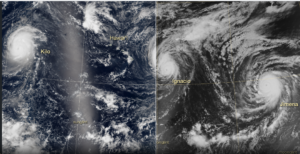
Those triple Cat 4 hurricanes were called Bolaven, Tembin, and Jelawat. They all swirled at the same time over the Pacific in late August, early September 2012. Those are sequential compound events. We can also find concurrent cyclones. NASA reported three giant Cat 4 cyclones over the Pacific in mid-September 2015 – for the first time in recorded history.
Analysts warn compound events, some pushed by climate forces, some with other drivers, are the greatest shock to an economy and the public. You may have already lived through a multiple disaster. This cluster of trouble is hard to plan for, personally and as a community. Government may fall if rapid recovery is not possible. This emerging face of climate change could shape history.
Last year, I covered compound hazards with a European perspective with Dr. Gabriele Messori. In the program you hear a short clip from that program.
If you want the European perspective, you can listen to or download that full 15 minute interview with Gabriele Messori in CD Quality.
What about sequential events, like one hurricane after another? I’m talking about you Lake Charles in Louisiana. My interview with American scientist Jane Baldwin about serial major fire events (or heat), all connected or developing within a relatively short period of time is sequential.
We study climate-driven disasters one at a time. Now we know, it is harder than that. Nature is complex and multi-tasks weather extremes.
The old future is gone, my friends.
I’m Alex Smith. Thank you for listening, and caring about our world.