In the last El Nino in 2023, carbon from Canada’s wildfires equaled total emissions from India. Wildfires are a world problem. Fire expert Michael Flannigan joins us. Then Amazon Godfather of rainforest science. Dr. Carlos Nobre: the Columbia conference to get off fossil fuels, better news on deforestation despite organized crime, and the awful Amazon tipping point. This is the find-out time.
I’m Alex Smith. Welcome to Radio Ecoshock.
Listen to or download this Radio Ecoshock show in CD Quality (57 MB) or Lo-Fi (14 MB)
*********** RADIO ECOSHOCK NEEDS YOUR HELP
Search engines are not kind to climate science. AI search engine summaries capture inquisitive people before they ever get to this blog. I can’t appeal for funding help on non-profit radio. So like many independent journalists, I’m being squeezed out financially. Recent donations are small. Even the modest costs of this weekly radio production are not being met. If you want others to hear scientists talk directly, along with authors and other experts, please take a minute to make a donation, large or small. Help Radio Ecoshock keep going! Thank you for your help.
************
EL NINO AND 2026 WILDFIRE SEASON
MIKE FLANNIGAN
As I write this blog in the middle of May, my part of British Columbia is in record drought. There was so little snow, so little spring moisture, that Lilac trees hardly flowered this year. The village is know for the sweet smell of Lilacs every year. This morning, a new wildfire sprang up just 10 miles, 16 kilometers West of our home. The fire is small now. We just tossed some backup drives in our main bug out bag. That is how this begins.
I have a big 250 gallon rain barrel hooked up to collect roof run-off. It fills up in the Spring so we have reserve water for our food garden every summer. Now, in the middle of May, the barrel is dry. The garden is a mix of soil and dust. We don’t like to talk about it, but people here have fire fear. This could be a bad one.
To get the expert view, I called up one of the best. Dr. Mike Flannigan is BC Innovation Research Chair in Predictive Services, Emergency Management and Fire Science at Thompson Rivers University. Mike was the Editor-in-Chief of the International Journal of Wildland Fire with leadership roles with the US National Assessment on Global Change, the Intergovernmental Panel on Climate Change and many other global efforts.
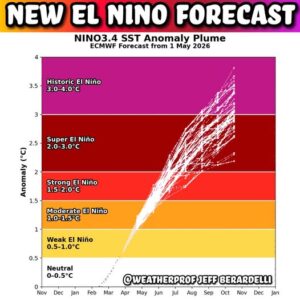
In the last El Nino of 2023, Mike and I talked about mind-boggling extreme fires in the Canadian North. Canadian wildfires in that year released as much carbon as the total carbon burning of India. Now experts are calling a new El Nino developing in May, months earlier than usual. It may be a strong one. What does that mean for expectations for this year’s fire season in North America? We already had some winter wildfires in the U.S. Southeast, in Florida, Georgia, and the Carolinas.
Listen to or download this 27 minute interview with Michael Flannigan in CD Quality or Lo-Fi
HOURLY FIRE REPORTING
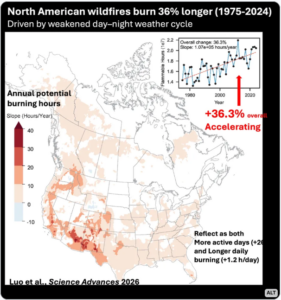
Let’s go to the new paper, the second from a PhD thesis by young scientist Kaiwei Luo. He’s from Flannigan’s former stomping ground at the University of Alberta. The title is “A weakened diurnal weather constraint leads to longer burning hours in North America”. That doesn’t sound exciting, but it changes everything about how we experience and fight wildfires. Scientists used to assess wildfires only after they were over. More recently with satellites and computer analysis we can explore daily fire behavior. It turns out, to understand the new fire regime, we need to drill down further into hourly fire activity.
Here is one way I understand the issue in this paper. When I camped out in La Paz in Mexico’s Baha Peninsula, older people retired there because there was no steep drop from day temperatures to night. Here in British Columbia, even after a very hot day, we may need to pull up a comforter by 4 in the morning. This is an example of the day/night change Kaiwei and his colleagues are talking about.
Longer burning hours also means wildfires continue to burn intensely even at night. They become intense very fast. Looking back at recent disasters, evacuation orders for the deadly 2023 Maui fire came at 3:43 a.m. In Jasper 2024, residents were ordered to leave town on short notice at 10 at night. Thousands of residents and tourists were forced to flee in the dark. In the LA fires, communities like West Altadena got formal evacuation orders around 3:25 a.m. Again residents fled in total darkness as power outages hit. This sounds like a new night-terror not common before climate change.
The new study finds the increase in potential burning hours, or PBH, has been increasing over the past 50 years, since 1975. Burning hours in the Boreal forests increased more slowly than further south in temperate and subtropical regions. That is opposite to what I expected. The increase in burning hours, including more night-time burning, is more extreme in Spring and Fall.
“[about] 60% of fires reached their maximum intensity within the first 24 hours after detection”.
Wow. That is terrifying. We are not ready for such fast fires,
Dr. Ryan Katz-Rosene at the University of Ottawa adds another dimension. He says: “Canada’s ‘managed’ boreal forest areas used to sequester over 100 Mt CO2 each year (net) from stand regeneration following wildfires, but in the last couple years these have tipped into ‘positive’ net emissions from decaying soil organic matter.” Mike explains the relationship between wildfires and emissions from soils. It’s big and important.
One of the wildest climate charts I know of: Canada's 'managed' boreal forest areas used to sequester over 100 Mt CO2 each year (net) from stand regeneration following wildfires, but in the last couple years these have tipped into 'positive' net emissions from decaying soil organic matter.
— Ryan Katz-Rosene, PhD (@ryankatzrosene.bsky.social) 2026-05-04T13:49:26.626Z
===================
AMAZON CARBON: FRIEND TO FOE?
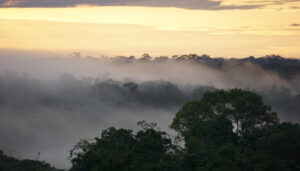
Amazon image Jeff Chambers (see his latest paper below)
CARLOS NOBRE

In April, the Amazon River hit record lows. Scientists warn the region is tipping into a new state, the “hypertropical climate”. Here with the view from Brazil, we have the Godfather of Amazon science, Dr. Carlos Nobre. With his PhD from MIT, Carlos is a pre-eminent Earth System scientist at the Institute of Advanced Studies at the University of São Paulo. Among his many roles, Dr. Nobre is also a Co-Chair of the International Science Panel for the Amazon.
Listen to or download this half hour interview with Carlos Nobre in CD Quality or Lo-Fi
There is so much worrying news, and new understanding of the Amazon. But to begin, Carlos just returned from the “First Conference On Transitioning Away From Fossil Fuels”. That was in Santa Marta Columbia. I asked Dr. Nobre to compare this meeting to your experiences at the long-running COP climate conferences, including the 2025 COP30 in Belém, Brazil, where he played a central role.
In late February 2025, Brazilian Environment Minister Marina Silva declared a nationwide environmental emergency specifically to get ahead of the wildfire season. The emergency was to expire in April of this year. Should the Amazon continue in a state of emergency? Carlos says definitely “yes”. Just consider this: reports from last month – April 2026 – showed water levels in the Amazon River and its tributaries dropped to record lows. This just after the traditional peak of the rainy season.
Brazil declares environmental emergency ahead of 2025 fire season
New science, March 2026, is dire. A PNAS study says, quote: “Less than half of the area in Amazonian forests that was affected by successive droughts during 2023–2024 is likely to recover before the next drought.” That sounds like a great forest spiraling into decline not just due to fire, but drought.
This reminds me of the problem of decreasing periods between wildfires in North America. Western forests evolved with fire. Some conifer cones are designed to withstand fire and then release their seeds. This works unless: (a) the fire burns so hot it destroys microbial life in the soil (required for trees to feed) and/or (b) the fire returns within five years (before the crop of seedling regrowth gets old enough to bear seeds).
Here we see the return period of extreme events is less than the seven years needed for Amazon forests to recover. So up to half of forests affected by drought (which I believe is about one quarter of the total Amazon forest) could fail to reproduce as the next drought comes too soon.
That new science is “Unprecedented Amazonian rainforests damage during the 2023–2024 droughts,” by Hao Bai et al.
CARBON CAPTURE FAILURE
What happens if the Amazon captures less carbon from the atmosphere than it emits, becoming like another industrial country in size of it’s emissions? Carlos says that is already happening. For one thing, if the Amazon tips toward become a grassy savanna, that means all of us would have to cut greenhouse gas emissions even further.
A new study from the Potsdam Institute, published May 6 in Nature, says deforestation in the Amazon could send the forest into a decline even before 2 degrees of global warming is reached. The title is “Deforestation-induced drying lowers Amazon climate threshold”.
HYPERTROPICAL CLIMATE
In February, the journal Nature published the study “Hot droughts in the Amazon provide a window to a future hypertropical climate”. That was led by Jeff Chambers with 29 co-authors. The authors say:
“ …under a hypertropical climate, temperature and moisture conditions during typical dry season months will more frequently exceed identified drought mortality thresholds, elevating the risk of forest dieback. Present-day hot droughts are harbingers of this emerging climate, offering a window for studying tropical forests under expected extreme future conditions.”
We talk on radio about a continent-sized forest few of us will ever see. Meanwhile, tens of millions of people are living in this hotter region. It is hotter than ever in Amazonian cities like Manaus with over two million people.
Learn more from this Berkeley article: “Unprecedented hot drought conditions are becoming more common, exposing trees to deadly stress and reducing the region’s ability to absorb anthropogenic carbon dioxide” by Robert Sanders.
THERE IS SOME BETTER NEWS
The World Resources Institute reports “Tropical Rainforest Loss Drops 36% in 2025”. Brazil is a big part of that improvement. I know governments there have gone back and forth on Amazon policy and enforcement, but there are hopeful signs, as Carlos Nobre explains.
But still there’s this: this 2026 drought is being treated by scientists as a “window into the future.” If the dry season continues to extend by just a few more weeks, we could see the irreversible conversion of vast rainforest tracts into degraded savanna.
The Amazon in 2026: A challenging year ahead, now off the center stage
EXTREME HEAT IN INDIA, PAKISTAN, BANGLADESH
You have to get outside mainstream media to find out anything happening in the real world outside the bubble. Like this headline from Al Jazeera May 8:
‘A calamity’: Why is a record heatwave sweeping South Asia?
Countries including India, Pakistan and Bangladesh have seen temperatures soar well above seasonal averages, with some areas approaching or exceeding 45°C. [113 F.]
Quoting from an article by Usaid Siddiqui:
“A record-breaking, deadly heatwave sweeping South Asia has pushed temperatures to dangerous highs, disrupting daily life for hundreds of millions and raising new concerns about the vulnerability of one of the world’s most densely populated regions.
Countries including India, Pakistan and Bangladesh have seen temperatures soar well above seasonal averages, with some areas approaching or exceeding 45-50 degrees Celsius (113-122 degrees Fahrenheit).”
“…Local media also reported that more than 90 of the world’s hottest cities were in India on April 24.”
That was from Al Jazeera. People in Asia are dying, we don’t know how many. Hundreds of millions have to work outside or their families do not eat that day. Hundreds of millions have no electricity. Air conditioning is a dream for millions more. Driving, flying, burning fossil fuels is making their lives miserable. We are killing them.
The heat is higher, weeks more super-hot days – global warming is here, now – and the developing “historic” El Nino will crank up the worse.
Somebody has to be the bearer of bad news.
I’m Alex Smith. Thank you for hanging in there and caring about our world.
Your articulation of the preventable catastrophes continues to shame mainstream sources and the kakistocracies that they protect!
Fighting & controlling the spread of wildfires is getting more problematic nowadays, and it is not just the sheer size of the areas affected. Traditional mitigation measures to create clear-ground fire breaks have some success, but have little effect in the face of “firenado” events, which have been on the increase for tbe past decade.
With flames & embers reaching over a mile high and driven by EF-2 & EF-3 strength winds, these highly dangerous extreme-o-fires can carry embers on the wind for many miles, faster than a car can drive !