The forecast is: record-breaking heat, wildfires in the West, and extreme rainfall mayhem across the world. Maybe the strongest El Niño in 150 years. Following breaking climate news, we explore a return to mass famine – including real hunger in the UK and America. Food riots in the next few years are possible. Aled Jones. Cambridge: UK food riots past and future. American scientist Joshua Elliot warns risk of American “food shock”. Will the monsoons that feed a billion people fail? Gayatri Kathayat reports from India.
Listen to or downloads this Radio Ecoshock show in CD Quality (57 MB) or Lo-Fi (14 MB)
“… we are willing to make the prediction that 2026 will be the warmest year in the period of instrumental temperature measurements. Of course, 2027 will be still hotter.”
– James Hansen Apr 30, 2026 ]
BIG BREAKING CLIMATE NEWS:
SUPER EL NINO ALREADY?
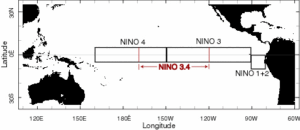
The strength of an El Nino is measured by ocean temperature in a particular part of the Eastern Pacific Ocean. This area is not right at the coast of South America but further out to sea. Once satellites measure .5 degrees C warmer than the long-term average, that is an El Nino. A warming of 1 degree is a relatively strong El Nino, 1.5 even stronger, but if sea temperatures go 2 degrees or more over the average some scientists call that a “super-El Nino”. A few meteorologists dubbed it “Godzilla” after the Japanese film monster from the sea.
Here is the strange part. “Normally” after a cooling La Nina, which we are coming out of, cannot be measured until at least June, maybe July. Trouble is: the water is El Nino hot already in April. This is not the five, now six thousand mile long-heat wave in the North Pacific this Spring. That is a different amazing ocean heat event, across the North Pacific, extending from around Micronesia toward California. ENSO is measured in the equatorial Pacific using Niño regions such as Niño 3.4 and nearby boxes along the equator.
Dr. James Hansen, former NASA Goddard chief scientist, just released his post “2026 On Track for Warmest Year” – April 30. Here he disagrees with an estimation by Carbon Brief that 2026 will be the second warmest year on record. The first three months of this year are the fourth warmest on record, but El Nino is expected to push much more heat, reaching a peak in December and January.
State of the climate: Strong El Niño puts 2026 on track for second-warmest year
Of course this burst of El Nino warming builds on continual warming due to burning fossil fuels and damaging nature. Hansen says sea surface temperatures are “consistently about 0.13°C warmer than 2023” – that last El Nino. Each heating event builds on a climbing base temperature.

But temperatures do not go back down to where they were when El Nino fades in a year or two. They have reached a new step, which may take us to 1.7 degrees C of global warming, or even higher. Also: the El Nino causes damages to ecosystems that cannot be reversed. In 2023, billions of fish died, and coastal ecosystems shifted. Over a million humans also died in the heat and destabilized weather.
If the El Nino coincides with an already existing drought and high fire risk, it can make all that much worse. However, parts of the world may get flooding rain events that end drought there. The impact of El Nino is different in various parts of the world. For example, there are generally fewer Atlantic hurricanes slamming into the Eastern United States during an El Nino. Bad hurricanes are not impossible, but less likely. But fire risk on the West Coast of North America can reach record levels. Meteorologist Jeff Berardelli says drought in US South could turn to flooding…due to strong El Nino.
El Nino may deliver wetter conditions and floods to China. My reading is that El Nino affects East Asia either less, or less predictably. We know historic cases where an El Nino caused millions of deaths due to crop failure in India. We’ll get to that later with the late Mike Davis, on Radio Ecoshock, describing mass deaths in the late Victorian times. Famine could come again, sooner than you think.
Berardelli suggests we may be approaching the strongest El Niño in 150 years. He says: “That’s not hype, it’s the actual median forecast right now for the developing event later this year. It could rival – or even surpass – the legendary 1877 El Niño, the strongest on record, which was linked to widespread drought, monsoon failure, and food crises.”
The strongest El Niño in 150 years?That’s not hype, it’s the actual median forecast right now for the developing event later this year.It could rival — or even surpass — the legendary 1877 El Niño, the strongest on record, which was linked to widespread drought, monsoon failure, and food crises 1/
— Jeff Berardelli (@weatherprof.bsky.social) 2026-04-29T13:12:42.122Z
==============
THE GOOD NEWS!
There is some better news on climate – all lost in the media frenzy of war and politics. It looks like Trump, the super-fossil fuel promoter, inadvertently helped the world transition away from fossil fuels. The blockades of the Persian Gulf cut off more than a billion barrels of oil and gas already. We hear a short clip from author Mark Herzgaard, director at the journalist outfit Covering Climate Now.
Leading the pack: the solar revolution in Pakistan, already underway well before the Iran war. Pakistanis installed so much solar power the Government was caught off guard. The country made a deal with natural gas producer Qatar to back out of contracts made to purchase Liquefied Natural Gas. Qatar agreed to divert 24 LNG Cargoes if Pakistan paid the price difference of selling those cargoes to others. That was last October.
Why? As Climate News reports: Pakistani families installed so much cheap solar panels and batteries, that Pakistan went from 2% solar to 25% solar in under 600 days. That is energy revolution and it is happening in countries all over the world. So many Australian homes have solar panels their government recently suggested making electricity free during the day just to use up excess production. Without government support or programs, people from the Philippines to Africa are hooking up cheap Chinese-made solar panels to better batteries. The alternative energy revolution is happening, and getting a big boost by the sudden short-falls of energy, and realization we can’t count on fossil fuels.
This is from 5 months ago.Pakistan *paid* Qatar to stop delivering gas that it already ordered, because Pakistani families installed so much cheap solar panels and batteries, that Pakistan went from 2% solar to 25% solar in under 600 days.
— Climate News (@climatenews.bsky.social) 2026-04-29T04:55:27.797Z
COLUMBIAN CONFERENCE:
GETTING REAL ABOUT QUITTING FOSSIL FUELS
Meanwhile an alternative to the continually failing COP conferences has appeared. Year after year, for 30 years, world government met to review the latest climate science from the Intergovernmental Panel on Climate Change – and then did nothing. Emissions continued to climb. The latest COP meetings were sponsored by big oil and gas producers. Final reports barely mentioned fossil fuels. We are all fed up with that as the world continues to heat up.
Finally another group of 57 countries, a third of the world’s economy, met in Santa Marta, Colombia. The First Conference On Transitioning Away From Fossil Fuels just wrapped up. This comes from a Covering Climate Now press release after the conference:
“France released what it called “the first national roadmap” by a developed country to phase out fossil fuels. The plan foresees removing coal from the national electricity grid by 2027, ending oil consumption by 2045 and gas by 2050. The Chinese electric car giant BYD and the Australian mining company Fortescue hosted a private sector roundtable aboard what Fortescue said was the world’s first cargo ship powered completely without fossil fuels.
The company urged businesses and governments to pursue “real zero” emissions, rather than the “net zero” goal that employs carbon offsets and allows continued emissions. Asked about the 80–89% of people around the world who want stronger climate action, Ana Toni, the Brazilian diplomat who served as executive director of the COP30 UN climate summit, urged citizens to act “at the national level. There are elections coming up, and what consumer choices people make also matter.””
That was from Covering Climate Now. France has a plan to get out of fossil fuels with dates. This is a first for a developed country. There is some hope for avoiding utter climate disaster.
Also in the good news department, China’s imports of LNG, liquefied tanker gas, are down significantly. This comes as Canada spends billions on new LNG export plants on the West Coast, expecting to sell to China. Expect some stranded assets. American researcher Justin Mikulka tells the story:
“Last year, China’s LNG imports were down 11% According to IEEFA, China’s LNG imports could fall by another 11% in 2026.”
To get an idea how big a change this is. Two years ago BNEF forecast that China would be importing 95 million tons of LNG by end of 2026. 60 million now seems more realistic.
“China is keeping LNG imports at multi-year lows, and is instead reselling cargoes around the region. That comes on the heels of weak demand growth prior to the war. Last year, China’s LNG imports were down 11% According to IEEFA, China’s LNG imports could fall by another 11% in 2026.”
Surely the drop in Chinese LNG demand is tied to their jaw-dropping massive solar installations and electrification of their transportation sector. The Chinese Government is intensely aware of climate damages. They know it’s real, and they don’t want the U.S. Navy or any other belligerents to cut their energy. If China, now the world’s biggest economy, can turn away from fossil fuels, there is some hope for the future.
============
CLIMATE CHANGE IN EUROPE
Before we get to interviews about climate, El Nino and the return of big famine, there is new reporting on climate change in Europe. The World Meteorological Organization released their European State of the Climate 2025. As the Irish Times reports it, “Europe’s Air Temperatures Becoming ‘Dangerously High’, Amid Record Heatwaves In 2025” – April 29, 2026.
Here is some of their reporting, based on work by the WMO and the European climate center:
“Temperatures exceeded 30 degrees inside Arctic Circle as entire continent suffered extreme weather
Turkey recorded an all-time high temperature of just over 50 degrees and the popular holiday spots of southern and eastern Spain had months of gruelling heat with up to 50 extra days of ‘feels-like’ temperatures above 32 degrees.
Even more startling was the unprecedented three-week heatwave that struck Norway, Sweden and Finland where temperatures exceeded 30 degrees inside the Arctic Circle.
The Greenland ice sheet shrank substantially during the year, losing 139 billion tonnes of ice – more ice than is contained in all of Europe’s mountain glaciers combined.
Snow in those mountain areas and across Europe, generally, was 30 per cent less than normal, leaving less white cover to reflect back the sun’s rays.
More than 70 per cent of rivers had lower than normal levels with flows below average for 11 months.
Wildfires burned more land than ever before, affecting 1,034,550 hectares – an area roughly the size of Dublin, Wicklow, Kildare, Meath, Louth and Wexford combined.”
That was just one year in Europe during climate change. Next year will be worse. Every year with high emissions gets worse – until we stop.
THE REPORT from WMO on Europe’s State of Climate 2025 is here.
================
THE COMING FAMINE
Now to the darkest news. Only older listeners can remember hearing news of mass famine overseas. With the Green Revolution and plentiful fertilizers global food production increased. A system of distribution to hungry places developed, with US AID as a central factor. Donald Trump and Elon Musk ended that crucial support. Reports from aid agencies suggest hundred of thousands of people have already died, weakened by hunger, because of that withdrawal. Other countries have followed. The international food distribution system is in tatters – just when the new emergency arrives.
Somewhere between 20 and 30 percent of total global fertilizer exports are currently obstructed or significantly delayed by the blockade by Iran and the United States. The Persian Gulf is the primary regional hub for nitrogen-based and phosphate-based fertilizers, making this a critical bottleneck for global agriculture.
This will slash crop yields. Some countries cannot get enough diesel fuel for farm tractors. Truck distribution of food becomes too expensive. Even in America, some families are putting food on credit cards, or doing without. More farmers will go bankrupt. More families directly growing food, will suffer through hunger. More people will die. Every wanna-be YouTube Channel says “nobody is talking about this”. But the growing food crisis is just that – nobody is reporting it.
The unnecessary blockade of food and fuel is not in a vacuum. Remember, this is all happening during violent weather events and relentlessly hotter times. Add the El Nino we talked about. And then the wild card few know about. What is it? History shows even the former “normal” climate contained extreme events. An El Nino in the 1800’s caused a million deaths. The American Southwest dried out completely for a few hundred years. So did Australia. This planet already had long cycles of drought and floods.

Gayatri Kathayat
We talked about that dreaded failure of the Indian Summer Monsoon that killed millions on Radio Ecoshock in 2022, with Professors Gayatri Kathayat and Ashish Sinha. In this show you hear a short sample from that interview.
Listen to or download this 22 minute interview with Gayatri Kathayat and Ashish Sinha in CD Quality or Lo-Fi
Now picture this. A hotter climate drives people and crops beyond their limits. Food aid collapses along with fertilizers. A super-El Nino kicks in. If that triple tragedy happens to coincide with a natural extreme event, what will happen?
————————
MIKE DAVIS
Late Victorian Holocaust
Bluesky user John Cutting says
“Honestly, I don’t have confidence that modern infrastructure will prevent similar horror. The world market will efficiently denude the developing world again and again through gouging and hoarding.”
John recommends a great book about the El Niño famines in the 1870s and 1890s “Late Victorian Holocausts: El Niño Famines and the Making of the Third World” by Mike Davis.

In 2019, three years before Mike’s untimely passing, he told us about that past Holocaust of hunger. Listen to that classic 29 minute full interview here.
Is that when undeveloped countries suffered the set-back keeping them from industrial progress seen in Europe and America? Did El Nino seal the fate of some parts of the world? Could it again?
FOOD RIOTS IN THE UK? REALLY?
You think the food shock is for poor people in some faraway country. How about the United Kingdom or the United States?

Aled Jones
Experts find food riots are possible in the United Kingdom as climate change ramps up. From Cambridge Aled Jones outlines how food stress boils over. Around the world, crops may not be planted or harvested when it gets too hot to work outside. Listen to or download that 28 minute interview in December 2023, Radio Ecoshock with Aled Jones.
AMERICANS NOT IMMUNE
American listeners – you are not immune to food shock! Some of you are already stressed, buying pasta instead of sky-high meat, or skipping your meal so kids get enough. But the real food shock will come if the Mid-West farms cannot produce. Listen to American scientist Joshua Elliot warning about the risk of American “food shock” – on Radio Ecoshock 2016.
Yes even in America and Europe, the hidden hungry could return. Overseas, they are already dying. Climate change, greed and human wars bring back the horror we thought we conquered.
Two recent Radio Ecoshock shows suggested ways to prepare for food shock. Get your own stored food insurance if you can, even on a budget. And help local food come back again. Reclaim food from the oligarchs. Food for the people.
I’m Alex Smith. Thank you for listening – and caring about others in this world.