Everybody pushing biofuels to save climate. Guest Cian Delaney from European NGO hub T&E finds these green alternatives could be worse than the fossil fuels they replace. With extreme wildfires, heatwaves, and hurricanes author and researcher Susannah Fisher on her new book “SINK OR SWIM: How the World Needs to Adapt to a Changing Climate”. Hard choices this week on Radio Ecoshock.
I’m Alex Smith.
Listen to or download this Radio Ecoshock show in CD Quality (57 MB) or Lo-Fi (14 MB)
Listen to or download this week’s Ecoshock show song “The Dark” (2 min) in CD Quality
Ethanol mixed with gas in every fill-up. Biodiesel schemes. Giant wood-powered electricity stations. Is it green? Let’s get to our first interview.
CIAN DELANEY – BIOFUELS WORSE
“Biofuels are not here to save the planet. They are here to save the fossil fuel industry.”
– Cian Delaney citing activist saying biofuels prolong acceptance of the internal combustion engine which is only supplied by fossil fuels.

As climate disasters ramp up, big powers and agencies push for more biofuels as a green answer. But does the math of emissions savings hold up? What if biofuels are a big mistake, leading to even more emissions and warming? Our guest Cian Delaney brings the latest. Cian is Campaign Coordinator on Energy for the European federation of NGOs T&E – Transport and Environment.
Every week there is a shiny new announcement about biofuels. In just one example, the Norwegian cruise ship Hurtigruten will run a “climate-neutral biofuel cruise” using hydro-treated vegetable oil. Are these ventures worthwhile or just green window dressing while we burn more fossil fuels?
Listen to or download this 27 minute interview with Cian Delaney in CD Quality (57 MB) or Lo-Fi (14 MB)
FACTS FROM T&E BRIEFING
https://bsky.app/profile/transportenvironment.org/post/3m2qi4tckw22u
“CrOP30: Why burning food for land-hungry biofuels is fuelling the climate crisis”
October 9, 2025
For the first time ever, Cerulogy, on behalf of T&E, looks at the global biofuels landscape today and what a growing market will look like in 2030.
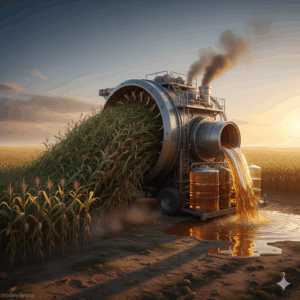
Today, the equivalent of 100 mn bottles of vegetable oil are burned in cars every day, meaning a fifth of all vegetable oil is never even used for food.
By 2030, biofuels crops will require land the size of France, which would make it the 6th largest country in terms of arable land use globally.
By 2030, biofuels are projected to emit 70 MtCO2e more than the fossil fuels they replace.
That’s the same as the emissions from almost 30 million diesel cars.
Biofuels are a bad climate solution and a huge waste of land, food and millions in subsidies. Burning crops for fuel only pushes us further away from our climate goals.
But biofuel production is only growing across the planet.”
LAND USE CHANGE
In 2008, Timothy Searchinger released the study “Use of U.S. Croplands for Biofuels Increases Greenhouse Gases Through Emissions from Land-Use Change“. The biofuel lobby trashed it. They complained about indirect land use change impacts of biofuels, also known as ILUC. This T&E briefing finds on average, with ILUC, biofuels produce about 16% more emissions than fossil fuels they are meant to replace!
The new T&E briefing before COP30 is based on a 2024 report called “Diverted harvest – Environmental Risk from Growth in International Biofuel Demand”.
According to this report biofuels account for 12% more carbon dioxide released that fossil fuels.
Inflation of food prices is a major issue in the United States and many other countries. Has biofuel production reached a point where fuel crops are competing with food crops? If not yet, when?
Humans already use about half of habitable land for agriculture. If the biofuel boom develops, what about limits? Is there peak human land use – beyond which nature cannot continue – and are biofuels part of that problem?
DEVELOPING WORLD – INDIA AND BRAZIL
In 2023 India launched the Global Biofuels Alliance to increase global use of biofuels. The Alliance now counts 32 member countries. Some of the largest fossil fuel producers, like the United States, Canada, and the United Arab Emirates part of this alliance that hopes to displace their products – but they know limited biofuels just make their oil and gas seem more “green”. They hope we feel better buying their products at the pumps thinking “at least some of it is ‘natural’”…
Brazil is the second largest producer of biofuels in the world. Just ahead of their COP Presidency, they launched a project to quadruple production of “sustainable fuels” by 2035. The Guardian reports Brazil plans to “ask countries at Cop30 to vastly increase biofuel use, leak suggests”.
SEE: Lapola; Schaldach, R; Alcamo, J; Bondeau, A; Koch, J; Koelking, C; Priess, JA; et al. (2010-02-08). “Indirect land-use changes can overcome carbon savings from biofuels in Brazil“. Proceedings of the National Academy of Sciences.
ALEX NOTES: It’s important to see the differences between primary crop feedstocks (where crops are grown specifically to make biogas or biodiesel) and secondary fuels from used cooking oil and other sources. Secondary fuels are much more limited in what they can supply. There are also “cellulosic biofuels”.
President Trump has a vague idea about biofuels. He Truthed that USA should no longer import cooking oil but produce it inside America. He may have been told, likely by a biofuels lobbyist, that USA imports large amounts of used cooking oil for use as biofuels.
So biofuels are a huge mistake, which is making climate change worse while destroying more of the natural world. They come from a kind of industrial-colonial mindset determined to keep using internal combustion engines rather than electric drive or other possibilities, like sail power.
WORLD’S LARGEST CARGO SAILBOAT MAKES FIRST TRANSATLANTIC CROSSING
World’s largest cargo sailboat makes first transatlantic crossing
Reuters, Oct 31, 2025
“The Neoliner Origin successfully finished its maiden transatlantic journey relying on its motor and other sails, despite sustaining aft sail damage.”
BIOFUEL WARNING FOR COP30:
“Scientists Call on Global Leaders to Limit Crop Biofuels Ahead of COP30”
November 5, 2025
“Over 100 members of the global scientific community have warned world of the dangers of unrestrained biofuels production
Ahead of the COP30 climate change negotiations, which open next week in Belém, Brazil, over 100 members of the global scientific community, including representatives from the Union of Concerned Scientists, have signed on to a letter calling on global leaders to limit a dangerous expansion of biofuels.
The letter comes as Brazil seeks high-level support for a leaders’ pledge to quadruple so-called “sustainable fuel” use—including a doubling of biofuels consumption—as a major component of the international community’s response to the climate crisis.
But mounting scientific evidence shows that, far from being a climate-friendly solution as many governments claim, on average the energy source is today globally responsible for 16% more emissions than the fossil fuels they replace. By 2030, biofuels are projected to emit, every year, 70 MtCO e more than the fossil fuels they replace, the equivalent of putting 30 million new diesel cars on the road….”
===========================
CLIMATE CHANGE IS HERE – TIME TO ADAPT
SUSANNAH FISHER
After extreme wildfires, heatwaves, and hurricanes we come to hard choices. It is too late for band-aids and promises. According to a new book by Susannah Fisher, it is time to “Sink or Swim”. After years advising governments and the United Nations, Susannah is a Principal Climate Researcher at University College London.
Listen to or download this 22 minute interview with Susannah Fisher in CD Quality or Lo-Fi
With the call to drastically slash greenhouse gas emissions, we reached a second stage – what to do now that climate change has arrived. Fisher warns that adaptation has largely tinkered at the margins of current systems, which is inadequate given the increasing severity of climate threats. Hard choices highlighted include managed retreat from coastal zones, reforming global food supply chains in the face of simultaneous droughts, and handling conflict over shrinking resources like water.
TEHRAN TO BE EVACUATED?

Current example: Tehran! There have been several years of unusual drought in Iran. Rivers have run dry and even large water storage dams are dry. Making it all worse, like most other humans, Iranians have been pumping up far more groundwater than can be replenished. Wells have to go impossibly deep and don’t provide. At the start of November, the government of Iran warned the capital city of over ten million people might have to be evacuated – IF there is no rain in the next month or two and IF current water rationing is not followed by everyone. This is hard adaptation.
Susannah Fisher’s new book contends that adaptation is inseparable from climate justice and should be undertaken with communities rather than imposed upon them. In many Western minds, this raises the image of villages far away organizing themselves. Actually, this means YOU. “We” need to reign in consumption, starting with wealthy people who won’t want to give up much, if anything. I think the majority ARE going to need to impose climate and justice on the half percent at the top of the fossil tower.
Frankly, well-informed people think we are already heading into climate disaster. At some point, we may spend less time on planning for emissions cuts in 2060, or minor cuts to help people feel they are contributing – and spend everything we’ve got on saving lives and livelihoods. As the title suggests, it is adaptation or massive human failure, along with a cohort of other species of all sizes – although Fisher emphasizes we still have to work on slashing emissions at the same time.
Doomers would welcome a book that doesn’t try to explain greenhouse gas reduction strategies (again, many books and reports do this) – but an experienced voice talking what we will do in this fast developing new reality.
This also goes to government and trust in government. Suppose scientists, financial experts, and government experts agree one million people need to move away from their homes perched on the Eastern Seaboard – because of extreme storms, and storm surge building on rising seas. The current approach is to leave it up to homeowners, although there have been buyout programs after major disasters like Hurricanes. For example, the U.S. FEMA has programs like the Hazard Mitigation Grant Program (HMGP) or Flood Mitigation Assistance (FMA).
The structures are then demolished, and the land is rezoned as permanent open space. This is a key part of the process – the land cannot be rebuilt upon, often being converted into wetlands, dunes, or parkland to act as a natural buffer against future storms.
Does FEMA still offer buyout money – or was that slashed as a climate hoax? One government response is to abandon people who made the mistake of building too close to a changing sea. After all, why should the rest of us pay for some millionaire who wanted front row seats to the ocean (and likely tried to wall that off so we can’t get to the sea…)? Not a good use of taxpayer money.
Maybe instead governments should enforce warning labels and advertise risks. Every deed for an ocean-front property for risk, or any kind of risk, should state that clearly and the buyer sign it. There should be no liability for the taxpayer. In addition, as with cigarettes, government advertising could warn against building or moving into high-risk areas.
That may not work in Mumbai though.
SOCIAL TWEAKING
Susannah Fisher warns social tweaking is not enough now. She writes:
“Lea Berrang-Ford, a professor at the University of Leeds, noticed a few years ago that the global community had very little idea how adaptation to climate change was happening across the world. She brought together a team to analyse huge amounts of peer-reviewed research on adaptation, and the work, published in the leading journal Nature Climate Change, confirmed that adaptation so far has been small-scale. It has focused on tweaking current policies and programmes and has been uneven across the world.”
Fisher cites the paper “A systematic global stocktake of evidence on human adaptation to climate change” published October 28, 2021 in Nature Climate Change.
IS ALEX A CLIMATE JUSTICE DOOMER?
Am I a climate justice doomer? Think of this: almost all governments of developed countries already carry fantastic national debts that can never be repaid. Increasing chunks of tax dollars just go to treasury investors. What if nations claim there simply is not enough money or resources to help every climate victim. Perhaps during a recession or economic crash, there will be nothing to cover the costs of moving and resettling faraway strangers.
A realist citing current trends might argue: despite conferences and pledges, it is obvious that a large part of humanity will move or die – without help from developed countries – and in fact climate refugees may be resisted by force if necessary, by the very countries who made the most out of burning fossil fuels. Are we just kidding ourselves about adaption planning and international funds for climate damages?
The largest single international funder of aid (America) just canceled all that. The Trump Administration has gutted FEMA, the Federal Emergency Management Administration. FEMA responded to disasters like hurricanes and flooding. These disasters are getting too large for a single State to pay for recovery. Municipal budgets are already overloaded. Insurance companies are withdrawing from coverage, or charging huge rates to discourage anyone but wealthy clients. That leaves it all to individuals, families and local communities. That is where help in coming times will come from. all that needs to be fed and watered in advance. Get good with your family and community.
I’m Alex Smith. Thank you for listening, and caring about our world.