Scientists find global food production will drop around 25% in a heated world – despite adaptation by farmers and new tech. Two plant scientists explain cutting edge tools to prepare key crops for climate change. From University of Illinois, Dr. Stephen Long reports on biotech breakthroughs to protect photosynthesis from climate damage. Canadian evolutionary botanist Sam Yeaman asks “Can wild plant adaptations help crops tolerate heat?” Exploring the future of food in a damaged climate, this is Radio Ecoshock.
Listen to or download this Radio Ecoshock show in CD Quality or Lo-Fi
HELP WANTED
I live on a very small income, mostly my old age pension, along with donations from listeners. Contributing listeners also pay for free distribution of all programs to people all over the world via the Internet. The 100 non-profit radio stations who broadcast Radio Ecoshock weekly get the program for free. It is a labor of love, carried out weekly for 19 straight years. If you can afford a donation of any amount, I would be grateful. I especially appeal to podcast listeners to “subscribe” as a monthly donor for $10 a month. That would be $2.50 a podcast. It’s not a bad price for a pipeline straight to the minds of the top climate scientists, and social activists of our time.
If this program helps you, please help me help others. Various options are here.
====================
THE COMING FOOD CRISIS IN THE HEAT
POSSIBLE SOLUTIONS – STEPHEN LONG
On our current path, Southeast Asia will suffer through 300 days a year with a heat index exceeding 41°C – 300 days above 105.8 Fahrenheit. People may survive, but crops feeding billions may not. Can we develop plants for a hotter world?

Dr. Stephen P. Long is part of a group of scientists with the paper “Safeguarding crop photosynthesis in a rapidly warming world”. Born in the UK, Long is Professor of Plant Biology and Crop Sciences at the University of Illinois. He is also visiting professor in Plant Sciences at Lancaster University and at Oxford University, UK. As Wiki says: “His work, published in Science, proved that photosynthesis can be manipulated to increase plant productivity – an idea once considered the holy grail of plant biology.”
Listen to or download this 27 minute interview with Stephen Long in CD Quality or Lo-Fi
First we assess the situation of agriculture and food, then we peek into the complex world of plant engineering. His team finds a critical threshold of 40 (104 F) to 45 degrees C (113 F) when plants suffer “irreversible losses”.
EARLIER BREAKTHROUGH PAPER
WITH LONG AS CO-AUTHOR
Improving photosynthesis and crop productivity by accelerating recovery from photoprotection
Johannes Kromdijk et al. published Nov 18, 2016 in Science. Paywall.
Abstract
Crop leaves in full sunlight dissipate damaging excess absorbed light energy as heat. When sunlit leaves are shaded by clouds or other leaves, this protective dissipation continues for many minutes and reduces photosynthesis. Calculations have shown that this could cost field crops up to 20% of their potential yield.
Here, we describe the bioengineering of an accelerated response to natural shading events in Nicotiana (tobacco), resulting in increased leaf carbon dioxide uptake and plant dry matter productivity by about 15% in fluctuating light.
Because the photoprotective mechanism that has been altered is common to all flowering plants and crops, the findings provide proof of concept for a route to obtaining a sustainable increase in productivity for food crops and a much-needed yield jump.
THE NEW PAPER
Safeguarding crop photosynthesis in a rapidly warming world
Carl J. Bernacchi, Stephen P. Long, Donald R. Ort – Published June 12, 2025 in Science – as part of a special issue review on plants in a warming world. (Paywall)
The original version slated for Jan 12 publication had this additional sentence in the Abstract:
“Protective measures within plants can be induced by growth at elevated temperatures but not from the sudden temperature elevation of heat waves.”
Strategies to improve the heat resilience of photosynthesis include
– modifying surface energy balance,
– optimizing canopy architecture,
– improving enzymatic heat tolerance, and
– (re)engineering key metabolic pathways for greater efficiency or to remove bottlenecks.
This Review summarizes present knowledge on the major mechanisms that underlie high- temperature inhibition of photosynthesis and explores opportunities for breeding and biotechnological interventions to overcome them.”
The authors say we are already past 1.5 and headed toward 2.7 degrees C over preindustrial by 2050 – if we continue on our present emissions path.
“Terrestrial surfaces are warming faster than ocean surfaces, and temporal variability is driving a large increase in short- duration extreme temperature events (heat waves).”
50 DAYS ABOVE 108 F FOR S. U.S.
By mid-century, the southern United States can expect around 50 more days at these temperatures per year…
THE HEAT EMERGENCY IS REAL
This research is not just about increasing profits for farmers or agribusiness. Nor is this problem only a scientific puzzler for the intellect. A real heat emergency is developing on every continent for human food production and all plants (and animals who depend on them). A hotter world needs answers, especially as humans have so far been unable or unwilling to control greenhouse gas emissions.
THERE ARE TWO UPPER LEVELS OF CROP TOLERANCE
… because there are two basic types of land plants: “monocots” put up just one leaf first above the surface. These include grass, palm trees and many other types of plants. Monocots are more heat tolerant. One Radio Ecoshock guest (Dr. Peter Ward) suggested the last plants on an overheated planet (a few billion years from now as the Sun expands) would be grass. The techniques used by these Moncots is called C4 photosynthesis.
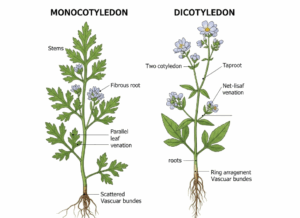
A far greater number of land species on Earth are “dicots”. These plants push up two leaves from the seed. Pretty well everything in your vegetable garden is a dicot, except corn. Dicots use C3 photosynthesis.
C4 photosynthesis is primarily found in certain types of grasses, sedges, and dicots, particularly those adapted to warm, dry, or high-light environments. Examples include maize, sugarcane, sorghum, and various tropical grasses. These plants will survive a hotter Earth with heat waves better than C3 types. About 85% of plant species use C3 photosynthesis, including important crops like rice, wheat, barley, and soybeans, as well as trees, shrubs, and other flowering plants.
According to the paper,
“Substantial declines in the net rate of CO2 uptake per unit of leaf area (A) occur when temperatures surpass the relatively low thermal optimum (Topt) of around 25°C [77 F] in most C3 crops, whereas C4 crops typically show a Topt of about 35°C [95 F]”.
When plant leaf surface has too much energy (heat) it can cool in three ways. Like humans with sweat, they can cool by evaporation of water which can achieve temperatures lower than ambient air. In addition, they can use convection and radiation, but these two cannot get below ambient air temperature, so they don’t help when air is above the damage threshold, like over 105 degrees F. for some plants.
If the plant cannot get enough water to evaporate, or cannot evaporate fast enough, then dangerous heat can build up in the leaf tissue.
IN HIGH HEAT, PLANTS CAN’T MOVE WATER FAST ENOUGH
“Field and controlled-environment studies indicate that many major crops fail to sufficiently enhance hydraulic conductivity at high temperatures, limiting their ability to meet rising evaporative demand.”
STRATEGIES USED BY PLANTS
1. MAKE LEAVES MORE REFLECTIVE (modifying surface energy balance)
Several leaf properties can increase reflectivity, including surface hairs (21), surface waxes (22), and leaf chlorophyll content. Given variability in each within crop germplasm, these properties could all be used in breeding crops with more reflective leaves.
2. CHANGE STRUCTURE OF CANOPY (optimizing canopy architecture)
Altered leaf angles may also decrease radiation interception around solar noon. Leaves that are more vertical intercept less direct radiation when solar elevation is high, decreasing thermal load around the warmest time of the day .
ALEX NOTES: I have seen different branch structures and orientation in varieties of the same species. Perhaps we can breed, for example, varieties that orient their leaves more vertically, so they receive less sunlight during peak hours when the sun is directly overhead…
3. PARA HELIOTROPISM (leaf motion, orientation)
A further mechanism for achieving reduced light absorption, particularly during water shortage, is paraheliotropism, which lowers light interception by dynamic changes in leaf orientation. This change in leaf orientation occurs through the action of the pulvinus, an enlarged section at the base of a leaf petiole (stalk) that causes the leaf to move as it swells or shrinks according to its water content.
In a soybean cultivar, strong paraheliotropic movement during mild drought and high sunlight was shown to significantly lower leaf temperature, transpiration, and water stress.
CARBON METABOLISM – the high temperature bottleneck
The paper says:
.”.. field experiments and controlled environment studies (Fig. 3) implicate carbon metabolism as the most important and physiologically meaningful cause of high- temperature inhibition of photosynthesis, and this is therefore the focus of this and the following sections.”
Plant carbon metabolism encompasses the processes by which plants convert atmospheric carbon dioxide into sugars and other organic molecules, and how these molecules are used for growth, energy, and storage. It’s a fundamental process for plant life, heavily influenced by environmental factors and crucial for plant development and survival.
CONCLUSIONS
ALEX: At this point in the conclusions, the authors seem to address two major issues:
1. the speed a beneficial change can reach world farmers, including those too poor to pay and
2. frustration with public suspicion and long processes for regulation in some countries.
As with many pro-bioengineering experts, they are looking at commercial crops mainly. They try to help the world feed ourselves, even as a hotter world with extreme heat threatens to gravely reduce food production. If starvation becomes more common, the public may join the demand for answers these plant scientists may be able to provide.
=============================
“CAN WILD PLANT ADAPTATIONS HELP CROPS TOLERATE HEAT?”
SAM YEAMAN
Scientists warn the crops that feed billions of us may not survive climate change. A new article in the journal Science asks: “Can wild plant adaptations help crops tolerate heat?” The author is Dr. Sam Yeaman from the University of Calgary Department of Biochemistry & Molecular Biology.

Listen to or download this 29 minute interview with Sam Yeaman in CD Quality or Lo-Fi
The new article says:
“Studying the diversity of ways that wild plants adapt to extreme climates is enabling the discovery of pathways, genes, and variants that exist outside the small pool of agricultural species, providing new targets for biotechnology.”
Essentially, Yeaman is writing about ways to study wild plants to find possible targets for biogenetic editing to help agricultural crops survive increasing climate change.
According to a University of Oxford study, the unprecedented heat wave in Russia 2010 slashed wheat production by 25%. This hurt exports and increased food costs in many other countries. Heat is worse now, with more to come. If there was a globally significant crop loss in a key grain, like rice or corn – how long would it take to develop and distribute a variety better equipped for heat waves?
In America, one government-funded study was cut apparently because the grant contained the world “transgenic”. I guess that was mistaken for trans sexuality. When some governments are slashing research funding, are you optimistic this field can continue – perhaps funded by private companies or foundations? Of course China has funded more science on crop tolerance and may become the world leaders.
======================
ALEX ON FOOD IN A RAPIDLY HEATING WORLD
It is miraculous that long ago, a complex chemical process happened on Earth, resulting in photosynthesis. Even more miraculous, it was accompanied by a memory system of instructions – DNA – to do it over and over again.
a new study in Nature on loss of food production as the world warms is titled “Impacts of climate change on global agriculture accounting for adaptation”. It was published June 18, 2025.
The CNN headline covering this paper is: “Children born now may live in a world where the US can only produce half as much of its key food crops”. The Guardian reports
“Maize, soy, rice, wheat, cassava and sorghum yields are projected to fall by as much as 120 calories per person per day for every 1C the planet heats up, according to new research in Nature, with average daily losses that could add up to the equivalent of not having breakfast.
The study found rising incomes and changes in farming practices could stem the losses by about a quarter by 2050 and by one-third by 2100 – though they would not stop them entirely.” [- from the Guardian June 18th.]
These food losses come as the United Nations projects global population to go from around 8 billion today to almost 10 billion by 2050 and still climbing after that. We don’t know how many more people will die during climate-induced extremes, but we do know there will be less food to go around.
As our guests tell us, just one or two new varieties of heat-resistant crops can take about 15 years to reach world farmers. The small group of bio-plant experts is growing, particularly in China, but we may need a crash investment and research program to avoid repeated famines and a billion hungry every day. Sadly, recently governments in some Western countries are going the other way: slashing funding for agricultural research and all science.
At the same time, the United States, and even Canada and Australia are in a phase of cutting regulations. Any artificial changes to plant life meant for release into the environment need real regulation, safety testing, and risk assessment. That may not happen either. The problem comes if one bad actor, or simple well-meaning mistakes, cripple a main crop like wheat or rice. Then society over-reacts against all work of this type, perhaps banning further plant research, or at least things like gene editing or trans-species implants. There goes another hope to stabilize food, which helps stabilize civilization.
Without enough food, revolutions, chaos and corruption flourish. Has climate change once again forced humans into a “Faustian Bargain”? We make a deal with dangerous manipulation of basic processes, like photosynthesis, to overcome the damage of other dangerous manipulation of the atmosphere. Future food is a wicked problem.
I’m Alex Smith. Thank you for listening, and caring about this world.